
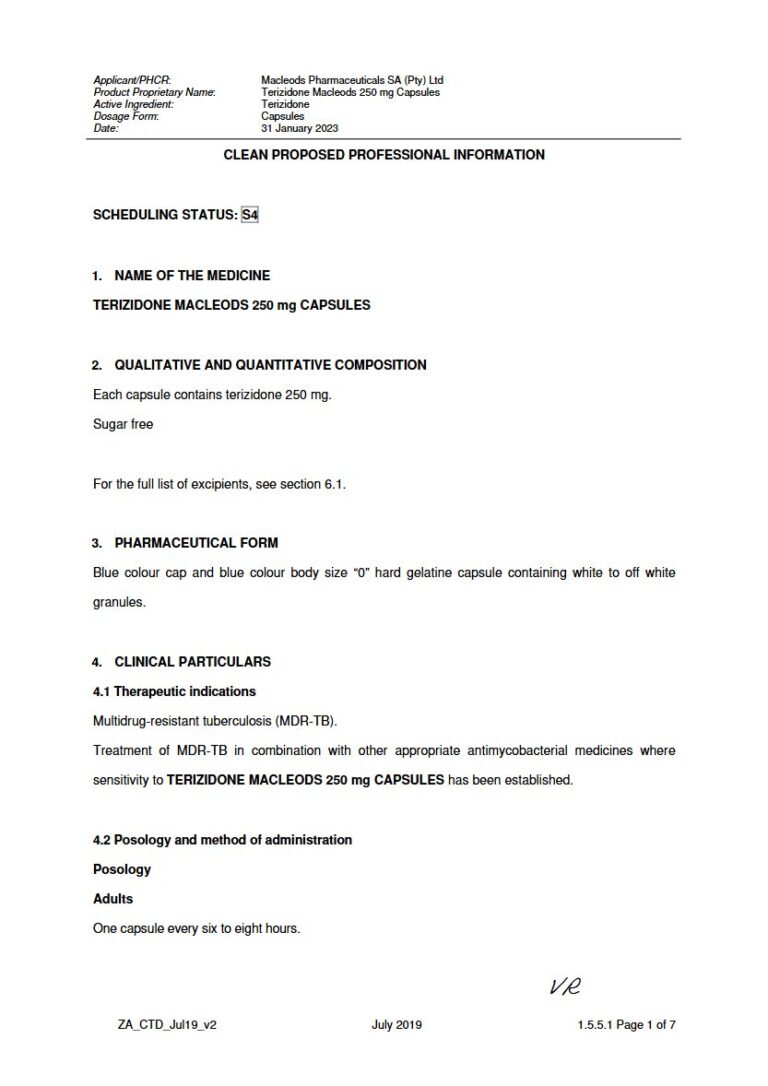
Terizidone Macleods 250 Mg Capsules
PDF Leaflet Revision Date: 06/03/2023
Clinical Summary
Quick overview from the medicine insert
Indication
Treatment of multidrug-resistant tuberculosis (MDR-TB).
Dosage (summary)
One capsule every 6-8 hours for adults.
Special Populations
- Renal impairment
- Hepatic impairment
Pregnancy & Breastfeeding
Safety not established; avoid in pregnancy and breastfeeding.
Key Drug Interactions
- Increased risk of convulsions with alcohol
- CNS toxicity with isoniazid
Contraindications
- Hypersensitivity to terizidone
- Severe renal insufficiency
- Epilepsy
- Depression
- Psychosis
- Severe anxiety
- Chronic alcoholism
- Porphyria
Common side effects
- Depression
- Anxiety
- Dizziness
- Drowsiness
- Skin reactions
Counselling Points
- Avoid alcohol during treatment.
- Monitor for neurotoxic effects.
- Report any severe side effects immediately.
Serious warnings
- Neurological reactions may occur; monitor plasma concentrations.
- Not for monotherapy in TB.
Important Disclaimer
The Terizidone Macleods 250 Mg Capsules professional information leaflet below is the property of Macleods Pharmaceuticals Sa and is provided on Medinsert exactly as issued, with no.. alterations or editorial changes. We make every effort to keep content current by updating documents as soon as new versions become available. Medinsert serves as a trusted access point for healthcare professionals, but does not replace official sources or clinical judgement. For more details, please read our full disclaimer. read more>>
 Healthcare Professionals Only
This content is for registered healthcare professionals
Sign in or create a free account to read the full package insert.
Free for HPCSA-registered professionals. Powered by Medinsert.
Clinical Particulars
Section 4 of the official insert — extracted exactly as issued, no alterations
4.1 Therapeutic indications
Multidrug-resistant tuberculosis (MDR-TB). Treatment of MDR-TB in combination with other appropriate antimycobacterial medicines where sensitivity to TERIZIDONE MACLEODS 250 mg CAPSULES has been established.
4.2 Posology and method of administration
Posology
Adults
One capsule every six to eight hours.
Method of administration
Oral use
4.3 Contraindications
- Hypersensitivity to terizidone, cicloserin or any of the excipients listed in section 6.1.
- Severe renal insufficiency.
- Epilepsy.
- Depression.
- Psychosis.
- Severe anxiety.
- Chronic alcoholism.
- Porphyria.
4.4 Special warnings and precautions for use
Warning: Neurological reactions are dose related and may be reduced by keeping the plasma concentrations below 30 u03bcg/ml. TERIZIDONE MACLEODS 250 mg CAPSULES should not be used as monotherapy in TB. TERIZIDONE MACLEODS 250 mg CAPSULES should be stopped if skin reactions or symptoms of neuro-toxicity develop (see Nervous system side effects). Large doses or the intake of alcohol increases the risk of seizures. Concurrent administration of pyridoxine has been suggested to prevent or relieve neurotoxic effects. Haematological, renal and hepatic functions should be monitored. Patients with mild to moderate renal impairment need lower doses.
4.5 Interactions with other medicines and other forms of interaction
Patients receiving TERIZIDONE MACLEODS 250 mg CAPSULES and taking alcohol are at an increased risk of convulsions. Neurotoxic effects may be potentiated by use of TERIZIDONE MACLEODS 250 mg CAPSULES with ethionamide, and concurrent use of TERIZIDONE MACLEODS 250 mg CAPSULES and isoniazid may result in increased CNS toxicity such as dizziness and drowsiness.
4.6 Fertility, pregnancy and lactation
Pregnancy
Safety in pregnancy has not been established. TERIZIDONE MACLEODS 250 mg CAPSULES passes to the foetus, amniotic fluid, therefore should be avoided in pregnant women.
Breastfeeding
Safety in lactation has not been established. TERIZIDONE MACLEODS 250 mg CAPSULES should be avoided in breastfeeding women.
4.7 Effects on ability to drive and use machines
TERIZIDONE MACLEODS 250 mg CAPSULES may cause anxiety, disorientation, confusion, dizziness and drowsiness. Patients should be instructed that if they experience these symptoms they should avoid potentially hazardous tasks such as driving or operating machinery.
4.8 Undesirable effects
Tabulated list of adverse reactions
MedDRA System organ class
Frequency
Adverse reactions
Blood and lymphatic system disorders
Less frequent
Megaloblastic anaemia, sideroblastic anaemia
Immune system disorders
Less frequent
Hypersensitivity reactions
Metabolism and nutrition disorders
Less frequent
Folate and Vitamin B12 deficiency
Psychiatric disorders
Frequent
Depression, anxiety, confusion, disorientation, psychosis with suicidal tendencies, aggression, irritability, paranoia, mania.
Nervous system disorders
Less frequent
Dizziness, vertigo, headache, drowsiness, speech difficulties, tremor, paresis, hyperreflexia, dysarthria, paraesthesia, coma, convulsions.
Gastrointestinal disorders
Less frequent
Gastrointestinal irritation
Hepatobiliary disorders
Less frequent
Increase in serum aminotransferases (especially in patients with liver disease).
Skin and subcutaneous disorders
Less frequent
Skin reactions, photosensitivity.
Reporting of suspected adverse reactions
Reporting suspected adverse reactions after authorisation of the medicine is important. It allows continued monitoring of the benefit/risk balance of the medicine. Health care providers are asked to report any suspected adverse reactions to SAHPRA via the u201c6.04 Adverse Drug Reactions Reporting Formu201d, found online under SAHPRAu2019s publications: https://www.sahpra.org.za/Publications/Index/8.
4.9 Overdose
Symptoms of overdose
Overdosage may lead to an accentuation of the side-effects listed above such as anxiety, confusion, somnolence, disorientation, depression, psychosis with suicidal tendencies, aggression, irritability and paranoia, vertigo, headache, drowsiness, speech difficulties, tremor, paresis, hyperreflexia, dysarthria, paraesthesia, coma, convulsions and heart failure, in which case a doctor should be consulted immediately.
Treatment of overdose
Treatment is symptomatic and supportive.
