
Tertroxin 20 Μg 20 μg Tablet.
PDF Leaflet Revision Date: 02 June 2023
Clinical Summary
Quick overview from the medicine insert
Indication
Treatment of myxoedema coma and severe chronic thyroid deficiency.
Dosage (summary)
Adults: Start with 10-20 u03bcg, increase to 80-100 u03bcg daily. Elderly: Start with 5 u03bcg daily.
Special Populations
- Elderly
- Paediatric population
Pregnancy & Breastfeeding
Limited placental transfer; excreted in breast milk.
Key Drug Interactions
- Anticoagulants
- Anticonvulsants
- Aspirin
- Oral contraceptives
Contraindications
- Hypersensitivity to liothyronine
- Cardiovascular disorders
- Untreated adrenal insufficiency
- Untreated hyperthyroidism
Common side effects
- Anginal pain
- Palpitations
- Headache
- Muscle cramps
Counselling Points
- Report chest pain or palpitations
- Monitor thyroid status regularly
- Avoid use in obesity management
Serious warnings
- Caution in endocrine disorders
- Risk of precipitating hyperthyroid state
- Monitor for cardiac dysrhythmias
Important Disclaimer
The Tertroxin 20 Μg 20 μg Tablet. professional information leaflet below is the property of Pharmacare and is provided on Medinsert exactly as issued, with no.. alterations or editorial changes. We make every effort to keep content current by updating documents as soon as new versions become available. Medinsert serves as a trusted access point for healthcare professionals, but does not replace official sources or clinical judgement. For more details, please read our full disclaimer. read more>>
 Healthcare Professionals Only
This content is for registered healthcare professionals
Sign in or create a free account to read the full package insert.
Free for HPCSA-registered professionals. Powered by Medinsert.
Clinical Particulars
Section 4 of the official insert — extracted exactly as issued, no alterations
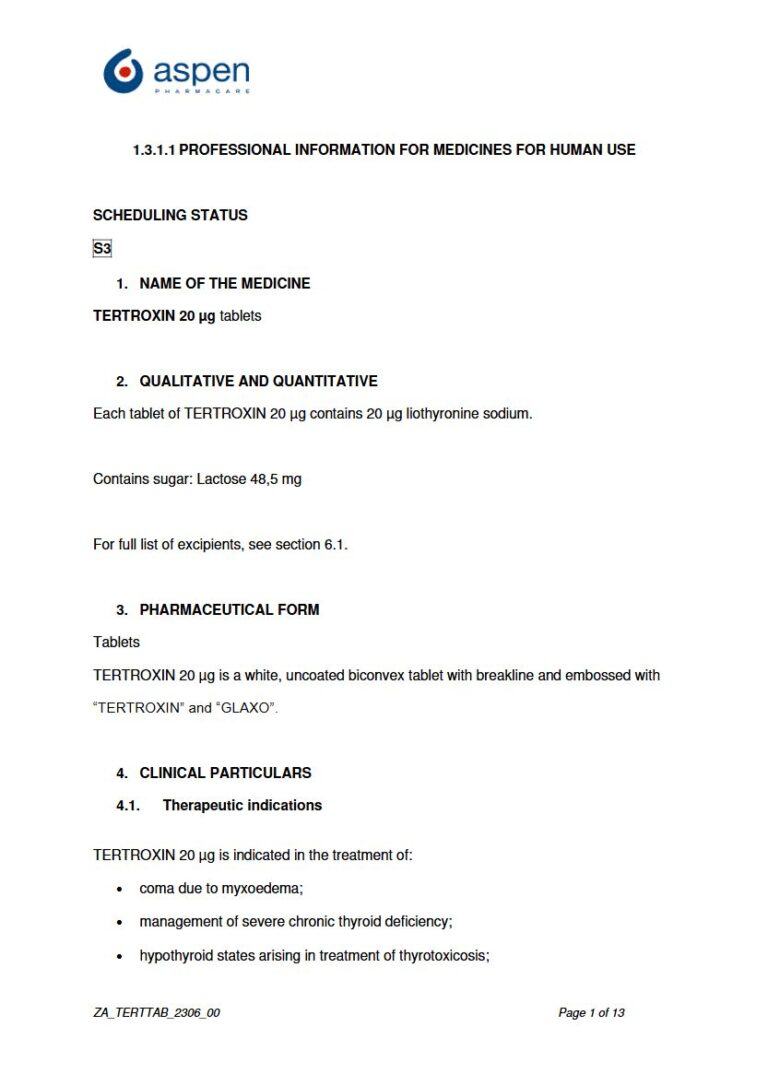
4.1. Therapeutic indications
TERTROXIN 20 u03bcg is indicated in the treatment of:
- coma due to myxoedema;
- management of severe chronic thyroid deficiency;
- hypothyroid states arising in treatment of thyrotoxicosis;
- TERTROXIN 20 u03bcg is also used therapeutically in thyrotoxicosis as an adjunct to carbimazole. After six months of this treatment it may be possible to distinguish drug-responsive patients from relapse-prone patients who are better treated with radio-iodine or surgery. Large doses of liothyronine normally suppress the uptake of iodine by the thyroid, but not in thyrotoxicosis and this forms the basis of a routine test for thyrotoxicosis.
4.2. Posology and method of administration
Posology
Adults
Thyroid deficiency: Treatment of adults may be started with doses of 10 u03bcg to 20 u03bcg increasing gradually to a total daily dosage of 80 u03bcg to 100 u03bcg after a few days.
Myxoedema coma: 100 u03bcg or more may be administered by stomach tube.
Thyrotoxicosis: As a diagnostic test in adults, 80 u03bcg or more of liothyronine are given daily for seven or eight days. The daily amount should be divided into 3 or 4 doses. Radio-iodine is then administered, and uptake by the thyroid can be estimated about 20 minutes later. Failure to suppress the uptake of radio-iodine is indicative of thyrotoxicosis.
As therapy for thyrotoxicosis with carbimazole: In adults 80 u03bcg of liothyronine daily. In some patients it is possible to discontinue the carbimazole after about a year without subsequent relapse.
Elderly population
The initial dosage should be 5 u03bcg daily (see Method of administration below to obtain small doses). TERTROXIN 20 u03bcg should be given in divided doses two or three times daily.
Paediatric population
The initial dosage should be 5 u03bcg daily (see Method of administration below to obtain small doses). TERTROXIN 20 u03bcg should be given in divided doses two or three times daily.
Method of administration
For oral administration. To obtain small doses: To obtain small doses tablets may be crushed and triturated with lactose for administration as a powder (see Elderly population and Paediatric population above).
4.3. Contraindications
TERTROXIN 20 u03bcg is contraindicated in:
- Patients with hypersensitivity to liothyronine sodium or to any excipients in TERTROXIN 20 u03bcg (see section 6.1).
- Patients with angina of effort or cardiovascular disorders.
- Patients with untreated adrenal cortical insufficiency.
- Patients with untreated hyperthyroidism.
4.4. Special warnings and precautions for use
Endocrine Disorders
TERTROXIN should be used with caution in patients with concomitant endocrine diseases such as diabetes mellitus or adrenocortical insufficiency.
Myxoedema and myxoedemic coma
In myxoedema, care must be taken to avoid imposing excessive burden on cardiac muscle affected by prolonged severe thyroid depletion. Glucocorticoids should be used in conjunction with thyroid hormones in the management of myxoedemic coma.
Cardiovascular disorders and angina
Angina may be precipitated where there is latent cardiac ischaemia (see section 4.3).
Hypothyroidism
In severe prolonged hypothyroidism, the decreased level of adrenocortical activity may require supplementation with adrenocorticotrophic hormones. Adrenal deficiency must be corrected in patients with hypopituitarism prior to commencement of liothyronine therapy. The use of thyroid hormones has been reported to precipitate a hyperthyroid state.
Obesity
TERTROXIN 20 u03bcg should not be used in the management of obesity in euthyroid patients because doses within the range of daily hormonal requirements are ineffective and larger doses may produce serious or life-threatening adverse effects.
Antidiabetic medicines and anticoagulants
Thyroid treatment may enhance the action of anticoagulants, requiring an initial increased frequency of monitoring of prothrombin times and upset the stability of patients receiving antidiabetic medicines. It is important to remind patients of increased insulin requirements if they are prescribed TERTROXIN 20 u03bcg. Patients should also be reminded of the importance of reporting to the doctor any chest pain, palpitations or excessive sweating.
Laboratory tests
Periodic assessment of thyroid status should be conducted by means of appropriate laboratory tests and clinical observation.
Elderly population
Special care is needed in the elderly who may exhibit increased sensitivity to the effects of thyroid replacement therapy (see section 4.2).
Paediatric population
Infants: Craniosynostosis may occur in infants given high doses of thyroid hormones (see section 4.2).
Children: A partial loss of hair may occur in children (paediatric patients) that are administered with thyroid hormones in the first few months of thyroid therapy, however this effect is usually a transient phenomenon, and later recovery is usually the rule (see section 4.2).
Excipients
TERTROXIN 20 u03bcg contains lactose. Patients with rare hereditary problems of galactose intolerance, total lactase deficiency or glucose-galactose malabsorption should not take TERTROXIN 20 u03bcg.
4.5. Interaction with other medicines and other forms of interaction
Anticoagulants
TERTROXIN 20 u03bcg therapy may potentiate the action of anticoagulants by increasing the catabolism of Vitamin K dependent clotting factors.
Anticonvulsant
Initiation or discontinuation of anticonvulsant medicines may alter liothyronine dose requirements. The effect of thyroid preparations, such as TERTROXIN 20 u03bcg, may be enhanced by phenytoin taken concomitantly. Phenytoin levels may be increased by liothyronine. Anticonvulsants such as carbamazepine and phenytoin enhance the metabolism of thyroid hormones and may displace them from plasma proteins.
Aspirin
The effect of thyroid preparations may be enhanced by aspirin. Aspirin displaces thyroid hormones from protein-binding sites.
Ketamine
Ketamine may cause hypertension and tachycardia when administered to patients receiving thyroid replacement therapy.
Oral contraceptives
Co-administration of oral contraceptives may result in an increased dosage requirement of thyroid therapy as estrogens increase levels of thyroid binding globulin.
Cardiac glycosides
If co-administered with cardiac glycosides, adjustment of the dosage of cardiac glycoside may be necessary. Thyroxine may potentiate digitalis toxicity. The increased metabolic rate following liothyronine therapy may increase digitalis requirements.
Colestyramine
Colestyramine given concurrently reduces gastrointestinal absorption of liothyronine as contained in TERTROXIN 20 u03bcg, by binding liothyronine within the gut lumen.
Tricyclic antidepressants
TERTROXIN 20 u03bcg increases receptor sensitivity to catecholamines thus potentially increasing the risk of cardiac dysrhythmias in patients receiving tricyclic antidepressants.
Monitoring patients on liothyronine therapy
A number of medicines may affect thyroid function tests and this should be borne in mind when monitoring patients on liothyronine therapy.
Insulin / oral hypoglycaemics
Patient requirements of insulin or oral hypoglycaemics may increase in patients receiving therapy with liothyronine.
4.6. Fertility, pregnancy and lactation
Pregnancy
There is limited placental transfer of thyroid hormones.
Breastfeeding
Liothyronine, as contained in TERTROXIN 20 u03bcg, is excreted in breast milk.
Fertility
No data available.
4.7. Effects on ability to drive and use machines
Since adverse reactions such as headaches have been reported in patients receiving TERTROXIN 20 u03bcg, patients should not drive, use machinery or perform any tasks that require concentration, until they are certain that TERTROXIN 20 u03bcg does not adversely affect their ability to do so (see section 4.4 and/or 4.8).
4.8. Undesirable effects
a) Summary of the safety profile
At the beginning of treatment, ordinary therapeutic doses may cause anginal pain, palpitations and cramps in the skeletal muscle.
b) Tabulated list of adverse reactions
System organ class Less Frequent
- Endocrine disorders Myxoedema 2
- Metabolism and nutrition disorders Excessive loss of weight 1
- Psychiatric disorders Restlessness 1 , excitability 1
- Nervous system disorders Headache 1
- Cardiac disorders Cardiac dysrhythmias 1 , tachycardia 1
- Vascular disorders Flushing 1
- Gastrointestinal disorders Diarrhoea 1
- Skin and subcutaneous tissue disorders Sweating 1
- Musculoskeletal and connective tissue disorders Muscle weakness 1
c) Description of selected adverse reactions
1 TERTROXIN 20 u03bcg is capable of producing the same side effects and can show the same symptoms of overdosage as the thyroid hormone, but in practice (except in myxoedema) these symptoms are uncommon and they disappear rapidly when treatment is stopped or the dosage is reduced, also refer to section 4.9. Overdose.
2 The euthyroid patient shows much greater tolerance to the thyroid hormone than the thyroprivic case. It has already been mentioned that in myxoedema side effects from the rapid re-establishment of the normal state may occur; these too are quickly controlled by reducing the dosage.
Reporting of suspected adverse reactions
If you get side effects, talk to your doctor, pharmacist or nurse. You can also report side effects to SAHPRA: via the u201c6.04 Adverse Drug Reactions Reporting Formu201d, found online under SAHPRAu2019s publications: https://www.sahpra.org.za/Publications/Index/8 Aspen Pharmacare: E-mail: [email protected] Tel: 0800 118 088 / +27 (0)11 239-6200
4.9. Overdose
Symptoms
The following effects are indicative of excessive dosage, and usually disappear on reduction of dosage or withdrawal of treatment for a day or two. Anginal pain, cardiac dysrhythmias, palpitation, and cramps in skeletal muscle; also, tachycardia, diarrhoea, restlessness, irritability, nervousness excitability, headache, flushing, sweating, excessive loss of weight and muscular weakness. Congestive heart failure may be induced or aggravated.
Treatment
Dosage should be reduced or therapy temporarily discontinued if signs and symptoms of overdose appear. Treatment may be reinstated at a lower dosage. In normal individuals, normal hypothalamic-pituitary-thyroid axis function is restored in 6 to 8 weeks after thyroid suppression. Treatment of acute massive thyroid hormone overdosage, is aimed at reducing gastrointestinal absorption of the medicines and counteracting central and peripheral effects, mainly those of increased sympathetic activity. Vomiting may be induced initially, if further gastrointestinal absorption can be reasonably prevented and barring contraindications such as coma, convulsions, or loss of the gagging reflex. Treatment is symptomatic and supportive. Oxygen may be administered, and ventilation maintained. Measures to control fever, hypoglycemia, or fluid loss, should be instituted if needed. The patient may present in shock. Symptoms may resemble thyroid storm and treatment is symptomatic. Congestive heart failure may require appropriate treatment. Supportive measures may include measures such as the management of fever, hypoglycaemia or fluid loss if necessary, as per the above.
