
Tibilive 2,5 mg Tablet
PDF Leaflet Revision Date: 14 May 2025
Clinical Summary
Quick overview from the medicine insert
Indication
Symptomatic treatment of menopause-related hot flushes and prevention of post-menopausal osteoporosis.
Dosage (summary)
1 tablet daily; start at least 12 months after last natural bleed.
Onset of Action / Duration
Onset: weeks, Duration: optimal results after 3 months.
Special Populations
- Elderly
- Renal impairment
- Hepatic impairment
Pregnancy & Breastfeeding
Contraindicated in pregnancy and breastfeeding.
Key Drug Interactions
- Anticoagulants
- CYP3A4 inducers
- St. John's wort
Contraindications
- Hypersensitivity to tibolone
- Hormone-dependent tumors
- History of venous thromboembolism
- Active liver disease
- Endometrial hyperplasia
Common side effects
- Dizziness
- Headache
- Vaginal discharge
- Breast tenderness
- Weight increase
Counselling Points
- Report any unusual bleeding
- Regular breast examinations
- Avoid in pregnancy and breastfeeding
Serious warnings
- Increased risk of stroke
- Increased risk of breast and endometrial cancer
- Thromboembolic events
Important Disclaimer
The Tibilive 2,5 mg Tablet professional information leaflet below is the property of Pharma Dynamics and is provided on Medinsert exactly as issued, with no.. alterations or editorial changes. We make every effort to keep content current by updating documents as soon as new versions become available. Medinsert serves as a trusted access point for healthcare professionals, but does not replace official sources or clinical judgement. For more details, please read our full disclaimer. read more>>
 Healthcare Professionals Only
This content is for registered healthcare professionals
Sign in or create a free account to read the full package insert.
Free for HPCSA-registered professionals. Powered by Medinsert.
Clinical Particulars
Section 4 of the official insert — extracted exactly as issued, no alterations
4.1 Therapeutic indications
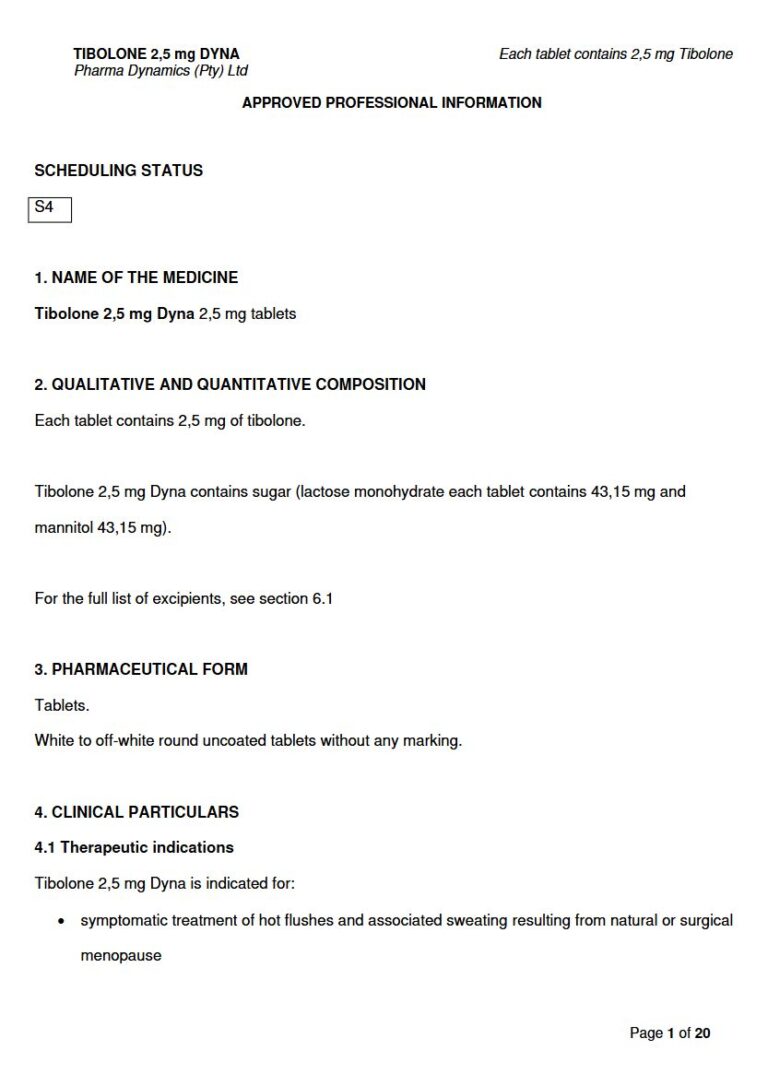
Tibolone 2,5 mg Dyna is indicated for:
- symptomatic treatment of hot flushes and associated sweating resulting from natural or surgical menopause
- prevention of post-menopausal osteoporosis
- improvement of bone-mineral density in patients with established post-menopausal osteoporosis.
4.2 Posology and method of administration
Posology
The dosage is 1 tablet per day. A missed dose should be taken as soon as remembered, unless it is more than 12 hours overdue. In the latter case, the missed dose should be skipped and the next dose should be taken at the normal time. Improvement of symptoms generally occurs within a few weeks but optimal results are obtained when therapy is continued for at least 3 months.
Starting Tibolone 2,5 mg Dyna
Women experiencing a natural menopause should commence treatment with Tibolone 2,5 mg Dyna at least 12 months after their last natural bleed. In case of a surgical menopause, treatment with Tibolone 2,5 mg Dyna may commence immediately. Any irregular/unscheduled vaginal bleeding, either on or off hormone replacement therapy (HRT), should be fully investigated to exclude malignancy before starting Tibolone 2,5 mg Dyna.
Method of administration
Oral use. Tibolone 2,5 mg Dyna should be swallowed whole with some water or other drink, preferably at the same time each day.
4.3 Contraindications
- hypersensitivity to tibolone or to any of the ingredients of Tibolone 2,5 mg Dyna (see section 6.1)
- known or suspected hormone-dependent tumours
- personal and family history of breast cancer, including suspected breast cancer
- previous idiopathic or current venous thromboembolism (deep venous thrombosis, (DVT) pulmonary embolism)
- known thrombophilic disorders e.g. protein C, protein S or antithrombin deficiency, including inherited thrombophilia (see section 4.4)
- active liver disease, severe liver disease, or a history of liver disease as long as liver function tests have failed to return to normal
- patients known with inherited genetic mutations: BRCA1 and BRCA2 genes
- early menstrual periods (before the age of 12 years)
- history of non-cancerous breast diseases (atypical hyperplasia or lobular carcinoma in situ)
- previous treatment using radiation therapy to the chest or breast
- previous exposure to diethylstilbestrol (DES)
- known or suspected oestrogen-dependent malignant tumours (e.g. endometrial cancer)
- vaginal bleeding of unknown etiology
- untreated endometrial hyperplasia
- cardiovascular or cerebrovascular disorders e.g. thrombophlebitis, thromboembolic processes or a history of these conditions
- any history of thromboembolic disease e.g. angina, myocardial infarction, stroke or transient ischaemic attack (TIA)
- porphyria
- pregnancy and lactation.
4.4 Special warnings and precautions for use
Tibolone 2,5 mg Dyna is not intended for contraceptive use. Tibolone 2,5 mg Dyna is prescribed for the treatment of postmenopausal symptoms and should only be initiated for symptoms that adversely affect quality of life. The use of Tibolone 2,5 mg Dyna should be avoided until 12 months after the last natural menstrual bleed. If Tibolone 2,5 mg Dyna is taken sooner than this, the frequency of irregular bleeding may be increased.
In the event that signs of thromboembolic processes occur, results of liver function tests become abnormal or if cholestatic jaundice appears, treatment with Tibolone 2,5 mg Dyna should be discontinued. As a result of an apparently stimulated endometrium due to some oestrogen production, vaginal bleeding may occur during Tibolone 2,5 mg Dyna therapy. Normally such bleeding is of short duration. Bleedings commencing after 3 months of treatment, or recurrent or of longer duration should be investigated.
When changing to Tibolone 2,5 mg Dyna from any other form of hormonal substitution therapy, it is always advisable to induce a withdrawal bleeding with a progestogen before starting Tibolone 2,5 mg Dyna. Tibolone, as in Tibolone 2,5 mg Dyna has been shown to be teratogenic in experimental animals and should not be used in pre-menopausal women.
The risks of stroke, breast cancer and endometrial cancer (women with an intact uterus) for each woman should be carefully assessed, in the light of her individual risk factors and bearing in mind the frequency and characteristics of both cancers and stroke, in terms of their response to treatment, morbidity and mortality.
Medical examination/follow-up
Periodic examinations must be done for endometrial hyperplasia, as well as possible signs of virilisation. Before initiating or reinstituting HRT or tibolone, as in Tibolone 2,5 mg Dyna, a complete personal and family medical history should be taken. Physical (including pelvic and breast) examination should be guided by this and by the contraindications and warnings for use. During treatment, periodic check-ups are recommended of a frequency and nature adapted to the individual woman. Women should be advised that changes in their breasts should be reported to their doctor or nurse (see Breast cancer below). Investigations, including appropriate imaging tools, e.g. mammography, should be carried out in accordance with currently accepted screening practices, modified to the clinical needs of the individual.
Conditions which need supervision
If any of the following conditions are present, have occurred previously, and/or have been aggravated during pregnancy or previous hormone treatment, the patient should be closely supervised. It should be taken into account that these conditions may recur or be aggravated during treatment with Tibolone 2,5 mg Dyna, in particular:
- leiomyoma (uterine fibroids) or endometriosis
- history of, or risk factors for, thromboembolic disorders (see below)
- risk factors for oestrogen dependant tumours, e.g. 1st degree heredity for breast cancer
- hypertension
- liver disorders (e.g. liver adenoma)
- diabetes mellitus with or without vascular involvement
- cholelithiasis
- migraine or (severe) headache
- systemic lupus erythematosus
- history of endometrial hyperplasia (see below)
- epilepsy
- asthma
- otosclerosis.
Reasons for immediate withdrawal therapy:
Tibolone 2,5 mg Dyna therapy should be discontinued either in the case of a contraindication being discovered, or in any of the following situations:
- jaundice or deterioration in liver function
- significant increase in blood pressure
- new onset of migraine-type headache
- pregnancy.
Endometrial hyperplasia and cancer
The available data from randomised controlled trials are conflicting, however observational studies have consistently shown that women who are prescribed tibolone, as in Tibolone 2,5 mg Dyna, in normal clinical practice are at an increased risk of having endometrial cancer diagnosed. In these studies, risk increased with increasing duration of use. Tibolone, as in Tibolone 2,5 mg Dyna increases endometrial wall thickness, as measured by transvaginal ultrasound. The endometrial cancer risk is about 5 in every 1,000 women with a uterus not using HRT or tibolone, as in Tibolone 2,5 mg Dyna. Break-through bleeding and spotting may occur during the first months of treatment (see section 4.3). Women should be advised to report any break-through bleeding or spotting if it is still present after 6 months of treatment, if it starts beyond that time or if it continues after treatment has been discontinued. The woman should be referred for gynaecological investigation, which is likely to include endometrial biopsy to exclude endometrial malignancy.
The randomised placebo controlled trial that included women who had not been screened for endometrial abnormalities at baseline, and therefore reflected clinical practice, identified the highest risk of endometrial cancer. In this study, a diagnosis of 0.8 additional cases of endometrial cancer in every 1,000 women who used tibolone for one year in this study were made.
Breast Cancer
Tibolone 2,5 mg Dyna contains tibolone which has combined estrogenic and progestogenic effects and therefore, on prolonged use, may increase the risk of developing breast cancer. A meta-analysis of prospective epidemiological studies from 1992 to 2018 reported a significant increase in the risk of developing breast cancer in 55,575 women 40 u2013 59 years of age who used menopausal hormone therapy (MHT). The risk increased steadily with duration of use and was slightly greater for oestrogen-progestogen than oestrogen only preparations, and the risk persisted for more than 10 years after stopping the treatment. The relative risk (RR) to develop breast cancer for oestrogen-progestogen preparations was 1.60 at 1 - 4 years and RR = 2.08 at 5 - 14 years, while that for oestrogen only preparations was 1.17 at 1 - 4 years and 1.33 at 5 - 14 years. There was no risk of developing breast cancer in women who started MHT at 60 years of age.
Evidence with respect to breast cancer risk in association with tibolone is inconclusive. One study has identified a significant increase in the risk of breast cancer in association with use of the 2,5 mg dose. This risk became apparent within a few years of use and increased with duration of intake, returning to baseline within a few (at most five) years after stopping treatment. These results could not be confirmed in a study using the General Practice Research Database (GPRD).
All women on Tibolone 2,5 mg Dyna should receive yearly breast examinations by a healthcare provider and perform monthly breast self-examinations. Women should be advised on what changes in their breasts should be reported to their doctor or nurse. Mammography evaluations should be done based on patient age, risk factors, and prior mammogram results.
No data for persistence of risk after stopping are available for tibolone, but a similar pattern cannot be ruled out. HRT, especially oestrogen-progestogen combined treatment, increases the density of mammographic images which may adversely affect the radiological detection of breast cancer.
Ovarian cancer
Ovarian cancer is much rarer than breast cancer. Long-term (at least 5 to 10 years) use of oestrogen-only HRT products has been associated with a slightly increased risk of ovarian cancer (see section 4.8). Some other studies suggest that the use of combined HRTs may be associated with a similar, or slightly smaller risk (see section 4.8). In one study it was shown that the relative risk for ovarian cancer with use of tibolone, as in Tibolone 2,5 mg Dyna was similar to the risk associated with use of other types of HRT.
Venous thromboembolism
Oestrogen or oestrogen-progestogen HRT is associated with a 1.3-3-fold risk of developing venous thromboembolism (VTE), i.e. deep vein thrombosis or pulmonary embolism. The occurrence of such an event is more likely in the first year of HRT than later (see section 4.8). In an epidemiological study using a UK database, the risk of VTE in association with tibolone was lower than the risk associated with conventional HRT, but only a small proportion of women were current users of tibolone and a small increase in risk compared with non-use cannot be excluded.
Patients with known thrombophilic states have an increased risk of VTE and HRT or tibolone, as in Tibolone 2,5 mg Dyna may add to this risk. HRT is therefore contraindicated in these patients (see section 4.3). Generally recognised risk factors for VTE include use of oestrogens, older age, major surgery, prolonged immobilisation, obesity (BMI > 30 kg/m2), pregnancy/postpartum period, systemic lupus erythematosus (SLE), and cancer. There is no consensus about the possible role of varicose veins in VTE. As in all postoperative patients, prophylactic measures need to be considered to prevent VTE following surgery. If prolonged immobilisation is to follow elective surgery, temporarily stopping HRT or tibolone 4 to 6 weeks earlier is recommended, if possible. Treatment should not be restarted until the woman is completely mobilised.
In women with no personal history of VTE but with a first degree relative with a history of thrombosis at young age, screening may be offered after careful counselling regarding its limitations (only a proportion of thrombophilic defects are identified by screening). If a thrombophilic defect is identified which segregates with thrombosis in family members or if the defect is 'severe' (e.g. antithrombin, protein S, or protein C deficiencies or a combination of defects) HRT or Tibolone 2,5 mg Dyna is contraindicated. Women already on anticoagulant treatment require careful consideration of the benefit-risk of use of HRT or Tibolone 2,5 mg Dyna. If VTE develops after initiating therapy, Tibolone 2,5 mg Dyna should be discontinued. Patients should be told to contact their doctors immediately when they are aware of a potential thromboembolic symptom (e.g. painful swelling of a leg, sudden pain in the chest, dyspnoea).
Coronary artery disease (CAD)
There is no evidence from randomised controlled trials of protection against myocardial infarction in woman with or without existing CAD who received combined oestrogen-progestogen or oestrogen-only HRT. In an epidemiological study using the General Practice Research Database (GPRD) no evidence was found of protection against myocardial infarction in post-menopausal women who received tibolone, as in Tibolone 2,5 mg Dyna.
Ischaemic stroke
Tibolone 2,5 mg Dyna increases the risk of stroke from the first year of treatment (see section 4.8). The baseline risk of stroke is strongly age-dependent and so the effect of Tibolone 2,5 mg Dyna is greater with older age.
Risk of ischaemic stroke
The relative risk of ischaemic stroke is not dependent on age or on duration of use, but as the baseline risk is strongly age-dependent, the overall risk of ischaemic stroke in women who use HRT or Tibolone 2,5 mg Dyna will increase with age.
A 2.9-year randomized, controlled study has estimated a 2.2-fold increase in the risk of stroke in women (mean age 68 years) who used 1.25 mg tibolone compared with placebo. The majority (80 %) of strokes were ischaemic.
The baseline risk of stroke is strongly age-dependent. Thus, the baseline incidence over a 5-year period is estimated to be 3 per 1,000 women aged 50 - 59 years and 11 per 1,000 women aged 60 - 69 years. For women who use tibolone, as in Tibolone 2,5 mg Dyna for 5 years, the number of additional cases would be expected to be about 4 per 1000 users aged 50 - 59 years and 13 per 1000 users aged 60 - 69 years.
4.5 Interaction with other medicines and other forms of interaction
No examples of interaction between tibolone, as in Tibolone 2,5 mg Dyna and other medicines have been reported in clinical practice. However, the following potential interactions should be considered on a theoretical basis:
Since tibolone may increase blood fibrinolytic activity (lower fibrinogen levels; higher ATIII, plasminogen and fibrinolytic activity values), it may enhance the effect of anticoagulants. This effect has been demonstrated with warfarin. Caution should therefore be exercised during the simultaneous use of Tibolone 2,5 mg Dyna and anticoagulants, especially when starting or stopping concurrent Tibolone 2,5 mg Dyna treatment. If necessary, the dose of warfarin should be adjusted.
There is limited information regarding pharmacokinetic interactions with tibolone. An in vivo study showed that simultaneous treatment of tibolone affects pharmacokinetics of the cytochrome P450 3A4 substrate midazolam to a moderate extent. Based on this, medicine interactions with other CYP3A4 substrates might be expected. CYP3A4 enzyme-inducing medicines such as barbiturates, carbamazepine, hydantoins and rifampicin may enhance the metabolism of tibolone, as in Tibolone 2,5 mg Dyna 2,5 mg, and thus decrease its therapeutic effect. Herbal preparations containing St. John's wort (Hypericum Perforatum) may induce the metabolism of oestrogens and progestogens via CYP3A4. Clinically, an increased metabolism of oestrogens and progestogens may lead to decreased effect and changes in the uterine bleeding profile.
Effect of HRT with oestrogens on other medicines
Hormone contraceptives containing oestrogens have been shown to significantly decrease plasma concentrations of lamotrigine when co-administered due to induction of lamotrigine glucuronidation. This may reduce seizure control. Although the potential interaction between hormone replacement therapy and lamotrigine has not been studied, it is expected that a similar interaction exists, which may lead to a reduction in seizure control among women taking both medicinal products together.
4.6 Fertility, pregnancy and lactation
Pregnancy
Tibolone 2,5 mg Dyna is contraindicated during pregnancy. If pregnancy occurs during medication with Tibolone 2,5 mg Dyna, treatment should be withdrawn immediately.
Breastfeeding
Tibolone 2,5 mg Dyna is contraindicated during breastfeeding.
Fertility
In animal studies, tibolone, as in Tibolone 2,5 mg Dyna, had anti-fertility activities by virtue of its hormonal properties.
4.7 Effects on ability to drive and use machines
Tibolone 2,5 mg Dyna is not known to have any effects on alertness and concentration. However, dizziness and visual disturbances may occur (see section 4.8) resulting in a minor influence on the ability to drive and use machines. Patients should be advised to exercise caution until they know how Tibolone 2,5 mg Dyna affects them.
4.8 Undesirable effects
Summary of the safety profile
This section describes undesirable effects, which were registered in 21 placebo-controlled studies and during post-marketing surveillance.
Tabulated list of adverse effects
System Organ Class Frequency Side effects
Metabolism and nutrition disorders Frequency unknown Oedema #
Psychiatric disorders Frequency unknown Depression #
Nervous system disorders Frequency unknown Dizziness # , headache # , migraine #
Eye disorders Frequency unknown Visual disturbances # , blurred vision #
Gastrointestinal disorders Frequent Frequency unknown Lower abdominal pain Gastrointestinal upset* # , abdominal discomfort* #
Hepatobiliary disorders Frequency unknown Changes in liver function parameters #
Skin and subcutaneous tissue disorders Frequent Less frequent Frequency unknown Abnormal hair growth Acne Rash # , seborrheic dermatosis # , pruritus #
Musculoskeletal, connective tissue and bone disorders Frequency unknown Arthralgia # , myalgia #
Reproductive system and breast disorders Frequent Less frequent Vaginal discharge, endometrial wall thickening, postmenopausal haemorrhage, breast tenderness, genital pruritus, vaginal candidiasis, vaginal haemorrhage, pelvic pain, cervical dysplasia, genital discharge, vulvovaginitis Breast discomfort, fungal infection, vaginal mycosis, nipple pain
Investigations Frequent Less frequent Weight increase, abnormal cervical smear* Amnesia *The majority consisted of benign changes. Cervix pathology (cervical carcinoma) was not increased with tibolone compared to placebo.
4.9 Overdose
Signs and symptoms:
In cases of acute overdose nausea, vomiting and vaginal bleeding in females may occur.
Management of overdose:
No specific antidote is known. Symptomatic treatment can be given if necessary.
