
Timucen 250 mg FC tablets
PDF Leaflet Revision Date: 30 October 2024
Clinical Summary
Quick overview from the medicine insert
Indication
Treatment of essential hypertension.
Dosage (summary)
250 mg two or three times daily; usual dose 500 mg u2013 2 g daily.
Special Populations
- Renal impairment
- Hepatic impairment
Pregnancy & Breastfeeding
Safety in pregnancy and lactation not established; crosses placenta and appears in breast milk.
Key Drug Interactions
- Enhanced hypotensive effects with thiazide diuretics
- Lithium toxicity risk
- Diminished effects with sympathomimetics
Contraindications
- Hypersensitivity to methyldopa
- Impaired kidney or liver function
- Mental depression
- Acute liver disease
- Phaeochromocytoma
- Porphyria
Common side effects
- Drowsiness
- Nausea
- Dryness of the mouth
- Dizziness
- Weakness
Counselling Points
- Caution advised when driving
- Monitor for signs of liver dysfunction
- Report any unexplained fever
Serious warnings
- Periodic blood counts and liver function tests advised
- Severe hypotension during anaesthesia
Important Disclaimer
The Timucen 250 mg FC tablets professional information leaflet below is the property of Trinity Pharma and is provided on Medinsert exactly as issued, with no.. alterations or editorial changes. We make every effort to keep content current by updating documents as soon as new versions become available. Medinsert serves as a trusted access point for healthcare professionals, but does not replace official sources or clinical judgement. For more details, please read our full disclaimer. read more>>
 Healthcare Professionals Only
This content is for registered healthcare professionals
Sign in or create a free account to read the full package insert.
Free for HPCSA-registered professionals. Powered by Medinsert.
Clinical Particulars
Section 4 of the official insert — extracted exactly as issued, no alterations
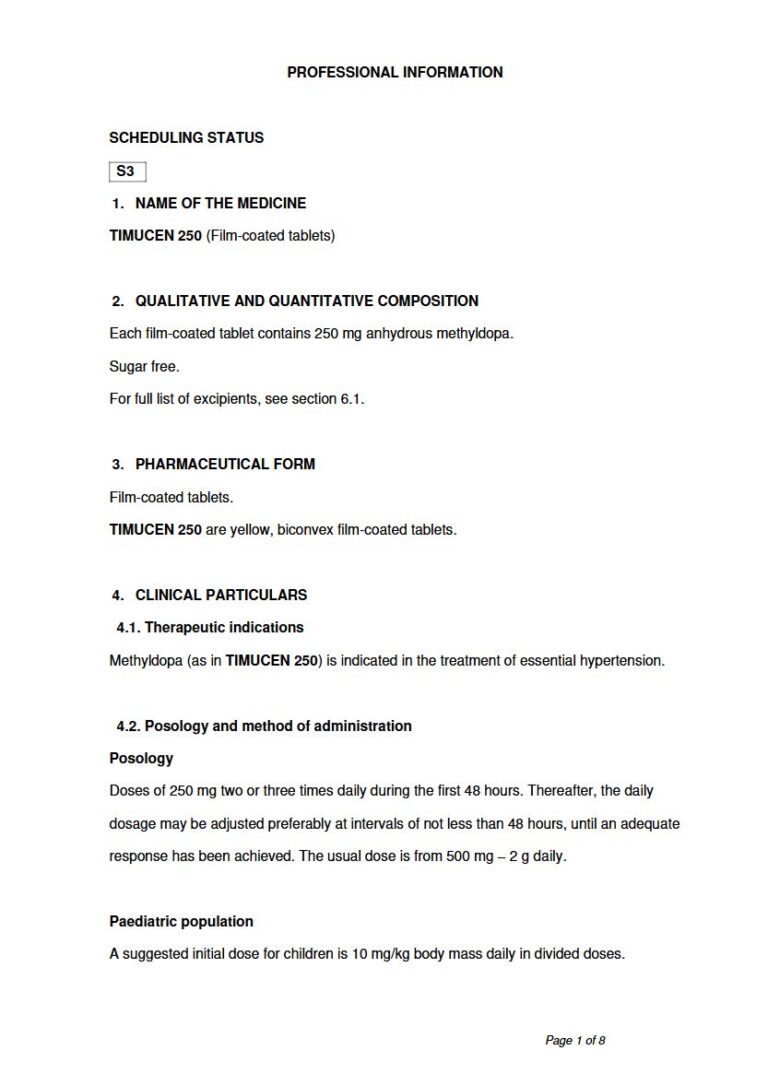
4.1. Therapeutic indications
Methyldopa (as in TIMUCEN 250) is indicated in the treatment of essential hypertension.
4.2. Posology and method of administration
Posology
Doses of 250 mg two or three times daily during the first 48 hours. Thereafter, the daily dosage may be adjusted preferably at intervals of not less than 48 hours, until an adequate response has been achieved. The usual dose is from 500 mg u2013 2 g daily.
Paediatric population
A suggested initial dose for children is 10 mg/kg body mass daily in divided doses.
Method of administration
For oral administration.
4.3. Contraindications
TIMUCEN 250 is contraindicated in:
u2022 Persons known to be hypersensitive to methyldopa or its excipients, listed in section 6.1.
u2022 Patients with impaired kidney or liver function or with a history of liver disease.
u2022 Mental depression.
u2022 It should not be given to patients with acute liver disease.
u2022 Phaeochromocytoma.
u2022 Porphyria. Methyldopa (as in TIMUCEN 250) has been reported to aggravate porphyria.
u2022 Patients on therapy with monoamine oxidase inhibitors (MAOI).
4.4. Special warnings and precautions for use
It is advisable to do periodic blood counts and to perform liver function tests at intervals during the first 6 to 12 weeks of treatment, or if the patient develops an unexplained fever. Patients taking TIMUCEN 250 may produce a positive response to a direct antiglobulin test (Coombs' test); if blood transfusion is required, prior knowledge of a positive direct antiglobulin test (Coombs' test) reaction will aid cross-matching. Methyldopa may occasionally cause urine to darken because of the breakdown of the medicine or its metabolites. Severe hypotension may occur during anaesthesia in patients being treated with methyldopa (as in TIMUCEN 250). Lower doses of general anaesthetics may be required. The hypotensive effects may be diminished by sympathomimetics, imipramine and other tricyclic antidepressants and monoamine oxidase inhibitors.
4.5. Interaction with other medicines and other forms of interaction
u2022 The hypotensive effects of methyldopa are enhanced by thiazide diuretics and other hypotensive agents.
u2022 Methyldopa (as in TIMUCEN 250) may interfere with the measurement of urinary uric acid by the phosphotungstate method, and serum glutamic-pyruvic transaminase, by the colormetric method. Methyldopa fluoresces at the same wavelengths as catecholamines and may cause erratic reports of elevated urinary catecholamine concentration.
u2022 Severe hypotension may occur during anaesthesia in patients being treated with TIMUCEN 250.
u2022 The hypotensive effects may be diminished by sympathomimetics, phenothiazines, imipramine and other tricyclic antidepressants and monoamine oxidase inhibitors (see section 4.3).
u2022 When TIMUCEN 250 and lithium are given concomitantly the patient should be monitored carefully for symptoms of lithium toxicity.
u2022 The combination of TIMUCEN 250 with other potentially hepatotoxic medicines, particularly halothane, is not advisable.
4.6. Fertility, pregnancy and lactation
Pregnancy
The safety of TIMUCEN 250 in pregnancy has not been established, as there are no adequate and well-controlled studies in pregnant women. Methyldopa crosses the placenta and reduced blood pressure has been reported in infants born to mothers receiving TIMUCEN 250.
Lactation
Methyldopa is distributed into breast milk in small amounts. The safety of TIMUCEN 250 in lactation has not been established.
4.7. Effects on ability to drive and use machines
The most common side-effect of methyldopa is drowsiness in the first 2 or 3 days; this usually decreases spontaneously (see section 4.8). Caution is advised when driving or using machinery.
4.8. Undesirable effects
a. Summary of the safety profile
The most common side-effect of methyldopa is drowsiness in the first 2 or 3 days; this usually decreases spontaneously or as a result of a reduction in the dosage.
b. Tabulated summary of adverse reactions
MedDRA system organ class
Frequency Adverse reactions
Infections and infestations
Less frequent Salivary gland inflammation.
Blood and lymphatic system disorders
Frequency unknown Thrombocytopenia, leucopenia, granulocytopenia, and haemolytic anaemia. Fever may occur within the first few weeks of therapy and may be accompanied by eosinophilia and abnormal liver function tests.
Endocrine disorders
Less frequent Hyperprolactinaemia.
Psychiatric disorders
Frequent Depression, psychic effects, impaired mental acuity, nightmares.
Nervous system disorders
Frequent Drowsiness, weakness, dizziness, light-headedness, headache. Less frequent Paraesthesia, Bell's palsy, parkinsonism. Involuntary choreoathetotic movements have occurred in patients with severe bilateral cerebrovascular disease.
Cardiac disorders
Less frequent Myocarditis, and aggravation of angina pectoris may occur. There may be bradycardia.
Vascular disorders
Less frequent Postural hypotension.
Respiratory, thoracic and mediastinal disorders
Frequent Nasal stuffiness.
Gastrointestinal disorders
Frequent Nausea, dryness of the mouth. Less frequent Black or sore tongue, pancreatitis, gastrointestinal upsets, diarrhoea, constipation.
Hepatobiliary disorders
Frequency unknown Jaundice with or without fever may occur. Liver damage may also develop after long-term administration and, rarely, fatal hepatic necrosis has been reported.
Skin and subcutaneous tissue disorders
Less frequent Eczematous rashes and lichenoid and granulomatous skin eruptions have occurred.
Musculoskeletal and connective tissue disorders
Less frequent Mild arthralgia, myalgia. Frequency unknown A condition resembling systemic lupus erythematosus has been reported.
Reproductive system and breast disorders
Frequent Disorders of sexual function. Less frequent Breast enlargement, lactation.
General disorders and administration site conditions
Frequent Oedema.
Investigations
Less frequent Uraemia. Frequency unknown A positive response to the direct Coombs' test may occur in 10 to 20 % of patients on prolonged therapy, usually without evidence of haemolysis.
Reporting of suspected adverse reactions
Reporting suspected adverse reactions after authorisation of the medicine is important. It allows continued monitoring of the benefit/risk balance of the medicine. Health care providers are asked to report any suspected adverse reactions to SAHPRA via the u201c6.04 Adverse Drug Reactions Reporting Formu201d, found online under SAHPRAu2019s publications: https://www.sahpra.org.za/Publications/Index/8
4.9. Overdose
See section 4.8 u201cUndesirable effectsu201d. Treatment is symptomatic and supportive. Methyldopa is dialysable.
