
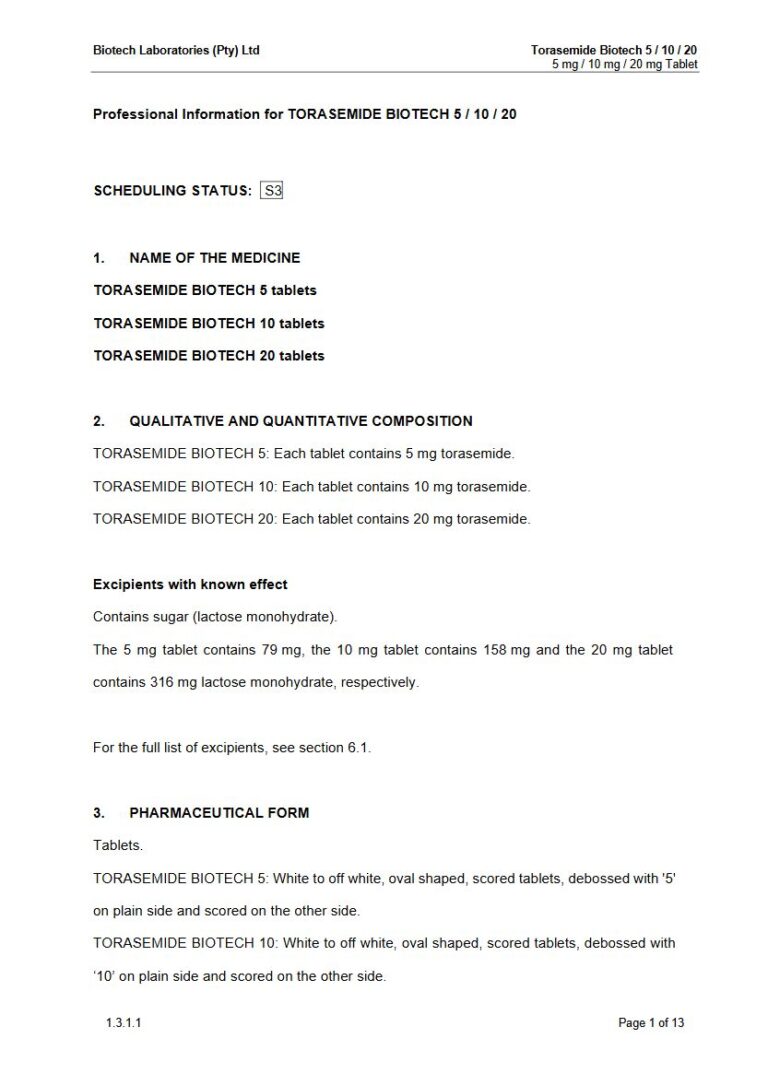
Torasemide Biotech 5 / 10 / 20 5 mg / 10 mg / 20 mg Tablets.
PDF Leaflet Revision Date: 05 February 2024
Clinical Summary
Quick overview from the medicine insert
Indication
Essential hypertension and oedema.
Dosage (summary)
Initiate with 2.5 mg for hypertension; 5 mg for oedema. Max 40 mg/day.
Onset of Action / Duration
Onset: 1 hour, Duration: 6-8 hours
Special Populations
- Renal impairment
- Hepatic impairment
Pregnancy & Breastfeeding
Contraindicated in pregnancy and lactation.
Key Drug Interactions
- ACE inhibitors
- NSAIDs
- Digoxin
- Lithium
Contraindications
- Hypersensitivity
- Anuria
- Hepatic coma
- Pregnancy
- Lactation
Common side effects
- Headache
- Dizziness
- Hypokalaemia
- Gastrointestinal symptoms
Counselling Points
- Take on an empty stomach
- Monitor blood pressure
- Report dizziness or weakness
Serious warnings
- Monitor electrolytes
- Risk of acute urinary retention
Important Disclaimer
The Torasemide Biotech 5 / 10 / 20 5 mg / 10 mg / 20 mg Tablets. professional information leaflet below is the property of Biotech Laboratories and is provided on Medinsert exactly as issued, with no.. alterations or editorial changes. We make every effort to keep content current by updating documents as soon as new versions become available. Medinsert serves as a trusted access point for healthcare professionals, but does not replace official sources or clinical judgement. For more details, please read our full disclaimer. read more>>
 Healthcare Professionals Only
This content is for registered healthcare professionals
Sign in or create a free account to read the full package insert.
Free for HPCSA-registered professionals. Powered by Medinsert.
Clinical Particulars
Section 4 of the official insert — extracted exactly as issued, no alterations
4.1 Therapeutic indications
Essential hypertension.
Oedema of cardiac and hepatic origin.
Pulmonary oedema due to acute cardiac insufficiency.
4.2 Posology and method of administration
Posology
Essential hypertension: Treatment is initiated with 2,5 mg torasemide per day. The usual maintenance dose is 2,5 mg per day. If this is insufficiently effective, the dose can be doubled to 5,0 mg per day. Higher doses will not lead to a further reduction of blood pressure.
Oedema of cardiac, hepatic and renal origin: Treatment is initiated with 5 mg per day. The usual maintenance dose is 5 mg per day. If this is insufficiently effective, the dose can be increased up to 20 mg per day depending on the severity of the disease. In individual cases as much as 40 mg per day has been administered.
Method of administration
For oral administration. Oral TORASEMIDE BIOTECH may be taken with some liquid on an empty stomach or at any time in relation to a meal, as convenient.
4.3 Contraindications
- Hypersensitivity to torasemide or any of the other ingredients of TORASEMIDE BIOTECH (see section 6.1).
- Renal failure with absence of urine production (anuria).
- Hepatic pre-coma and coma.
- Pregnancy and lactation (see section 4.6).
- Patients with known hypersensitivity to sulfonylureas.
- Hypovolaemia.
- Hyponatraemia, hypokalaemia.
- Severe disorders of micturition (e.g. prostate hypertrophy).
- TORASEMIDE BIOTECH should not be used in children of 12 years or younger.
4.4 Special warnings and precautions for use
TORASEMIDE BIOTECH should not be given in pre-comatose states associated with hepatic cirrhosis. Hypokalaemia, hyponatraemia, hypovolaemia disorders of micturition must be corrected before treatment. TORASEMIDE BIOTECH should be used with care in patients with prostatic hyperplasia or impairment of micturition since it can precipitate acute urinary retention. Careful monitoring of the carbohydrate metabolism is recommended in patients with latent or manifest diabetes mellitus, since a rise in blood glucose may occur. Long term treatment with TORASEMIDE BIOTECH requires regular monitoring of the electrolyte balance, glucose, uric acid, creatinine and lipid levels. Careful monitoring is required in patients with a tendency to hyperuricaemia and gout.
Patients with rare hereditary problems of lactose- or glucose intolerance, the Lapp lactase deficiency of glucose-galactose malabsorption should not take TORASEMIDE BIOTECH.
4.5 Interaction with other medicines and other forms of interaction
The effect of antihypertensive medicines may be potentiated when used in combination with TORASEMIDE BIOTECH. Consecutive treatment or start of a new co-medication with an ACE (angiotensin-converting enzyme) inhibitor may result in an excessive fall in blood pressure. The action of antidiabetic medicines may be reduced by TORASEMIDE BIOTECH. Dosage adjustment of hypoglycaemic medications may be necessary. Concurrent and/or sequential administration with TORASEMIDE BIOTECH and amphotericin B parenteral should be avoided, since the potential for nephrotoxicity may be increased, especially in the presence of renal function impairment. Anti-inflammatory medicines, nonsteroidal anti-inflammatory drugs (NSAIDs), especially indomethacin may reduce the natriuretic action of TORASEMIDE BIOTECH. When using TORASEMIDE BIOTECH simultaneously with digoxin, a potassium and/or magnesium deficiency may increase the sensitivity of the cardiac muscle to digoxin. Concurrent use of lithium with TORASEMIDE BIOTECH may promote lithium toxicity because of reduced renal clearance. Probenecid may reduce the diuretic and hypotensive effect of TORASEMIDE BIOTECH. The risk of hypokalaemia may be increased by TORASEMIDE BIOTECH. The kalidiuretic effect of mineralo- and glucocorticosteroids and laxatives may be increased. TORASEMIDE BIOTECH may potentiate the damaging effects of aminoglycocide antibiotics, cisplatin preparations and cephalosporins on the ear and kidney and the cardio-and neurotoxic effect of lithium, especially at high dose therapy. The action of curare containing muscle relaxants and of theophylline can be potentiated by TORASEMIDE BIOTECH. TORASEMIDE BIOTECH may decrease arterial responsiveness to pressor medicines, e.g. epinephrine (adrenaline) and norepinephrine (noradrenaline). In patients receiving high doses of salicylates, salicylate-toxicity may be increased by TORASEMIDE BIOTECH. On concomitant treatment with colestyramine, bioavailability and thus the efficacy of TORASEMIDE BIOTECH may be reduced. The anticoagulant effects of warfarin or heparin may be decreased when these medicines are used concurrently with TORASEMIDE BIOTECH. The concurrent use of sympathomimetics with TORASEMIDE BIOTECH may reduce the antihypertensive effects of TORASEMIDE BIOTECH.
4.6 Fertility, pregnancy and lactation
Pregnancy
Safety and efficacy in pregnant women have not been established. TORASEMIDE BIOTECH is contraindicated during pregnancy (see section 4.3).
Breastfeeding
It is not known whether TORASEMIDE BIOTECH is distributed into breast milk. TORASEMIDE BIOTECH is contraindicated during lactation (see section 4.3).
Fertility
No data available.
4.7 Effects on ability to drive and use machines
Individually varying reactions can impair alertness (e.g. patientu2019s ability to drive vehicles or to operate machinery). This applies particularly when beginning treatment, switching from another medicine or starting a new co-medication and in conjunction with alcohol. Patients taking TORASEMIDE BIOTECH should be warned to take special caution when performing tasks requiring their attention, if they experience dizziness or related symptoms.
4.8 Undesirable effects
Blood and the lymphatic system disorders
Less frequent: Thrombocytopenia, leukopenia, anaemia.
Immune system disorders
Less frequent: Acute hypersensitivity reactions (which may be life-threatening).
Metabolism and nutrition disorders
Frequent: Metabolic alkalosis, fluid and electrolyte imbalance (e.g. hypovolaemia, hyponatraemia). Less frequent: Lowered potassium levels.
Nervous system disorders
Frequent: Headache, dizziness. Frequency unknown: Feelings of weakness, loss of appetite and cramps, confusional states, paraesthesia, cerebral ischaemia.
Eye disorders
Frequency unknown: Visual disturbances.
Ear and labyrinth disorders
Less frequent: Ototoxicity (ringing or buzzing in ears or loss of hearing).
Cardiac disorders
Frequency unknown: Thromboembolic complications and cardiac ischaemia or myocardial infarction, angina pectoris, syncope.
Vascular disorders
Less frequent: Hypotension. Frequency unknown: Embolism.
Gastrointestinal disorders
Frequent: Gastrointestinal symptoms (loss of appetite, upper abdominal pain, nausea, vomiting, diarrhoea, constipation). Frequency unknown: Dry mouth, pancreatitis.
Hepato-biliary disorders
Less frequent: Hepatic enzyme increase (e.g. Gamma-glutamyl transferase increase).
Skin and subcutaneous tissue disorders
Less frequent: Allergic skin reactions, e.g. pruritus and exanthema or photosensitisation. Frequency unknown: Serious skin reactions (e.g. Stevens-Johnson syndrome, toxic epidermal necrolysis).
Musculoskeletal and connective tissue disorders
Frequent: Muscle spasm.
Renal and urinary disorders
Less frequent: Urinary retention, bladder dilation, increased blood urea, increased blood creatinine. Frequency unknown: In patients with urinary obstructions, e.g. prostate hypertrophy, increased urine production can lead to urine retention resulting in distension of the bladder.
General disorders and administration site conditions
Frequent: Fatigue, asthenia.
Investigations
Less frequent: Increased blood uric acid, increased blood glucose, increased lipids (e.g. increased blood triglycerides, increased blood cholesterol.
Reporting of suspected adverse reactions
Reporting suspected adverse reactions after authorisation of TORASEMIDE BIOTECH is important. It allows continued monitoring of the benefit/risk balance of TORESAMIDE BIOTECH. Healthcare providers are asked to report any suspected adverse reactions via the u201c6.04 Adverse Drug Reaction Reporting Formu201d, found online under SAHPRAu2019s publications: https://www.sahpra.org.za/Publications/Index/8.
4.9 Overdose
In the event of overdosage there may be a marked diuresis with the danger of loss of liquids and electrolytes which may lead to somnolence and confusion, hypotension, circulatory collapse and gastrointestinal symptoms. No specific antidote is known. Symptoms of overdosage generally disappear on reduction of the dose or withdrawal of the medicine and simultaneous replacement of fluid and electrolytes (to be monitored). Treatment is symptomatic and supportive.
