
Umbulali Ntshulube 937,50 Mg/5 ml
PDF Leaflet Revision Date: 17 July 2020
Clinical Summary
Quick overview from the medicine insert
Indication
Elimination of roundworm and threadworm.
Dosage (summary)
Adults: 30 ml for roundworm; 15 ml daily for threadworm. Children: weight-based dosing.
Special Populations
- Renal impairment
- Hepatic impairment
Pregnancy & Breastfeeding
Not recommended in pregnancy, especially first trimester. Breastfeeding mothers should wait 8 hours post-dose before nursing.
Key Drug Interactions
- Antagonistic effect with pyrantel
- Enhanced effects with phenothiazines
Contraindications
- Hypersensitivity to piperazine
- Epilepsy
- Severe renal impairment
Common side effects
- Dizziness
- Nausea
- Headaches
- Skin rashes
Counselling Points
- Take after food
- Maintain cleanliness to prevent reinfection
- Skip missed doses
Serious warnings
- Caution in neurological disturbances
- Contains sucrose affecting glycaemic control
Important Disclaimer
The Umbulali Ntshulube 937,50 Mg/5 ml professional information leaflet below is the property of Avid Brands SA and is provided on Medinsert exactly as issued, with no.. alterations or editorial changes. We make every effort to keep content current by updating documents as soon as new versions become available. Medinsert serves as a trusted access point for healthcare professionals, but does not replace official sources or clinical judgement. For more details, please read our full disclaimer. read more>>
 Healthcare Professionals Only
This content is for registered healthcare professionals
Sign in or create a free account to read the full package insert.
Free for HPCSA-registered professionals. Powered by Medinsert.
Clinical Particulars
Section 4 of the official insert — extracted exactly as issued, no alterations
4.1 Therapeutic indications
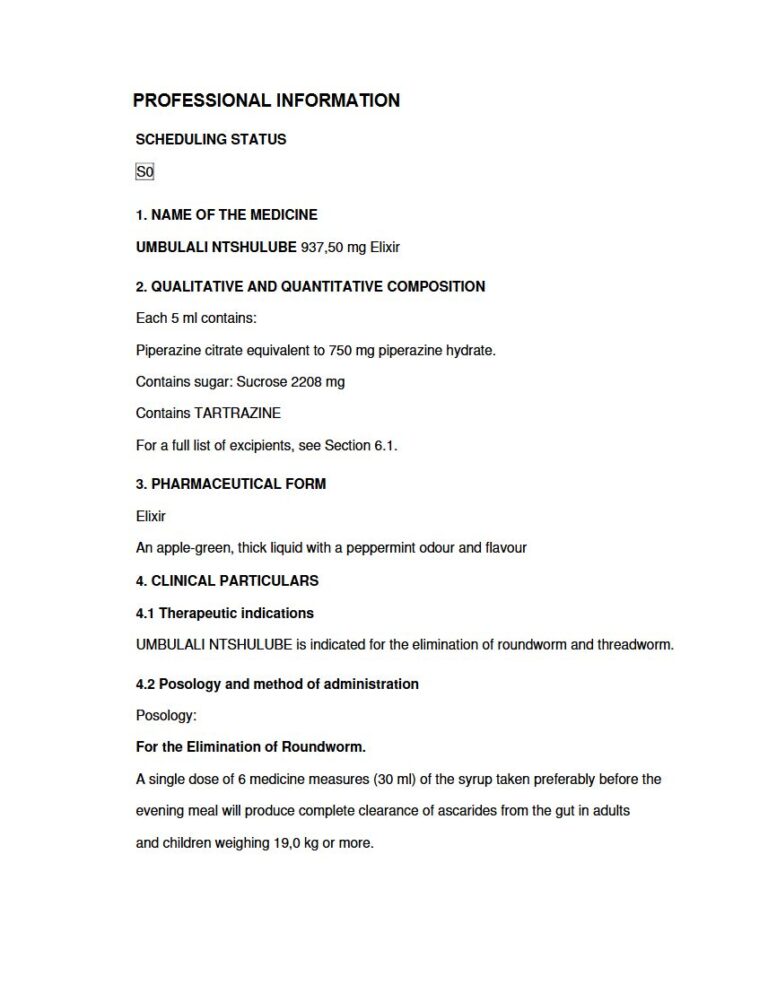
UMBULALI NTSHULUBE is indicated for the elimination of roundworm and threadworm.
4.2 Posology and method of administration
Posology:
For the Elimination of Roundworm.
A single dose of 6 medicine measures (30 ml) of the syrup taken preferably before the evening meal will produce complete clearance of ascarides from the gut in adults and children weighing 19,0 kg or more.
For infants and children weighing under 19,0 kg, the corresponding dose is 4 medicine measures (20 ml).
No fasting or other supplementary measures are necessary, but in cases of constipation, a saline purgative should be given the following morning.
For the Elimination of Threadworm.
Administer daily after food for seven days.
The most effective dose is from 50 to 70 mg of piperazine per kg of body mass per day.
Dosage Schedule For The Treatment Of Threadworm:
- Age Weight Dosage To be continued for seven days
- 9 - 24 months 6,5 u2013 9,5 kg u00bd medicine measure daily (2,5 ml)
- 2 u2013 4 years 9,5 u2013 12,5 kg 1 medicine measure daily (5,0 ml)
- 4 u2013 7 years 12,5 u2013 19,0 kg 1u00bd medicine measures daily (7,5 ml)
- 7 u2013 13 years 19,0 u2013 38,0 kg 2 medicine measures daily (10,0 ml)
- 13 years to adult over 38,0 kg 3 medicine measures daily (15,0 ml)
In rare instances it may be necessary to repeat the course after one week.
No special diet is required.
Attention to general cleanliness is important in order to prevent reinfection from untreated cases. It is advisable to examine all members of a household and treat all positive cases at the same time, to prevent transmission of the worms and reinfestation.
If you miss a dose, skip the missed dose. Do not double doses.
Method of administration:
For oral use only.
4.3 Contraindications
UMBULALI NTSHULUBE is contraindicated in:
- u2022 patients who are hypersensitive to piperazine or to any of the excipients listed in section 6.1.
- u2022 patients with epilepsy or severe renal impairment.
4.4 Special warnings and precautions for use
UMBULALI NTSHULUBE should be given with caution to patients with neurological disturbances, mild to moderately impaired renal function or hepatic impairment.
Contains sucrose. Patients with rare hereditary conditions such as fructose intolerance, glucose-galactose mal-absorption or sucrase-isomaltase insufficiency should not take UMBULALI NTSHULUBE.
Contains sucrose which may have an effect on the glycaemic control of patients with diabetes mellitus.
UMBULALI NTSHULUBE contains FD & C Yellow No 5 (Tartrazine) which may cause allergic type reactions (including bronchial asthma) in certain susceptible individuals.
Although the overall incidence of tartrazine sensitivity in the general population is currently thought to be low, it is frequently seen in patients who have aspirin sensitivity.
4.5 Interaction with other medicinal products and other forms of interaction
The anthelmintic effects of piperazine, as in UMBULALI NTSHULUBE, and pyrantel may be antagonized when the two medicines are used together.
UMBULALI NTSHULUBE may enhance the adverse effects of phenothiazines such as chlorpromazine.
4.6 Fertility, pregnancy and lactation
Pregnancy
Use of UMBULALI NTSHULUBE during pregnancy is not recommended, especially during the first trimester, unless immediate treatment with UMBULALI NTSHULUBE is essential.
Breastfeeding
Piperazine, as in UMBULALI NTSHULUBE, is distributed into breast milk. Mothers are advised to take a dose after breastfeeding then not to breastfeed for 8 hours during which period milk should be expressed and discarded at the regular feeding times.
Fertility
There is no data available on the effects of UMBULALI NTSHULUBE on fertility.
4.7 Effects on ability to drive and use machines
UMBULALI NTSHULUBE can cause drowsiness, dizziness and blurred vision which may have an effect on your ability to drive and use machines.
4.8 Undesirable effects
Blood and lymphatic disorders
Frequency unknown: Haemolytic anaemia, thrombocytopenia, epistaxis, haemoptysis.
Immune system disorders
Less frequent: Skin rashes, urticaria
Frequency unknown: Bronchospasm, Stevens-Johnson syndrome, angioedema, serum-sickness-like illness, hypersensitivity vasculitis
Nervous system disorders
Less frequent: Headaches.
Frequency unknown: Somnolence, dizziness, nystagmus, muscular incoordination, weakness, ataxia, paraesthesia, myoclonic contractions, choreiform movements, tremor, convulsions, loss of reflexes.
Eye disorders
Less frequent: Transient visual disturbances such as blurred vision, cataract formation.
Gastrointestinal disorders
Less frequent: Nausea, vomiting, diarrhoea, abdominal pain
Hepato-biliary disorders
Frequency unknown: Viral hepatitis-like reactions.
Reporting of suspected adverse reactions
Reporting of suspected adverse reactions after authorisation of the medicinal product is important. It allows continued monitoring of the benefit/risk balance of the medicinal product. Healthcare providers are asked to report any suspected adverse reactions to SAHPRA via the u201c6.04 Adverse Drug Reactions Reporting Formu201d, found online under SAHPRAu2019s publications:
https://www.sahpra.org.za/Publications/Index/8
4.9 Overdose
Toxic effects may be produced with prolonged treatment with large dosages. Dizziness, blurred vision or nausea experienced under these conditions should cease when treatment is discontinued. Treatment is symptomatic and supportive.
