
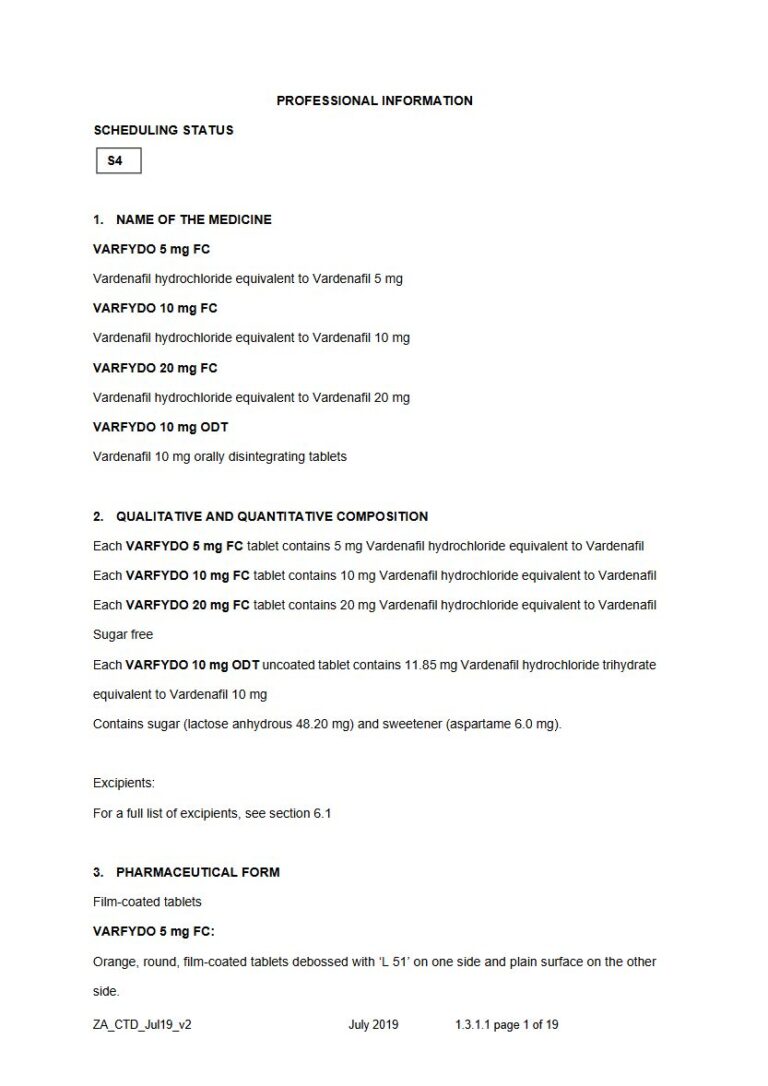
Varfydo 5mg, 10mg, 20mg FC tablets
PDF Leaflet Revision Date: 24 May 2024
Clinical Summary
Quick overview from the medicine insert
Indication
Treatment of erectile dysfunction.
Dosage (summary)
Starting dose: 10 mg taken 1 hour before sexual activity; max 20 mg once daily.
Onset of Action / Duration
Onset: 30-120 mins, Duration: 4-5 hours
Special Populations
- Elderly
- Hepatic impairment
- Renal impairment
Pregnancy & Breastfeeding
Not indicated for women; no studies in pregnant women.
Key Drug Interactions
- Nitrates
- CYP3A4 inhibitors
- Alpha-blockers
Contraindications
- Hypersensitivity to vardenafil
- Concomitant use with nitrates
- NAION
- Severe hepatic impairment
Common side effects
- Headache
- Dizziness
- Flushing
- Nasal congestion
Counselling Points
- Take as needed before sexual activity
- Avoid nitrates and CYP3A4 inhibitors
- Report sudden vision loss
Serious warnings
- Serious cardiovascular events
- QT interval prolongation
- Vision loss
Important Disclaimer
The Varfydo 5mg, 10mg, 20mg FC tablets professional information leaflet below is the property of Macleods Pharmaceuticals Sa and is provided on Medinsert exactly as issued, with no.. alterations or editorial changes. We make every effort to keep content current by updating documents as soon as new versions become available. Medinsert serves as a trusted access point for healthcare professionals, but does not replace official sources or clinical judgement. For more details, please read our full disclaimer. read more>>
 Healthcare Professionals Only
This content is for registered healthcare professionals
Sign in or create a free account to read the full package insert.
Free for HPCSA-registered professionals. Powered by Medinsert.
Clinical Particulars
Section 4 of the official insert — extracted exactly as issued, no alterations
4.1 Therapeutic indications
Treatment of erectile dysfunction.
4.2 Posology and method of administration
Posology: Recommended adult dose: The recommended starting dose is 10 mg VARFYDO taken as needed (approximately one hour) before sexual activity. However, the medicine may be taken anywhere from 25 minutes to at least up to 4 to 5 hours before sexual activity. The maximum recommended dose frequency is once per day. VARFYDO can be taken with or without food. Sexual stimulation is required for a natural response to treatment. Dose range: The recommended daily dose of VARFYDO is 5 to 20 mg. Based on efficacy and tolerability, the dose may be increased to 20 mg or decreased to 5 mg. The maximum recommended dose is 20 mg once daily. Special populations: Elderly (above 65 years): Dosage adjustments are not required in elderly patients. Children: VARFYDO is not indicated for use in children. Patients with hepatic impairment: No dose adjustment is needed in patients with mild hepatic impairment (Child-Pugh A). Vardenafil (the active ingredient in VARFYDO) clearance is reduced in patients with moderate hepatic impairment (Child-Pugh B), supporting a starting dose of 5 mg VARFYDO film-coated tablets, which may subsequently be increased to 10 mg VARFYDO film-coated tablets or orally disintegrating tablets. Patients with moderate hepatic impairment (Child-Pugh B) should not use VARFYDO ODT 10 mg. The pharmacokinetics of vardenafil has not been studied in patients with severe hepatic impairment (Child-Pugh C) (see Section 5.2). Patients with renal impairment: No dose adjustment is needed in patients with mild (CL cr > 50 to 80 mL /min), moderate (CL cr > 30 to 50 mL /min), or severe (CL cr < 30 mL/min) renal impairment. Vardenafil (the active ingredient in VARFYDO) clearance is reduced in patients with moderate hepatic impairment (Child-Pugh B), supporting a starting dose of 5 mg VARFYDO Orally disintegrating tablets, which may subsequently be increased to 10 mg VARFYDO Orally disintegrating tablets. Patients with moderate hepatic impairment (Child-Pugh B) should not use VARFYDO 10 mg ODT. The pharmacokinetics of vardenafil (the active ingredient in VARFYDO) has not been studied in patients requiring dialysis. Method of administration: VARFYDO film-coated tablets are for oral use and can be taken with or without food. VARFYDO 10 mg ODT is an orally disintegrating tablet that is placed on the tongue and dissolves in the mouth in the presence of saliva. It should be taken by itself without food or liquid in the mouth. It should be taken immediately upon release from the blister. VARFYDO 10 mg ODT can be taken with or without food.
4.3 Contra-indications
Contra-indicated in patients with a known hypersensitivity to the active substance (vardenafil hydrochloride) or any of the excipients listed in section 6.1. VARFYDO is contra-indicated in patients who are concomitantly treated with nitrates or nitric oxide donors. Doctors should discuss with patients the contra-indications of VARFYDO. VARFYDO is contraindicated in patients who have loss of vision in one eye because of non-arteritic anterior ischaemic optic neuropathy (NAION), regardless of whether this episode was in connection or not with previous phosphodiesterase 5 (PDE5) inhibitor exposure. u2022 Women, new-borns and children. u2022 End-stage renal disease requiring dialysis. u2022 Anatomical deformation of the penis (such as angulation, cavernosal fibrosis or Peyronieu2019s disease). u2022 Conditions which may predispose to priapism (such as sickle cell anaemia, multiple myeloma or leukaemia). u2022 Hypotension (resting systolic blood pressure of 170/110 mmHg). u2022 Recent history of stroke, life-threatening arrhythmia or myocardial infarction (within last 6 months). u2022 Uncontrolled cardiac failure. u2022 Unstable angina. u2022 Known hereditary degenerative retinal disorders such as retinitis pigmentosa. u2022 Bleeding disorders. u2022 Active peptic ulceration. u2022 Severe impairment of liver function. u2022 Concomitant use of VARFYDO with the HIV protease inhibitors indinavir and ritonavir (see section 4.5). Concomitant use of vardenafil with the potent CYP3A4 inhibitors ketoconazole and itraconazole (oral form) in men older than 75 years (see section 4.5). Moderate hepatic impairment (see Section 4.4). u2022 People with phenylketonuria. u2022 Patients with rare hereditary lactose intolerance.
4.4 Special warnings and precautions for use
Serious cardiovascular events including sudden death, tachycardia, myocardial infarction, ventricular tachy-arrythmia, angina pectoris and cerebrovascular disorders (including transient ischaemic attack and cerebral haemorrhage) have been reported in temporal association with vardenafil. Most of the patients in whom these events have been reported had pre-existing cerebrovascular risk factors. However, it is not possible to definitively determine whether these events are related directly to these risk factors, to vardenafil, to sexual activity or to a combination of these other factors. Effects on QTc interval: Reported clinical data of the effect of vardenafil on QT interval in healthy males, indicated that vardenafil produced increases in QTc interval. Recorded post-marketing data study evaluating the effect of combining vardenafil with another medicine of comparable QT effect showed an additive QT effect when compared with either medicine alone. These observations should be considered when prescribing VARFYDO to patients with known history of QT prolongation or patients who are taking medications known to prolong the QT interval. Patients taking Class IA (e.g. quinidine, procainamide) or Class III (e.g. amiodarone, sotalol) antiarrhythmic medications or those with congenital QT prolongation, should avoid using VARFYDO. Effect on vision: Transient vision loss and cases of non-arteritic ischaemic optic neuropathy have been reported in connection with the intake of medicines containing vardenafil, such as VARFYDO. The patient should be advised that in the case of sudden vision loss, he should stop taking VARFYDO and consult immediately a doctor. (see Section 4.8). Concomitant use of alpha-blockers: Consistent with vasodilatory effects of alpha-blockers and VARFYDO, the concomitant use of VARFYDO with alpha-blockers may lead to symptomatic hypotension in some patients. Prior to initiating any treatment for erectile dysfunction, doctors should consider the cardiovascular status of their patients, since there is a degree of cardiac risk associated with sexual activity. [PRODUCT NAME] should not be used in men for whom sexual activity is not recommended because of their underlying cardiovascular status. Treatment should only be initiated if the patient is stable on his alpha-blocker therapy (see Section 4.5). In those patients who are stable on alpha-blocker therapy, VARFYDO should be initiated at the lowest recommended starting dose of 5 mg VARFYDO film-coated tablets. VARFYDO may be administered at any time with tamsulosin. In those patients already taking an optimised dose of VARFYDO, alpha-blocker therapy should be initiated at the lowest dose. Stepwise increase in alpha-blocker dose may be associated with further lowering of blood pressure in patients taking a PDE5 inhibitor including VARFYDO. General: The safety and efficacy of combinations of VARFYDO with other treatments for erectile dysfunction have not been studied. Therefore the use of such combinations is not recommended. The safety of VARFYDO 10 mg ODT has not been studied in patients with moderate hepatic impairment, therefore use of VARFYDO ODT 10 in these patients is not recommended (see Section 4.3). Concomitant use of the potent cytochrome P450 (CYP) 3A4 inhibitors; e.g. ketoconazole, itraconazole, indinavir and ritonavir can be expected to produce markedly increased plasma levels of vardenafil, the active ingredient in VARFYDO (see Section 4.5). A maximum dose of 5 mg VARFYDO film-coated tablets should not be exceeded when used in combination with erythromycin or clarithromycin. A maximum dose of 5 mg VARFYDO film-coated tablets should not be exceeded if used in combination with ketoconazole and itraconazole. VARFYDO must not be taken with dosages of ketoconazole and itraconazole higher than 200 mg (see Section 4.5). Concomitant intake of grapefruit or grapefruit juice is expected to increase the plasma concentrations of vardenafil. The combination should be avoided (see section 4.5). Effect on bleeding: VARFYDO has not been administered to patients with bleeding disorders or active peptic ulceration. Therefore VARFYDO should not be given to these patients (see Section 4.3). In humans, VARFYDO has no effect on bleeding time alone or with acetylsalicylic acid. In vitro studies with human platelets indicate that VARFYDO alone did not inhibit platelet aggregation induced by a variety of platelet agonists. With super therapeutic concentrations of vardenafil, the active ingredient in VARFYDO, a small concentration dependent enhancement of the antiaggregatory effect of sodium nitroprusside, a nitric oxide donor, was observed. The combination of heparin and VARFYDO had no effect on bleeding time in rats, but this interaction has not been studied in humans. Aspartame: VARFYDO ODT 10 mg contains aspartame, a source of phenylalanine which may be harmful to people with phenylketonuria (see Section 4.3). Contains lactose. Patients with the rare hereditary conditions of galactose intolerance e.g. galactosaemia, Lapp lactase deficiency, glucose-galactose malabsorption or fructose intolerance should not take VARFYDO 10 mg ODT.
4.5 Interaction with other medicines and other forms of interaction
Nitrates, nitric oxide donors: The blood pressure lowering effect of sublingual nitroglycerin (0,4 mg) taken 1 and 4 hours after vardenafil administration were potentiated by vardenafil in healthy middle aged subjects. Concomitant use of VARFYDO with nitrates is contra-indicated. CYP inhibitors: Concomitant use with the HIV protease inhibitors indinavir or ritonavir, which are highly potent inhibitors of CYP3A4, is contraindicated (see Sections 4.3 & 4.4). Vardenafil as in VARFYDO is metabolised predominantly by hepatic enzymes via cytochrome P450 (CYP) isoform 3A4, with some contribution from CYP3A5 and CYP2C isoforms. Therefore, inhibitors of these enzymes may reduce VARFYDO clearance. Reported clinical data showed: Cimetidine (400 mg b.i.d.), a non-specific cytochrome P450 inhibitor, had no effect on vardenafil AUC and C max when co-administered with vardenafil (20 mg) to healthy volunteers. Erythromycin (500 mg t.i.d.), a CYP3A4 inhibitor, caused a 4-fold increase in vardenafil AUC and a 3-fold increase in Cmax when co-administered with vardenafil (5 mg) to healthy volunteers. Ketoconazole (200 mg), which is a potent CYP3A4 inhibitor, caused a 10-fold increase in vardenafil (the active ingredient in vardenafil) AUC and a 4-fold increase in C max when co-administered with vardenafil (5 mg) to healthy volunteers. Co-administration of vardenafil VARFYDO (10 mg) with the HIV protease inhibitor indinavir (800 mg t.i.d.) resulted in a 16-fold increase in vardenafil (the active ingredient in vardenafil) AUC and a 7-fold increase in vardenafil C max. At 24 hours after co-administration, the plasma levels of vardenafil were approximately 4 % of the maximum vardenafil plasma level (C max). Ritonavir (600 mg b.i.d) resulted in a 13-fold increase in vardenafil C max and a 49-fold increase in vardenafil AUC 0-24 when co-administered with vardenafil 5 mg. The interaction is a consequence of blocking hepatic metabolism of vardenafil by ritonavir, a highly potent CYP3A4 inhibitor, which also inhibits CYP2C9. Ritonavir significantly prolonged the half-life of vardenafil to 25, 7 hours. Concomitant use of potent CYP3A4 inhibitors such as ketoconazole, itraconazole, indinavir or ritonavir can be expected to produce markedly increased vardenafil plasma levels. Co-administration of erythromycin (500 mg three times a day), a CYP3A4 inhibitor, with vardenafil (5 mg) resulted in a 4-fold increase in vardenafil AUC and a 3-fold increase in C max. Although a specific interaction study has not been conducted, the co-administration of clarithromycin can be expected to result in similar effects on vardenafil AUC and C max. When used in combination with a moderate CYP3A4 inhibitor such as erythromycin or clarithromycin, vardenafil dose adjustment might be necessary (see sections 4.2 and 4.4). Co-administration of ketoconazole (200 mg), a potent CYP3A4 inhibitor with vardenafil (5 mg) resulted in a 10-fold increase in vardenafil AUC and a 4-fold increase in vardenafil C max. Others: Vardenafil (20 mg), when co-administered with glibenclamide (glyburide, 3,5 mg), did not affect the relative bioavailability of glibenclamide (no effect on AUC and C max of glibenclamide). There was no evidence that vardenafil (the active ingredient in VARFYDO) pharmacokinetics were altered by coadministration of glibenclamide. No pharmacokinetic and pharmacodynamic (prothrombin time and clotting factor II, VII and X) interaction was shown when Warfarin (25 mg) was co-administered with vardenafil (20 mg). Vardenafil pharmacokinetics was not affected by co-administration of Warfarin. No relevant pharmacokinetic interaction was shown when vardenafil (20 mg), was co-administered with nifedipine (30 or 60 mg). The combined treatment of vardenafil and nifedipine did not lead to pharmacodynamic interaction (as compared to placebo, vardenafil produced mean additional blood pressure reductions of 5, 9 mmHg and 5,2 mmHg for supine systolic and diastolic blood pressure, respectively).
4.6 Fertility, pregnancy and lactation
VARFYDO is not indicated for use by women. There are no studies of vardenafil in pregnant women. There are no fertility data available.
4.7 Effects on ability to drive and use machines
As dizziness and abnormal vision or eye disorder were reported in clinical trials with VARFYDO, patients should exercise caution when driving, operating hazardous machinery or performing hazardous tasks.
4.8 Undesirable effects
Summary of the reported safety profile: The most frequent adverse reactions include those related to the nervous system such as headaches and dizziness and those related to vascular system such as vasodilatation. Tabulated summary of adverse events: System organ class Frequency Undesirable effect Infections and infestations Less frequent Conjunctivitis Immune system disorders Less frequent Allergic oedema and angioedema and allergic reaction Psychiatric disorders Less frequent Sleep disorder, anxiety Frequent Headache, dizziness Nervous system disorders Less frequent Paraesthesia and dysesthesia, Somnolence, syncope, amnesia, seizure Frequency unknown Cerebral haemorrhage Eye disorders Less frequent Visual disturbance, ocular hyperaemia, visual colour distortions, eye pain and eye discomfort, photophobia, increase in intraocular pressure Frequency unknown Non-arteritic anterior ischemic optic neuropathy (NAION), visual disturbances including vision loss, retinal detachment Ear and labyrinth disorders Less frequent Tinnitus, vertigo Frequency unknown Sudden deafness or loss of hearing Cardiac disorders Less frequent Palpitation, tachycardia, angina pectoris, myocardial infarction, ventricular tachyarrhythmias Frequency unknown Sudden death Vascular disorders Frequent Vasodilatation Flushing Less frequent Hypotension Hypertension Respiratory, thoracic and mediastinal disorders Frequent Nasal congestion Less frequent Dyspnoea, sinus congestion, epistaxis Frequent Dyspepsia Gastrointestinal disorders Less frequent Nausea, gastrointestinal and abdominal pain, dry mouth, diarrhoea, gastroesophageal reflux disease, gastritis, vomiting Hepatobiliary disorders Less frequent Increase in transaminases, increase in gamma-glutamyl-transferase Skin and subcutaneous tissue disorders Less frequent Erythema, rash, photosensitivity reaction Musculoskeletal and connective tissue disorders Less frequent Back pain, increase in creatine phosphokinase, increased muscle tone and cramping, myalgia Renal and urinary disorders Frequency unknown Haematuria Reproductive system and breast disorders Less frequent Increase in erection, priapism Frequency unknown Penile haemorrhage, haematospermia General disorders and administration site conditions Less frequent Feeling unwell, chest pain Reporting of suspected adverse reactions: Reporting suspected adverse reactions after authorisation of the medicine is important. It allows continued monitoring of the benefit/risk balance of the medicine. Health care providers are asked to report any suspected adverse reactions to SAHPRA via the u201c6.04 Adverse Drug Reactions Reporting Formu201d, found online under SAHPRAu2019s publications: https://www.sahpra.org.za/Publications/Index/8.
4.9 Overdose
In reported single dose volunteer studies, vardenafil (the active ingredient in VARFYDO) was tested in doses up to and including 80 mg per day. When 40 mg was administered twice daily, cases of severe back pain were observed. In cases of overdose, standard supportive measures should be taken as required. Renal dialysis is not expected to accelerate clearance as vardenafil (the active ingredient in VARFYDO) is highly bound to plasma proteins and not significantly eliminated in the urine.
