
Vaticol Xl 80 mg FC tablet.
PDF Leaflet Revision Date: 27 November 2023
Clinical Summary
Quick overview from the medicine insert
Indication
Adjunct to diet for lowering cholesterol levels and slowing coronary atherosclerosis.
Dosage (summary)
One 80 mg tablet once daily at night.
Special Populations
- Renal impairment
- Hepatic impairment
- Elderly population
Pregnancy & Breastfeeding
Contraindicated in pregnancy and lactation due to potential harm.
Key Drug Interactions
- Fibrates
- Gemfibrozil
- Colchicine
- Ciclosporin
- Warfarin
Contraindications
- Hypersensitivity
- Active liver disease
- Severe renal insufficiency
- Pregnancy
- Lactation
Common side effects
- Headache
- Insomnia
- Dyspepsia
- Nausea
- Myopathy
Counselling Points
- Take at night
- Report muscle pain or weakness
- Monitor liver function tests
- Use effective contraception if of childbearing potential
Serious warnings
- Risk of myopathy and rhabdomyolysis
- Liver enzyme increases
- Risk of interstitial lung disease
Important Disclaimer
The Vaticol Xl 80 mg FC tablet. professional information leaflet below is the property of Pharmacare and is provided on Medinsert exactly as issued, with no.. alterations or editorial changes. We make every effort to keep content current by updating documents as soon as new versions become available. Medinsert serves as a trusted access point for healthcare professionals, but does not replace official sources or clinical judgement. For more details, please read our full disclaimer. read more>>
 Healthcare Professionals Only
This content is for registered healthcare professionals
Sign in or create a free account to read the full package insert.
Free for HPCSA-registered professionals. Powered by Medinsert.
Clinical Particulars
Section 4 of the official insert — extracted exactly as issued, no alterations
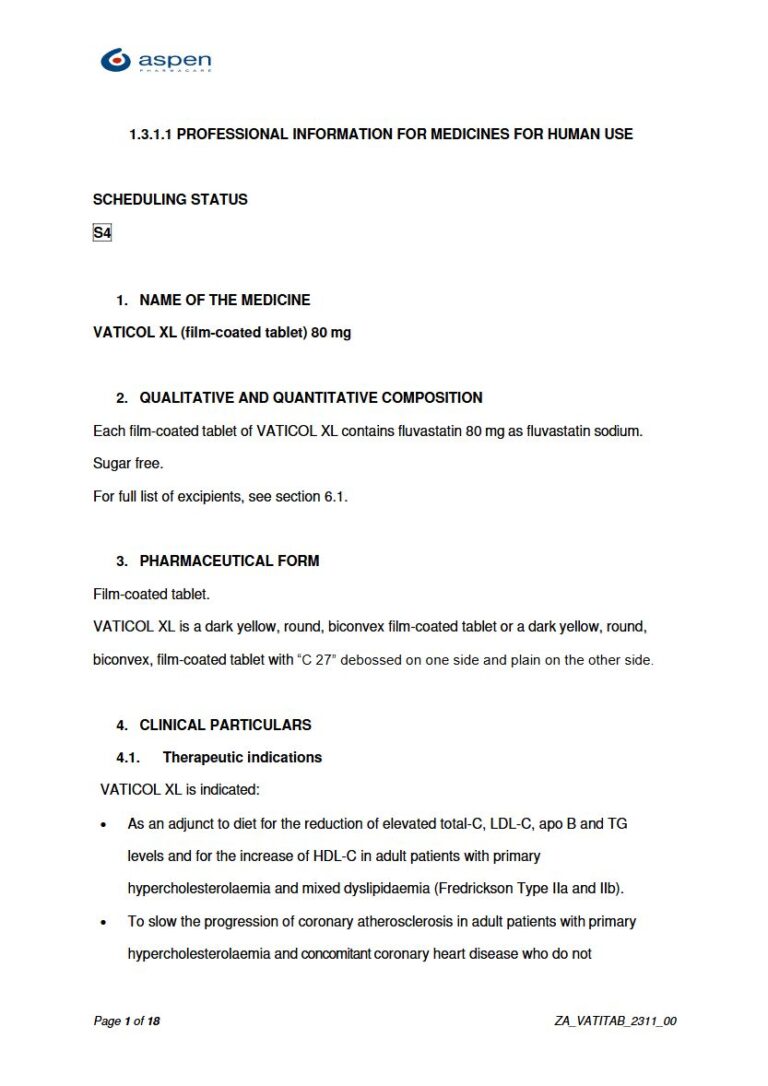
4.1. Therapeutic indications
VATICOL XL is indicated:
- As an adjunct to diet for the reduction of elevated total-C, LDL-C, apo B and TG levels and for the increase of HDL-C in adult patients with primary hypercholesterolaemia and mixed dyslipidaemia (Fredrickson Type IIa and IIb).
- To slow the progression of coronary atherosclerosis in adult patients with primary hypercholesterolaemia and concomitant coronary heart disease who do not adequately respond to dietary control.
- To reduce the risk of undergoing coronary revascularization procedures in patients with multivessel disease.
4.2. Posology and method of administration
Posology
The patient should be placed on a standard cholesterol-lowering diet before initiating treatment with VATICOL XL and should remain on this diet during treatment with VATICOL XL. If appropriate, a program of weight control and physical exercise should be implemented.
Adults: One 80 mg film-coated tablet once daily at night. It is recommended that serum cholesterol levels be determined 4 weeks after initiation of therapy with VATICOL XL and at periodic levels thereafter. Doses should be adjusted according to the patientu2019s response, with dose adjustments made at intervals of 4 weeks or more.
Special populations
Renal Impairment
Fluvastatin is cleared by the liver, with less than 6 % of the administered dose excreted into the urine. The pharmacokinetics of fluvastatin remain unchanged in patients with mild to severe renal insufficiency. No dose adjustments are therefore necessary in these patients however, due to limited experience with doses >40 mg/day in case of severe renal impairment (CrCL <0,5 mL/sec or 30 mL/min), these doses should be initiated with caution (see section 4.3).
Hepatic impairment
VATICOL XL is contraindicated in patients with active liver disease, or unexplained, persistent elevations in serum transaminases (see section 4.3).
Elderly population
In clinical studies with VATICOL XL efficacy and tolerability were demonstrated in age groups both above and under 65 years. In the elderly group (> 65 years), there was no evidence of reduced tolerability. Therefore there is no need to adjust dose based on age.
Paediatric population
VATICOL XL is contraindicated for use in a paediatric population (see section 4.3).
Method of administration
For oral administration VATICOL XL is best taken in the evening or at bedtime. It may be taken without regard to meals and should be swallowed whole with a full glass of water.
4.3. Contraindications
VATICOL XL is contraindicated in:
- Patients with hypersensitivity to fluvastatin or to any excipients as contained in VATICOL XL (see section 6.1).
- Active liver disease or unexplained persistent elevations of serum-aminotransaminases and creatine-phosphokinase (see section 4.2).
- Severe renal insufficiency (i.e. creatinine clearance < 30 ml/min).
- Pregnancy and lactation.
- Concomitant administration of fibrates or gemfibrozil.
No data are available for the use in patients with homozygous familial hypercholesterolaemia. VATICOL XL has not been tested in children and is therefore contraindicated in children under the age of 18 years (see section 4.2).
4.4. Special warnings and precautions for use
Risk of myasthenia gravis and ocular myasthenia
Statins, e.g. fluvastatin as contained in VATICOL XL have been reported to induce de novo or aggravate pre-existing myasthenia gravis or ocular myasthenia (see section 4.8). VATICOL XL should be discontinued in case of aggravation of symptoms. Recurrences when the same or a different statin was (re-) administered have been reported.
Liver disease
Use with caution in patients with a history of hepatic disease or alcoholism. Increases in liver enzymes may occur. Post-marketing cases of fatal and non-fatal hepatic failures have been reported with some statins including fluvastatin, as contained in VATICOL XL. Although a causal relationship with fluvastatin, as contained in VATICOL XL, treatment has not been determined, patients should be advised to report any potential symptoms or signs of hepatic failure (e.g. nausea, vomiting, loss of appetite, jaundice, impaired brain function, easy bruising or bleeding), and treatment discontinuation should be considered. It is recommended that liver function tests be performed at baseline and every 6 weeks during the first 3 months of therapy and then every 8 weeks during the remainder of the first year of therapy. Thereafter, liver function tests should be performed periodically (approximately every 6 months). Patients who develop elevated serum transaminase levels should have the measurements repeated and then performed more frequently. If the transaminase levels show evidence of progression, particularly if they rise to three times the upper limit of normal and are persistent, VATICOL XL should be discontinued.
Skeletal muscle
Myopathy has been reported with fluvastatin, such as VATICOL XL. Myositis and rhabdomyolysis have been reported. In patients with unexplained diffuse myalgias, muscle tenderness or muscle weakness, and/or marked elevation of creatine kinase (CK) values, myopathy, myositis or rhabdomyolysis have to be considered. Patients should therefore be advised to promptly report unexplained muscle pain, muscle tenderness or muscle weakness, particularly if accompanied by malaise or fever. There have been reports of an immune-mediated necrotizing myopathy (IMNM) during or after treatment with some statins. IMNM is clinically characterized by persistent proximal muscle weakness and elevated serum creatine kinase, which persist despite discontinuation of statin, such as VATICOL XL, treatment.
Creatinine kinase (CK)
There is no current evidence to require routine monitoring of plasma total CK or other muscle enzyme levels in asymptomatic patients on statins, as contained in VATICOL XL. If CK has to be measured it should not be done following strenuous exercise or in the presence of any plausible alternative cause of CK-increase as this makes the value interpretation difficult.
Before treatment
As with all other statins physicians should prescribe fluvastatin, as contained in VATICOL XL, with caution in patients with pre-disposing factors for rhabdomyolysis and its complications. A creatine kinase level should be measured before starting VATICOL XL treatment in the following situations:
- Renal impairment
- Hypothyroidism
- Personal or familial history of hereditary muscular disorders
- Previous history of muscular toxicity with a statin or fibrate
- Alcohol abuse
- Sepsis
- Hypotension
- Excessive exercise of muscle
- Major surgery or trauma
- Severe metabolic, endocrine or electrolyte disorders
- Uncontrolled seizures
- In elderly (age> 70 years), the necessity of such measurement should be considered, according to the presence of other predisposing factors for rhabdomyolysis.
In such situations, the risk of treatment should be considered in relation to the possible benefit and clinical monitoring is recommended. If CK levels are significantly elevated at baseline > 5 x ULN), levels should be re-measured within 5 to 7 days later to confirm the results. If CK levels are still significantly elevated > 5 x ULN) at baseline, treatment should not be started.
Whilst on treatment
If muscular symptoms like pain, weakness or cramps occur in patients receiving VATICOL XL, their CK levels should be measured. Treatment should be stopped if these levels are found to be significantly elevated (> 5 x ULN). If muscular symptoms are severe and cause daily discomfort, even if CK levels are elevated to u2264 5 x ULN, treatment discontinuation should be considered.
Should the symptoms resolve and CK levels return to normal, then re-introduction of VATICOL XL or another statin may be considered at the lowest dose and under close monitoring. The risk of myopathy has been reported to be increased in patients receiving immunosuppressive medicines (including ciclosporin), fibrates, nicotinic acid or erythromycin together with other HMG-CoA reductase inhibitors. Isolated cases of myopathy have been reported post-marketing for concomitant administration of fluvastatin with ciclosporin and fluvastatin with colchicine. VATICOL XL should be used with caution in patients receiving such concomitant medicinal product (see section 4.5).
Interaction with fusidic acid
VATICOL XL must not be co-administered with systemic formulations of fusidic acid or within 7 days of stopping fusidic acid treatment. In patients where the use of systemic fusidic acid is considered essential, statin treatment, such as VATICOL XL, should be discontinued throughout the duration of fusidic acid treatment. There have been reports of rhabdomyolysis (including some fatalities) in patients receiving fusidic acid and statins in combination (see section 4.5). The patient should be advised to seek medical advice immediately if they experience any symptoms of muscle weakness, pain or tenderness. Statin therapy may be re-introduced seven days after the last dose of fusidic acid.
Where prolonged systemic fusidic acid is needed, e.g., for the treatment of severe infections, the need for co-administration of VATCOL XL and fusidic acid should only be considered on a case-by-case basis and under close medical supervision.
Interstitial lung disease
Interstitial lung disease has been reported with some statins, such as VATICOL XL, especially with long term therapy (see section 4.8). Presenting features can include dyspnoea, non-productive cough and deterioration in general health (fatigue, weight loss and fever). If it is suspected a patient has developed interstitial lung disease, VATICOL XL therapy should be discontinued.
Diabetes mellitus
Statins, such as VATICOL XL, as a class, raise blood glucose and, in some patients, at high risk of future diabetes, may produce a level of hyperglycaemia where formal diabetes care is appropriate. This risk, however, is outweighed by the reduction in vascular risk with statins and therefore should not be a reason for stopping VATICOL XL treatment. Patients at risk (fasting glucose 5,6 to 6,9 mmol/L, BMI>30kg/m2, raised triglycerides, hypertension) should be monitored both clinically and biochemically according to national guidelines.
4.5. Interactions with other medicines
Fibrates and niacin: Concomitant administration of VATICOL XL with bezafibrate, gemfibrozil, ciprofibrate or niacin (nicotinic acid) has no clinically relevant effect on the bioavailability of fluvastatin or the other lipid-lowering medicine. Since an increased risk of myopathy and/or rhabdomyolysis has been observed in patients receiving HMGCoA reductase inhibitors together with any of these molecules, the benefit and the risk of concurrent treatment should be carefully weighed and these combinations should only be used with caution (see section 4.4).
Colchicine: Myotoxicity, including muscle pain and weakness and rhabdomyolysis, has been reported in isolated cases with concomitant administration of colchicine. The benefit and the risk of concurrent treatment should be carefully weighed and these combinations should only be used with caution (see section 4.4).
Ciclosporin: Studies in renal transplant patients indicate that the bioavailability of fluvastatin (up to 40 mg/day) is not elevated to a clinically significant extent in patients on stable regimens of ciclosporin. The results from another study in which 80 mg fluvastatin prolonged-release tablets were administered to renal transplant patients who were on stable ciclosporin regimen showed that fluvastatin exposure (AUC) and maximum concentration (C max) were increased 2-fold compared to historical data in healthy subjects. Although these increases in fluvastatin levels were not clinically significant, this combination should be used with caution. Starting and maintenance dose of fluvastatin should be as low as possible when combined with ciclosporin. 80 mg Fluvastatin VATICOL XL had no effect on the bioavailability of ciclosporin when co-administered.
Warfarin and other coumarin derivatives: In healthy volunteers, the use of fluvastatin, as contained in VATICOL XL, and warfarin (single dose) did not adversely influence warfarin plasma levels and prothrombin times compared to warfarin alone. However, isolated incidences of bleeding episodes and/or increased prothrombin times have been reported in patients on fluvastatin receiving concomitant warfarin or other coumarin derivatives. It is recommended that prothrombin times are monitored when fluvastatin treatment is initiated, discontinued, or the dose changes in patients receiving warfarin or other coumarin derivatives.
Rifampicin: Administration of fluvastatin to healthy volunteers pre-treated with rifampicin (rifampin) resulted in a reduction of the bioavailability of fluvastatin by about 50 %. Although at present there is no clinical evidence that fluvastatin, as contained in VATICOL XL, efficacy in lowering lipid levels is altered, for patients undertaking long-term rifampicin therapy (e.g. treatment of tuberculosis), appropriate adjustment of fluvastatin dose may be warranted to ensure a satisfactory reduction in lipid levels.
Oral antidiabetic medicines: For patients receiving oral sulfonylureas (glibenclamide (glyburide), tolbutamide) for the treatment of noninsulin dependent (type 2) diabetes mellitus (NIDDM), addition of fluvastatin, as contained in VATICOL XL, does not lead to clinically significant changes in glycaemic control. In glibenclamide-treated NIDDM patients (n=32), administration of fluvastatin (40 mg twice daily for 14 days) increased the mean C max, AUC, and t u00bd of glibenclamide by approximately 50 %, 69 %, and 121 %, respectively. Glibenclamide (5 to 20 mg daily) increased the mean C max and AUC of fluvastatin by 44 % and 51 %, respectively. In this study there were no changes in glucose, insulin, and C-peptide levels. However, patients on concomitant therapy with glibenclamide (glyburide) and fluvastatin, as contained in VATICOL XL, should continue to be monitored appropriately when their fluvastatin dose is increased to 80 mg per day.
Bile acid sequestrants: VATICOL XL should be administered at least 4 hours after the resin (e.g. colestyramine) to avoid a significant interaction due to active substance binding of the resin.
Fluconazole: Administration of fluvastatin, as contained in VATICOL XL, to healthy volunteers pre-treated with fluconazole (CYP 2C9 inhibitor) resulted in an increase in the exposure and peak concentration of fluvastatin by about 84 % and 44 %. Although there was no clinical evidence that the safety profile of fluvastatin was altered in patients pretreated with fluconazole for 4 days, caution should be exercised when fluvastatin is administered concomitantly with fluconazole.
Histamine H2-receptor antagonists and proton pump inhibitors: Concomitant administration of VATICOL XL with cimetidine, ranitidine or omeprazole results in an increase in the bioavailability of fluvastatin, which, however, is of no clinical relevance.
Phenytoin: The overall magnitude of the changes in phenytoin pharmacokinetics during co-administration with fluvastatin, as contained in VATICOL XL, is relatively small and not clinically significant. Thus routine monitoring of phenytoin plasma levels is sufficient during coadministration with fluvastatin.
Cardiovascular medicines: No clinically significant pharmacokinetic interactions occur when fluvastatin, as contained in VATICOL XL, is concomitantly administered with propranolol, digoxin, losartan, clopidogrel or amlodipine. Based on the pharmacokinetic data, no monitoring or dose adjustments are required when fluvastatin is concomitantly administered with these medicines.
Itraconazole and erythromycin: Concomitant administration of fluvastatin, as contained in VATICOL XL, with the potent cytochrome P450 (CYP) 3A4 inhibitors itraconazole and erythromycin has minimal effects on the bioavailability of fluvastatin. Given the minimal involvement of this enzyme in the metabolism of fluvastatin, it is expected that other CYP3A4 inhibitors (e.g. ketoconazole, ciclosporin) are unlikely to affect the bioavailability of fluvastatin.
Fusidic acid: The risk of myopathy including rhabdomyolysis may be increased by the concomitant administration of systemic fusidic acid with statins. The mechanism of this interaction (whether it is pharmacodynamic or pharmacokinetic, or both) is yet unknown. There have been reports of rhabdomyolysis (including some fatalities) in patients receiving this combination. If treatment with systemic fusidic acid is necessary, fluvastatin, as contained in VATICOL XL, treatment should be discontinued throughout the duration of the fusidic acid treatment (see section 4.4).
Grapefruit juice: Based on the lack of interaction of fluvastatin with other CYP3A4 substrates, fluvastatin, as contained in VATICOL XL, is not expected to interact with grapefruit juice.
4.6. Fertility, pregnancy and lactation
Pregnancy
Since HMG-CoA reductase inhibitors decrease the synthesis of cholesterol and possibly of other biologically active substances derived from cholesterol, they may cause foetal harm when administered to pregnant women. VATICOL XL is contraindicated in pregnancy (see section 4.3). Use of an effective contraceptive is recommended for women of childbearing potential taking VATICOL XL. If pregnancy occurs during treatment with VATICOL XL, the medication should be discontinued.
Breastfeeding
VATICOL XL is contraindicated during lactation because of the potential for serious adverse effects in the breastfed infant (see section 4.3).
Fertility
In animal studies no effects on male and female fertility were observed.
4.7. Effects on ability to drive and use machines
VATICOL XL is not anticipated to interfere with the ability to drive or operate machines. Patients should not drive, use machinery or perform any tasks that require concentration until they are certain that VATICOL XL do not adversely affect their ability to do so safely (see sections 4.4 and/or 4.8).
4.8. Undesirable effects
a) Summary of the safety profile
No information available.
b) Tabulated list of adverse reactions
System organ class
Frequent
Less frequent
Frequency unknown (cannot be estimated from available data)
Blood and the lymphatic system disorders
Thrombocytopenia
Immune system disorders
Hypersensitivity reactions (rash, urticaria), anaphylactic reaction
Nervous system disorders
Headache, insomnia
Paraesthesia, dysesthesia, hypoesthesia also known to be associated with the underlying hyperlipidaemic disorders
Myasthenia gravis
Eye disorders
Ocular myasthenia
Vascular disorders
Vasculitis
Respiratory, thoracic and mediastinal disorders
Interstitial lung disease
Gastrointestinal disorders
Dyspepsia, nausea, abdominal pain
Pancreatitis
Diarrhoea
Hepatobiliary disorders
Reversible increases in serum transaminases, hepatitis.
Skin and subcutaneous tissue disorders
Angioedema, face oedema and other skin reactions (e.g. eczema, dermatitis, bullous exanthema, skin rash, urticaria)
Musculoskeletal and connective tissue disorders
Lupus like syndrome, myopathy, myalgia, myositis and rhabdomyolysis associated with increased creatine kinase concentrations (presenting as fever, muscle aches or cramps, muscle weakness)
Immune-mediated necrotising myopathy (see section 4.4)
Renal and urinary disorders
Acute renal failure associated with rhabdomyolysis
Reproductive and breast disorders
Erectile dysfunction*
Investigations
Increased blood creatinine phosphokinase, increased blood transaminases
c) Description of selected adverse reactions
*Based on post-marketing experience with fluvastatin via spontaneous case reports and literature cases. Because these reactions are reported voluntarily from a population of uncertain size, it is not possible to reliably estimate their frequency which is therefore categorised as not known.
The following adverse events have been reported with some statins:
- Sleep disturbances, including insomnia and nightmares,
- Memory loss
- Sexual dysfunction
- Depression
- Diabetes Mellitus: Frequency will depend on the presence or absence of risk factors (fasting blood glucose u2265 5 ,6 mmol/L, BMI>30kg/m2, raised triglycerides, history of hypertension).
- Tendinopathy, sometimes complicated by tendon rupture
Reporting of suspected adverse reactions
Reporting suspected adverse reactions after authorisation of the medicine is important. It allows continued monitoring of the benefit/risk balance of the medicine. Healthcare providers are asked to report any suspected adverse reactions to SAHPRA via the u201c6.04 Adverse Drug Reactions Reporting Formu201d, found online under SAHPRAu2019s publications: https://www.sahpra.org.za/Publications/Index/8 Aspen Pharmacare: E-mail: [email protected] Tel: 0800 118 088/ +27 (0)11 239-6200
4.9. Overdose
Symptoms
To date there has been limited experience with overdose of fluvastatin, as contained in VATICOL XL. (See sections 4.4 and 4.8)
Treatment
Specific treatment is not available for fluvastatin, as contained in VATICOL XL, overdose. Should an overdose occur, the patient should be treated symptomatically and supportive measures instituted, as required. Liver function tests and serum CK levels should be monitored.
