
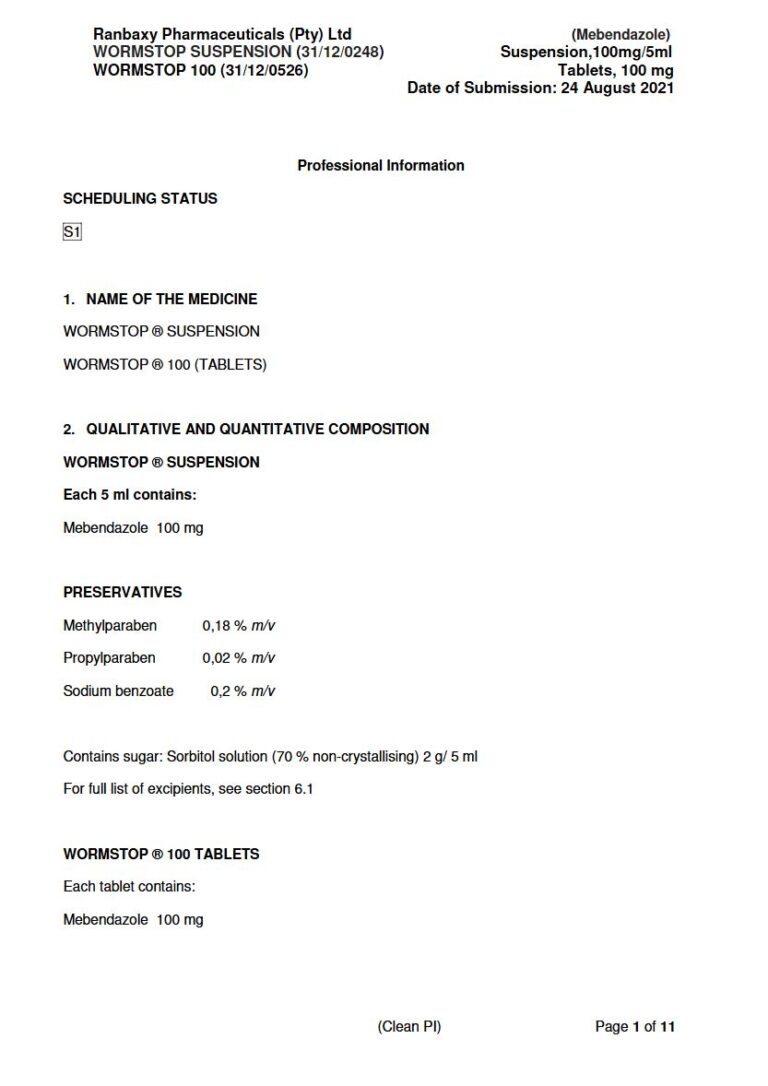
Wormstop Suspension & Tablet
PDF Leaflet Revision Date: 30 October 2021
Clinical Summary
Quick overview from the medicine insert
Indication
Treatment of single and mixed helminth gastrointestinal infestations.
Dosage (summary)
Adults and children over 1 year: 100 mg (5 ml) twice daily for 3-6 days depending on the infestation.
Special Populations
- Children under 1 year
- Hepatic impairment
Pregnancy & Breastfeeding
Contraindicated in pregnancy and lactation due to teratogenic effects.
Key Drug Interactions
- Cimetidine may increase plasma concentrations
- Avoid metronidazole
Contraindications
- Hypersensitivity to mebendazole
- Children under 1 year
- Pregnancy
Common side effects
- Neutropenia
- Convulsions
- Abdominal pain
- Nausea
- Rash
Counselling Points
- Take with food for better absorption
- Report any severe side effects
- Complete the full course of treatment
Serious warnings
- Reversible liver function disturbances
- Convulsions in children
Important Disclaimer
The Wormstop Suspension & Tablet professional information leaflet below is the property of Ranbaxy Pharmaceuticals and is provided on Medinsert exactly as issued, with no.. alterations or editorial changes. We make every effort to keep content current by updating documents as soon as new versions become available. Medinsert serves as a trusted access point for healthcare professionals, but does not replace official sources or clinical judgement. For more details, please read our full disclaimer. read more>>
 Healthcare Professionals Only
This content is for registered healthcare professionals
Sign in or create a free account to read the full package insert.
Free for HPCSA-registered professionals. Powered by Medinsert.
Clinical Particulars
Section 4 of the official insert — extracted exactly as issued, no alterations
4.1. Therapeutic indications
WORMSTOPu00ae is indicated for the treatment of single and mixed helminth gastrointestinal infestations caused by:
- nematodes such as:
- Trichuris trichiura (whipworm)
- Ancylostoma duodenale (hookworm)
- Necator americanus (hookworm)
- Ascaris lumbricoides (large roundworm)
- Ternidens deminutus
- Enterobius vermicularis (pinworm)
- Strongyloides stercoralis (threadworm)
- cestodes such as:
- Taenia spp (tapeworm)
- infestations by Moniliformis moniliformis
4.2 Posology and method of administration
Whipworm; Hookworm; Large Round Worm; Pinworm; Ternidens Deminutus; Infestations by Moniliformis moniliformis:
Tablets: One tablet (100 mg) twice daily (morning and evening) for three consecutive days. This standard dosage applies to adults, children and infants over the age of 1 year.
Suspension: One medicine measure (5 ml) twice daily (morning and evening) for three consecutive days. This standard dosage applies to adults, children and infants over the age of 1 year.
Tapeworm (Taenia spp):
Tablets: One tablet (100 mg) twice daily (morning and evening) for six consecutive days. This standard dosage applies to adults, children and infants.
Suspension: One medicine measure (5 ml) twice daily (morning and evening) for six consecutive days. This standard dosage applies to adults, children and infants.
Threadworm (Strongyloides stercoralis):
Tablets:
Adults: Two tablets (200 mg) twice daily (morning and evening) for three consecutive days.
Children: One tablet (100 mg) twice daily (morning and evening) for three consecutive days.
Suspension:
Adults: Two medicine measures (10 ml) twice daily (morning and evening) for three consecutive days.
Children: One medicine measure (5 ml) twice daily (morning and evening) for three consecutive days.
A second course of treatment should be given to those patients who are still infected three to four weeks after the first course. In worm-eradication campaigns the standard course should be administered every quarter during the first year. If a helminth is not susceptible to the standard dosage, a treatment course of longer than three days and/or involving higher doses than 100 mg tablet / 10 ml suspension is recommended. The efficacy of WORMSTOPu00ae is dependent upon the duration of physical contact between the medicine and parasite. When gastro-intestinal transit time is accelerated, eg. in diarrhoea, it is necessary to repeat the dose at more frequent intervals daily. For infants under 1 year of age, see section 4.3 and 4.4.
4.3 Contraindications
Hypersensitivity to mebendazole or to any of the excipients of WORMSTOPu00ae (see section 6.1).
WORMSTOPu00ae should not be used in children below the age of 1 year.
WORMSTOPu00ae should not be given during pregnancy, as it is teratogenic in animals (see section 4.6).
Concomitant use of mebendazole and metronidazole should be avoided.
4.4 Special warnings and precautions for use
There have been reports of reversible liver function disturbances, hepatitis, neutropenia and glomerulonephritis described in patients who were treated with dosages substantially above those recommended for prolonged periods of time. (See section 4.9).
Convulsions in children, including in infants below one year of age, have been reported. WORMSTOPu00ae should not be given to children below 1 year of age.
WORMSTOPu00ae should only be given to very young children if their worm infections interfere significantly with the nutritional status and the physical development.
WORMSTOPu00ae SUSPENSION contains sorbitol 70 % solution and may cause gastrointestinal discomfort and have a mild laxative effect.
4.5 Interaction with other medicines and other forms of interaction
Concomitant treatment with cimetidine may inhibit the metabolism of the mebendazole in the liver, resulting in increased plasma concentrations of the medicine especially during prolonged treatment. In the latter case, determination of plasma concentrations is recommended in order to allow dose adjustments.
Concomitant use of WORMSTOPu00ae and metronidazole should be avoided.
4.6 Fertility, pregnancy and lactation
WORMSTOPu00ae is contra-indicated during pregnancy and lactation (see section 4.3). Mebendazole has shown embryotoxic and teratogenic activity in rats and in mice at single oral doses. It is not known whether mebendazole is excreted in human breast milk.
4.7 Effects on ability to drive and use machines
WORMSTOPu00ae has no influence on the ability to drive and use machines.
4.8 Undesirable effects
System Organ Class
Frequent
Less frequent
Blood and Lymphatic System Disorders
- Neutropenia
- Agranulocytosis *
Immune System Disorders
- Hypersensitivity including anaphylactic reaction and anaphylactoid reaction
Nervous System Disorders
- Convulsions
- Dizziness
Gastrointestinal Disorders
- Abdominal pain
- Abdominal discomfort
- Diarrhoea
- Flatulence
- Nausea
- Vomiting
Hepatobiliary Disorders
- Hepatitis
- Abnormal liver function tests
Skin and Subcutaneous Tissue Disorders
- Rash
- Toxic epidermal necrolysis
- Stevens-Johnson syndrome
- Exanthema
- Angioedema
- Urticaria
- Alopecia
Renal and Urinary Disorders
- Glomerulonephritis*
* Reported in higher and prolonged doses
Reporting of suspected adverse reactions after authorisation of the medicine is important. It allows continued monitoring of the benefit/risk balance of the medicine. Health care providers are asked to report any suspected adverse reactions to SAHPRA via the u201c6.04 Adverse Drug Reaction Reporting Formu201d, found online under SAHPRAu2019s publications: https://www.sahpra.org.za/Publications/Index/8
4.9 Overdose
In patients treated at dosages substantially higher than recommended or for prolonged periods of time, the following adverse reactions have been reported: liver function disturbances, hepatitis, neutropenia and glomerulonephritis. With the exception of glomerulonephritis, these also have been reported in patients who were treated with mebendazole at standard dosages. In the event of accidental overdosage, abdominal cramps, nausea, vomiting and diarrhoea may occur. If poisoning or excessive overdosage is suspected it is recommended, on general principles, that vomiting be induced or gastric lavage be performed, and such symptomatic supportive therapy be administered as appears indicated. Activated charcoal may be given.
