
Xatral Xl 10mg Tablet
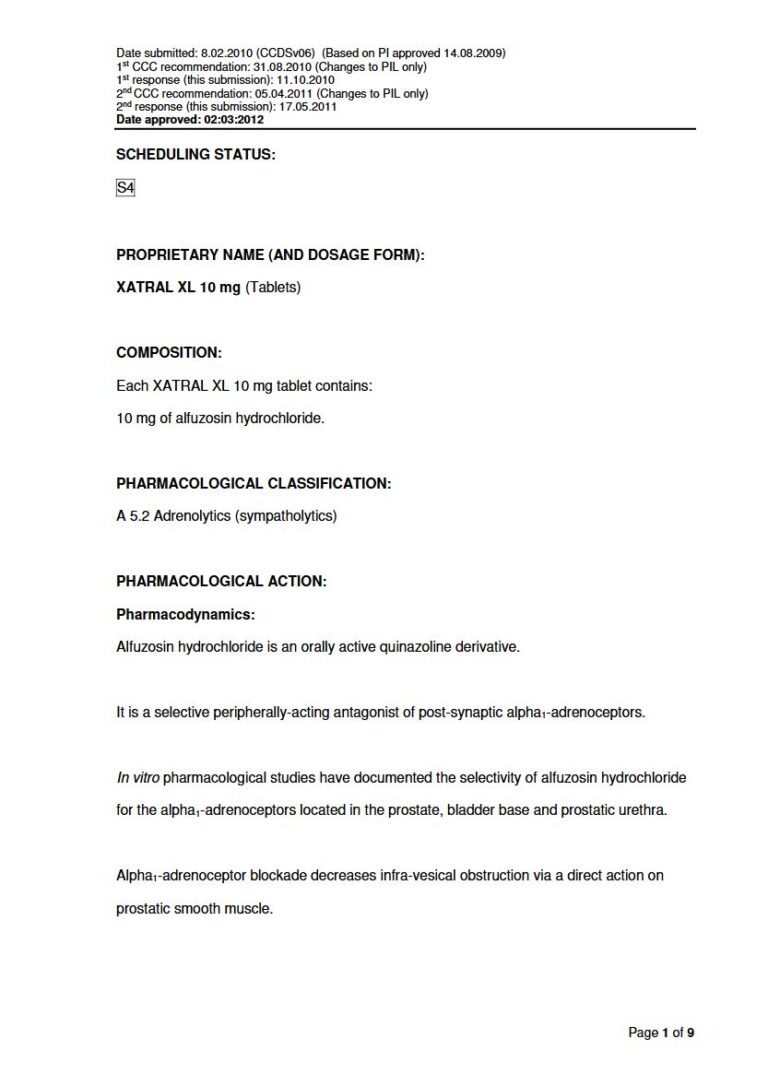
PDF Leaflet Revision Date: 02 March 2012
Clinical Summary
Quick overview from the medicine insert
Indication
Treatment of functional symptoms of benign prostatic hyperplasia.
Dosage (summary)
10 mg once daily after meals.
Special Populations
- Elderly
- Renal impairment
- Hepatic impairment
Key Drug Interactions
- Antihypertensive drugs
- Nitrates
- CYP3A4 inhibitors
Contraindications
- Hypersensitivity to alfuzosin
- Orthostatic hypotension
- Severe renal insufficiency
Common side effects
- Nausea
- Dizziness
- Headache
- Fatigue
Counselling Points
- Take after meals
- Swallow tablets whole
- Inform surgeon of alpha 1-blocker use before cataract surgery
Serious warnings
- Postural hypotension may occur
- Care in patients with symptomatic orthostatic hypotension
Important Disclaimer
The Xatral Xl 10mg Tablet professional information leaflet below is the property of Sanofi-Aventis South Africa and is provided on Medinsert exactly as issued, with no.. alterations or editorial changes. We make every effort to keep content current by updating documents as soon as new versions become available. Medinsert serves as a trusted access point for healthcare professionals, but does not replace official sources or clinical judgement. For more details, please read our full disclaimer. read more>>
 Healthcare Professionals Only
This content is for registered healthcare professionals
Sign in or create a free account to read the full package insert.
Free for HPCSA-registered professionals. Powered by Medinsert.
Clinical Particulars
Section 4 of the official insert — extracted exactly as issued, no alterations
4.1 Therapeutic indications
Treatment of functional symptoms of benign prostatic hyperplasia. Adjunctive therapy with urethral catheterisation for acute urinary retention (AUR) related to benign prostatic hyperplasia (BPH).
4.2 Posology and method of administration
Benign prostatic hyperplasia (BPH): The recommended dose for XATRAL XL 10 mg tablets is one tablet daily to be taken after meals (as bioavailability in the fasting state is less than half that after a meal).
Acute urinary retention (AUR): One 10 mg tablet daily after a meal to be taken from the first day of catheterisation. Tablets should be swallowed whole.
4.3 Contraindications
Hypersensitivity to alfuzosin or any component. Orthostatic hypotension. Combination with other alpha 1 -adrenoceptor blockers. Hepatic insufficiency. Severe renal insufficiency. Not indicated for children.
4.4 Special warnings and precautions for use
In some subjects, in particular patients receiving antihypertensive medications, postural hypotension with or without symptoms (dizziness, fatigue, sweating) may develop within a few hours following administration. In such cases, the patient should lie down until the symptoms have completely disappeared. These effects are usually transient, occur at the beginning of treatment, and do not usually prevent the continuation of treatment. The patient should be warned of the possible occurrence of such events.
Care should be taken when XATRAL XL 10 mg is administered to patients with symptomatic orthostatic hypotension.
4.5 Interactions with other medicines
Combinations contraindicated: Alpha 1 -adrenoceptor blockers (see CONTRAINDICATIONS).
Combinations to be taken into account:
- Antihypertensive drugs (see WARNINGS).
- Nitrates.
- General anaesthetics: Administration of general anaesthetics to a patient treated with XATRAL XL 10 mg may lead to a decrease in blood pressure.
- Potent CYP3A4 inhibitors such as ketoconazole, itraconazole and ritonavir since XATRAL XL 10 mg blood levels are increased.
4.6 Fertility, pregnancy and lactation
There are no data available on the effect of driving vehicles. Adverse reactions such as vertigo, dizziness and asthenia may occur. This should be taken into account when driving vehicles and operating machinery.
4.7 Effects on ability to drive and use machines
There are no data available on the effect of driving vehicles. Adverse reactions such as vertigo, dizziness and asthenia may occur. This should be taken into account when driving vehicles and operating machinery.
4.8 Undesirable effects
The following frequency rating is used, when applicable:
- very common : u2265 1/10;
- common : u2265 1/100 and < 1/10;
- uncommon : u2265 1/1000 and < 1/100;
- rare : u2265 1/10 000 and < 1/1000;
- very rare : u2264 1/10 000.
Gastrointestinal disorders:
- Common: Nausea, gastralgia
- Uncommon: Diarrhoea, dry mouth
Central and peripheral nervous system disorders:
- Common: Faintness/dizziness, headache
- Uncommon: Vertigo, drowsiness, malaise
Cardiovascular disorders, general:
- Uncommon: Tachycardia, symptomatic hypotension (postural), syncope, palpitations
- Very rare: Angina pectoris in patients with pre-existing coronary artery disease (see SPECIAL PRECAUTIONS)
- Unknown: Atrial fibrillation
Eye disorders:
- Unknown: Intraoperative Floppy Iris Syndrome (IFIS) (see SPECIAL PRECAUTIONS).
Respiratory system disorders:
- Uncommon: Rhinitis
Hepato-biliary disorders:
- Unknown: Hepatocellular injury, cholestatic liver disease
Skin and appendages disorders:
- Uncommon: Rash, pruritus
- Very rare: Urticaria, angioedema
Body as a whole - general disorders:
- Common: Asthenia
- Uncommon: Flushes, oedema, chest pain
Reproductive system and breast disorders:
- Unknown: Priapism
4.9 Overdose
In case of overdosage, the patient should be hospitalised, kept in the supine position, and conventional treatment of hypotension should take place. XATRAL XL 10 mg is not dialysable because of its high degree of protein binding. Treatment is symptomatic and supportive.
