
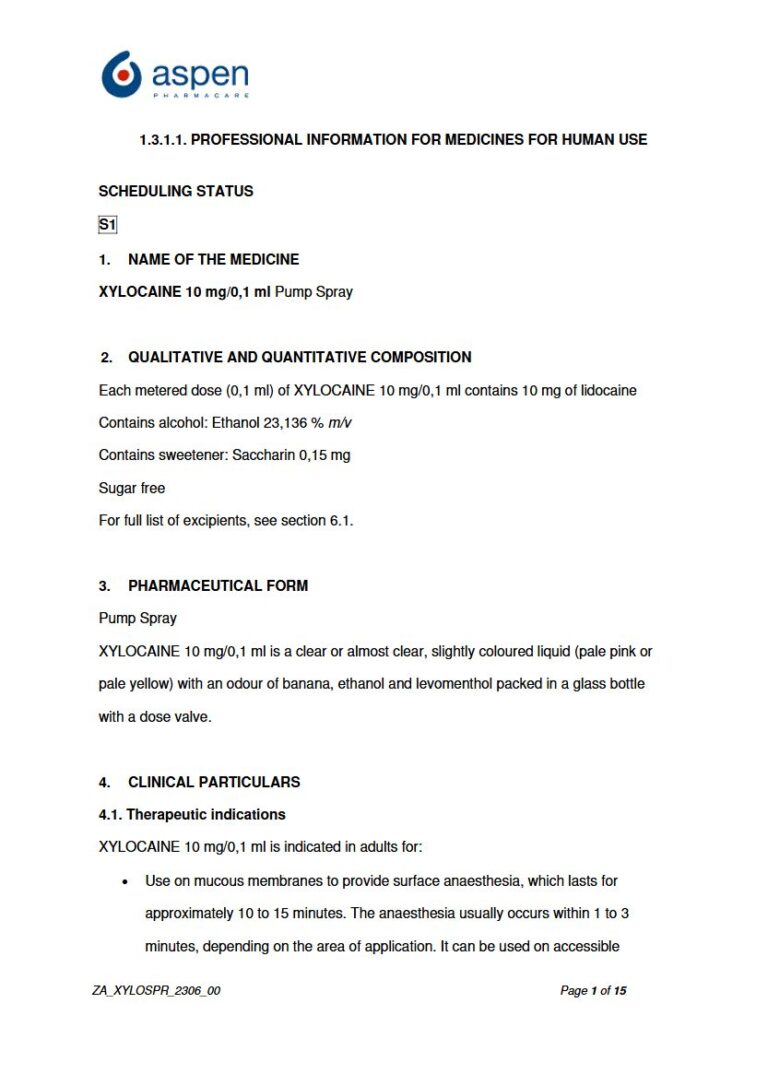
Xylocaine 10 mg/0,1 ml Pump Spray
PDF Leaflet Revision Date: 21 June 2023
Clinical Summary
Quick overview from the medicine insert
Indication
Surface anaesthesia on mucous membranes.
Dosage (summary)
Adults: 20-200 mg depending on procedure; max 5-7 mg/kg.
Onset of Action / Duration
Onset: 1-3 mins, Duration: 10-15 mins
Special Populations
- Elderly
- Children over 12 years
- Patients with liver damage
- Patients with renal dysfunction
Pregnancy & Breastfeeding
Safety in pregnancy not established; minimal risk in breastfeeding.
Key Drug Interactions
- Antidysrhythmics (e.g., amiodarone)
- Cimetidine
- Beta-blockers
Contraindications
- Hypersensitivity to lidocaine
- Neonates
- Infants
Common side effects
- Local irritation
- Sore throat
- Hoarseness
- Convulsions
- Hypotension
Counselling Points
- Do not eat for 60 mins post-application
- Monitor for signs of toxicity
- Use minimal effective dose
Serious warnings
- Caution in patients with epilepsy
- Risk of aspiration
- Avoid on endotracheal tube cuffs
Important Disclaimer
The Xylocaine 10 mg/0,1 ml Pump Spray professional information leaflet below is the property of Pharmacare and is provided on Medinsert exactly as issued, with no.. alterations or editorial changes. We make every effort to keep content current by updating documents as soon as new versions become available. Medinsert serves as a trusted access point for healthcare professionals, but does not replace official sources or clinical judgement. For more details, please read our full disclaimer. read more>>
 Healthcare Professionals Only
This content is for registered healthcare professionals
Sign in or create a free account to read the full package insert.
Free for HPCSA-registered professionals. Powered by Medinsert.
Clinical Particulars
Section 4 of the official insert — extracted exactly as issued, no alterations
4.1. Therapeutic indications
XYLOCAINE 10 mg/0,1 ml is indicated in adults for:
- Use on mucous membranes to provide surface anaesthesia, which lasts for approximately 10 to 15 minutes. The anaesthesia usually occurs within 1 to 3 minutes, depending on the area of application. It can be used on accessible mucous membranes prior to examination, endoscopy or instrumentation, surgical or other procedures.
- Otorhinolaryngology: To prepare for puncture of the maxillary sinus, analgesia of the tympanic membrane and pharynx and to prevent gagging when inserting instruments.
- Obstetrics: As a mucosal surface analgesic in normal deliveries, low forceps or vacuum extractions. Postoperatively to relieve pain during suturing and episiotomy.
- Dentistry: As a local anaesthetic prior to injections, incisions of minor abscesses, deep scaling and before taking intra-oral impressions.
- General anaesthesia: XYLOCAINE 10 mg/0,1 ml may be employed to prevent a patient coughing with an endotracheal tube in situ during surgical anaesthesia.
4.2. Posology and method of administration
Posology
Reactions and complications are best averted by employing the minimal effective dosage. The following dosage recommendations should be regarded as a guide. The clinician's experience and knowledge of the patient's physical status are of importance in calculating the required dose.
Each activation of the metered dose valve delivers 10 mg XYLOCAINE 10 mg/0,1 ml. It is unnecessary to dry the site prior to application.
Adults
| Area | Recommended dose (mg) |
|---|---|
| Nasal procedures, e.g. puncture of the maxillary sinus | 20 to 60 |
| Oral and dental procedures, e.g. prior to injection | 20 to 200 |
| Procedures in the oropharynx, e.g. gastrointestinal endoscopy | 20 to 200 |
| Procedures in the respiratory tract, e.g. insertion of instruments and tubes | 50 to 400 |
| Procedures in the larynx, trachea and bronchi | 50 to 200 |
| Procedures in obstetrics and gynaecology, e.g. vaginal delivery, suturing of ruptures in the mucosa and cervical biopsies | 50 to 200 |
Dosage recommendations in the table should be regarded as guidelines for use in the average adult (70 kg). Individual variations occur. In adults with a high body weight a gradual reduction in the dosage is often necessary and should be based on the ideal body weight. It is recommended that the maximum dose used should not exceed 5 to 7 mg/kg per procedure. Since absorption is variable and especially high in the trachea and bronchi (see section 4.4 and section 5.2) the maximum recommended doses vary depending on the area of application, as indicated in Table 1 above.
Paediatric population
Children over 12 years of age weighing less than 25 kg should be given doses commensurate with their weight and physiological condition. In children between 3 to 12 years of age, doses should not exceed 3 mg/kg for laryngotracheal use and 4 to 5 mg/kg for nasal, oral and oropharyngeal use. XYLOCAINE 10 mg/0,1 ml is not for use in neonates (aged 3 months or less) and infants (less than 1 year of age). The number of sprays depends on the area to be anaesthetised. XYLOCAINE 10 mg/0,1 ml should not be used on cuffs of endotracheal tubes (ETT) made of plastic (see section 4.4.).
Method of administration
XYLOCAINE 10 mg/0,1 ml is administered using the supplied nozzle.
4.3. Contraindications
XYLOCAINE 10 mg/0,1 ml is contraindicated in:
- Patients with hypersensitivity to lidocaine or other amide-type local anaesthetics or to any of the excipients in XYLOCAINE 10 mg/0,1 ml (see section 6.1).
- Neonates and infants.
4.4. Special warnings and precautions for use
XYLOCAINE 10 mg/0,1 ml should not be used on cuffs of endotracheal tubes (ETT) made of plastic. Lidocaine base in contact with both PVC and non-PVC cuffs of endotracheal tubes may cause damage of the cuff. This damage is described as pinholes, which may cause leakage that could lead to pressure loss in the cuff.
XYLOCAINE 10 mg/0,1 ml is porphyrinogenic in vitro and should only be prescribed to patients with acute porphyria on strong or urgent indications. Appropriate precautions should be taken for all porphyric patients.
XYLOCAINE 10 mg/0,1 ml should be given with caution to patients with epilepsy, impaired cardiac conduction, shock, or with liver damage and in patients with severe renal dysfunction. Doses should be reduced in elderly and debilitated patients, and in children. Excessive dosage or short intervals between doses may result in high plasma levels and serious adverse effects. Absorption from mucous membranes is variable but is especially high from the bronchial tree. Such applications may therefore result in rapidly rising or excessive plasma concentrations, with an increased risk for toxic symptoms, such as convulsions. XYLOCAINE 10 mg/0,1 ml should be used with caution in patients with wounds or traumatised mucosa in the region of the proposed application. A damaged mucosa will permit increased systemic absorption. The management of serious adverse reactions may require the use of resuscitative equipment; oxygen and other resuscitative medicines (see section 4.9).
When used in the mouth or throat, XYLOCAINE 10 mg/0,1 ml may impair swallowing and increase the risk of aspiration and patients should be cautioned not to eat for at least 60 minutes after the anaesthetic. Numbness of the tongue or buccal mucosa may increase the danger of biting trauma.
When XYLOCAINE 10 mg/0,1 ml is applied to the respiratory tract of paralysed patients under general anaesthesia, higher blood concentrations may occur than in spontaneously breathing patients. Unparalysed patients are more likely to swallow a large proportion of the dose which then undergoes considerable first-pass hepatic metabolism following absorption from the gut.
Patients treated with antidysrhythmic medicines class III (e.g. amiodarone) should be under close surveillance and ECG monitoring considered, since cardiac effects may be additive (see section 4.5).
The application of XYLOCAINE 10 mg/0,1 ml to the skin for prolonged periods or to extensive areas should be avoided. XYLOCAINE 10 mg/0,1 ml should not be given to patients with hypovolaemia, heart block or other conduction disturbances and should be used with caution in patients with congestive heart failure, bradycardia or respiratory depression.
4.5. Interaction with other medicines and other forms of interaction
XYLOCAINE 10 mg/0,1 ml should be used with caution in patients receiving other local anaesthetics or medicines structurally related to amide-type local anaesthetics e.g. antidysrhythmics such as mexiletine and tocainide since the toxic effects are additive. Specific interaction studies with XYLOCAINE 10 mg/0,1 ml and antidysrhythmics medicines class III (e.g. amiodarone) have not been performed, but caution is advised (see section 4.4).
Medicines that reduce the clearance of XYLOCAINE 10 mg/0,1 ml (e.g. cimetidine or beta-blockers) may cause potentially toxic plasma concentrations when XYLOCAINE 10 mg/0,1 ml is given in repeated high doses.
4.6. Fertility, pregnancy and lactation
The safety of XYLOCAINE 10 mg/0,1 ml in pregnancy and lactation has not been established.
Pregnancy
There is no, or inadequate evidence of the safety of lidocaine, as in XYLOCAINE 10 mg/0,1 ml, in human pregnancy. Animal studies have shown no hazard.
Breastfeeding
Lidocaine, as in XYLOCAINE 10 mg/0,1 ml, enters the mother's milk, but in such small quantities that there is generally no risk of the child being affected at therapeutic dose levels.
4.7. Effects on ability to drive and use machines
XYLOCAINE 10 mg/0,1 ml has a minor influence on the ability to drive and use machines. Depending on the dose, local anaesthetics may have a very mild effect on mental function and may temporarily impair locomotion and coordination.
4.8. Undesirable effects
a) Tabulated list of adverse reactions
System Organ Class
Less frequent
Immune system disorders
Hypersensitivity reactions (e.g. Anaphylactic reaction, Anaphylactic shock, Anaphylactoid reaction, Angioedema) have been reported
b) Description of selected adverse reactions
Local reactions: Local irritation at the application site has been described. Following application to laryngeal mucosa before endotracheal intubation, reversible symptoms such as sore throat, hoarseness and loss of voice have been reported. The use of XYLOCAINE 10 mg/0,1 ml provides surface anaesthesia during an endotracheal procedure but does not prevent post-intubation soreness.
Systemic reactions: XYLOCAINE 10 mg/0,1 ml may have systemic adverse effects as a result of raised plasma concentrations of lidocaine following excessive dosage or accidental intravenous injection or by absorption of large amounts through mucous membranes, damaged skin or from highly vascular areas. Such reactions may occur acutely. Systemic toxicity mainly involves the central nervous system and the cardiovascular system. Excitation of the CNS may be manifested by restlessness, excitement, nervousness, dizziness, tinnitus, blurred vision, nausea and vomiting, muscle twitching, tremors and convulsions. Excitation may be transient and followed by depression with drowsiness, respiratory failure and coma. There may be simultaneous effects on the cardiovascular system with myocardial depression and peripheral vasodilation resulting in hypotension and bradycardia; dysrhythmias and cardiac arrest may occur.
4.9. Overdose
Symptoms
Toxic reactions originate mainly in the central nervous and the cardiovascular systems. Central nervous system toxicity is a graded response with symptoms and signs of escalating severity. The first symptoms are circumoral paraesthesia, numbness of the tongue, light-headedness, hyperacusis and tinnitus. Visual disturbance and muscular tremors are more serious and precede the onset of generalised convulsions. Unconsciousness and grand mal convulsions may follow, which may last from a few seconds to several minutes. Hypoxia and hypercarbia occur rapidly following convulsions due to the increased muscular activity, together with the interference with normal respiration. In severe cases apnoea may occur. Acidosis increases the toxic effects of the local anaesthetics. Recovery is due to redistribution and metabolism of the local anaesthetic medicine from the central nervous system. Recovery may be rapid unless large amounts of the medicine have been administered.
Cardiovascular effects are only seen in cases with high systemic concentrations. Severe hypotension, bradycardia, dysrhythmia and cardiovascular collapse may be the result in such cases. Cardiovascular toxic effects are generally preceded by signs of toxicity in the central nervous system, unless the patient is receiving a general anaesthetic or is heavily sedated with medicines such as benzodiazepines or barbiturates.
Treatment
The benefit of lipid rescue is built on the concept of the u201clipid sinku201d theory. It is scientifically documented for lipophilic medicines such as some amide type local anaesthetics. Lidocaine is hydrophilic and the benefit of lipid rescue has not been adequately documented. Severe neurological symptoms (convulsions, CNS depression) must be treated symptomatically by respiratory support and the administration of anticonvulsive medicines. If circulatory arrest should occur, immediate cardiopulmonary resuscitation should be instituted. Optimal oxygenation and ventilation and circulatory support as well as treatment of acidosis are of vital importance.
