
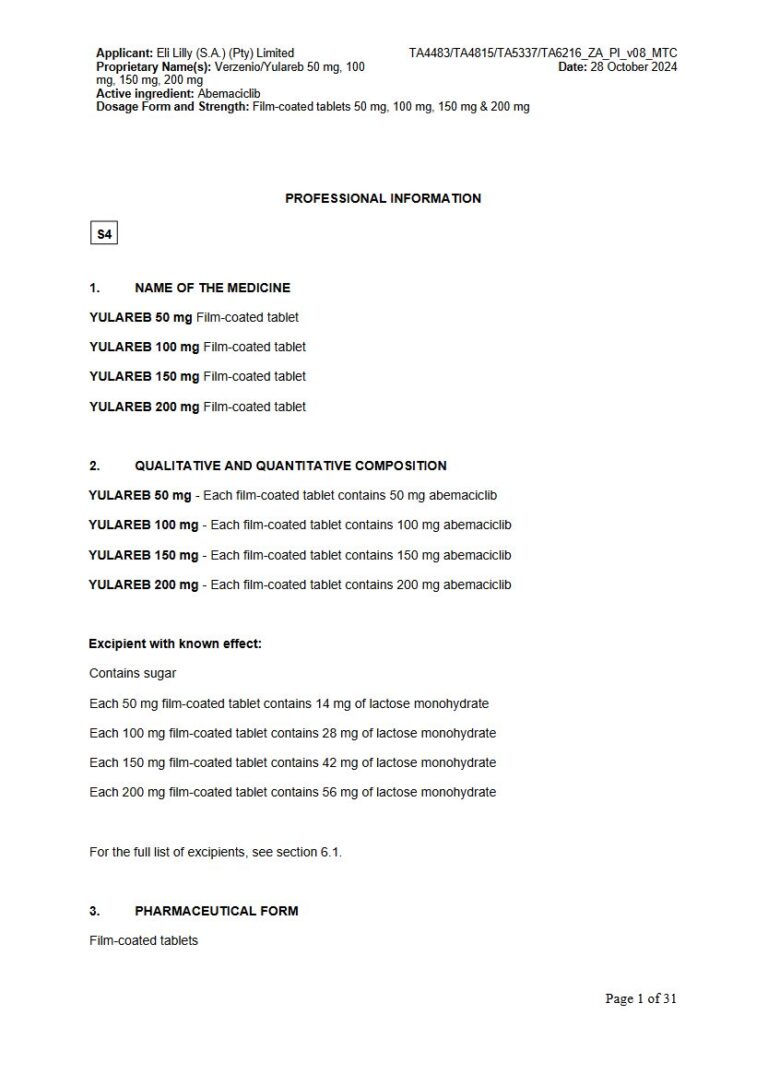
Yulareb FC Tablets
PDF Leaflet Revision Date: 28 October 2024
Clinical Summary
Quick overview from the medicine insert
Indication
Adjuvant treatment of HR-positive, HER2-negative early breast cancer and advanced/metastatic breast cancer.
Dosage (summary)
150 mg twice daily with endocrine therapy; 200 mg twice daily as monotherapy.
Onset of Action / Duration
Onset: 6-8 days, Duration: Continuous as long as clinical benefit.
Special Populations
- Elderly
- Renal impairment
- Hepatic impairment
Pregnancy & Breastfeeding
Contraindicated in pregnancy and breastfeeding; use effective contraception.
Key Drug Interactions
- Avoid ketoconazole
- Monitor with strong CYP3A inhibitors
- Avoid CYP3A inducers
Contraindications
- Hypersensitivity to abemaciclib
- Pregnancy
- Breastfeeding
Common side effects
- Diarrhoea
- Neutropenia
- Fatigue
- Nausea
- Vomiting
Counselling Points
- Start antidiarrheal therapy at first sign of loose stools.
- Monitor for signs of infection and report fever.
- Avoid grapefruit products.
- Take doses at the same times daily and swallow whole.
Serious warnings
- Severe diarrhoea
- Neutropenia
- Interstitial lung disease
- Hepatotoxicity
Important Disclaimer
The Yulareb FC Tablets professional information leaflet below is the property of Eli Lilly (SA) and is provided on Medinsert exactly as issued, with no.. alterations or editorial changes. We make every effort to keep content current by updating documents as soon as new versions become available. Medinsert serves as a trusted access point for healthcare professionals, but does not replace official sources or clinical judgement. For more details, please read our full disclaimer. read more>>
 Healthcare Professionals Only
This content is for registered healthcare professionals
Sign in or create a free account to read the full package insert.
Free for HPCSA-registered professionals. Powered by Medinsert.
Clinical Particulars
Section 4 of the official insert — extracted exactly as issued, no alterations
4.1. Therapeutic indications
Early Breast Cancer
nYULAREB in combination with endocrine therapy is indicated for the adjuvant treatment of adult patients with hormone receptor (HR)-positive, human epidermal growth factor receptor 2 (HER2)-negative, node-positive early breast cancer at high risk of recurrence (see section 5.1). In pre- or perimenopausal women, aromatase inhibitor endocrine therapy should be combined with a luteinising hormone-releasing hormone (LHRH) agonist.
nAdvanced or Metastatic Breast Cancer
n- n
- YULAREB is indicated for the treatment of hormone receptor positive (HR+), human epidermal growth factor receptor 2 negative (HER2u2212) advanced or metastatic breast cancer: n
- in combination with an aromatase inhibitor as initial endocrine-based therapy for the treatment of postmenopausal women; and men, with hormone receptor (HR)-positive, human epidermal growth factor receptor 2 (HER2)-negative advanced or metastatic breast cancer. n
- in combination with fulvestrant for the treatment of adult patients with hormone receptor (HR)-positive, human epidermal growth factor receptor 2 (HER2)-negative advanced or metastatic breast cancer with disease progression following endocrine therapy. In pre- or perimenopausal women, the endocrine therapy should be combined with a Luteinising hormone-releasing hormone (LHRH) agonist. n
- as monotherapy for the treatment of adult patients with HR-positive, HER2-negative advanced or metastatic breast cancer with disease progression following endocrine therapy and prior chemotherapy in the metastatic setting. n
4.2. Posology and method of administration
- n
- When used in combination with fulvestrant, tamoxifen or an aromatase inhibitor, the recommended dose of YULAREB is 150 mg taken orally twice daily. Refer to the Full Professional Information of the individual adjuvant medicines for the recommended doses. n
- Pre/perimenopausal women and men treated with the combination of YULAREB plus an aromatase inhibitor should be treated with a gonadotropin-releasing hormone agonist (GnRH) according to current clinical practice standards. n
- Pre/perimenopausal women treated with the combination of YULAREB plus fulvestrant should be treated with a GnRH according to current clinical practice standards. n
- When used as monotherapy, the recommended dose of YULAREB is 200 mg taken orally twice daily. n
Duration of treatment
nEarly Breast Cancer
nYULAREB should be taken continuously for two years, or until disease recurrence or unacceptable toxicity occurs.
nAdvanced or Metastatic Breast Cancer
nYULAREB should be taken continuously as long as the patient is deriving clinical benefit from therapy or until unacceptable toxicity occurs. YULAREB may be taken with or without food (see section 5.2).
nIf the patient vomits or misses a dose of YULAREB, instruct the patient to take the next dose at its scheduled time. Instruct patients to swallow YULAREB tablets whole and not to chew, crush, or split tablets before swallowing. Instruct patients not to ingest YULAREB tablets if broken, cracked, or otherwise not intact.
nDose Modification
nDose Modifications for Adverse Reactions Management of some adverse events may require dose interruption and/or dose reduction. If dose reduction is necessary, decrease the dose by 50 mg at a time. Discontinue YULAREB for patients unable to tolerate 50 mg twice daily.
n| Table 1: YULAREB Dose Modification for Adverse events | ||
|---|---|---|
| Dose Level | YULAREB Dose Combination with Fulvestrant, Tamoxifen, or an Aromatase Inhibitor | YULAREB Dose for Monotherapy |
| Recommended starting dose | 150 mg twice daily | 200 mg twice daily |
| First dose reduction | 100 mg twice daily | 150 mg twice daily |
| Second dose reduction | 50 mg twice daily | 100 mg twice daily |
| Third dose reduction | Not applicable | 50 mg twice daily |
4.3 Contraindications
Hypersensitivity to abemaciclib or any of the ingredients in YULAREB.
nConcomitant use with ketoconazole (see section 4.5)
nPregnancy and lactation (see section 4.6)
4.4 Special warnings and precautions for use
Diarrhoea
nSevere diarrhoea associated with dehydration and infection occurred in patients treated with YULAREB. Diarrhoea occurred in 81 % to 90 % of patients receiving YULAREB in clinical trials. Grade 3 diarrhoea occurred in 8 % to 20 % of these patients. Most patients experienced diarrhoea during the first month of YULAREB treatment. The median time to onset of the first diarrhoea event ranged from 6 to 8 days and the median duration of diarrhoea for grades 2 and 3 diarrhoea ranged from 6 to 11 days and 5 to 8 days, respectively. Across trials, 19 % to 26 % of patients with diarrhoea required a YULAREB dose interruption and 13 % to 23 % required a dose reduction.
nInstruct patients that at the first sign of loose stools, they should start antidiarrhoeal therapy, increase oral fluids and notify their healthcare provider for further instructions and appropriate follow-up. For Grade 3 or 4 diarrhoea or diarrhoea that requires hospitalization, discontinue YULAREB until toxicity resolves to u2264 Grade 1, and then resume YULAREB at the next lower dose (see section 4.2).
nNeutropenia
nNeutropenia, including febrile neutropenia and fatal neutropenic sepsis, occurred in patients treated with YULAREB. Neutropenia occurred in 37 % to 46 % of patients receiving YULAREB in clinical trials. A Grade u2265 3 decrease in neutrophil count (based on laboratory findings) occurred in 19 % to 32 % of these patients. The median time to first episode of Grade u2265 3 neutropenia ranged from 29 days to 33 days, and the median duration of Grade u2265 3 neutropenia ranged from 11 days to 16 days. Febrile neutropenia has been reported in < 1 % of patients exposed to YULAREB across trials. Monitor complete blood counts prior to starting YULAREB therapy, every 2 weeks for the first 2 months, monthly for the next 2 months, and as clinically indicated. Dose modification is recommended for patients who develop Grade 3 or 4 neutropenia (see section 4.2).
nInterstitial Lung Disease (ILD) or Pneumonitis
nSevere, life-threatening, or fatal interstitial lung disease (ILD) or pneumonitis can occur in patients treated with YULAREB and other CDK4/6 inhibitors. Monitor patients for pulmonary symptoms indicative of ILD or pneumonitis. Symptoms may include hypoxia, cough, dyspnoea, or interstitial infiltrates on radiologic exams. Infectious, neoplastic, and other causes for such symptoms should be excluded by means of appropriate investigations.
nDose interruption or dose reduction is recommended for patients who develop persistent or recurrent Grade 2 ILD or pneumonitis. Permanently discontinue YULAREB in all patients with Grade 3 or 4 ILD or pneumonitis (see section 4.2).
nHepatotoxicity
nGrade u22653 increased ALT (2 % to 6 %) and AST (2 % to 3 %) were reported in patients receiving YULAREB in breast cancer studies. Across clinical trials, the median time to onset of Grade u2265 3 ALT increases ranged from 57 to 87 days and the median time to resolution to Grade < 3 was 13 to 14 days. The median time to onset of Grade u2265 3 AST increases ranged from 71 to 185 days and the median time to resolution to Grade < 3 ranged from 11 to 15 days. Monitor liver function tests (LFTs) prior to the start of YULAREB therapy, every 2 weeks for the first 2 months, monthly for the next 2 months, and as clinically indicated. Based on the level of ALT elevations, YULAREB may require dose modification (see section 4.2).
nVenous Thromboembolism
nAcross clinical trials venous thromboembolic events 159 were reported in 2 % to 5 % of patients treated with YULAREB. Venous thromboembolic events including deep vein thrombosis, pulmonary embolism, pelvic venous thrombosis, cerebral venous sinus thrombosis, subclavian and axillary vein thrombosis, and inferior vena cava thrombosis have been reported. Across the clinical development program, deaths due to venous thromboembolism have been reported. YULAREB has not been studied in patients with early breast cancer who had a history of venous thromboembolism. Monitor patients for signs and symptoms of venous thrombosis and pulmonary embolism and treat as medically appropriate. Dose interruption is recommended for early breast cancer patients with any grade venous thromboembolic event and for advanced or metastatic breast cancer patients with a Grade 3 or 4 venous thromboembolic event (see section 4.2).
nArterial Thromboembolic Events
nA potential increased risk for serious arterial thromboembolic events (ATEs), including ischemic stroke and myocardial infarction, has been observed in metastatic breast cancer studies when YULAREB was administered in combination with endocrine therapies. The benefits and risks of continuing YULAREB in patients who experience a serious ATE should be considered.
nEmbryo-Foetal Toxicity
nBased on findings from animal studies and the mechanism of action, YULAREB can cause foetal harm when administered to a pregnant woman (see Human reproduction, pregnancy).
nLactose
nPatients with the rare hereditary conditions of galactose intolerance e.g., galactosaemia, Lapp lactase deficiency, glucose-galactose malabsorption or fructose intolerance should not take YULAREB.
nSodium
nThis medicinal product contains less than 1 mmol sodium (23 mg) per tablet, that is to say essentially u201csodium - freeu201d.
4.5 Interactions with other medicines
CYP3A inhibitors
nYULAREB is primarily metabolised by CYP3A. Concomitant use of a CYP3A inhibitor, clarithromycin resulted in a 3,4-fold increase in the plasma exposure of YULAREB and a 2,2-fold increase in the plasma exposure of YULAREB plus YULAREB active metabolites in patients with advanced and/or metastatic cancer.
nKetoconazole
nDo not use with ketoconazole. Ketoconazole increases the AUC of YULAREB by up to 16-fold (see section 4.3).
nOther strong CYP3A inhibitors
nIn patients with recommended starting doses of 200 mg twice daily or 150 mg twice daily, reduce the YULAREB dose to 100 mg twice daily with concomitant use of strong CYP3A inhibitors other than ketoconazole. In patients who have had a dose reduction to 100 mg twice daily due to adverse reactions, further reduce the YULAREB dose to 50 mg twice daily with concomitant use of strong CYP3A inhibitors. If a patient taking YULAREB discontinues a strong CYP3A inhibitor, increase the YULAREB dose (after 3-5 half-lives of the inhibitor) to the dose that was used before starting the inhibitor.
nModerate CYP3A Inhibitors
nWith concomitant use of moderate CYP3A inhibitors, monitor for adverse reactions and consider reducing the YULAREB dose in 50 mg decrements as demonstrated in Table 1, if necessary.
nStrong and moderate CYP3A Inducers
nConcomitant use of YULAREB with the CYP3A inducer rifampicin decreased the plasma exposure of YULAREB plus its active metabolites by 95 % and 77 % respectively, based on AUC. Concomitant use of CYP3A inducers with YULAREB is not recommended (see section 4.2). YULAREB and its major active metabolites inhibit the renal transporters organic cation transporter 2 (OCT2), multidrug and toxin extrusion protein 1 (MATE1), and MATE2-K. In vivo interactions of YULAREB with clinically relevant substrates of these transporters, such as creatinine, may occur (see section 4.8).
4.6 Fertility, pregnancy and lactation
Pregnancy
nYULAREB is contraindicated during pregnancy (see section 4.3) Based on findings in animals, YULAREB can cause foetal harm when administered to a pregnant woman. In animal studies, YULAREB was teratogenic and caused decreased foetal weight at maternal exposures that were similar to human clinical exposure based on AUC at the recommended human dose. Advise pregnant women of the potential risk to a foetus.
nWomen of childbearing potential
nWomen with reproductive potential should have a negative pregnancy test before starting YULAREB. They should use highly effective contraception during treatment and for 3 weeks after the last dose of YULAREB.
nBreastfeeding
nWomen taking YULAREB should not breastfeed their infants (see section 4.3). Because of the potential for serious adverse events in breastfeeding infants from YULAREB, a breastfeeding woman should not breastfeed during treatment with YULAREB and for at least 3 weeks after the last dose.
nFertility
nCytotoxic effects to the male reproductive tract in rats and dogs indicate that YULAREB may impair fertility in males. No effects on female reproductive organs were observed.
4.7 Effects on ability to drive and use machines
The adverse effects of YULAREB may impair driving ability and the ability to handle machines, e.g., dizziness, diarrhoea, vomiting (see section 4.8).
4.8 Undesirable effects
Summary of the safety profile
nThe most commonly occurring adverse reactions are diarrhoea, infections, neutropenia, leukopenia, anaemia, fatigue, nausea, vomiting, alopecia and decreased appetite. Of the most common adverse reactions, Grade u2265 3 events were less than 5 % with the exception of neutropenia, leukopenia, and diarrhoea.
nTabulated list of adverse reactions
nIn the following table, adverse reactions are listed in order of MedDRA body system organ class and frequency. Frequency gradings are: very common ( u2265 1 / 10), common ( u2265 1 / 100 to < 1 / 10), uncommon ( u2265 1 / 1 000 to < 1 / 100), rare ( u2265 1 / 10 000 to < 1 / 1 000), very rare (< 1 / 10 000), and not known (cannot be estimated from the available data).
n| Table 8. Adverse reactions reported in the phase 3 studies of abemaciclib in combination with endocrine therapy a (N = 3 559) | |||||
|---|---|---|---|---|---|
| System Organ Class | Very Common | Common | Uncommon | ||
| Infections and infestations | Infections b | ||||
| Blood and lymphatic system disorders | Neutropenia | Leukopenia | Anaemia | Thrombocytopenia | Lymphopenia h |
| Febrile neutropenia e | |||||
| Metabolism and nutrition disorders | Decreased appetite | ||||
| Nervous system disorders | Headache f | Dysgeusia g | Dizziness g | ||
| Eye disorders | Lacrimation increased | ||||
| Vascular disorders | Venous thromboembolism c | ||||
| Respiratory, thoracic and mediastinal disorders | ILD/pneumonitis d | ||||
| Gastrointestinal disorders | Diarrhoea | Vomiting | Nausea | Stomatitis f | Dyspepsia f |
| Skin and subcutaneous tissue disorders | Alopecia g | Pruritus g | Rash g | Nail disorder f | Dry skin e |
| Musculoskeletal and connective tissue disorders | Muscular weakness e | ||||
| General disorders and administration site conditions | Pyrexia e | Fatigue | |||
| Investigations | Alanine aminotransferase increased g | Aspartate aminotransferase increased g |
a Abemaciclib in combination with anastrozole, letrozole, exemestane, tamoxifen, or fulvestrant. b Infections include all reported Preferred Terms that are part of the System Organ Class Infections and Infestations. c Venous thromboembolic events include deep vein thrombosis (DVT), pulmonary embolism, cerebral venous sinus thrombosis, subclavian, axillary vein thrombosis, DVT inferior vena cava and pelvic venous thrombosis. d Interstitial lung disease (ILD)/pneumonitis for early breast cancer (EBC) include all reported Preferred Terms that are part of the MedDRA SMQ interstitial lung disease. For metastatic breast cancer (mBC) Preferred Terms include interstitial lung disease, pneumonitis, organising pneumonia, pulmonary fibrosis and bronchiolitis obliterans. e Considered ADRs in the mBC setting only (MONARCH 2 and MONARCH 3). f Considered ADRs in the EBC setting only (monarchE). g Common frequency in the EBC setting (monarchE), very common in the mBC setting (MONARCH 2 and MONARCH 3). h Common frequency in mBC setting (MONARCH 2 and MONARCH 3), very common in the EBC setting (monarchE).
nDiarrhoea
nDiarrhoea was the most commonly reported adverse reaction (see table 8). Diarrhoea incidence was greatest during the first month of YULAREB dosing and was lower during subsequent months. Patients recovered to baseline or lesser grade diarrhoea with supportive treatment, such as loperamide, and/or dose reductions (see section 4.2).
nNeutropenia
nNeutropenia was reported frequently across studies. In the monarchE study, neutropenia was reported in 45,8 % of patients. Grade 3 or 4 decrease in neutrophil counts (based on laboratory findings) was reported in 19,1 % of patients receiving abemaciclib in combination with endocrine therapy with a median time to onset of 30 days, and median time to resolution of 16 days. Febrile neutropenia was reported in 0,3 % patients. In MONARCH 2 and MONARCH 3 studies, neutropenia was reported in 45,1 % of patients. Grade 3 or 4 decrease in neutrophil counts (based on laboratory findings) was reported in 28,2 % of patients receiving abemaciclib in combination with aromatase inhibitors or fulvestrant. The median time to onset of Grade 3 or 4 neutropenia was 29 to 33 days, and median time to resolution was 11 to 15 days. Febrile neutropenia was reported in 0,9 % patients. Dose modification is recommended for patients who develop Grade 3 or 4 neutropenia (see section 4.2).
nIncreased aminotransferases
nIn the monarchE study, ALT and AST elevations were reported frequently (12,3 % and 11,8 %, respectively) in patients receiving abemaciclib in combination with endocrine therapy. Grade 3 or 4 ALT or AST elevations (based on laboratory findings) were reported in 2,6 % and 1,6 % patients. The median time to onset of Grade 3 or 4 ALT elevation was 118 days, and median time to resolution was 14,5 days. The median time to onset of Grade 3 or 4 AST elevation was 90,5 days, and median time to resolution was 11 days. In MONARCH 2 and MONARCH 3 studies, ALT and AST elevations were reported frequently (15,1 % and 14,2 %, respectively) in patients receiving abemaciclib in combination with aromatase inhibitors or fulvestrant. Grade 3 or 4 ALT or AST elevations (based on laboratory findings) were reported in 6,1 % and 4,2 % patients. The median time to onset of Grade 3 or 4 ALT elevation was 57 to 61 days, and median time to resolution was 14 days. The median time to onset of Grade 3 or 4 AST elevation was 71 to 185 days, and median time to resolution was 13 to 15 days. Dose modification is recommended for patients who develop Grade 3 or 4 ALT or AST increase (see section 4.2).
nIncreased Serum Creatinine
nYULAREB has been shown to increase serum creatinine due to inhibition of renal tubular transporters without affecting glomerular function (as measured by iohexol clearance). Increases in serum creatinine occurred within the first month of YULAREB dosing, remained elevated but stable through the treatment period, and were reversible upon treatment discontinuation, and the increase is not accompanied by changes in markers of renal function, such as blood urea nitrogen (BUN), cystatin C, or calculated glomerular filtration rate based on cystatin C.
nAdverse reactions from spontaneous reporting
nThe following adverse reactions have been identified during post-approval use of YULAREB. Because these reactions are reported voluntarily from a population of uncertain size, it is not always possible to reliably estimate their frequency or establish a causal relationship to drug exposure.
nRespiratory disorders: Interstitial lung disease (ILD)/pneumonitis (see section 4.4).
nReporting of suspected adverse reactions
nReporting suspected adverse reactions after authorisation of the medicine is important. It allows continued monitoring of the benefit/risk balance of the medicine. Health care providers are asked to report any suspected adverse reactions to SAHPRA via the u201c6.04 Adverse Drug Reactions Reporting Formu201d, found online under SAHPRAu2019s publications: https://www.sahpra.org.za/Publications/Index/8. Alternately, report suspected adverse events to the company at [email protected].
4.9 Overdose
In case of overdose, use supportive therapy. There is no known antidote for YULAREB overdose.
