
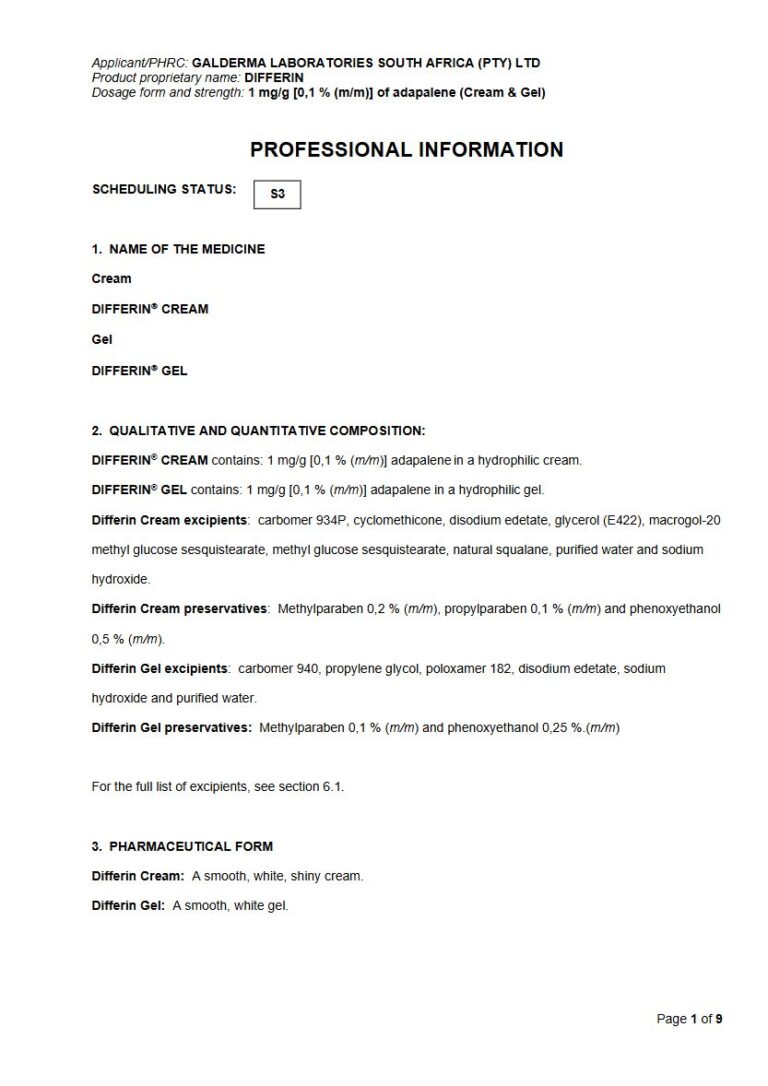
Differin Cream 1mg Cream
PDF Leaflet Revision Date: 4 September 2020
Clinical Summary
Quick overview from the medicine insert
Indication
Treatment of acne vulgaris.
Dosage (summary)
Apply a thin film once daily at night after washing.
Onset of Action / Duration
Onset: 4-8 weeks for clinical improvement.
Special Populations
- Paediatric patients under 12 years
Pregnancy & Breastfeeding
Contraindicated in pregnancy and breastfeeding.
Key Drug Interactions
- Other retinoids
- Irritant products
Contraindications
- Hypersensitivity
- Pregnancy
Common side effects
- Dry skin
- Skin irritation
- Erythema
Counselling Points
- Apply to affected areas only
- Use non-comedogenic cosmetics
- Avoid excessive sunlight exposure
Serious warnings
- Avoid contact with eyes and mucous membranes
- Potential for local irritation
Important Disclaimer
The Differin Cream 1mg Cream professional information leaflet below is the property of Galderma Laboratories South Africa and is provided on Medinsert exactly as issued, with no.. alterations or editorial changes. We make every effort to keep content current by updating documents as soon as new versions become available. Medinsert serves as a trusted access point for healthcare professionals, but does not replace official sources or clinical judgement. For more details, please read our full disclaimer. read more>>
 Healthcare Professionals Only
This content is for registered healthcare professionals
Sign in or create a free account to read the full package insert.
Free for HPCSA-registered professionals. Powered by Medinsert.
Clinical Particulars
Section 4 of the official insert — extracted exactly as issued, no alterations
4.1 Therapeutic indications
Differin Cream and Differin Gel is indicated for the treatment of acne vulgaris of the face, chest and back where comedones, papules and pustules predominate.
4.2 Posology and method of administration
Posology
Differin Cream and Differin Gel should be applied to the acne affected areas once a day before retiring and after washing. A thin film of the cream or gel should be applied avoiding the eyes, lips and mucous membranes see section 4.4. Clinical improvement is expected to be clearly evident after four to eight weeks of treatment with further improvement expected with continued use. With patients for whom it is necessary to reduce the frequency of application or to temporarily discontinue treatment, frequency of application may be restored or therapy resumed once it is judged that the patient can tolerate the treatment. If patients use cosmetics, these should be non-comedogenic and non-astringent. Differin Cream and Differin Gel should not be used in patients with severe acne.
Method of administration
A thin film of the cream or gel should be applied avoiding the eyes, lips and mucous membranes. Differin Cream and Differin Gel is not to be taken orally and is for cutaneous use only.
Paediatric population
The safety and effectiveness of Differin Cream and Differin Gel have not been studied in children below 12 years of age, therefore, it should not be used in these patients.
4.3 Contra-indications:
Hypersensitivity to the active or any of the excipients listed in section 6.1. Pregnancy (see section 4.6) Women planning a pregnancy.
4.4 Special warnings and precautions for use
Differin Gel contains :
- Methyl parahydroxybenzoate (E218) that can cause allergic reactions (can arise after the treatment is completed)
- Propylene glycol that can be irritating to the skin.
Differin Cream contains:
- Methyl parahydroxybenzoate (E218) and propyl parahydroxybenzoate (E216) that can cause allergic reactions (can arise after the treatment is completed)
If a reaction suggesting sensitivity or severe irritation occurs, use of Differin Cream and Differin Gel should be discontinued. If the degree of local irritation warrants, patients should be directed to use the medication less frequently, to discontinue use temporarily or to discontinue use altogether. Differin Cream and Differin Gel should not come into contact with the eyes, mouth, angles of the nose or mucous membranes. If Differin Cream and Differin Gel come into contact with the eye, wash immediately with warm water. Differin Cream and Differin Gel should not be applied to broken skin (cuts and abrasions) or to eczematous skin, nor should it be used in patients with severe acne involving large areas of the body, especially in women of childbearing age who are not on effective contraception. Differin Cream and Differin Gel should not be used in patients with severe acne. The safety of using adapalene during repeated exposure to sunlight or UV irradiation has not been established in either animals or man. Exposure to excessive sunlight or UV irradiation should therefore be avoided.
Paediatric population
The safety and effectiveness of Differin Cream and Differin Gel have not been studied in children below 12 years of age, therefore, it should not be used in these patients.
4.5 Interactions with other medicines and other forms of interaction
There are no known interactions with other medications which might be used cutaneously and concurrently with Differin Cream and Differin Gel, however, other retinoids or medicines with a similar mode of action should not be used concurrently with adapalene. Adapalene is essentially stable to oxygen and light and is chemically non-reactive. Whilst extensive studies in animals and man have shown neither phototoxic nor photoallergic potential for adapalene, the safety of using adapalene during repeated exposure to sunlight or UV irradiation has not been established in either animals or man. Exposure to excessive sunlight or UV irradiation should therefore be avoided. Absorption of adapalene through human skin is low, and therefore interaction with systemic medication is unlikely. There is no evidence that the efficacy of oral medicines such as contraceptives and antibiotics is influenced by the cutaneous use of Differin Cream and Differin Gel. Differin Cream and Differin Gel has a potential for local irritation and therefore it is possible that concomitant use of peeling agents, astringents or irritant products may produce additive irritant effects. However, cutaneous antiacne treatments e.g., erythromycin (up to 4 %) or clindamycin phosphate (1 % as the base) solutions or benzoyl peroxide water based creams up to 10 %, may be used in the morning when Differin Cream and Differin Gel is used at night as there is no mutual degradation or cumulative irritation.
4.6 Fertility, pregnancy and lactation:
Orally administered retinoids have been associated with congenital abnormalities. When used in accordance with the prescribing information, topically administered retinoids are generally assumed to result in low systemic exposure due to minimal dermal absorption. However, there could be individual factors (e.g. damaged skin barrier, excessive use) that contribute to an increased systemic exposure.
Pregnancy
Differin Cream and Gel are contraindicated (see section 4.3) in pregnancy, or in women planning a pregnancy. In case of unexpected pregnancy, treatment should be discontinued. Animal studies by the oral route have shown teratogenicity.
Lactation
No study on animal or human milk transfer was conducted after cutaneous application of Differin Cream and Differin Gel. Safety in lactation has not been demonstrated. Differin Cream and Differin Gel should not be used during breastfeeding.
4.7 Effects on ability to drive and the use of machines
Differin Cream and Differin Gel have no or negligible influence on the ability to drive and use machines.
4.8 Undesirable effects
The side-effects tend to be more pronounced during the first two weeks of treatment. The major undesirable effect which may occur is irritation of the skin which is reversible when treatment is reduced in frequency or discontinued. Methyl parahydroxybenzoate (E218) and propyl parahydroxybenzoate (E216) that can cause allergic reactions (can arise after the treatment is completed) Propylene glycol can be irritating to the skin. Differin Cream and Differin Gel may cause the following adverse drug reactions:
Body System (MeDRA) Frequency Adverse Drug Reaction
Skin and subcutaneous tissue disorders
Common (u2265 1/1 00 to < 1/10) Dry skin, skin irritation, skin burning sensation, erythema
Uncommon (u2265 1/1000 to < 1/100) Contact dermatitis, skin discomfort, sunburn, pruritus, skin exfoliation, acne flare
Unknown* Dermatitis allergic (allergic contact dermatitis), skin pain, skin swelling, application site burn**, skin hypopigmentation, skin hyperpigmentation
Eye disorders
Unknown * Eyelid irritation, eyelid erythema, eyelid pruritus, eyelid swelling
Immune system Disorders
Unknown * Anaphylactic reaction, angioedema
* Post marketing surveillance data
** Most of the cases of u201capplication site burnu201d were superficial burns but cases with second degree burn reactions have been reported.
4.9 Overdose
Refer to section 4.8. Differin Cream and Differin Gel is not to be taken orally and is for cutaneous use only. If the medication is applied excessively, no more rapid results will be obtained and marked redness, peeling or discomfort may occur.
