
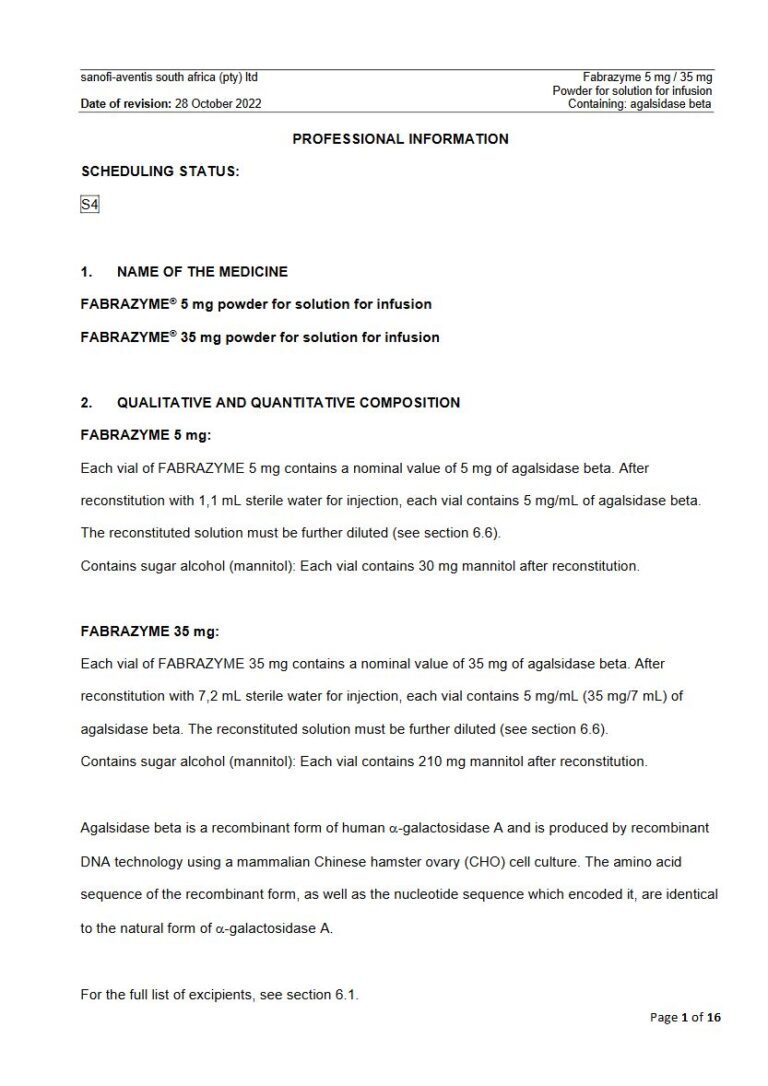
Fabrazyme 5 mg / 35 mg Powder for solution for infusion
PDF Leaflet Revision Date: 28 October 2022
Clinical Summary
Quick overview from the medicine insert
Indication
Treatment of Fabry disease.
Dosage (summary)
1.0 mg/kg body weight IV every 2 weeks over 2 hours.
Special Populations
- Renal insufficiency
- Hepatic insufficiency
- Elderly patients
- Children younger than 8 years
Pregnancy & Breastfeeding
Not recommended during pregnancy; may be excreted in breast milk.
Key Drug Interactions
- Chloroquine
- Amiodarone
- Benoquin
- Gentamycin
Contraindications
- Hypersensitivity to agalsidase beta or excipients
Common side effects
- Headache
- Dizziness
- Nausea
- Vomiting
- Anaphylaxis
Counselling Points
- Monitor for infusion reactions
- Consider home infusion if tolerated
- Avoid during pregnancy and breastfeeding
Serious warnings
- Infusion-associated reactions
- Hypersensitivity reactions
Important Disclaimer
The Fabrazyme 5 mg / 35 mg Powder for solution for infusion professional information leaflet below is the property of Sanofi-Aventis South Africa and is provided on Medinsert exactly as issued, with no.. alterations or editorial changes. We make every effort to keep content current by updating documents as soon as new versions become available. Medinsert serves as a trusted access point for healthcare professionals, but does not replace official sources or clinical judgement. For more details, please read our full disclaimer. read more>>
 Healthcare Professionals Only
This content is for registered healthcare professionals
Sign in or create a free account to read the full package insert.
Free for HPCSA-registered professionals. Powered by Medinsert.
Clinical Particulars
Section 4 of the official insert — extracted exactly as issued, no alterations
4.1 Therapeutic indications
FABRAZYME (agalsidase beta) is indicated for use in patients with Fabry disease.
4.2 Posology and method of administration
Posology
The recommended dose of FABRAZYME is 1,0 mg/kg body weight infused every 2 weeks as a slow IV infusion over 2 hours or longer. The initial IV infusion rate should be no more than 0,25 mg/min or 15 mg/hour. The infusion rate may be slowed in the event of infusion-associated reactions. After patient tolerance has been established, the infusion rate may be increased gradually with subsequent infusions, as tolerated.
Overall, the safety and efficacy of FABRAZYME treatment administered at 1,0 mg/kg every 2 weeks in children between the ages of 8 and 16 years are consistent with that seen in adults. Patients younger than 8 years of age were not included in clinical studies.
Infusion of FABRAZYME at home may be considered for patients who are tolerating their infusions well. The decision to have a patient move to home infusion should be made after evaluation and recommendation by the treating specialist. Patients experiencing adverse events during the home infusion need to immediately stop the infusion process and seek the attention of a health care provider. Subsequent infusions may need to occur in a clinical setting. Dose and infusion rate should remain constant while at home and should not be changed without supervision of a health care provider.
Special populations
Renal insufficiency: No changes in dose are necessary for patients with renal insufficiency.
Hepatic insufficiency: Studies in patients with hepatic insufficiency have not been performed.
Elderly patients: The safety and efficacy of FABRAZYME in patients older than 65 years have not been established.
Children younger than 8 years: The safety and efficacy of FABRAZYME in patients younger than 8 years of age have not been evaluated.
Method of administration
For instructions on reconstitution and dilution of FABRAZYME before administration, see section 6.6.
4.3 Contraindications
Known hypersensitivity to agalsidase beta or to any of the other ingredients of FABRAZYME (see section 6.1).
4.4 Special warnings and precautions for use
Immunogenicity:
Since agalsidase beta (r-hu03b1GAL) is a recombinant protein, the development of lgG antibodies is expected in patients with little or no residual enzyme activity. The majority of patients developed lgG antibodies to r-hu03b1GAL, typically within 3 months of the first infusion with FABRAZYME. Over time, the majority of seropositive patients in clinical trials demonstrated either a downward trend in titres (based on a u2265 4-fold reduction in titre from the peak measurement to the last measurement) (40 % of the patients), tolerised (no detectable antibodies confirmed by 2 consecutive radioimmunoprecipitation (RIP) assays) (14 % of the patients), or demonstrated a plateau (35 % of the patients).
Infusion-associated reactions:
Patients with antibodies to r-hu03b1GAL have a greater potential to experience infusion-associated reactions (lARs), which are defined as any related adverse event occurring on the infusion day. These patients should be treated with caution when re-administering agalsidase beta. Antibody status should be regularly monitored. In clinical trials, sixty-seven per cent (67 %) of the patients experienced at least one infusion-associated reaction. The frequency of lARs decreased over time. Patients experiencing mild or moderate infusion-associated reactions when treated with agalsidase beta during clinical trials have continued therapy after a reduction in the infusion rate (~ 0,15 mg/min; 10 mg/hour) and/or pre-treatment with antihistamines, paracetamol, ibuprofen and/or corticosteroids.
Hypersensitivity:
Allergic-type hypersensitivity reactions are possible. A small number of patients have experienced reactions suggestive of immediate (Type I) hypersensitivity. In clinical trials, approximately 1 % of patients developed anaphylactic or severe allergic reactions during FABRAZYME infusion. If severe allergic or anaphylactic-type reactions occur, immediate discontinuation of the administration of FABRAZYME should be considered and appropriate treatment initiated. The current medical standards for emergency treatment are to be observed. The risks and benefits of re-administering FABRAZYME following a severe hypersensitivity or anaphylactoid reaction should be considered. With careful rechallenge FABRAZYME has been re-administered to all 6 patients who tested positive for IgE antibodies or had a positive skin test to FABRAZYME in a clinical trial. In this trial, the initial rechallenge administration was at a low dose and a lower infusion rate [1/2 the therapeutic dose (0,5 mg/kg) at 1/25 the initial standard recommended rate (0,01 mg/min)]. Once a patient tolerates the infusion, the dose may be increased to reach the therapeutic dose of 1 mg/kg and the infusion rate may be increased by slowly titrating upwards, as tolerated.
Patients with advanced renal disease: The effect of FABRAZYME treatment on kidney function may be limited in patients with advanced renal disease.
Useful laboratory tests for monitoring patients: It is suggested that patients be monitored periodically for IgG antibody formation.
4.5 Interaction with other medicines and other forms of interaction
Interactions with food and drink are unlikely. No formal medicine interaction studies have been performed. No in vitro metabolism studies have been performed. FABRAZYME should not be administered with chloroquine, amiodarone, benoquin or gentamycin due to a risk of inhibition of intracellular u03b1-galactosidase A activity.
4.6 Fertility, pregnancy and lactation
Pregnancy
There are no adequate data from the use of FABRAZYME in pregnant women. Animal studies do not indicate direct or indirect harmful effects with respect to embryonal/fetal development. FABRAZYME should not be used during pregnancy.
Breastfeeding
FABRAZYME may be excreted in breast milk. Because there are no data available on effects in neonates exposed to FABRAZYME via breast milk, it is recommended to stop breastfeeding when FABRAZYME is used.
Fertility
Studies have not been conducted to assess the potential effects of FABRAZYME on impairment of fertility.
4.7 Effects on ability to drive and use machines
FABRAZYME can cause side effects such as dizziness or somnolence (see section 4.8). Caution is advised when driving a vehicle or operating machinery until the effects of FABRAZYME are known.
4.8 Undesirable effects
Side effects have been reported according to the following categories: Very common (u2265 1/10), common (u2265 1/100, < 1/10), uncommon (u2265 1/1 000, < 1/100). The occurrence of an adverse reaction in a single patient is defined as uncommon in light of the relatively small number of patients treated. Adverse reactions only reported during the post-marketing period are also included below at a frequency category of u201cnot knownu201d (cannot be estimated from the available data). Adverse reactions were mostly mild to moderate in severity:
Infections and infestations
Common: Nasopharyngitis
Uncommon: Rhinitis
Immune system disorders
Common: Anaphylaxis or severe allergic reactions, angioedema
Not known: Anaphylactoid reaction
Nervous system disorders
Very common: Headache, paraesthesia
Common: Dizziness, somnolence, hypoaesthesia, burning sensation, lethargy, syncope
Uncommon: Hyperaesthesia, tremor
Eye disorders
Common: Increased lacrimation
Uncommon: Eye pruritus, ocular hyperaemia
Ear and labyrinth disorders
Common: Tinnitus, vertigo
Uncommon: Auricular swelling, ear pain
Cardiac disorders
Common: Tachycardia, palpitations, bradycardia
Uncommon: Sinus bradycardia
Vascular disorders
Common: Flushing, hypertension, pallor, hypotension, hot flushes
Uncommon: Peripheral coldness
Respiratory, thoracic and mediastinal disorders
Common: Dyspnoea, nasal congestion, throat tightness, wheezing, cough, exacerbated dyspnoea
Uncommon: Bronchospasm, pharyngolaryngeal pain, rhinorrhoea, tachypnoea, upper respiratory tract congestion
Not known: Hypoxia
Gastrointestinal disorders
Very common: Nausea, vomiting
Common: Abdominal pain, upper abdominal pain, abdominal discomfort, stomach discomfort, oral hypoaesthesia, diarrhoea
Uncommon: Dyspepsia, dysphagia
Skin and subcutaneous tissue disorders
Common: Pruritus, urticaria, rash, erythema, generalised pruritus, angioneurotic oedema, swelling face, maculopapular rash
Uncommon: Livedo reticularis, erythematous rash, pruritic rash, skin discolouration, skin discomfort
Not known: Leukocytoclastic vasculitis
Musculoskeletal, connective tissue and bone disorders
Common: Pain in extremity, myalgia, back pain, muscle spasms, arthralgia, muscle tightness, musculoskeletal stiffness
Uncommon: Musculoskeletal pain
General disorders and administration site conditions
Very common: Chills, pyrexia, feeling cold
Common: Fatigue, chest discomfort, feeling hot, peripheral oedema, pain, asthenia, chest pain, face oedema, hyperthermia
Uncommon: Feeling hot and cold, influenza-like illness, infusion site pain, infusion site reaction, injection site thrombosis, malaise, oedema
Investigations
Not known: Decreased oxygen saturation.
Description of selected adverse reactions
Infusion-associated reactions: Infusion-associated reactions consisted most often of fever and chills. Additional symptoms included mild or moderate dyspnoea, hypoxia (oxygen saturation decreased), throat tightness, chest discomfort, flushing, pruritus, urticaria, face oedema, angioedema, rhinitis, bronchospasm, tachypnoea, wheezing, hypertension, hypotension, tachycardia, palpitations, abdominal pain, nausea, vomiting, infusion-related pain including pain at the extremities, myalgia, and headache. The infusion-associated reactions were managed by a reduction in the infusion rate together with the administration of nonsteroidal anti-inflammatory medicines, antihistamines and/or corticosteroids. Pre-infusion administration of these medicines is advisable in some patients. Sixty-seven per cent (67 %) of the patients experienced at least one infusion-associated reaction. The frequency of these reactions decreased over time. The majority of these reactions can be attributed to the formation of IgG antibodies and/or complement activation. In a limited number of patients IgE antibodies were demonstrated.
Post-marketing experience:
During the post-marketing period, the adverse reaction profile was generally similar to that seen during the clinical studies. Adverse effects seen during the post-marketing period included: feeling hot and cold, malaise, musculoskeletal pain, oedema, rhinitis, rhinorrhoea, and oxygen saturation decreased/hypoxia. Infusion site reaction was seen and not unexpected given the route of administration. One patient reported an event of leukocytoclastic vasculitis. One case of membranous glomerulonephritis has been reported. A small number of patients have experienced anaphylactoid reactions which in some cases were considered life-threatening. Signs and symptoms of possible anaphylactoid reactions have included events of localised angioedema, generalised urticaria, bronchospasm and hypotension (see section 4.4).
Reporting of suspected adverse reactions
Reporting suspected adverse reactions after authorisation of FABRAZYME is important. It allows continued monitoring of the benefit/risk balance of FABRAZYME. Health care providers are asked to report any suspected adverse reactions to:
u2022 The Pharmacovigilance Unit at Sanofi: [email protected] (email) or 011 256-3700 (tel), or
u2022 SAHPRA via the u201c6.04 Adverse Drug Reaction Reporting Formu201d, found online under SAHPRAu2019s publications: https://www.sahpra.org.za/Publications/Index/8
4.9 Overdose
See section 4.8. Treatment is symptomatic and supportive. There have been no reports of overdose with FABRAZYME. In clinical trials, patients have received doses up to 3,0 mg/kg body weight.
