
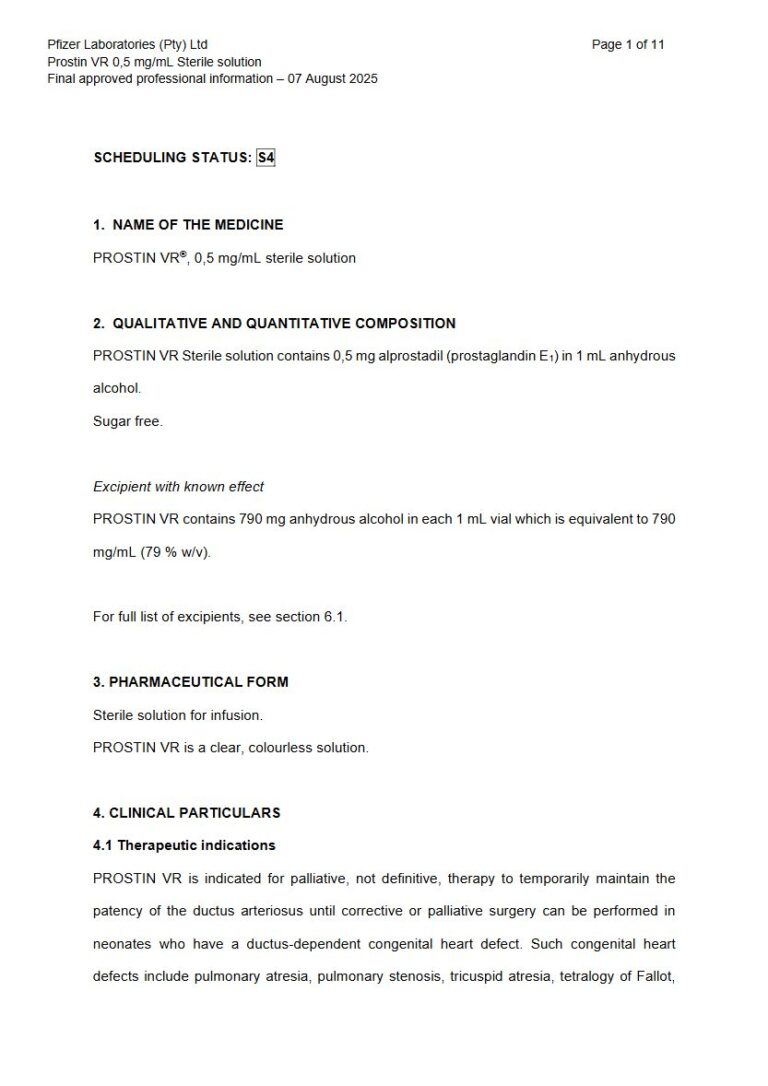
Prostin Vr 0,5 mg/mL Sterile solution for infusion.
PDF Leaflet Revision Date: 07 August 2025
Clinical Summary
Quick overview from the medicine insert
Indication
Palliative therapy to maintain ductus arteriosus patency in neonates with congenital heart defects.
Dosage (summary)
Start at 0.1 mcg/kg/min, adjust to lowest effective dose.
Special Populations
- Neonates
- Patients with bleeding tendencies
Key Drug Interactions
- Co-administration with propylene glycol or alcohol may increase ethanol effects
Contraindications
- Respiratory distress syndrome
Common side effects
- Flushing
- Bradycardia
- Hypotension
- Apnoea
Counselling Points
- Administer only in facilities with pediatric intensive care
- Monitor for signs of overdose
Serious warnings
- Monitor for antral hyperplasia and gastric outlet obstruction with long-term use
Important Disclaimer
The Prostin Vr 0,5 mg/mL Sterile solution for infusion. professional information leaflet below is the property of Pfizer Laboratories and is provided on Medinsert exactly as issued, with no.. alterations or editorial changes. We make every effort to keep content current by updating documents as soon as new versions become available. Medinsert serves as a trusted access point for healthcare professionals, but does not replace official sources or clinical judgement. For more details, please read our full disclaimer. read more>>
 Healthcare Professionals Only
This content is for registered healthcare professionals
Sign in or create a free account to read the full package insert.
Free for HPCSA-registered professionals. Powered by Medinsert.
Clinical Particulars
Section 4 of the official insert — extracted exactly as issued, no alterations
4.1 Therapeutic indications
PROSTIN VR is indicated for palliative, not definitive, therapy to temporarily maintain the patency of the ductus arteriosus until corrective or palliative surgery can be performed in neonates who have a ductus-dependent congenital heart defect. Such congenital heart defects include pulmonary atresia, pulmonary stenosis, tricuspid atresia, tetralogy of Fallot, interruption of the aortic arch, coarctation of the aorta, mitral atresia, or transposition of the great vessels with or without other defects.
4.2 Posology and method of administration
Pathological studies of the ductus arteriosus and pulmonary arteries of infants treated with prostaglandin E 1 have disclosed histologic changes compatible with a weakening effect upon these structures. The specificity or clinical relevance of these findings is not known. Cortical proliferation of the long bones has been reported following long-term infusions of alprostadil in neonates and dogs. The cortical proliferation in neonates regressed after withdrawal of the medication. The administration of alprostadil (PGE 1) to neonates may result in gastric outlet obstruction secondary to antral hyperplasia. This effect appears to be related to duration of therapy and cumulative dose of the medicine. Neonates receiving alprostadil (PGE 1) at recommended doses for more than 120 hours should be closely monitored for evidence of antral hyperplasia and gastric outlet obstruction. Alprostadil (PGE 1) should be infused for the shortest time and at the lowest dose which will produce the desired effects. The risk of long-term infusion of alprostadil (PGE 1) should be weighed against the possible benefits that critically ill infants may derive from its administration. Use alprostadil (PGE 1) cautiously in neonates with histories of bleeding tendencies. If full diagnostic facilities are not immediately available, cyanosis (PO 2 less than 40 mmHg) and restricted pulmonary blood flow apparent on an X-ray are good indicators of congenital heart defects. Infusion rate should be decreased if arterial pressure falls.
PROSTIN VR should be administered only by medically trained personnel in facilities in which neonates can receive or have access to paediatric intensive care. Cyanotic neonates with congenital heart defects, treated with alprostadil, may experience apnoea. Apnoea is most often observed in cyanotic neonates weighing less than 2 kg at birth and usually appears during the first hour of medicine infusion. Therefore, PROSTIN VR should be used only where ventilatory assistance is immediately available.
Posology
Infusion should begin with 0,1 micrograms alprostadil per kilogram of body mass per minute. When an effect is achieved, decrease the infusion to the lowest possible dose while maintaining the desired effects.
Method of administration
The preferable route of administration for PROSTIN VR is by continuous intravenous infusion into a large vein. Alternatively, PROSTIN VR may be administered through an umbilical artery catheter placed at the ductal opening. Adverse effects have occurred with both routes of administration, but the types of reactions are different. A higher incidence of flushing has been associated with intra-arterial than with intravenous administration.
Directions for use of the ampoules
No ampoule file is needed to open the ampoules. The neck of the ampoule is pre-scored at the point of constriction. A coloured dot on the ampoule helps to orientate the ampoule. Take the ampoule and face the coloured dot. The ampoule opens easily by placing the thumb on the coloured dot and gently pressing downwards. For instructions on dilution of PROSTIN VR before administration, see section 6.6.
Paediatric population
PROSTIN VR contains a quantity of alcohol that is likely to affect children (see section 4.4).
4.3 Contraindications
Care should be taken to avoid the use of PROSTIN VR in neonates with respiratory distress syndrome (hyaline membrane disease), which sometimes can be confused with cyanotic heart disease.
4.4 Special warnings and precautions for use
Pathological studies of the ductus arteriosus and pulmonary arteries of infants treated with PROSTIN VR have disclosed histologic changes compatible with a weakening effect upon these structures. The specificity or clinical relevance of these findings is not known. Cortical proliferation of the long bones has been reported following long-term infusions of PROSTIN VR in neonates and dogs. The cortical proliferation in neonates regressed after withdrawal of the medicine. The administration of PROSTIN VR to neonates may result in gastric outlet obstruction secondary to antral hyperplasia. This effect appears to be related to duration of therapy and cumulative dose of the medicine. Neonates receiving PROSTIN VR at recommended doses for more than 120 hours should be closely monitored for evidence of antral hyperplasia and gastric outlet obstruction. PROSTIN VR should be infused for the shortest time and at the lowest dose which will produce the desired effects. The risk of long-term infusion of PROSTIN VR should be weighed against the possible benefits that critically ill infants may derive from its administration. Use PROSTIN VR cautiously in neonates with histories of bleeding tendencies.
If full diagnostic facilities are not immediately available, cyanosis (PO 2 less than 40 mmHg) and restricted pulmonary blood flow apparent on an X-ray are good indicators of congenital heart defects. Infusion rate should be decreased if arterial pressure falls.
4.5 Interaction with other medicines and other forms of interaction
Not applicable
4.6 Fertility, pregnancy and lactation
Not applicable
4.7 Effects on ability to drive and use machines
Not applicable
4.8 Undesirable effects
Summary of the safety profile
In the neonate whose ductus arteriosi must be kept patent, the most frequent adverse reactions observed with PROSTIN VR infusion are related to its known pharmacological effects.
Cardiac disorders
The most common adverse reactions reported were flushing, bradycardia, hypotension, tachycardia, cardiac arrest, and oedema. The following reactions were also reported: congestive heart failure, hyperaemia, pneumopericardium, second degree heart block, shock, spasm of the right ventricle infundibulum, supraventricular tachycardia, ventricular fibrillation and ventricular hypertrophy.
Nervous system disorder
The most common adverse reactions reported were apnoea, fever and seizures. The following reactions were also reported: cerebral bleeding, hyperextension of the neck, hyperirritability, hypothermia, jitteriness, lethargy, microcephaly and stiffness.
Respiratory, thoracic, and mediastinal disorders
Bradypnoea, bronchial wheezing, hypercapnia, hypoplastic lungs, pneumothorax, respiratory depression, respiratory distress and tachypnoea.
Gastrointestinal disorders
Diarrhoea, biliary atresia, gastric regurgitation and hyperbilirubinaemia.
Blood and lymphatic system disorders
Disseminated intravascular coagulation, hypochromic anaemia, anaemia, bleeding and thrombocytopenia.
Renal and urinary disorders
Adverse reactions reported were anuria, haematuria, polycystic kidneys and renal failure. Tachyphylaxis, sepsis and peritonitis were also reported.
Metabolism and nutrition disorders
Hypokalaemia, hyperkalaemia and hypoglycaemia.
Reporting of suspected adverse reactions
Reporting suspected adverse reactions after authorisation of the medicine is important. It allows continued monitoring of the benefit/risk balance of the medicine. Health care providers are requested to report any suspected adverse drug reactions to SAHPRA via the Med Safety APP (Medsafety X SAHPRA) and eReporting platform (who-umc.org) found on SAHPRA website. Report any suspected adverse drug reactions associated with the use of the medicine directly to Pfizer via [email protected].
4.9 Overdose
Apnoea, bradycardia, pyrexia, hypotension and flushing may be signs of overdose. If apnoea or bradycardia occur, the infusion should be discontinued and the appropriate medical treatment initiated. Caution should be used if the infusion is restarted. If pyrexia or hypotension occur, the infusion rate should be reduced until these symptoms subside. Flushing is usually attributed to incorrect intra-arterial catheter placement and is usually alleviated by repositioning the tip of the catheter.
