
Gelusil-S Tablet
Clinical Summary
Quick overview from the medicine insert
Important Disclaimer
The Gelusil-S Tablet professional information leaflet below is the property of Inova Pharmaceuticals and is provided on Medinsert exactly as issued, with no.. alterations or editorial changes. We make every effort to keep content current by updating documents as soon as new versions become available. Medinsert serves as a trusted access point for healthcare professionals, but does not replace official sources or clinical judgement. For more details, please read our full disclaimer. read more>>
 Healthcare Professionals Only
This content is for registered healthcare professionals
Sign in or create a free account to read the full package insert.
Free for HPCSA-registered professionals. Powered by Medinsert.
Clinical Particulars
Section 4 of the official insert — extracted exactly as issued, no alterations
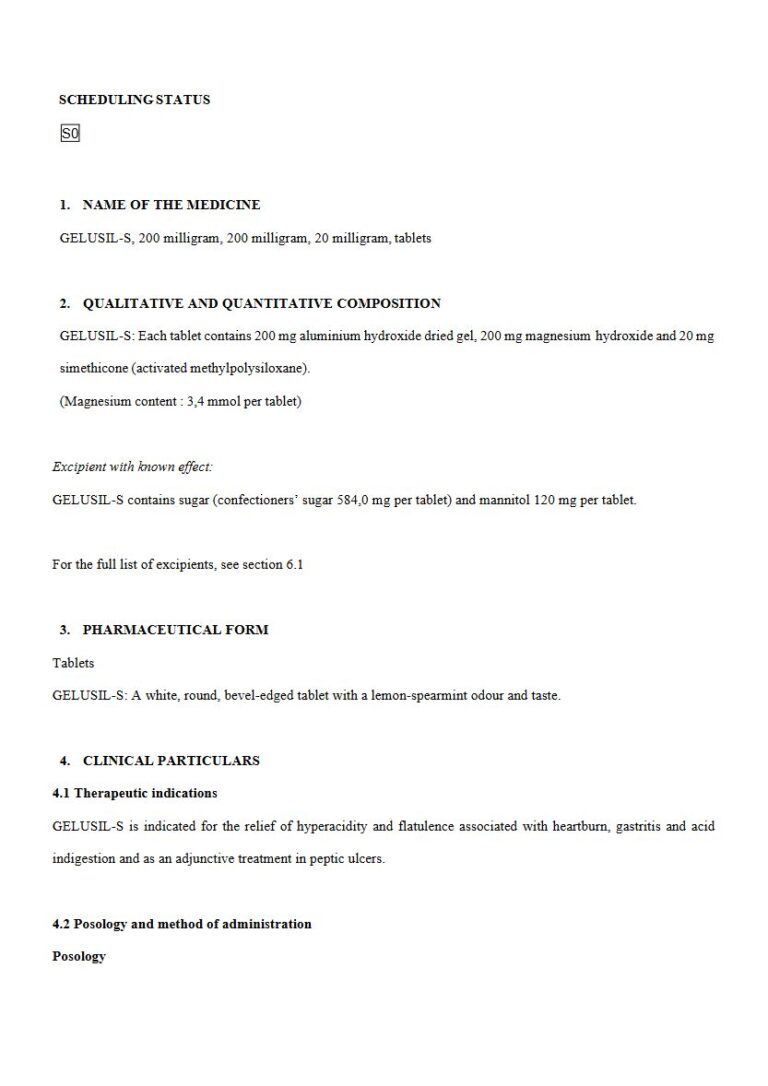
4.1 Therapeutic indications
GELUSIL - S is indicated for the relief of hyperacidity and flatulence associated with heartburn, gastritis and acid indigestion and as an adjunctive treatment in peptic ulcers.
4.2 Posology and method of administration
Posology
Adults (including the elderly): The usual dosage is one or two tablets chewed or allowed to disintegrate in the mouth 4 to 8 times a day, preferably between meals, or as directed by a doctor or pharmacist. Do not take more than 16 tablets in a 24 hour period.
Paediatric population
Not recommended for children (see section 4.3).
4.3 Contraindications
- Known hypersensitivity to aluminium hydroxide, magnesium hydroxide, simethicone or any of the excipients of GELUSIL - S listed in section 6.
- Patients with impaired renal function or renal failure.
- Patients who are severely debilitated.
- Contraindicated in children.
4.4 Special warnings and precautions for use
Aluminium hydroxide may cause constipation and magnesium salts overdose may cause hypomotility of the bowel; large doses of GELUSIL - S may trigger or aggravate intestinal obstruction and ileus in patients at higher risk such as those with renal impairment, or the elderly. Aluminium hydroxide is not well absorbed from the gastrointestinal tract, and systemic effects are therefore rare in patients with normal renal function. However, excessive doses or long-term use, or even normal doses in patients with low-phosphorus diets, may lead to phosphate depletion (due to aluminium-phosphate binding) accompanied by increased bone resorption and hypercalciuria with the risk of osteomalacia. Medical advice is recommended in case of long-term use or in patients at risk of phosphate depletion. In patients with renal impairment, plasma levels of both aluminium and magnesium increase. In these patients, a long-term exposure to high doses of aluminium and magnesium salts may lead to dementia or microcytic anaemia. Aluminium hydroxide may be unsafe in patients with porphyria undergoing haemodialysis. Magnesium hydroxide may cause diarrhoea, an effect that is dose-dependent. Hypermagnesaemia may occur, usually in patients with renal impairment. Information on excipients of GELUSIL - S: GELUSIL - S contains confectionersu2019 sugar. Patients with rare hereditary problems of fructose intolerance, glucose-galactose mal-absorption or sucrase-isomaltase insufficiency should not take GELUSIL - S.
4.5 Interactions with other medicines and other forms of interactions
In general, patients should be advised not to take any oral medication within at least 2 hours of taking GELUSIL - S. GELUSIL - S used concurrently with oral tetracyclines, rifampicin, ciprofloxacin, cefdinir, cefpodoxime, methenamine, digoxin, quinidine, oral iron preparations, anticholinergic medicines, barbiturates, quinines, warfarin, vitamins, H2 receptor antagonists, oral isoniazid, sucralfate, sodium fluoride, cyclines, diflunisal, digoxin, bisphosphonates, ethambutol, fluoroquinolones, lincosamides, metoprolol, penicillamine, ketoconazole, phenytoin, phenothiazines, hydroxychloroquine, chloroquine, chlorpromazine, levothyroxine and rosuvastatin may reduce the absorption of these medicines. Levothyroxine may also bind to simethicone which may delay or reduce the absorption of levothyroxine. Caution is advised when used concomitantly with polystyrene sulphonate due to the potential risk of reduced effectiveness of the resin in binding potassium of metabolic alkalosis in patients with renal failure (reported with aluminium hydroxide and magnesium hydroxide), and of intestinal obstruction (reported with aluminium hydroxide). Aluminium hydroxide and citrates may result in increased aluminium levels, especially in patients with renal impairment. Quinidine: Concomitant use of aluminium products with quinidines may increase the serum levels of quinidine and lead to quinidine overdosage. Tetracycline: Because of the aluminium content, GELUSIL - S should not be concomitantly administered with tetracycline-containing antibiotics or any tetracycline salts. Urine alkalinisation secondary to administration of magnesium hydroxide may modify excretion of some medicines; thus, increased excretion of salicylates has been seen.
4.6 Fertility, pregnancy and lactation
Pregnancy
Safety in pregnancy has not been established.
Breastfeeding
Safety in lactation has not been established.
4.7 Effects on ability to drive and use machines
GELUSIL - S has no or negligible influence on the ability to operate hazardous machinery, including motor vehicles.
4.8 Undesirable effects
System Organ Class Frequency Side effects
Immune system disorders Less frequent Hypersensitivity reactions, pruritus, urticaria, angioedema, anaphylactic reactions
Metabolism and nutrition disorders Less frequent Hypermagnesaemia* (due to prolonged use, large doses and/or renal disease). Symptoms may include flushing of the skin, thirst, hypotension due to peripheral vasodilation, drowsiness, confusion, loss of tendon reflexes due to neuromuscular blockade, muscle weakness, respiratory depression, cardiac dysrhythmias, coma and cardiac arrest. Hyperaluminemia, hyperphosphatemia, low-phosphate diets may lead to phosphate depletion with increased bone resorption and hypercalciuria with the risk of osteomalacia**
Psychiatric disorders Less frequent Encephalopathy and dementia in patients with chronic renal failure receiving high doses,** confusion
Nervous system disorders* Less frequent Drowsiness, neuromuscular blockade, coma
Cardiac disorders* Less frequent Cardiac dysrhythmias, cardiac arrest
Vascular disorders*: Less frequent: Peripheral vasodilation, hypotension due to peripheral vasodilation
Respiratory, thoracic and mediastinal disorders* Less frequent Respiratory depression
Gastrointestinal disorders Less frequent Nausea**, vomiting**, diarrhoea**, constipation**, intestinal obstruction due to large doses**, ileus, thirst
Skin and subcutaneous tissue disorders* Less frequent Flushing of the skin
Musculoskeletal, connective tissue and bone disorders Less frequent Loss of tendon reflexes due to neuromuscular blockade*, muscle weakness*, osteomalacia due to high doses in patients with low-phosphate diets and patients with chronic renal failure**
Renal and urinary disorders Less frequent Renal dysfunction, renal failure
* Side effects specific to magnesium
** Side effects specific to aluminium hydroxide
Reporting of suspected adverse reactions
Reporting suspected adverse reactions after authorisation of the medicine is important. It allows continued monitoring of the benefit/risk balance of the medicine. Healthcare providers are asked to report any suspected adverse reactions to SAHPRA via the u201c6.04 Adverse Drug Reactions Reporting Formu201d, found online under SAHPRAu2019s publications: https://www.sahpra.org.za/Publications/Index/8.
4.9 Overdose
Serious symptoms are unlikely following overdosage. Reported symptoms of acute overdose with GELUSIL - S include diarrhoea, abdominal pain, vomiting. Large doses of this product may trigger or aggravate intestinal obstruction and ileus in patients at risk (see section 4.4 and section 4.8). Aluminium and magnesium are eliminated through urinary route; treatment of acute overdose consists of administration of IV calcium gluconate, rehydration and forced diuresis. In case of renal function deficiency, haemodialysis or peritoneal dialysis is necessary.
