
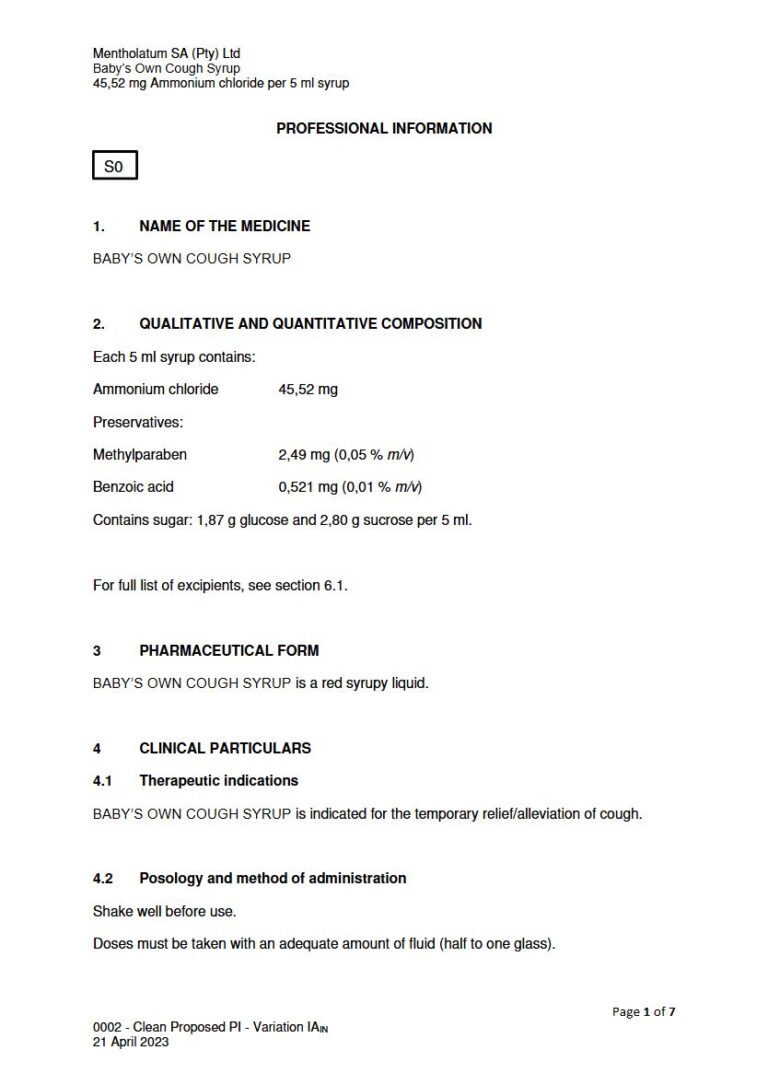
Baby’S Own Cough Syrup
PDF Leaflet Revision Date: 15 May 2023
Clinical Summary
Quick overview from the medicine insert
Indication
Temporary relief of cough.
Dosage (summary)
Adults: 15-30 ml every 2-4 hours; Children 2-12 years: 7.5-15 ml every 2-4 hours.
Special Populations
- Hepatic impairment
- Renal impairment
Pregnancy & Breastfeeding
Safety in pregnancy and lactation not established.
Contraindications
- Hypersensitivity to ammonium chloride
- Hepatic impairment
- Renal impairment
Common side effects
- Nausea
- Vomiting
- Acidosis
- Hypokalaemia
Counselling Points
- Take with adequate fluid
- Contains sucrose
- Not for children under 2 years
Serious warnings
- Investigate persistent coughs
- Caution in heart disease
- May cause drowsiness
Important Disclaimer
The Baby’S Own Cough Syrup professional information leaflet below is the property of Mentholatum Sa and is provided on Medinsert exactly as issued, with no.. alterations or editorial changes. We make every effort to keep content current by updating documents as soon as new versions become available. Medinsert serves as a trusted access point for healthcare professionals, but does not replace official sources or clinical judgement. For more details, please read our full disclaimer. read more>>
 Healthcare Professionals Only
This content is for registered healthcare professionals
Sign in or create a free account to read the full package insert.
Free for HPCSA-registered professionals. Powered by Medinsert.
Clinical Particulars
Section 4 of the official insert — extracted exactly as issued, no alterations
4.1 Therapeutic indications
BABYu2019S OWN COUGH SYRUP is indicated for the temporary relief/alleviation of cough.
4.2 Posology and method of administration
Shake well before use. Doses must be taken with an adequate amount of fluid (half to one glass).
Children: 2 to 6 years: 7,5 ml every 2 to 4 hours in water. 6 to 12 years: 15 ml every 2 to 4 hours in water. Adults: 15 ml to 30 ml every 2 to 4 hours in water.
Method of administration Doses must be taken orally.
4.3 Contraindications
Hypersensitivity to ammonium chloride or any of the ingredients of BABYu2019S OWN COUGH SYRUP. BABYu2019S OWN COUGH SYRUP is contra-indicated in patients with hepatic or renal impairment.
4.4 Special warnings and precautions for use
Persistent coughs should be investigated for possible underlying cause by the patientu2019s doctor. Liquorice may cause reversible sodium retention and potassium loss leading to hypertension, water retention and electrolyte imbalance. Use with caution in patients with heart disease. BABYu2019S OWN COUGH SYRUP contains sucrose. Patients with rare hereditary conditions such as fructose intolerance, glucose-galactose mal-absorption or sucrase-isomaltase insufficiency should not take BABYu2019S OWN COUGH SYRUP.
BABYu2019S OWN COUGH SYRUP contains glucose and sucrose which may have an effect on the glycaemic control of patients with diabetes mellitus. BABYu2019S OWN COUGH SYRUP contains 0,521 mg benzoic acid in each 5 ml dosage unit. Benzoic acid may increase jaundice in newborn babies (up to 4 weeks old) and should therefore not be used in children under 2 years of age. BABYu2019S OWN COUGH SYRUP contains Carmoisine CI 14720 as colourant that may cause allergic reactions.
4.5 Interaction with other medicines and other forms of interaction
No interaction studies have been performed.
4.6 Fertility, pregnancy and lactation
The safety of this preparation in pregnancy and lactation has not been established.
4.7 Effects on ability to drive and use machines
Large doses of BABYu2019S OWN COUGH SYRUP may cause drowsiness and interfere with your ability to drive or use machinery.
4.8 Undesirable effects
Possible side effects include: Gastrointestinal disorders: Frequency unknown: nausea and vomiting General disorders and administrative site conditions: Frequency unknown: acidosis and hypokaleamia.
Reporting of suspected adverse reactions: Reporting suspected adverse reactions after authorisation of the medicine is important. It allows continued monitoring of the benefit/risk balance of the medicine. Healthcare providers are asked to report any suspected adverse reactions to SAHPRA via the u201c6.04 Adverse Drug Reactions Reporting Formu201d found online under SAHPRAu2019s publications: https://www.sahpra.org.za/Publications/Index/8.
4.9 Overdose
Large doses of BABYu2019S OWN COUGH SYRUP may cause nausea, vomiting, thirst, headache, abnormally deep and rapid breathing and progressive drowsiness, gastric irritation, acidosis and hypokalaemia. If the capacity of the liver to convert ammonium ion to urea is exceeded, hepatic encephalopathy may ensue. Large doses of camphor may cause nausea, vomiting, dizziness, colic, headache, a feeling of warmth, delirium, muscle twitching, recurrent fits, depression of the central nervous system and coma. Breathing is difficult and the breath has a characteristic odour; anuria may occur. Treatment of overdosage is symptomatic and supportive.
