
Clear Cough Syrup 5 ml SYRUP
PDF Leaflet Revision Date: 22 November 2022
Clinical Summary
Quick overview from the medicine insert
Indication
Alleviation of cough.
Dosage (summary)
Adults: 5-10 ml every 3-4 hours; max 4 doses/day.
Special Populations
- Elderly
- Children under 6
- Hepatic impairment
- Renal impairment
Pregnancy & Breastfeeding
Safety in pregnancy and lactation not established.
Key Drug Interactions
- Alcohol
- MAOIs
- Nervous system depressants
Contraindications
- Hypersensitivity
- Impaired hepatic function
- Impaired renal function
- Asthma
- Porphyria
- Children under 6
Common side effects
- Drowsiness
- Dizziness
- Hypotension
- Gastrointestinal disturbances
Counselling Points
- Avoid alcohol
- Store out of children's reach
- Consult doctor if cough persists over 1 week
Serious warnings
- Risk of serious heart problems
- Potential for misuse
- May impair ability to drive
Important Disclaimer
The Clear Cough Syrup 5 ml SYRUP professional information leaflet below is the property of Ranbaxy Pharmaceuticals and is provided on Medinsert exactly as issued, with no.. alterations or editorial changes. We make every effort to keep content current by updating documents as soon as new versions become available. Medinsert serves as a trusted access point for healthcare professionals, but does not replace official sources or clinical judgement. For more details, please read our full disclaimer. read more>>
 Healthcare Professionals Only
This content is for registered healthcare professionals
Sign in or create a free account to read the full package insert.
Free for HPCSA-registered professionals. Powered by Medinsert.
Clinical Particulars
Section 4 of the official insert — extracted exactly as issued, no alterations
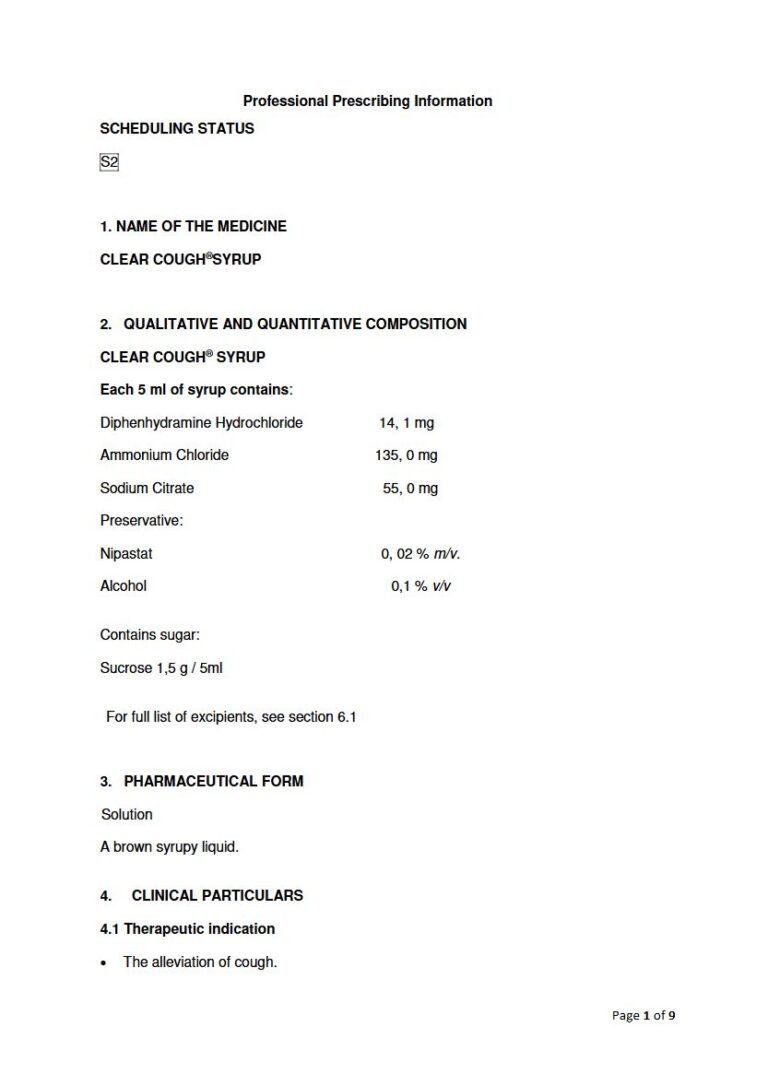
4.1 Therapeutic indication
u2022 The alleviation of cough.
4.2 Posology and Method of Administration
A maximum of four doses per day should not be exceeded.
ADULTS: One to two medicine measures (5 u2013 10 ml) every three to four hours.
CHILDREN: 6 to 12 years: Half to one medicine measure (2, 5 - 5 ml) every four hours. CLEAR COUGH u00ae SYRUP should not be given to children under 6 years (see section 4.3).
Method of Administration
Doses must be taken orally with an adequate amount of fluid (half to one glass)
4.3 Contraindications
u2022 Hypersensitivity to diphenhydramine hydrochloride, ammonium chloride, sodium citrate or any of the excipients listed in section 6.1
u2022 CLEAR COUGH u00ae SYRUP is contra-indicated in the presence of impaired hepatic or renal function.
u2022 During an attack of asthma.
u2022 Porphyria
u2022 Concurrent use of CLEAR COUGH u00ae SYRUP in patients taking monoamine oxidase inhibitors (MAOIs) is contra-indicated (see section 4.4).
u2022 CLEAR COUGH u00ae SYRUP is contraindicated in children under 6 years
4.4 Special warnings and precautions for use
The use of high doses of diphenhydramine-containing medicines, such as CLEAR COUGH u00ae SYRUP, may lead to serious heart problems, seizures, coma and death. Healthcare professionals are advised to:
- Be aware that CLEAR COUGH u00ae SYRUP may be misused in order to cause a hallucinatory effect, and to alert caregivers about the risks related to its misuse in teenagers.
- Encourage teenagers and caregivers to read the CLEAR COUGH u00ae SYRUP patient information leaflet included in the medicine package in order to familiarise themselves with the recommended dose and important safety information.
Advise consumers, parents and caregivers to store CLEAR COUGH u00ae SYRUP and all other over-the-counter (OTC) and prescription medicines out of childrenu2019s reach and sight. It is recommended that medicines should be locked up to prevent accidental poisonings by children and misuse by teenagers.
This medicine may lead to drowsiness and impaired concentration that may be aggravated by the simultaneous intake of alcohol or other central nervous system depressants. Patients should be advised, particularly at the initiation of therapy, against taking charge of vehicles or machinery or performing potentially hazardous tasks where loss of concentration could lead to accidents.
CLEAR COUGH u00ae SYRUP should not be taken concurrently with patients taking monoamine-oxidase inhibitors (MAOIs) or within 14 days of stopping therapy with MAOIs, as drowsiness and anticholinergic effects may be potentiated (see section 4.5).
A persistent cough may be a sign of a serious condition. If cough persists for more than 1 week, tend to recur or is accompanied by high fever, rash or persistent headache, the patient should be advised to consult a doctor.
CLEAR COUGH u00ae SYRUP should not be taken for persistent or chronic cough such as occurring with smoking, asthma, emphysema or where cough is accompanied by excessive phlegm (mucous).
Preparations containing sodium salts should be used cautiously in patients with cardiac failure, hypertension, impaired renal function, peripheral and pulmonary oedema and in toxaemia of pregnancy.
CLEAR COUGH u00ae SYRUP should be used cautiously in patients with cardiac failure, hypertension, peripheral and pulmonary oedema, cardiovascular disease, glaucoma, prostatic hypertrophy and patients with urinary retention.
CLEAR COUGH u00ae SYRUP should not be used in patients with impaired renal or liver function, or in pregnancy (see section 4.3).
The positive results of skin allergy tests may be suppressed.
Elderly population
Elderly patients are more susceptible to the central nervous system depressant and hypotensive effects. The elderly are particularly prone to dizziness, sedation, confusion, hypotension and anticholinergic effects.
Paediatric population
May cause excitability especially in children.
Sucrose: CLEAR COUGH u00ae SYRUP contains sucrose. Patients with rare hereditary problems of fructose intolerance, glucose-galactose malabsorption or sucrose u2013 isomaltase insufficiency should not take/be given CLEAR COUGH u00ae SYRUP
4.5 Interaction with other medicines and other forms of Interaction
The use of CLEAR COUGH u00ae SYRUP in conjunction with nervous system depressants such as alcohol, barbiturates, hypnotics, narcotic analgesics, sedatives, tranquillisers, anticholinergic medicines and tricyclic antidepressants is not recommended as their effects may be enhanced by diphenhydramine as contained in CLEAR COUGH u00ae SYRUP.
Monoamine-oxidase inhibitors will potentiate both the drowsiness effect and the anticholinergic effects of diphenhydramine, therefore, CLEAR COUGH u00ae SYRUP should not be taken concurrently with patients taking MAOIs or within 14 days of stopping therapy with MAOIs.
The effects of medicines with anticholinergic activity such as tricyclic antidepressants or maprotiline will be potentiated. The warning signs of damage caused by ototoxic medicines may be masked by diphenhydramine, as in CLEAR COUGH u00ae SYRUP.
4.6 Fertility, pregnancy and lactation
Pregnancy
Safety in pregnancy has not been established.
Lactation
Safety in lactation has not been established.
4.7 EFFECTS ON ABILITY TO DRIVE AND USE MACHINES
This medicine may lead to drowsiness and impaired concentration, which may be aggravated by simultaneous intake of alcohol or other central nervous system depressant agents. Patients should be warned against taking charge of vehicles or machinery or performing potentially hazardous tasks where loss of concentration may lead to accidents.
4.8 Undesirable effects
a) Summary of the safety profile
The most commonly reported adverse reactions caused by diphenhydramine is sedation which includes drowsiness, inability to concentrate, lassitude, dizziness, hypotension, muscular weakness and incoordination
b) Tabulated list of adverse reactions
System Organ Class Frequency Adverse reaction
Blood and lymphatic system disorders Less Frequent Haemolytic anaemia, leukopenia, thrombocytopenia
Immune system disorder Less Frequent Hypersensitivity (allergic) reactions
Metabolism and nutrition disorders Less Frequent Anorexia, hyper-chloraemic acidosis and hypokalaemia
Psychiatric disorders Frequent Elation or depression, irritability, nightmares, euphoria, extra-pyramidal effects, mental confusion
Nervous system disorders Frequent Headache, drowsiness or progressive drowsiness, inability to concentrate, lassitude, dizziness, insomnia, nervousness, tremors, tingling, epileptiform seizures and convulsions
Eye disorders Less Frequent Blurred vision
Ear and labyrinth disorders Less Frequent Tinnitus
Cardiac disorders Less Frequent Hypotension, tachycardia, hyperventilation
Gastrointestinal disorders Frequent Gastro-intestinal disturbances, constipation, diarrhoea, epigastric pain, nausea, vomiting, dryness of mouth and thirst
4.9 Overdose
Retention of sodium leads to the accumulation of fluid, with cerebral oedema and peripheral and pulmonary oedema. Symptoms of hypernatraemia may include restlessness, weakness, thirst, reduced salivation and lachrymation, swollen tongue, flushing of the skin, pyrexia, dizziness, headache, oliguria, hypotension, tachycardia, delirium, hyperpnoea and respiratory arrest. Other symptoms of overdosage are gastro-intestinal upset, drowsiness, hypochloraemic acidosis and hypokalaemia.
Diphenhydramine hydrochloride overdosage may be fatal, especially in children in whom main symptoms are central nervous system stimulation and antimuscarinic effects, including ataxia, excitement, hypotension, drowsiness, hallucinations, muscle tremor, convulsions, dilated pupils, dry mouth, flushed face and hyperpyrexia, respiratory collapse, death may occur from respiratory failure.
Ataxia, drowsiness, hyperpyrexia and hypotension may occur. Treatment is symptomatic and supportive.
