
Amorolfine 5% Glenmark Nail lacquer
PDF Leaflet Revision Date: 15 October 2024
Clinical Summary
Quick overview from the medicine insert
Indication
Onychomycoses caused by dermatophytes, yeasts, and moulds.
Dosage (summary)
Apply once or twice weekly to affected nails.
Special Populations
- Children
Pregnancy & Breastfeeding
Not recommended during pregnancy and lactation due to limited experience.
Key Drug Interactions
- Avoid use with nail varnish or artificial nails during treatment.
Contraindications
- Hypersensitivity to amorolfine or excipients
- Pregnancy
- Lactation
- Children
Common side effects
- Nail discoloration
- Broken nails
- Brittle nails
Counselling Points
- File down affected nails before application.
- Clean nails with alcohol swab before each application.
- Do not reuse nail files on healthy nails.
Serious warnings
- Avoid contact with skin around nails, eyes, ears, and mucous membranes.
Important Disclaimer
The Amorolfine 5% Glenmark Nail lacquer professional information leaflet below is the property of Glenmark Pharmaceuticals South Africa and is provided on Medinsert exactly as issued, with no.. alterations or editorial changes. We make every effort to keep content current by updating documents as soon as new versions become available. Medinsert serves as a trusted access point for healthcare professionals, but does not replace official sources or clinical judgement. For more details, please read our full disclaimer. read more>>
 Healthcare Professionals Only
This content is for registered healthcare professionals
Sign in or create a free account to read the full package insert.
Free for HPCSA-registered professionals. Powered by Medinsert.
Clinical Particulars
Section 4 of the official insert — extracted exactly as issued, no alterations
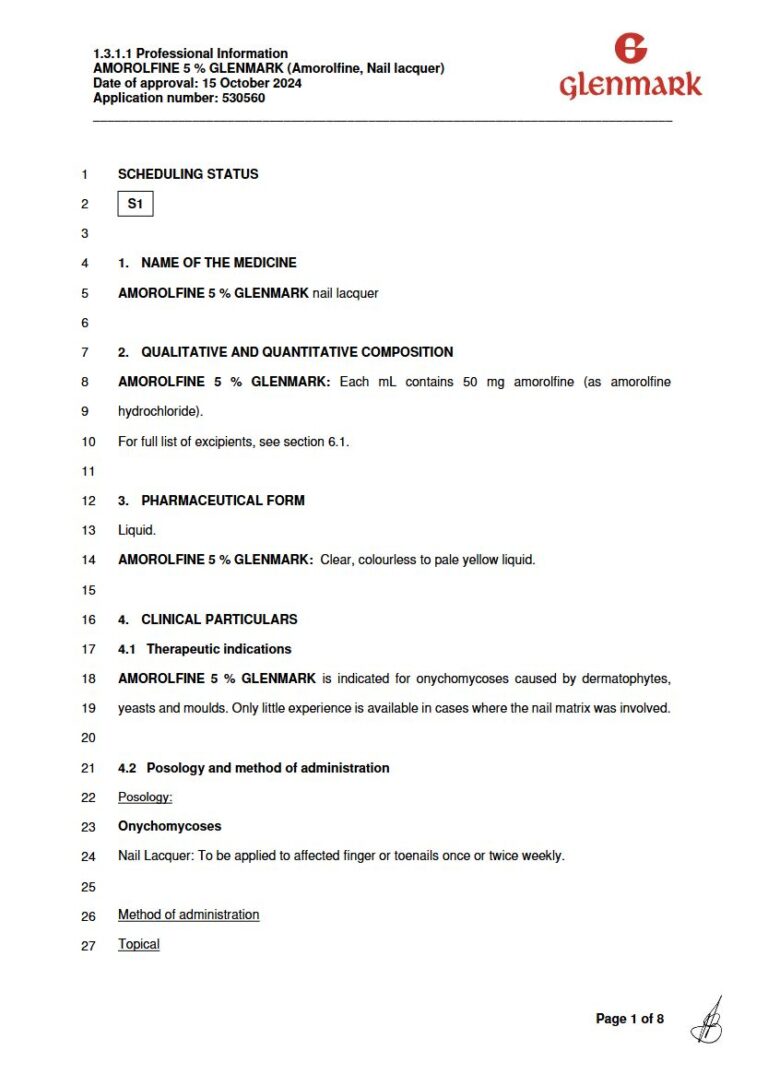
4.1 Therapeutic indications
AMOROLFINE 5 % GLENMARK is indicated for onychomycoses caused by dermatophytes, yeasts and moulds. Only little experience is available in cases where the nail matrix was involved.
4.2 Posology and method of administration
Posology: Onychomycoses Nail Lacquer: To be applied to affected finger or toenails once or twice weekly.
Method of administration Topical
The patient should apply the nail lacquer as follows:
- Before the first application of AMOROLFINE 5 % GLENMARK, it is essential that the affected areas of nail (particularly the nail surfaces) should be filed down as thoroughly as possible using a disposable nail file supplied. The surface of the nail should then be cleansed and degreased using an alcohol-soaked swab (as supplied). Before repeating application of AMOROLFINE 5 % GLENMARK, the affected nails should be filed down again as required and must always first be cleansed with an alcohol-soaked swab to remove any remaining lacquer. Caution: Nail files used for affected nails must not be used for healthy nails.
- With the applicator supplied, apply the nail lacquer to the entire surface of the affected nails and allow it to dry for approximately 3-5 minutes. For each nail to be treated, dip the applicator into the nail lacquer without wiping off any of the lacquer on the bottle neck. After use, clean the applicator with the same pre-soaked swab used before for nail cleansing. Keep the bottle tightly closed.
- When working with organic solvents (thinners, white spirit, etc.) wear impermeable gloves to protect the AMOROLFINE 5 % GLENMARK on the nails. Treatment should be continued without interruption until the nail is regenerated and the affected areas are finally cured. The required duration of treatment depends essentially on intensity and localisation of the infection and on growth rate of the nails, but in general, it is six months for fingernails and nine to twelve months for toenails. Clinical experience indicates that cure is achieved after six months in approximately 50 % of distal onychomycosis cases in which less than 80 % of the nail surface was affected. Mycological cure was achieved in 60-80 % of cases.
4.3 Contraindications
AMOROLFINE 5 % GLENMARK is contra-indicated in:
- Individuals with known hypersensitivity to amorolfine hydrochloride or any of the excipients listed in section 6.1. These individuals should not reuse AMOROLFINE 5 % GLENMARK
- Pregnancy and lactation. No experience exists with pregnancy and breastfeeding while using AMOROLFINE 5 % GLENMARK
- Children.
4.4 Special warnings and precautions for use
AMOROLFINE 5 % GLENMARK should not be applied on the skin around the nail. Avoid contact of the lacquer with eyes, ears and mucous membranes. Owing to the lack of clinical experience available to date, children (particularly young children and infants) should not be treated with AMOROLFINE 5 % GLENMARK. Before repeat application of AMOROLFINE 5 % GLENMARK, cosmetic nail lacquer should be removed carefully. Use of cosmetic lacquers or artificial nails should be avoided during treatment with AMOROLFINE 5 % GLENMARK. After applying AMOROLFINE 5 % GLENMARK, an interval of at least 10 min should be respected before application of any cosmetic nail lacquer. When organic solvents are used impermeable gloves shall be used otherwise AMOROLFINE 5 % GLENMARK will be removed. A systemic or local allergic reaction could possibly occur after use of this product. If this happens, the product should be stopped immediately, and medical advice should be sought. Remove the product carefully by using a nail remover solution. The product should not be reapplied.
4.5 Interaction with other medicines and other forms of interaction
No interaction studies have been performed. Use of nail varnish or artificial nails should be avoided during treatment.
4.6 Fertility, pregnancy and lactation
Pregnancy Experience with amorolfine use during pregnancy and/or lactation is limited. Only a few cases of exposure to topical amorolfine use in pregnant women have been reported in the post-authorisation setting, therefore the potential risk is unknown. Studies in animals have shown reproductive toxicity at high oral doses; it is unknown whether amorolfine is excreted in human milk. Amorolfine should not be used during pregnancy and/or lactation unless clearly necessary.
4.7 Effects on ability to drive and use machines
AMOROLFINE 5 % GLENMARK has no influence on the ability to drive and use machines.
4.8 Undesirable effects
Nail disorders (e.g., nail discoloration, broken nails, brittle nails) may occur. These reactions can also be linked to the onychomycosis itself.
Tabulated summary of adverse reactions The adverse reactions are listed by system organ class and absolute frequency.
System Organ Class Adverse Reactions Frequency Category Immune system disorders Hypersensitivity (systemic allergic reaction) Frequency unknown
Skin and subcutaneous tissue disorders Nail disorder, nail discolouration, onychoclasis (broken nails), onychorrhexis (brittle nails). However, these reactions can also be linked to the onychomycosis itself. Frequent Skin burning sensation, contact dermatitis Less frequent Erythema, pruritis, urticaria, blister Frequency unknown
Reporting of suspected adverse reactions Reporting suspected adverse reactions after authorisation of the medicine is important. It allows continued monitoring of the benefit/risk balance of the medicine. Health care providers are asked to report any suspected adverse reactions to SAHPRA via the u201c6.04 Adverse Drug Reactions Reporting Formu201d, found online under SAHPRAu2019s publications: https://www.sahpra.org.za/Publications/Index/8
4.9 Overdose
No systemic signs of overdose are expected following topical application of AMOROLFINE 5 % GLENMARK. Should AMOROLFINE 5 % GLENMARK be ingested, treatment should be symptomatic and supportive.
