
Allmox Capsules
PDF Leaflet Revision Date: 31/03/2025
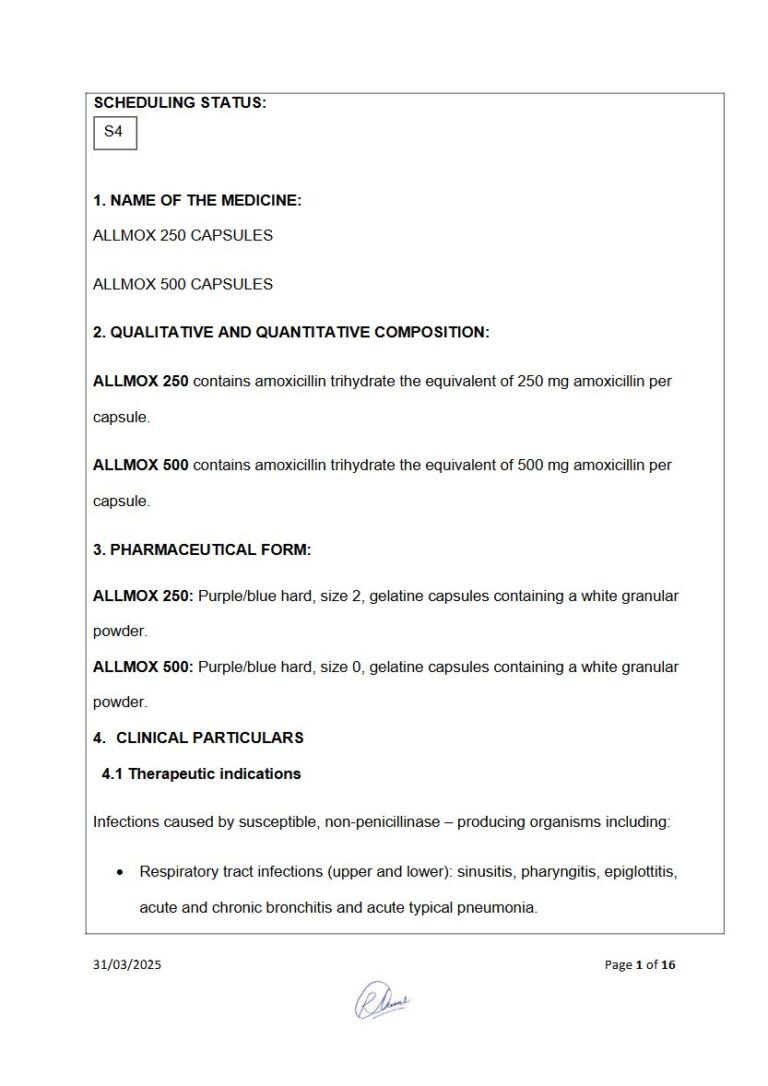
Clinical Summary
Quick overview from the medicine insert
Indication
Infections caused by susceptible, non-penicillinase-producing organisms.
Dosage (summary)
250 mg to 500 mg every 8 hours; Gonorrhoea: 3 g as a single dose.
Special Populations
- Renal impairment
- Hepatic impairment
Pregnancy & Breastfeeding
Limited data show no increased risk in pregnancy; excreted in breast milk, may cause diarrhea in infants.
Key Drug Interactions
- Probenecid
- Allopurinol
- Tetracyclines
- Oral anticoagulants
- Methotrexate
Contraindications
- Hypersensitivity to amoxicillin
- History of severe hypersensitivity to beta-lactams
- Infectious mononucleosis
Common side effects
- Diarrhoea
- Nausea
- Skin rash
- Dizziness
- Convulsions
Counselling Points
- Take with water, do not open capsules
- Monitor for allergic reactions
- Report any severe side effects
- Maintain hydration to prevent crystalluria
Serious warnings
- Serious hypersensitivity reactions
- Convulsions in renal impairment
- Antibiotic-associated colitis
Important Disclaimer
The Allmox Capsules professional information leaflet below is the property of Innovata Pharmaceuticals and is provided on Medinsert exactly as issued, with no.. alterations or editorial changes. We make every effort to keep content current by updating documents as soon as new versions become available. Medinsert serves as a trusted access point for healthcare professionals, but does not replace official sources or clinical judgement. For more details, please read our full disclaimer. read more>>
 Healthcare Professionals Only
This content is for registered healthcare professionals
Sign in or create a free account to read the full package insert.
Free for HPCSA-registered professionals. Powered by Medinsert.
Clinical Particulars
Section 4 of the official insert — extracted exactly as issued, no alterations
4.1 Therapeutic indications
Infections caused by susceptible, non-penicillinase u2013 producing organisms including:
- Respiratory tract infections (upper and lower): sinusitis, pharyngitis, epiglottitis, acute and chronic bronchitis and acute typical pneumonia.
- Otitis media;
- Urinary tract infections;
- Uncomplicated gonococcal infections;
- Meningitis (sensitivity tests must be performed);
- Gastrointestinal infections including salmonella and typhoid;
- Uncomplicated gastro-enteritis and enteric fever;
- Miscellaneous: Skin and soft tissue infections, bacteraemia and as adjunct in the treatment of sepsis caused by gram-negative bacteria.
4.2 Posology and method of administration
Posology
Adults and children over 12 years
- 250 mg to 500 mg every 8 hours depending on the severity of the infection.
- Gonorrhoea: 3 g amoxicillin (e.g. six ALLMOX 500 capsules) as a single dose usually combined with 1 g probenecid.
- In the treatment of beta-haemolytic streptococcal infections, a therapeutic dose should be administered for at least 10 days.
Special Populations
Renal impairment. Patients with renal insufficiency should have their dosage adapted according to creatinine clearance.
Creatinine clearance dosage of amoxicillin (Allmox)
- Creatinine clearance
- Dosage
- > 30 ml / min
- Usual dosage
- 11 u2013 30 ml / min
- 2/3 of usual dose
- >10 ml / min
- 1/3 of usual dose
Method of administration
ALLMOX is for oral use. Swallow with water without opening capsule. Absorption of ALLMOX is unimpaired by food.
4.3 Contraindications
- Hypersensitivity to amoxicillin, to any of the penicillins or to any of the excipients (see section 6.1)
- History of a severe immediate hypersensitivity reaction (e.g. anaphylaxis) to another beta-lactam medicine (e.g. a cephalosporin, carbapenem or monobactam).
- ALLMOX should not be given to patients with infectious mononucleosis, since they are especially susceptible to amoxicillin-induced skin rashes, patients with lymphatic leukaemia and patients with hyperuricaemia being treated with allopurinol, may be at increased risk of developing skin rashes.
4.4 Special warnings and precautions for use
Hypersensitivity reactions
Serious and occasionally fatal hypersensitivity reactions (including anaphylactoid and severe cutaneous adverse reactions) have been reported in patients on penicillin therapy. These reactions are more likely to occur in individuals with a history of penicillin hypersensitivity and in atopic individuals. Hypersensitivity reactions can also progress to Kounis syndrome, a serious allergic reaction that can result in myocardial infarction (see section 4.8). Presenting symptoms of such reactions can include chest pain occurring in association with an allergic reaction to amoxicillin (see section 4.8). If an allergic reaction occurs, ALLMOX therapy must be discontinued, and appropriate alternative therapy instituted.
Non-susceptible microorganisms
Amoxicillin is not suitable for the treatment of some types of infection unless the pathogen is already documented and known to be susceptible or there is a very high likelihood that the pathogen would be suitable for treatment with amoxicillin (see section 5.1). This particularly applies when considering the treatment of patients with urinary tract infections and severe infections of the ear, nose and throat.
Convulsions
Convulsions may occur in patients with impaired renal function or in those receiving high doses or in patients with predisposing factors (e.g. history of seizures, treated epilepsy or meningeal disorders (see section 4.8).
Renal impairment
In patients with renal impairment, the dose should be adjusted according to the degree of impairment (see section 4.2).
Skin reactions
The occurrence at the treatment initiation of a feverish generalised erythema associated with pustula may be a symptom of acute generalised exanthemous pustulosis (AGEP, see section 4.8). This reaction requires amoxicillin discontinuation and contraindicates any subsequent administration.
Jarisch-Herxheimer reaction
The Jarisch-Herxheimer reaction has been reported following amoxicillin treatment of syphilis (see section 4.8). Caution should be used when treating syphilis with amoxicillin. The Jarisch-Herxheimer reaction has been reported following amoxicillin treatment of Lyme disease (see section 4.8). It results directly from the bactericidal activity of amoxicillin on the causative bacteria of Lyme disease, the spirochaete Borrelia burgdorferi. Patients should be reassured that this is a common and usually self-limiting consequence of antibiotic treatment of Lyme disease.
Overgrowth of non-susceptible microorganisms
Prolonged use may result in overgrowth of non-susceptible organisms. Antibiotic-associated colitis has been reported with nearly all antibacterial medicines and may range in severity from mild to life threatening (see section 4.8). Therefore, it is important to consider this diagnosis in patients who present with diarrhoea during, or subsequent to, the administration of any antibiotics. Should antibiotic-associated colitis occur, amoxicillin should immediately be discontinued, a medical practitioner consulted, and an appropriate therapy initiated. Anti-peristaltic medicines are contraindicated in this situation.
Prolonged therapy
Periodic assessment of organ system functions; including renal, hepatic and hematopoietic function is advisable during prolonged therapy. Elevated liver enzymes and changes in blood counts have been reported (see section 4.8).
Anticoagulants
Prolongation of prothrombin time has been reported in patients receiving amoxicillin. Appropriate monitoring should be undertaken when anticoagulants are prescribed concomitantly. Adjustments in the dose of oral anticoagulants may be necessary to maintain the desired level of anticoagulation (see section 4.5 and 4.8).
Crystalluria
In patients with reduced urine output, crystalluria has been observed, predominantly with parenteral therapy. During the administration of high doses of amoxicillin, it is advisable to maintain adequate fluid intake and urinary output in order to reduce the possibility of amoxicillin crystalluria. In patients with bladder catheters, a regular check of patency should be maintained (see section 4.8 and 4.9).
Interference with diagnostic tests
Elevated serum and urinary levels of amoxicillin are likely to affect certain laboratory tests. Due to the high urinary concentrations of amoxicillin, false positive readings are common with chemical methods. It is recommended that when testing for the presence of glucose in urine during amoxicillin treatment, enzymatic glucose oxidase methods should be used. The presence of amoxicillin may distort assay results for estriol in pregnant women.
4.5 Interaction with other medicines and other forms of interaction
Probenecid
Probenecid decreases the renal tubular secretion of amoxicillin. Concomitant use of probenecid may result in increased and prolonged blood levels of amoxicillin.
Allopurinol
Concurrent use of allopurinol during treatment with amoxicillin can increase the likelihood of allergic skin reactions.
Tetracyclines
Tetracyclines and other bacteriostatic medicines may interfere with the bactericidal effects of amoxicillin.
Oral anticoagulants
Oral anticoagulants and penicillin antibiotics have been widely used in practice without reports of interaction. However, in the literature there are cases of increased international normalised ratio (INR) in patients maintained on acenocoumarol or warfarin and prescribed a course of amoxicillin. If co-administration is necessary, the prothrombin time or international normalised ratio should be carefully monitored with the addition or withdrawal of amoxicillin. Moreover, adjustments in the dose of oral anticoagulants may be necessary (see sections 4.4 and 4.8).
Methotrexate
Penicillin may reduce the excretion of methotrexate causing a potential increase in toxicity.
Oral contraceptives
Amoxicillin may decrease the efficacy of oestrogen-containing oral contraceptives. Amoxicillin may affect the absorption of other medicines, due to its effect on the gastrointestinal flora.
4.6 Fertility, pregnancy and lactation
Pregnancy
Animal studies do not indicate direct or indirect harmful effects with respect to reproductive toxicity. Limited data on the use of amoxicillin during pregnancy in humans do not indicate an increased risk of congenital malformations.
Breastfeeding
Amoxicillin is excreted into breast milk in small quantities with the possible risk of sensitisation. Consequently, diarrhoea and fungus infection of the mucous membranes are possible in the breastfed infant, so that breastfeeding might have to be discontinued.
Fertility
There are no data on the effects of amoxicillin on fertility in humans. Reproductive studies in animals have shown no effects on fertility.
4.7 Effects on ability to drive and use machines
Amoxicillin may be associated with allergic reactions, dizziness, and convulsions. Therefore, patients must be cautious when driving or using machines and should be advised not to drive or operate machinery if they experience these symptoms (see section 4.8).
4.8 Undesirable effects
Infections and infestations
Less frequent: Mucocutaneous candidiasis
Blood and lymphatic system disorders
Less frequent: Reversible leukopenia (including severe neutropenia or agranulocytosis), reversible thrombocytopenia and haemolytic anaemia, prolongation of bleeding time and prothrombin time (see section 4.4).
Immune system disorders
Less frequent: Severe allergic reactions, including angioedema, anaphylaxis, serum sickness and hypersensitivity vasculitis (see section 4.4)
Frequency unknown: Jarisch-Herxheimer reaction (see section 4.4)
Nervous system disorders
Less frequent: Hyperkinesia, dizziness and convulsions (see section 4.4)
Gastrointestinal disorders
Frequent: Diarrhoea, nausea
Less frequent: Vomiting, antibiotic associated colitis (including pseudomembraneous colitis and haemorrhagic colitis see section 4.4), black hairy tongue.
Hepato-biliary disorders
Less frequent: Hepatitis and cholestatic jaundice, a moderate rise in AST and/or ALT
Skin and subcutaneous tissue disorders
Frequent: Skin rash
Less frequent: Urticaria, pruritus, skin reactions such as erythema multiforme, Stevens-Johnson syndrome, toxic epidermal necrolysis, bullous and exfoliative dermatitis, acute generalised exanthematous pustulosis (AGEP) (see section 4.4), drug reaction with eosinophilia and systemic symptoms (DRESS)
Frequency unknown: Linear IgA disease
Cardiac Disorders
Frequency unknown: Kounis syndrome
Renal and urinary disorders
Less frequent: Interstitial nephritis, crystalluria (see sections 4.4 and 4.9)
Reporting side effects
Reporting suspected adverse reactions after authorisation of the medicine is important. It allows continued monitoring of the benefit/risk balance of the medicine. Health care providers are requested to report any suspected adverse drug reactions to SAHPRA via the Med Safety APP (Medsafety X SAHPRA) and eReporting platform (who-umc.org) found on SAHPRA website.
4.9 Overdose
Symptoms
Gastrointestinal symptoms (such as nausea, vomiting and diarrhoea) and disturbance of the fluid and electrolyte balances may be evident. Amoxicillin crystalluria, in some cases leading to renal failure, has been observed. Convulsions may occur in patients with impaired renal function or in those receiving high doses (see sections 4.4 and 4.8).
Treatment
Gastrointestinal symptoms may be treated symptomatically, with attention to the water/electrolyte balance. ALLMOX can be removed from the circulation by haemodialysis (see section 4.2).
