
Be-Tabs Ascorbic Acid 500 mg Tablet
PDF Leaflet Revision Date: 16 September 2022
Clinical Summary
Quick overview from the medicine insert
Indication
Treatment of ascorbic acid deficiency, especially scurvy.
Dosage (summary)
500 mg orally twice daily after meals, max 1000 mg/day.
Special Populations
- Renal impairment
- Hyperoxaluria
Pregnancy & Breastfeeding
Caution in pregnancy; excreted in breast milk but not hazardous.
Key Drug Interactions
- Increases renal excretion of amphetamine
- Decreases plasma ascorbate with smoking
- Increases iron absorption
- Interferes with glucose tests
Contraindications
- Hypersensitivity to ascorbic acid
- Hyperoxaluria
Common side effects
- Headache
- Flushing
- Nausea
- Vomiting
- Stomach cramps
- Diarrhoea
Counselling Points
- Take after meals
- Report any unusual symptoms
- Avoid high doses if at risk of hyperoxaluria
Serious warnings
- Tolerance may develop with high doses
- May interfere with serological tests
Important Disclaimer
The Be-Tabs Ascorbic Acid 500 mg Tablet professional information leaflet below is the property of Ranbaxy Pharmaceuticals and is provided on Medinsert exactly as issued, with no.. alterations or editorial changes. We make every effort to keep content current by updating documents as soon as new versions become available. Medinsert serves as a trusted access point for healthcare professionals, but does not replace official sources or clinical judgement. For more details, please read our full disclaimer. read more>>
 Healthcare Professionals Only
This content is for registered healthcare professionals
Sign in or create a free account to read the full package insert.
Free for HPCSA-registered professionals. Powered by Medinsert.
Clinical Particulars
Section 4 of the official insert — extracted exactly as issued, no alterations
4.1 Therapeutic indications
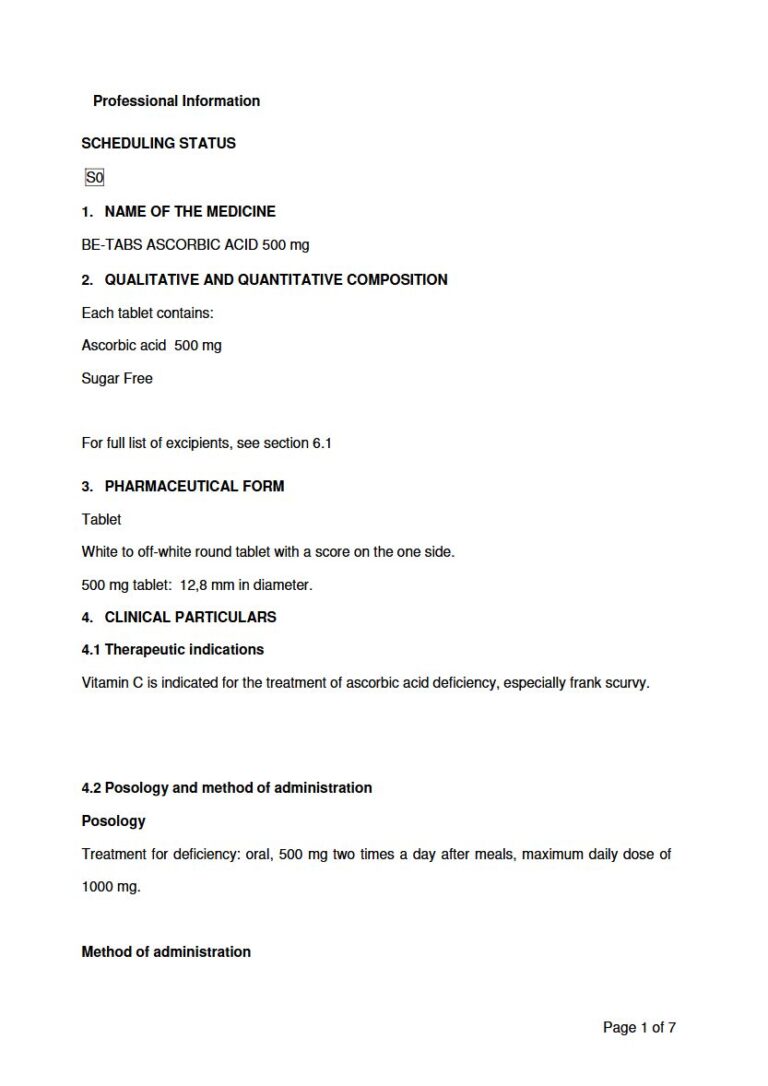
Vitamin C is indicated for the treatment of ascorbic acid deficiency, especially frank scurvy.
4.2 Posology and method of administration
Posology Treatment for deficiency: oral, 500 mg two times a day after meals, maximum daily dose of 1000 mg.
Method of administration For oral administration.
4.3 Contraindications
- BE - TABS ASCORBIC ACID 500 mg is contraindicated in patients with a known hypersensitivity to the active substance, ascorbic acid or to any of the excipients listed in section 6.1,
- Ascorbic acid should be given with care to patients with hyperoxaluria.
4.4 Special warnings and precautions for use
Tolerance may be induced in patients taking high doses. Increased intake of ascorbic acid over a prolonged period may result in increased renal clearance of ascorbic acid, and deficiency may result if the intake is reduced or withdrawn rapidly. (See section 4.8)
Interference with serological testing Ascorbic acid may interfere with tests and assays for urinary glucose, giving false-negative results with methods utilising glucose oxidase with indicator (e.g. Labstix, Testape) and false-positive results with neocuproin methods. Estimation of uric acid by phosphotungstate or uricase with copper reduction and measurement of creatinine in non-deproteinised serum may also be affected. High doses of ascorbic acid may give false-negative readings in faecal occult blood tests.
4.5 Interaction with other medicines and other forms of interaction
Ascorbic acid increases the renal excretion of amphetamine. The plasma concentration of ascorbate is decreased by smoking and oral contraceptives. Ascorbic acid increases the absorption of iron. Concomitant administration of aspirin and ascorbic acid may interfere with absorption of ascorbic acid. Renal excretion of salicylate is not affected and does not lead to reduced anti-inflammatory effects of aspirin.
Concomitant administration of aluminium-containing antacids may increase urinary aluminium elimination. Concurrent administration of antacids and ascorbic acid is not recommended, especially in patients with renal insufficiency. Co-administration with amygdalin (a complementary medicine) can cause cyanide toxicity. Concurrent administration of ascorbic acid with desferrioxamine enhances urinary iron excretion. Cases of cardiomyopathy and congestive heart failure have been reported in patients with idiopathic haemochromatosis and thalassaemias receiving desferrioxamine who were subsequently given ascorbic acid. Ascorbic acid should be used with caution in these patients and cardiac function monitored. Ascorbic acid may interfere with biochemical determinations of creatinine, uric acid and glucose in samples of blood and urine.
4.6 Fertility, pregnancy and lactation
Pregnancy For ascorbic acid no clinical data on exposed pregnancies are available. Animal studies do not indicate direct or harmful effects with respect to pregnancy, embryonal/foetal development, parturition or postnatal development. Pregnant women should exercise caution.
Breast-feeding Ascorbic acid is excreted in breast milk. Though again caution should be exercised, no evidence exists suggesting such excretion is hazardous to the infant.
4.7 Effects on ability to drive and use machines
On the basis of the product's pharmacodynamic profile and reported adverse events, ascorbic acid has no known effect on an individual's ability to drive or operate machinery.
4.8 Undesirable effects
System Organ Class Frequency Unknown Nervous system disorders Headache Vascular disorders Flushing Gastrointestinal disorders Nausea, vomiting and stomach cramps. Large doses of ascorbic acid may cause diarrhoea. Skin and subcutaneous tissue disorders Redness of skin Renal and urinary disorders Patients known to be at risk of hyperoxaluria should not ingest ascorbic acid doses exceeding 1 g daily as there may be increased urinary oxalate excretion. However, such risk has not been demonstrated in normal, non-hyper oxaluric individuals. Increased intake of ascorbic acid over a prolonged period may result in increased renal clearance of ascorbic acid, and deficiency may result if the intake is reduced or withdrawn rapidly. Doses of more than 600mg daily have a diuretic effect. Ascorbic acid has been implicated in precipitating haemolytic anaemia in certain individuals deficient of glucose-6-phosphate dehydrogenase.
Reporting of suspected adverse reactions Reporting suspected adverse reactions after authorisation of the medicine is important. It allows continued monitoring of the benefit/risk balance of the medicine. Health care providers are asked to report any suspected adverse reactions to SAHPRA via the u201c6.04 Adverse Drug Reactions Reporting Formu201d, found online under SAHPRAu2019s publications: https://www.sahpra.org.za/Publications/Index/8
4.9 Overdose
Symptoms At doses of over 3 g per day unabsorbed ascorbic acid is mainly excreted unmetabolised in the faeces. Absorbed ascorbic acid additional to the body's needs is rapidly eliminated. Large doses of ascorbic acid may cause diarrhoea and the formation of renal oxalate calculi. Symptomatic treatment may be required. Ascorbic acid may cause acidosis or haemolytic anaemia in certain individuals with a deficiency of glucose 6-phosphate dehydrogenase. Renal failure can occur with massive ascorbic acid overdosage.
Management Gastric lavage may be given if ingestion is recent otherwise general supportive measures should be employed as required.
