
Tenopress 25 mg, 50 mg, 100 mg Film-coated tablets
PDF Leaflet Revision Date: 20 January 2023
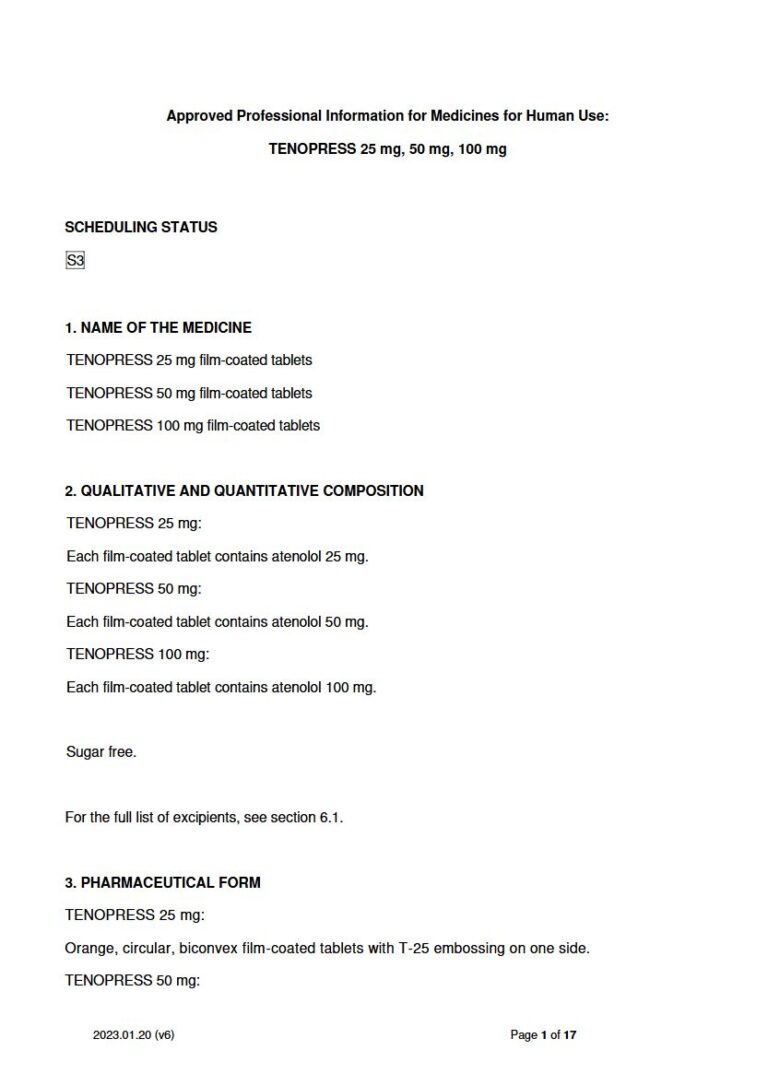
Clinical Summary
Quick overview from the medicine insert
Indication
Management of mild to moderate hypertension and angina pectoris.
Dosage (summary)
Adults: 50 to 100 mg once daily; elderly: 50 mg once daily.
Special Populations
- Elderly
- Renal impairment
Pregnancy & Breastfeeding
Safety not established; may cause fetal growth retardation and neonatal hypotonia.
Key Drug Interactions
- Hypoglycaemic agents
- Phenothiazines
- Antiarrhythmic agents
- Calcium antagonists
Contraindications
- Hypersensitivity to atenolol
- Cardiogenic shock
- Heart block
- Bradycardia
- Severe peripheral arterial disease
Common side effects
- Bradycardia
- Dizziness
- Fatigue
- Cold extremities
- Nausea
Counselling Points
- Monitor heart rate
- Avoid abrupt discontinuation
- Report any signs of severe allergic reactions
Serious warnings
- Caution in asthma
- Risk of rebound hypertension with clonidine withdrawal
- Gradual discontinuation recommended
Important Disclaimer
The Tenopress 25 mg, 50 mg, 100 mg Film-coated tablets professional information leaflet below is the property of Austell Laboratories and is provided on Medinsert exactly as issued, with no.. alterations or editorial changes. We make every effort to keep content current by updating documents as soon as new versions become available. Medinsert serves as a trusted access point for healthcare professionals, but does not replace official sources or clinical judgement. For more details, please read our full disclaimer. read more>>
 Healthcare Professionals Only
This content is for registered healthcare professionals
Sign in or create a free account to read the full package insert.
Free for HPCSA-registered professionals. Powered by Medinsert.
Clinical Particulars
Section 4 of the official insert — extracted exactly as issued, no alterations
4.1 Therapeutic indications
TENOPRESS is indicated for the management of:
- Mild to moderate hypertension.
- Angina pectoris.
4.2 Posology and method of administration
Posology
Adults:
Hypertension: 50 to 100 mg once a daily as a single dose. Additional doses are unlikely to be of any benefit. TENOPRESS may be combined with diuretics or other antihypertensive agents to achieve a further reduction in blood pressure.
Angina pectoris: 50 to 100 mg daily as single or divided doses.
Special populations
Elderly population: May have increased or decreased sensitivity to the effects of the usual adult dose and a dose reduction may be necessary. The usual dose for both indications is 50 mg once daily.
Renal failure: Since TENOPRESS is excreted via the kidneys, dosage should be adjusted in cases of severe impairment of renal function. No significant accumulation of TENOPRESS occurs at a glomerular filtration rate (GFR) greater than 35 mL/min/1,73 m2 (normal range is 100 - 150 mL/min/1,73 m2). For patients with a creatinine clearance of 15 - 35 mL/min/1,73m2 (equivalent to serum creatinine of 300 - 600 micromol/litre) the oral dose should be 50 mg daily or 100 mg once every two days. For patients with a creatinine clearance of < 15 mL/min/1,73 m2 (equivalent to serum creatinine of > 600 micromol/litre) the oral dose should be 25 mg daily or 50 mg on alternate days or 100 mg once every four days. Patients on haemodialysis should be given 50 mg orally after each dialysis; this should be done under hospital supervision as marked falls in blood pressure can occur.
Paediatric population: Safety and efficacy have not been established.
Method of administration: TENOPRESS is for oral use.
4.3 Contraindications
- Hypersensitivity to the atenolol or to any of the excipients listed in section 6.1.
- Cardiogenic shock.
- Second and third-degree heart block.
- Bradycardia less than 50 beats/minute.
- Metabolic acidosis.
- Severe peripheral arterial circulatory disturbances.
- Raynaudu2019s phenomenon.
- Sick sinus syndrome.
- Untreated phaeochromocytoma.
- Hypotension.
- After prolonged fasting.
- Avoid the use of TENOPRESS in cardiac failure unless or until signs of failure are controlled with digitalis or diuretics.
- Beta-blockers should be avoided in uncontrolled heart failure because of their negative inotropic effects, excluding that due to hypertrophic obstructive cardiomyopathy.
- Particular caution should be exercised with patients suffering from the following: asthma, bronchitis, chronic respiratory diseases. Although cardioselective (beta-1) beta-adrenoceptor blocking agents may have less effect on lung function than non-selective beta-adrenoceptor blocking agents, these should be avoided in patients with reversible obstructive airways disease, unless there are compelling clinical reasons for their use.
- In the perioperative period it is generally unwise to reduce the dosage to which the patient is accustomed, as there may be danger of aggravation of angina pectoris or hypertension.
- A patient's normal tachycardic response to hypovolemia or blood loss may be obscured during or after surgery. Particular caution should be taken in this regard.
4.4 Special warnings and precautions for use
- TENOPRESS should be used with caution in patients with: Thyrotoxicosis: Symptoms may be masked.
- First-degree heart block-negative inotropic effect.
- TENOPRESS modifies the tachycardia associated with hypoglycaemia.
- Patients with phaeochromocytoma usually require treatment with alpha-adrenergic blocker.
- Asthma, bronchitis, chronic pulmonary disease.
- Tachycardia responses may be obscured. Particular caution should be taken in this regard.
- Angina attacks: Patients with Prinzmetal's angina may experience an increase in the number and duration of angina attacks due to unopposed alpha-receptor mediated coronary artery vasoconstriction.
- Peripheral arterial circulatory disturbances and less severe peripheral vascular diseases: peripheral circulation may be reduced resulting in a worsening of these conditions and may cause peripheral gangrene.
- If the decision is made to withdraw TENOPRESS before anaesthesia, at least 48 hours should be allowed to elapse between the last dose and surgery. If the medicine is to be continued, care should be taken when using anaesthetics such as ether, cyclopropane and trichloroethylene. Atropine (1-2 mg I.V.) may be used to correct vagal dominance. The patient must be maintained on their usual dosage perioperatively to avoid aggravation of angina pectoris or hypertension.
- The dosage of TENOPRESS should be adjusted in severe renal impairment (see section 4.2).
- Care should be taken in prescribing TENOPRESS together with Class 1 antidysrhythmic agents such as disopyramide, myocardial depressants and inhibitors of AV conduction such as calcium antagonists.
- Caution should be exercised when transferring a patient from clonidine, as the withdrawal of clonidine may result in the release of large amounts of catecholamines that may give rise to a hypertensive crisis. If TENOPRESS is administered in these circumstances, the unopposed alpha receptor stimulation may potentiate this effect. If TENOPRESS and clonidine are given concurrently, the clonidine should not be discontinued until several days after the withdrawal of TENOPRESS as severe rebound hypertension may occur.
- TENOPRESS should be used with caution in combination with verapamil in patients with impaired ventricular function. This combination should not be given to patients with conduction abnormalities. Neither medicine should be administered intravenously within 48 hours of discontinuing the other. The intravenous administration of calcium antagonists and antiarrhythmic agents is not recommended during therapy with TENOPRESS.
- Abrupt discontinuation of therapy may cause exacerbation of angina pectoris in patients suffering from ischaemic heart disease. Discontinuation of therapy should be gradual, and patients should be advised to limit the extent of their physical activity during the period that the medicine is being discontinued.
- Administration to pregnant mothers shortly before giving birth or during labour may result in the newborn infants being born hypotonic, collapsed and hypoglycaemic.
- Will reduce heart rate as a result of its pharmacological action. In the rare instances when a treated patient develops symptoms which may be attributable to a slow heart rate and the pulse rate drops to less than 50 u2013 55 bpm at rest, the dose should be reduced.
- May cause a more severe reaction to a variety of allergens when given to patients with a history of anaphylactic reaction to such allergens. Such patients may be unresponsive to the usual doses of adrenaline (epinephrine) used to treat the allergic reactions.
- May cause a hypersensitivity reaction including angioedema and urticaria.
- Should be used with caution in the elderly, starting with a lesser dose (see Section 4.2).
- Although cardioselective (beta1) beta-blockers may have less effect on lung function than non-selective beta-blockers, as with all beta-blockers, these should be avoided in patients with reversible obstructive airways disease, unless there are compelling clinical reasons for their use. Where such reasons exist, TENOPRESS may be used with caution. Occasionally, some increase in airways resistance may occur in asthmatic patients however, and this may usually be reversed by commonly used dosage of bronchodilators such as salbutamol or isoprenaline.
- It is dangerous to administer this medicine concomitantly with the following medicines: hypoglycaemic agents, phenothiazines and various antiarrhythmic agents. Such drug-drug interactions can have life-threatening consequences.
- SPECIAL NOTE: - digitalisation of patients receiving long-term beta-blocker therapy may be necessary if congestive cardiac failure is likely to develop. This combination can be considered despite the potentiation of the negative chronotropic effect of the two medicines. Careful control of dosages, and of the individual patient's response (and notably pulse rate), is essential in this situation.
4.5 Interaction with other medicines and other forms of interaction
- Care should be taken when using anaesthetic agents with TENOPRESS. The anaesthetist should be informed and the choice of anaesthetic should be an agent with as little negative inotropic activity as possible. Use of TENOPRESS with anaesthetic agents may result in attenuation of the reflex tachycardia and increase the risk of hypotension. Anaesthetic agents causing myocardial depression are best avoided.
- It is dangerous to administer this medicine concomitantly with the following medicines: hypoglycaemic agents, phenothiazines and various antiarrhythmic agents. Such drug-drug interactions can have life-threatening consequences.
- Quinidine, procainamide, lignocaine: Myocardial depressant effects may be enhanced by TENOPRESS.
- Concomitant therapy with dihydropyridines, e.g. nifedipine, may increase the risk of hypotension, and cardiac failure may occur in patients with latent cardiac insufficiency.
- Digitalis glycosides, in association with beta-blockers, may increase atrioventricular conduction time.
- Clonidine: Rebound hypertension can occur with concomitant use, especially following sudden withdrawal of TENOPRESS. If TENOPRESS and clonidine are used together, then clonidine should not be discontinued until several days after the withdrawal of the beta-blocker.
- Disopyramide: since both medicines can cause depressed contractility and conductivity of the heart, severe bradycardia is possible. This medicine-medicine interaction may have life-threatening consequences.
- Calcium blockers: concurrent use may result in severe hypotension and cardiac failure may occur in patients with latent cardiac insufficiency.
- Verapamil: use with caution in patients with impaired ventricular function and /or SA or AV conduction abnormalities. This combination should not be given to patients with conduction abnormalities.
- Sympathomimetics such as adrenaline/epinephrine: May negate the effect of the TENOPRESS.
- Nonsteroidal anti-inflammatory medicines (e.g. indomethacin and ibuprofen) - may decrease the hypotensive effect of beta-blockers).
- Concomitant use with insulin and oral antidiabetic medicines may lead to the intensification of the blood sugar lowering effects of these medicines. Symptoms of hypoglycaemia, particularly tachycardia, may be masked (see section 4.4).
4.6 Fertility, pregnancy and lactation
Safety and efficacy in pregnancy and lactation have not been established. Administration of TENOPRESS to pregnant mothers has been associated with growth retardation of the foetus. Administration of TENOPRESS to pregnant mothers shortly before birth or during labour may result in hypotonia, collapse or hypoglycaemia in the newborn.
4.7 Effects on ability to drive and use machines
TENOPRESS has no or negligible influence on the ability to drive and use machines. However, it should be taken into account that occasionally dizziness or fatigue may occur.
4.8 Undesirable effects
a) Tabulated list of adverse reactions
The table below shows all adverse drug reactions (ADRs) observed during clinical trials and postmarket spontaneous reports with Atenolol.
System Organ Class Frequency Frequent Less Frequent Not known Blood and lymphatic system disorders Blood disorders such as thrombocytopenia, purpura Psychiatric disorders Sleep disturbances of the type noted with other beta-blockers, mood changes, nightmares, confusion, psychoses and hallucinations Depression Nervous system disorders Dizziness, headache, paraesthesia Eye disorders Disturbances of vision, dry eyes Ear and labyrinth disorders Transient hearing loss, Cardiac disorders Bradycardia congestive cardiac failure, heart block, fluid retention, exacerbation of peripheral vascular disease or the development of Raynaud's phenomenon, peripheral gangrene may be precipitated. Vascular disorders Cold extremities Postural hypotension which may be associated with syncope, intermittent claudication may be increased if already present, in susceptible patients, Raynaudu2019s phenomenon Respiratory, thoracic and mediastinal disorders Bronchoconstriction may occur in patients suffering from asthma, bronchitis and other chronic pulmonary diseases. Gastrointestinal disorders Nausea, vomiting, diarrhoea, constipation, mass gain, stomatitis, dry mouth Hepatobiliary disorders Raised liver enzymes. Elevations of transaminase levels, hepatic toxicity including intrahepatic cholestasis Skin and subcutaneous tissue disorders Perspiration, skin rash, alopecia, Psoriasiform skin reactions, exacerbation of psoriasis Hypersensitivity reactions, including angioedema and urticaria Musculoskeletal and connective tissue disorders Muscle cramps, myopathy, skeletal muscle weakness. Lupus-like syndrome Reproductive system and breast disorders sexual impotence. General disorders and administration site conditions Fatigue Investigations An increase in ANA (Antinuclear Antibodies) has been observed, however the clinical relevance of this is not clear
c. Description of selected adverse reactions Adverse reactions are more common in patients with renal decompensation.
Reporting of suspected adverse reactions Reporting suspected adverse reactions after authorisation of the medicine is important. It allows continued monitoring of the benefit/risk balance of the medicine. Healthcare professionals are asked to report any suspected adverse reactions to SAHPRA via the u201c6.04 Adverse Drug Reaction Reporting Formu201d, found online under SAHPRAu2019s publications: https://www.sahpra.org.za/Publications/Index/8 Suspected adverse reactions can also be reported directly to the HCR via [email protected].
4.9 Overdose
Signs and symptoms: Overdosage may produce bradycardia and severe hypotension. Bronchospasm and heart failure may be produced in certain individuals. Cases of overdose should be observed for at least 4 hours, as apnoea and cardiovascular collapse may appear suddenly.
Treatment: Repeated activated charcoal may be necessary in overdose. Atropine may be used to treat severe bradycardia. If the response is inadequate, glucagon may be given intravenously. Alternatively, dobutamine may be required to reverse beta-blockade. Cardiac pacing may be required for severe bradycardia. Bronchospasm should be treated with IV aminophylline or inhaled or IV beta-agonist eg. salbutamol.
