
Ivacid Iv Lyophilised 40 mg Solution
PDF Leaflet Revision Date: 30 September 2024
Clinical Summary
Quick overview from the medicine insert
Indication
Short-term treatment of duodenal ulcer, gastric ulcer, reflux oesophagitis, and Zollinger-Ellison Syndrome.
Dosage (summary)
40 mg IV once daily; max 7 days IV, then switch to oral.
Special Populations
- Elderly
- Renal impairment
- Hepatic impairment
Pregnancy & Breastfeeding
Safety in pregnancy and lactation not established.
Key Drug Interactions
- Atazanavir
- Nelfinavir
- Clopidogrel
- Methotrexate
Contraindications
- Hypersensitivity to pantoprazole
- Severe liver impairment
- Children under 18
Common side effects
- Injection site thrombophlebitis
- Clostridium difficile associated diarrhoea
- Headache
- Dizziness
Counselling Points
- Report any decrease in urine volume
- Monitor for signs of renal function decline
- Avoid driving if experiencing dizziness
Serious warnings
- Gastric malignancy may be masked
- Risk of Clostridium difficile infection
- Acute interstitial nephritis
Important Disclaimer
The Ivacid Iv Lyophilised 40 mg Solution professional information leaflet below is the property of Austell Laboratories and is provided on Medinsert exactly as issued, with no.. alterations or editorial changes. We make every effort to keep content current by updating documents as soon as new versions become available. Medinsert serves as a trusted access point for healthcare professionals, but does not replace official sources or clinical judgement. For more details, please read our full disclaimer. read more>>
 Healthcare Professionals Only
This content is for registered healthcare professionals
Sign in or create a free account to read the full package insert.
Free for HPCSA-registered professionals. Powered by Medinsert.
Clinical Particulars
Section 4 of the official insert — extracted exactly as issued, no alterations
4.1 Therapeutic indications
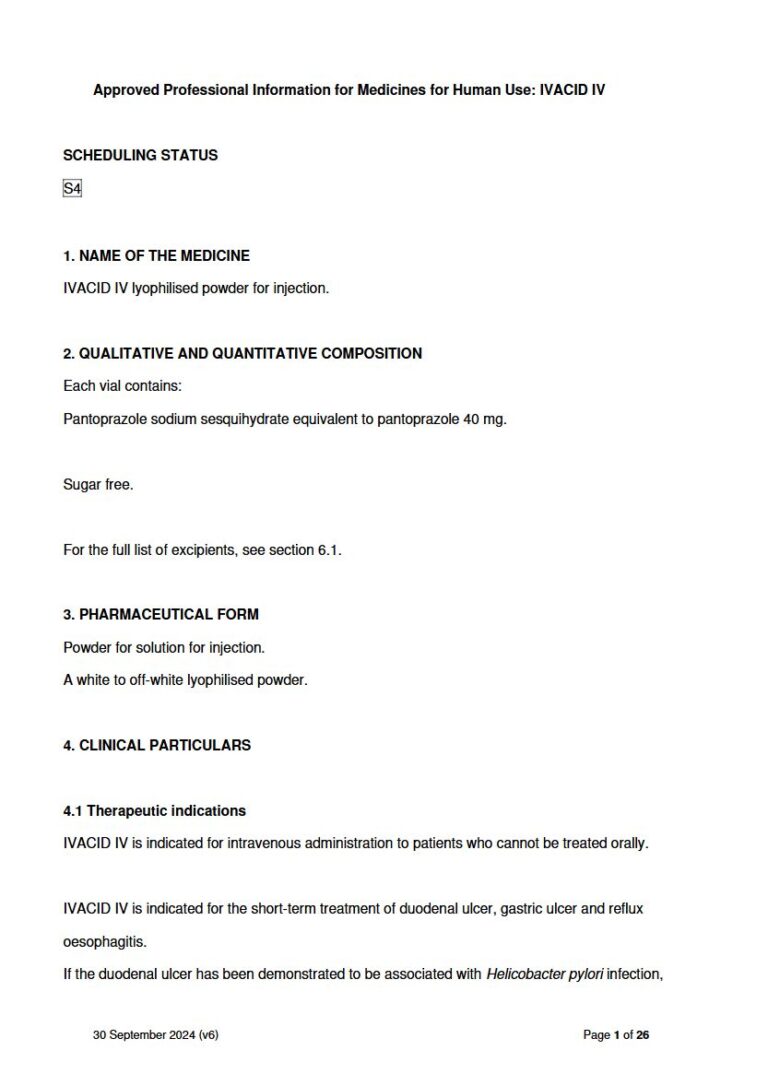
IVACID IV is indicated for intravenous administration to patients who cannot be treated orally. IVACID IV is indicated for the short-term treatment of duodenal ulcer, gastric ulcer and reflux oesophagitis. If the duodenal ulcer has been demonstrated to be associated with Helicobacter pylori infection, IVACID IV used in combination with appropriate antibiotics may be useful. IVACID IV is indicated for the treatment of Zollinger u2013 Ellison Syndrome.
4.2 Posology and method of administration
Posology
The recommended intravenous dose is one vial (pantoprazole 40 mg) IVACID IV per day. IVACID IV is indicated for intravenous administration to patients who cannot be treated orally. IVACID IV may be used intravenously for up to 7 days. As soon as oral therapy is possible, treatment should be replaced with the same oral dose, in compliance with the approved dosage regimen.
Duodenal ulcer
The recommended dose is 40 mg pantoprazole once daily. The total treatment with intravenous and oral pantoprazole should be 2 to 4 weeks. If the duodenal ulcer has been demonstrated to be associated with Helicobacter pylori infections, IVACID IV used in combination with appropriate antibiotics may be useful.
Gastric ulcer
The recommended dose is 40 mg pantoprazole once daily for 4 to 8 weeks. In the case of suspected gastric ulcer, malignancy of the gastric ulcer should be excluded, as treatment could conceal the symptoms and may delay diagnosis.
Reflux oesophagitis
The recommended dose is IVACID IV once daily for 4 to 8 weeks. If gastroesophageal reflux disease (GERD) symptom control has not been achieved after four weeks of treatment with the prescribed daily dose, especially where differentiation of diagnosis of GERD with angina and congestive heart failure is present, further investigation is recommended.
Zollinger-Ellison syndrome
For management of Zollinger-Ellison syndrome patients should start their treatment with a daily dose of 80 mg (2 vials of IVACID IV). Thereafter, the dosage can be titrated up or down as needed using measurements of gastric acid secretions as a guide. With doses above 80 mg daily, the dose should be divided and given twice daily. In case rapid acid control is required, a starting dose of 80 mg pantoprazole (2 vials of IVACID IV) is sufficient to manage a decrease of acid output into the target range (<10 mEq/h) within one hour in the majority of patients. Transition from IVACID IV to the oral formulation should be performed as soon as it is clinically justified.
Long-term treatment
Long-term treatment with IVACID IV is currently not indicated as there are insufficient clinical data.
Special populations
Elderly population
No dosage adjustment is necessary in the elderly.
Renal impairment
No dosage adjustment is required in the presence of impaired renal function (see section 5.2).
Hepatic impairment
A daily dose of 20 mg pantoprazole should not be exceeded in patients with mild to moderate liver impairment (see sections 4.4 and 5.2).
Paediatric population
The safety and efficacy of pantoprazole 40 mg powder for solution for injection, as in IVACID IV in children aged under 18 years have not been established (see section 4.3). Therefore, IVACID IV powder for solution for injection is contraindicated for use in patients below 18 years of age. Currently available data are described in section 5.2 but no recommendation on a posology can be made.
Method of administration
The ready-to-use solution may be administered directly after reconstitution with sodium chloride 9 mg/mL (0,9 %) solution for injection, or it may be further diluted with sodium chloride 9 mg/mL (0,9 %) solution for injection or glucose (5 %) solution for injection before parenteral administration. For instructions for preparation and storage of solution before parenteral administration, see section 6.6. The medicine should be administered intravenously over 2 - 15 minutes.
4.3 Contraindications
- Hypersensitivity to pantoprazole or to any of the excipients listed in section 6.1.
- Safety and efficacy in children have not been established.
- Severely impaired liver function (see section 4.4).
- Safety in pregnancy and lactation has not been established (see section 4.6).
- Concomitant administration with atazanavir or nelfinavir (see sections 4.4 and 4.5).
4.4 Special warnings and precautions for use
Gastric malignancy
Symptomatic response to pantoprazole as in IVACID IV may mask the symptoms of gastric malignancy and may delay diagnosis. In the presence of any alarm symptom (e. g. significant unintentional weight loss, recurrent vomiting, dysphagia, haematemesis, anaemia or melaena) and when gastric ulcer is suspected or present, malignancy should be excluded. Further investigation is to be considered if symptoms persist despite adequate treatment.
Clostridium difficile associated diarrhoea
PPI therapy like IVACID IV may be associated with an increased risk of Clostridium difficile associated diarrhoea (CDAD), especially in hospitalised patients. This diagnosis should be considered for diarrhoea that does not improve (see section 4.8). Patients should use the lowest dose and shortest duration of IVACID IV therapy appropriate to the condition being treated.
Acute interstitial nephritis (AIN) leading to acute kidney injury (AKI) and/or chronic kidney disease
IVACID IV may increase the risk of subclinical acute interstitial nephritis (AIN) associated with proton pump inhibitors (PPIs) leading to chronic renal inflammation and reduced renal function (tubular injury being u201ctubulointerstitial nephritisu201d also called u201cAcute interstitial nephritis (AIN)u201d) (see section 4.8). AIN has been observed in patients taking PPIs, such as IVACID IV, and may occur at any point during PPI therapy. AIN is characterised by an inflammatory reaction within the tubulointerstitial space of the kidney. Acute interstitial inflammatory reactions are associated with damage to the tubulointerstitium and can progress to acute kidney injury (AKI) (acute renal failure). AIN may be drug-related, infectious, systemic, autoimmune, genetic, and idiopathic with the most common cause being related to a medicine or drug exposure. Patients may present with varying signs and symptoms from symptomatic hypersensitivity reactions to non-specific symptoms of decrease renal function (e.g., malaise, nausea, anorexia). A delay in diagnosis and continued use of the PPI can lead to chronic renal failure. Patients on treatment with PPIs must be frequently monitored for renal function and the urine checked for haematuria and/or proteinuria. Patients should be advised to report any decrease in urine volumes or if they suspect that there is blood in their urine. Treatment with PPIs, such as IVACID IV should be discontinued in patients with AIN.
Concomitant administration with atazanavir or nelfinavir
Co-administration of IVACID IV with atazanavir or nelfinavir is contraindicated. Their absorption is dependent on acidic intragastric pH, and concomitant administration with pantoprazole as in IVACID IV causes a significant reduction in their bioavailability (see sections 4.3 and 4.5).
Hepatic impairment
Liver function should be monitored regularly during treatment with IVACID IV, particularly on long-term use. In the case of a rise of the liver enzymes, IVACID IV should be discontinued (see section 4.2).
Bone fractures
Proton pump inhibitors, especially if used in high doses and over long durations (> 1 year), may modestly increase the risk of hip, wrist and spine fracture (see section 4.8), predominantly in older people or in the presence of other recognised risk factors. Observational studies suggest that proton pump inhibitors, such as pantoprazole as in IVACID IV may increase the overall risk of fracture by 10 u2013 40 %. Some of this increase may be due to other risk factors. Patients should use the lowest dose and shortest duration of PPI therapy appropriate to the condition being treated. Patients at risk of osteoporosis should receive care according to current clinical guidelines and they should have an adequate intake of vitamin D and calcium.
Hypomagnesaemia
Severe hypomagnesaemia has been reported in patients treated with PPIs like pantoprazole as in IVACID IV for at least three months, and in most cases for a year. Serious manifestations of hypomagnesaemia such as fatigue, tetany, delirium, convulsions, dizziness and ventricular dysrhythmia can occur but they may begin insidiously and be overlooked. In most affected patients, hypomagnesaemia improved after magnesium replacement and discontinuation of the PPI. For patients expected to be on prolonged treatment or who take PPIs with digoxin or medicines that may cause hypomagnesaemia (e.g. diuretics), health care professionals should consider measuring magnesium levels before starting PPI treatment and periodically during treatment.
Subacute cutaneous lupus erythematosus (SCLE)
Proton pump inhibitors, such as pantoprazole as in IVACID IV are associated with very infrequent cases of SCLE (see section 4.8). If lesions occur, especially in sun exposed areas of the skin, and if accompanied by arthralgia, the patient should seek medical help promptly and the healthcare professional should consider stopping IVACID IV. SCLE after previous treatment with a proton pump inhibitor may increase the risk of SCLE with other proton pump inhibitors.
Vitamin B12 (cyanocobalamin) absorption
Daily treatment with IVACID IV over a long period of time (e.g. longer than 3 years) may lead to malabsorption of cyanocobalamin caused by hypo- or achlorhydria. Cases of cyanocobalamin deficiency under acid-blocking therapy have been reported in the literature. This should be considered when respective clinical symptoms are observed.
Atrophic gastritis
Atrophic gastritis has been noted occasionally in gastric corpus biopsies from patients treated long-term with pantoprazole as in IVACID IV, particularly in patients who were H. pylori positive.
Gastrointestinal infections caused by bacteria
Treatment with IVACID IV may lead to a slightly increased risk of gastrointestinal infections caused by bacteria such as Salmonella and Campylobacter (see section 4.8).
Interactions with diagnostic investigations for neuroendocrine tumours
Increased Chromogranin A (CgA) level may interfere with investigations for neuroendocrine tumours. To avoid this interference, IVACID IV treatment should be stopped for at least 5 days before CgA measurements. If CgA and gastrin levels have not returned to reference range after initial measurement, measurements should be repeated 14 days after cessation of proton pump inhibitor, such as IVACID IV treatment.
Concomitant use of IVACID IV with methotrexate
Concomitant use of PPIs such as IVACID IV with methotrexate (primarily at high dose; see methotrexate prescribing information) may elevate and prolong serum levels of methotrexate and/or its metabolite, possibly leading to methotrexate toxicities. In high-dose methotrexate administration, a temporary withdrawal of the IVACID IV may be considered in some patients (see section 4.5).
Intravenous use
IVACID IV is for intravenous route only and must not be given by any other route.
Mild gastrointestinal complaints
IVACID IV is not indicated for mild gastrointestinal complaints such as nervous dyspepsia.
Reflux oesophagitis
Diagnosis of reflux oesophagitis should be confirmed by endoscopy.
4.5 Interaction with other medicines and other forms of interaction
Effects of pantoprazole on the pharmacokinetics of other substances
Active substances with pH dependent absorption
Because of profound and long-lasting inhibition of gastric acid secretion, pantoprazole as in IVACID IV may interfere with the absorption of other medicines where gastric pH is an important determinant of oral bioavailability.
Atazanavir or nelfinavir
Co-administration of atazanavir and other HIV medicines whose absorption is pH-dependent with proton-pump inhibitors might result in a substantial reduction in the bioavailability of these HIV medicines and might impact the efficacy of these medicines (see section 4.4). Therefore, the co-administration of proton pump inhibitors, such as IVACID IV with atazanavir or nelfinavir is contraindicated. If the combination of HIV protease inhibitors with a proton pump inhibitor is judged unavoidable, close clinical monitoring (e.g. virus load) is recommended. A pantoprazole dose of 20 mg per day should not be exceeded. Dosage of the HIV protease inhibitor may need to be adjusted.
Other active substances
The absorption of medicines whose absorption is pH dependent, e.g. ketoconazole, itraconazole, posaconazole, ampicillin esters, iron salts and other medicines such as erlotinib is significantly reduced and thus clinical efficacy may be impaired when they are taken concomitantly with PPIs such as pantoprazole as in IVACID IV.
Substances metabolised by CYP2C19 and CYP3A4
Pantoprazole, the active ingredient of IVACID IV is metabolised in the liver via the cytochrome P450 enzyme system. The main metabolic pathway is demethylation by CYP2C19 and other metabolic pathways include oxidation by CYP3A4. Interaction studies with medicines also metabolized with these pathways, like carbamazepine, glibenclamide, nifedipine, and an oral contraceptive containing levonorgestrel and ethinyl oestradiol, did not reveal clinically significant interactions. An interaction of pantoprazole with other medicines or compounds which are metabolised using the same enzyme system cannot be excluded.
Substances metabolised by CYP2C19
The metabolism of concomitant pro-drugs or active substances also metabolised by CYP2C19, may be decreased and the systemic exposure to these active substances decreased or increased, respectively. Examples of such a pro-drug is clopidogrel and of active substances are R-warfarin and other vitamin K antagonists, cilostazol, diazepam and phenytoin.
Clopidogrel
Clopidogrel is metabolised to its active metabolite in part by CYP2C19. Co-administration of clopidogrel and proton pump inhibitors like pantoprazole as in IVACID IV, which inhibits CYP2C19 metabolism may result in a significant decreased exposure to the active metabolite of clopidogrel with a resultant decrease in inhibition of platelet aggregation and thus reduce the antiplatelet effect of clopidogrel. As a precaution, concomitant use of pantoprazole and clopidogrel should be discouraged.
Diazepam
Pantoprazole as in IVACID IV may prolong the elimination of diazepam.
Phenytoin
Pantoprazole as in IVACID IV may prolong the elimination of phenytoin. Monitoring phenytoin plasma concentration is recommended.
Coumarin anticoagulants
The response to anticoagulants such as warfarin may be affected by any concomitant medication. Co-administration of pantoprazole as in IVACID IV with warfarin or phenoprocoumon did not affect the pharmacokinetics of warfarin, phenoprocoumon or INR. However, there have been reports of increased INR and prothrombin time in patients receiving PPIs and warfarin or phenoprocoumon concomitantly as pantoprazole as in IVACID IV may prolong the elimination of warfarin. Increases in INR and prothrombin time may lead to abnormal bleeding, and even death. It is therefore good practice to monitor the patient with additional PT (prothrombin time) / INR (International normalised ratio) determinations when IVACID IV is initiated, discontinued or taken irregularly.
Active substances metabolised by CYP3A4
Tacrolimus
Concomitant administration of pantoprazole, as in IVACID IV may decrease the CYP3A4 metabolism and increase the blood levels of tacrolimus in some people. A reinforced monitoring of tacrolimus concentrations as well as renal function (creatinine clearance) should be performed, and dosage of tacrolimus adjusted if needed.
Unknown mechanism
Methotrexate
Concomitant use of high dose methotrexate (e.g. 300 mg) and proton-pump inhibitors, such as pantoprazole as in IVACID IV has been reported to elevate and prolong serum levels of methotrexate and/or its metabolite hydroxymethotrexate in some patients (see section 4.4). Therefore in settings where high-dose methotrexate is used, for example cancer and psoriasis, a temporary withdrawal of pantoprazole may need to be considered.
Effects of other active substances on the pharmacokinetics of pantoprazole
Inhibitors of CYP2C19 and/or CYP3A4
Since pantoprazole is metabolised by CYP2C19 and CYP3A4, active substances known to inhibit CYP2C19 or CYP3A4 (such as voriconazole, fluvoxamine) may lead to increased pantoprazole serum levels by decreasing pantoprazole's rate of metabolism. A dose reduction may be considered for patients treated long-term with high doses of pantoprazole, or those with hepatic impairment. The plasma concentration of both pantoprazole as in IVACID IV and voriconazole may be increased.
Inducers of CYP2C19 and/or CYP3A4
Enzyme inducers affecting CYP2C19 and CYP3A4 such as rifampicin and St Johnu00b4s wort (Hypericum perforatum) may reduce the plasma concentrations of PPIs such as pantoprazole as in IVACID IV that are metabolized through these enzyme systems.
Other interactions
Concomitant administration with medicines that may cause hypomagnesaemia
Proton pump inhibitors including, pantoprazole as in IVACID IV, can cause hypomagnesaemia when used for a prolonged period, and the risk may be further increased when combined with other medicines that also have this effect. For patients expected to be on prolonged treatment or who take IVACID IV with medicines that may cause hypomagnesaemia such as digoxin, tacrolimus or diuretics, measuring of magnesium levels before starting IVACID IV treatment and periodically during treatment should be considered (see section 4.4).
False Positive Urine Tests for THC
There have been reports of false positive urine screening tests for tetrahydrocannabinol (THC) in patients receiving proton pump inhibitors, such as pantoprazole as in IVACID IV. An alternative confirmatory method should be considered to verify positive results.
Food
Concomitant intake of food has no influence on the bioavailability.
Antacids
There are no interactions with concomitantly administered antacids.
4.6 Fertility, pregnancy and lactation
Pregnancy
Safety in pregnancy has not been established (see section 4.3).
Breastfeeding
Excretion of pantoprazole into human milk has been reported. Safety during lactation has not been established (see section 4.3).
Fertility
It has been reported that there was no evidence of impaired fertility following the administration of pantoprazole in animal studies.
4.7 Effects on ability to drive and use machines
Adverse reactions such as dizziness and visual disturbances and somnolence may occur. Patients should be advised, particularly at the initiation of therapy, against taking charge of vehicles or machinery or performing potentially hazardous tasks where loss of concentration could lead to accidents.
4.8 Undesirable effects
a) Summary of the safety profile
It is reported that the most common side effects are benign fundic gland polyps and injection site thrombophlebitis.
b) Tabulated list of adverse reactions
The table below shows all adverse drug reactions (ADRs) observed during clinical trials and postmarket spontaneous reports with pantoprazole.
System Organ Class Frequency Frequent Less Frequent Not known
Infections and infestations Clostridium difficile associated diarrhoea (CDAD)
Blood and lymphatic system disorders agranulocytosis, thrombocytopenia; leukopenia; pancytopenia
Immune system disorders hypersensitivity (including anaphylactic reactions and anaphylactic shock)
Metabolism and nutrition disorders hyperlipidaemias and lipid increases (triglycerides, cholesterol); weight changes hyponatraemia; hypomagnesaemia (see section 4.4); hypocalcaemia (1); hypokalaemia
Psychiatric disorders sleep disorders, depression (and all aggravations), disorientation (and all aggravations) hallucination; confusion (especially in predisposed patients, as well as the aggravation of these symptoms in case of pre-existence)
Nervous system disorders headache; dizziness, taste disorders paraesthesia
Eye disorders disturbances in vision/blurred vision
Gastrointestinal disorders fundic gland polyps (benign) diarrhoea; nausea/vomiting; abdominal distension and bloating; constipation; microscopic colitis
dry mouth; abdominal pain and discomfort
Hepatobiliary disorders liver enzymes increased (transaminases, u03b3 -gt), bilirubin increased hepatocellular injury; jaundice; hepatocellular failure
Skin and subcutaneous tissue disorders rash/exanthema/eruption; pruritus, urticaria; angioedema Stevens-Johnson syndrome; Lyell syndrome (toxic epidermal necrolysis); erythema multiforme; photosensitivity; subacute cutaneous lupus erythematosus (see section 4.4)
Musculoskeletal and connective tissue disorders fracture of the hip, wrist or spine (see section 4.4), arthralgia; myalgia muscle spasm (2)
Renal and urinary disorders interstitial nephritis (with possible progression to renal failure)
Reproductive system and breast disorders gynaecomastia
General disorders and administration site conditions injection site thrombophlebitis asthenia, fatigue and malaise, body temperature increased; peripheral oedema
1 Hypocalcaemia in association with hypomagnesemia 2 Muscle spasm as a consequence of electrolyte disturbance
4.9 Overdose
There are no known symptoms of overdosage in man. Systemic exposure with up to 240 mg administered intravenously over 2 minutes, were well tolerated. As pantoprazole is extensively protein bound, it is not readily dialysable. In the case of an overdose with clinical signs of intoxication, apart from symptomatic and supportive treatment, no specific therapeutic recommendations can be made.
