
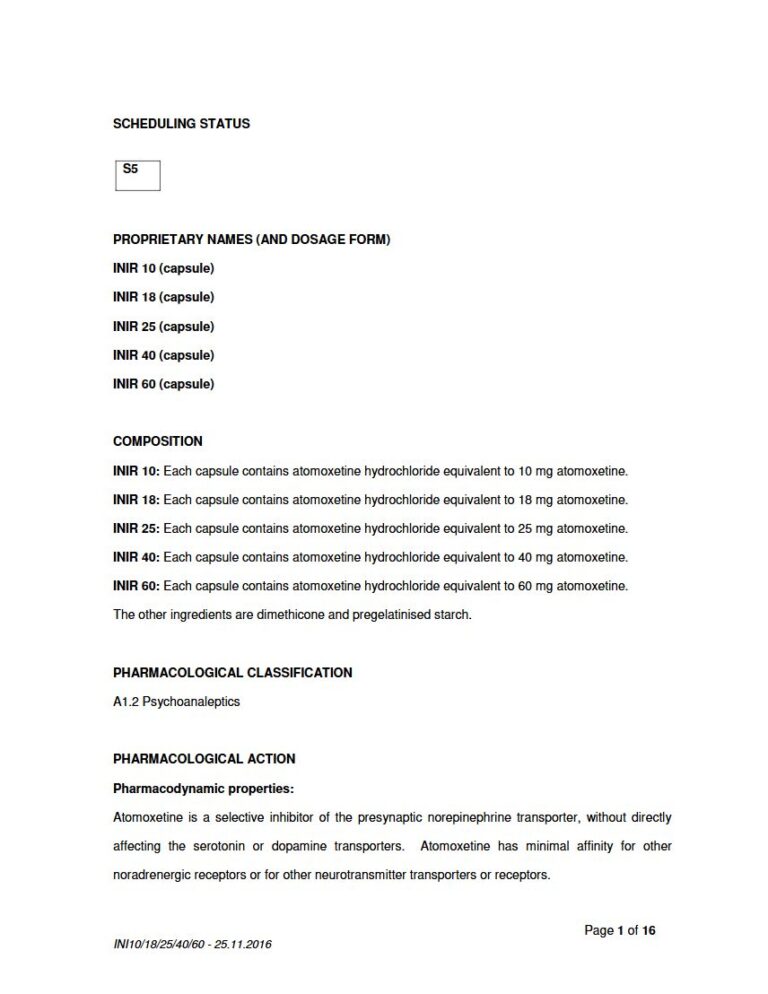
Inir 10mg, 18mg, 25mg, 40mg, 60mg Capsule
PDF Leaflet Revision Date: 25 November 2016
Clinical Summary
Quick overview from the medicine insert
Indication
Treatment of ADHD in children 6 years and older, adolescents, and adults.
Dosage (summary)
Children <70 kg: 0.5 mg/kg, maintenance 1.2 mg/kg/day; Adults: Initiate at 40 mg, maintenance 80 mg.
Onset of Action / Duration
Onset: 1-2 hours, Duration: Not specified.
Special Populations
- Hepatic impairment
- End-stage renal disease
Pregnancy & Breastfeeding
No adequate studies in pregnancy; unknown if excreted in human milk.
Key Drug Interactions
- MAOIs
- Beta-adrenergic agonists
- CYP2D6 inhibitors
Contraindications
- Hypersensitivity to atomoxetine
- Uncontrolled hypertension
- Narrow angle glaucoma
Common side effects
- Decreased appetite
- Suicidal ideation
- Mood swings
- Dizziness
- Palpitations
Counselling Points
- Monitor for mood changes
- Use caution when driving
- Do not open capsules
- Report jaundice or liver symptoms
Serious warnings
- Risk of suicidal behavior
- Liver injury
- Mood swings
- Cardiovascular effects
Important Disclaimer
The Inir 10mg, 18mg, 25mg, 40mg, 60mg Capsule professional information leaflet below is the property of Dr Reddy’S Laboratories and is provided on Medinsert exactly as issued, with no.. alterations or editorial changes. We make every effort to keep content current by updating documents as soon as new versions become available. Medinsert serves as a trusted access point for healthcare professionals, but does not replace official sources or clinical judgement. For more details, please read our full disclaimer. read more>>
 Healthcare Professionals Only
This content is for registered healthcare professionals
Sign in or create a free account to read the full package insert.
Free for HPCSA-registered professionals. Powered by Medinsert.
Clinical Particulars
Section 4 of the official insert — extracted exactly as issued, no alterations
4.1 Therapeutic indications
INIR is indicated for: The treatment of Attention-Deficit/Hyperactivity Disorder (ADHD) in children 6 years of age or older, adolescents and adults.
4.2 Posology and method of administration
Do not exceed the recommended daily dose and subsequent increases, as potentially serious side effects could result with overdosing. INIR capsules should not be opened. In the event of the capsule contents coming into contact with the eye, the eyes should be immediately flushed with water and medical advice obtained. Hands and any contaminated surfaces should be washed as soon as possible.
Dosing of children and adolescents up to 70 kg body weight: INIR should be initiated at a total dose of approximately 0,5 mg/kg. The initial dose should be maintained for a minimum of 7 days prior to upward dose titration according to clinical response and tolerability. The recommended maintenance dose is approximately 1,2 mg/kg/day (depending on the patientu2019s weight and available dosage strengths of INIR). No additional benefit has been demonstrated for doses higher than 1,2 mg/kg/day. Treatment must be initiated by or under the supervision of a medical practitioner with appropriate knowledge and experience of childhood and/or adolescent behavioural disorders (for example, paediatrician or child/adolescent psychiatrist).
Dosing of children and adolescents over 70 kg body weight and adults: INIR should be initiated at a total daily dose of 40 mg. The initial dose should be maintained for a minimum of 7 days prior to upward dose titration according to clinical response and tolerability. The recommended maintenance dose is 80 mg. No additional benefit has been demonstrated for doses higher than 80 mg. Treatment must be initiated by or under the supervision of a medical practitioner with appropriate knowledge and experience of adult ADHD, e.g. a psychiatrist.
General dosing information: INIR may be taken with or without food. For those ADHD patients who have hepatic insufficiency or end-stage renal disease, cautious titration of INIR to the desired clinical response is recommended. Atomoxetine clearance may be reduced in patients with hepatic insufficiency. INIR may exacerbate hypertension in patients with end-stage renal disease. INIR may be discontinued without tapering the dose. Long-term use: No fixed dose-response studies have been conducted in adults. The recommended daily dose of 80 mg reflects the optimal daily dose of 1,2 mg/kg/day demonstrated in children and adolescents. No controlled long-term studies have been conducted in adults. Missing a dose: If patients miss a dose, they should take it as soon as possible; however, they should not take more than the prescribed total daily amount of INIR in a 24-hour period.
4.3 Contraindications
INIR should not be used in:
- Patients with a hypersensitivity to atomoxetine or to any of the excipients of INIR.
- Patients with uncontrolled hypertension or impairment of liver function.
- Combination with monoamine oxidase inhibitors (MAOIs). INIR should not be used within a minimum of 2 weeks after discontinuing therapy with MAOIs. Treatment with MAOIs should not be initiated within 2 weeks after discontinuing INIR.
- Narrow angle glaucoma: In clinical studies, the use of INIR was associated with an increased risk of mydriasis and therefore its use is not recommended in patients with narrow angle glaucoma.
4.4 Special warnings and precautions for use
Allergic events: allergic reactions including rash, angioedema and urticaria, have been reported in patients taking INIR. Suicide-related behaviour (suicide attempts and suicidal ideation), hostility (predominantly aggression, oppositional behaviours and anger) and emotional lability: has been reported in patients treated with INIR. Patients should be monitored for the appearance and worsening of such behaviours. The possibility of serious psychiatric adverse events cannot be excluded. There is evidence that the risk of psychiatric adverse events is increased in children with a personal history of mood disorders, or who have a family history of mood disorders. Mood swings: INIR may increase the risk of mood swings including hostility and emotional lability. Hepatic effects: INIR should be discontinued in patients with jaundice or laboratory evidence of liver injury and should not be restarted. Rarely, liver toxicity manifested by elevated hepatic enzymes and bilirubin with jaundice, has been reported. Signs and symptoms likely to indicate liver involvement include, pruritus, dark urine, jaundice, right upper quadrant tenderness or unexplained u201cflu-likeu201d symptoms. Laboratory testing to determine liver enzyme levels and bilirubin should be done upon the first sign or symptom of possible liver involvement. Due to the seemingly idiosyncratic nature of the liver injury, routine monitoring of liver function is unlikely to be helpful in minimising the risk of such reactions. Depression: INIR lacks efficacy as treatment modality in depression. Growth and development: Weight gain and longitudinal growth should be monitored during treatment with INIR. Cardiovascular effects: Many patients taking INIR experience a modest increase in pulse (mean <10 bpm) and/or increase in blood pressure (mean <5 mm Hg). INIR should be used with caution in patients with hypertension, tachycardia, cardiovascular or cerebrovascular disease. Orthostatic hypotension has also been reported. Use with caution in any condition that may predispose patients to hypotension, or conditions associated with abrupt heart rate or blood pressure changes. Paediatric use: The safety and efficacy of INIR in paediatric patients less than 6 years of age have not been established. The efficacy of atomoxetine beyond 18 months of treatment and safety of INIR beyond 2 years of treatment have not been systematically evaluated. Geriatric use: The safety and efficacy of INIR in geriatric patients have not been established. Effects on the ability to drive and use machines: Patients should be advised to use caution when driving a car or operating hazardous machinery until they are reasonably certain that their performance is not affected by INIR.
4.5 Interactions with other medicines
Monoamine oxidase inhibitors (MAOIs): See u2018CONTRA-INDICATIONSu2019. Interactions with other medicines and other forms of interaction: Beta-adrenergic receptor agonists: INIR should be administered with caution to patients being treated with systemically administered (oral, inhaled or intravenous) salbutamol or other u03b2-2 agonists, because the action of salbutamol on the cardiovascular system can be potentiated. Cytochrome P450 enzyme: Atomoxetine did not cause clinically significant inhibition of induction of cytochrome P450 enzymes, including CYP1A2, CYP3A, CYP2D6 and CYP2C9. Atomoxetine is principally metabolised by the CYP2D6 pathway. In CYP2D6 extensive metabolisers, inhibitors of CYP2D6 increase atomoxetine steady-state plasma concentrations to exposures similar to those observed in CYP2D6 poor metabolisers. In vitro studies suggest that co-administration of cytochrome P450 inhibitors to CYP2D6 poor metabolisers will not increase the plasma concentrations of atomoxetine. Slower titration of atomoxetine may be necessary. No dosage adjustment of INIR is required when co-administered with CYP2D6 inhibitors. Methylphenidate: Co-administration of methylphenidate with INIR did not increase cardiovascular effects beyond those seen with methylphenidate administration alone. Pressor medicines: Because of possible effects on blood pressure, INIR should be used cautiously with pressor medicines. Medicines that affect gastric pH: Medicines that elevate gastric pH (magnesium hydroxide/aluminium hydroxide, omeprazole) had no effect on atomoxetine bioavailability. Alcohol: Consumption of ethanol with INIR did not change the intoxicating effects of ethanol. Midazolam: Co-administration of INIR (60 mg BID for 12 days) with midazolam, a model compound for CYP3A4 metabolised medicines (single dose of 5 mg), resulted in 15 % increase in AUC of midazolam. No dose adjustment is recommended for medicines metabolized by CYP3A. Medicines that affect norepinephrine (noradrenaline): Medicines that affect norepinephrine should be used cautiously when co-administered with INIR because of the potential for additive or synergistic pharmacological effects. Medicines highly bound to plasma protein: In vitro medicine-displacement studies were conducted with INIR and other highly bound medicines at therapeutic concentrations. INIR did not affect the binding of warfarin, acetylsalicylic acid, phenytoin or diazepam to human albumin. Similarly, these compounds did not affect the binding of INIR to human albumin.
4.6 Fertility, pregnancy and lactation
Pregnancy: No adequate and well-controlled studies have been conducted with INIR in pregnant women. Lactation: INIR and/or its metabolites were excreted in the milk of rats. It is not known if INIR is excreted in human milk.
4.7 Effects on ability to drive and use machines
Patients should be advised to use caution when driving a car or operating hazardous machinery until they are reasonably certain that their performance is not affected by INIR.
4.8 Undesirable effects
Table 1: Side effects in Child and Adolescent patients
System Organ Class/Adverse Event Frequent Less frequent Infections and Infestations Influenza x Metabolism and Nutritional Disorders Anorexia (loss of appetite) x Decreased appetite x Psychiatric Disorders Suicidal ideation* x Suicidal behavior x Aggression/hostility* x Anger* x Early morning awakening x Irritability x Mood swings x Agitation x Anxiety x Depression and depressed mood x Tics x Emotional lability x Psychosis (including hallucinations) x Nervous System Disorders Dizziness x Headache x Somnolence 2 x Syncope x Tremor x Migraine x Paraesthesia x Hypoaesthesia x Seizure x Eye Disorders Mydriasis x Blurred vision x Cardiac Disorders Palpitations x Sinus tachycardia x QT interval prolongation x Vascular disorders Raynaudu2019s phenomenon x Respiratory, thoracic and mediastinal disorders Dyspnoea x Gastrointestinal Disorders Abdominal pain 1 x Constipation x Dyspepsia x Nausea x Vomiting x Hepatobiliary disorders Increased blood bilirubin x Abnormal/increased liver function tests x Jaundice x Hepatitis x Liver injury x Acute hepatic failure x Skin and Subcutaneous Tissue Disorders Dermatitis x Pruritus x Rash x Hyperhidrosis x Allergic reactions x Renal and urinary disorders Urinary hesitation x Urinary retention x Reproductive system and breast disorders Priapism x Male genital pain x General Disorders and Administration Site Conditions Asthenia x Fatigue x Lethargy x Chest pain x Investigations Decreased weight x Increased heart rate x Increased blood pressure x 1 Also includes upper abdominal pain, stomach and epigastric discomfort 2 Also includes sedation
Table 2: Side effects in Adult patients
System Organ Class/Adverse Event Frequent Less frequent Metabolism and nutrition disorders Decreased weight x Psychiatric Disorders Early morning awakening x Decreased libido x Sleep disorder x Insomnia x Suicide-related events x Aggression/hostility* x Agitation x Anxiety x Depression and depressed mood x Tics x Emotional lability x Restlessness x Psychosis (including hallucinations) x Nervous System Disorders Dizziness x Insomnia 2 x Paraesthesia x Sinus headache x Headache x Dysgeusia x Somnolence (including sedation) x Tremor x Syncope x Migraine x Hypoaesthesia x Seizure x Eye Disorders Blurred vision x Cardiac Disorders Palpitations x Tachycardia x QT interval prolongation x Vascular Disorders Hot flushes x Flushing x Peripheral coldness x Raynaudu2019s phenomenon x Respiratory, thoracic and mediastinal disorders Dyspnoea x Gastrointestinal Disorders Abdominal pain 1 x Constipation x Dry mouth x Dyspepsia x Flatulence x Nausea x Hepatobiliary disorders Abnormal/increased liver function tests x Jaundice x Hepatitis x Liver injury x Acute hepatic failure x Increased blood bilirubin x Skin and Subcutaneous Tissue Disorders Rash x Hyperhidrosis x Dermatitis x Allergic reactions x Pruritis x Urticaria x Musculoskeletal and connective tissue disorders Muscle spasms x Renal and Urinary Disorders Difficulty in micturition x Urinary hesitation x Urinary retention x Dysuria x Pollakiuria x Micturition urgency x Reproductive System and Breast Disorders Dysmenorrhoea x Ejaculation disorder x Ejaculation failure x Erectile disturbance x Menstruation irregular x Prostatitis x Male genital pain x Abnormal orgasm x Priapism x General Disorders and Administration Site Conditions Fatigue x Chills x Asthenia x Lethargy x Feeling jittery x Irritability x Thirst x Feeling cold x Chest pain x Investigations Increased blood pressure x Increased heart rate x Decreased weight x 1 Also includes upper abdominal pain, stomach and epigastric discomfort 2 Also includes sedation *Post-marketing experience: The following events have been reported: aggression, hostility, suicidal ideation, anger, suicidal behavior, abnormal liver function tests, jaundice and hepatitis* (see u2018WARNINGS AND SPECIAL PRECAUTIONSu2019). Investigations: increased blood pressure. Vascular disorders: peripheral vascular instability and/or Raynaudu2019s phenomenon, potential to worsen pre-existing Raynaudu2019s phenomenon. Urogenital system: painful or prolonged penile erection, male genital pain, urinary hesitation and urinary retention in children and adolescents. Nervous system disorders: syncope, paraesthesia in children and adolescents, hypoaesthesia. Psychiatric disorders: sensory disturbances including hallucinations. General disorders and administration site conditions: lethargy.
4.9 Overdose
Human experience: The most commonly reported symptoms accompanying acute and chronic overdoses were somnolence, agitation, hyperactivity, abnormal behaviour and gastrointestinal symptoms. Signs and symptoms consistent with mild to moderate sympathetic nervous system activation (e.g. mydriasis, tachycardia, dry mouth) have also been observed. In some cases of overdose, seizures have been reported. There have also been reports of fatal acute overdose involving a mixed ingestion of INIR and at least one other medicine.
Management of overdose: An airway should be established. Monitoring of cardiac and vital signs is recommended, along with appropriate symptomatic and supportive measures. Gastric lavage may be indicated if performed soon after ingestion. Activated charcoal may be useful in limiting absorption. Because INIR is highly protein-bound, dialysis is not likely to be useful in the treatment of overdose.
