
Zithromax Suspension 200mg / 5ml Suspension
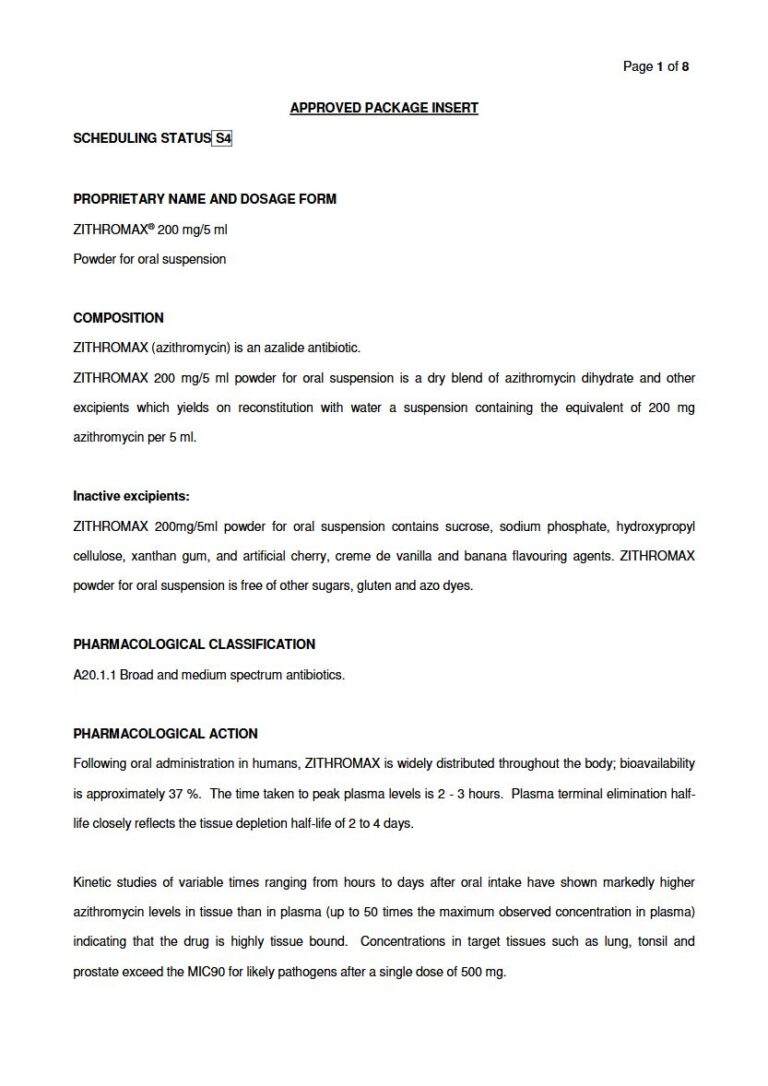
PDF Leaflet Revision Date: 20 September 1993
Clinical Summary
Quick overview from the medicine insert
Indication
Indicated for mild to moderate infections caused by susceptible organisms.
Dosage (summary)
Adults: 500 mg once daily. Children: 10 mg/kg once daily for 3 days.
Onset of Action / Duration
Onset: 2-3 hours, Duration: 2-4 days
Special Populations
- Hepatic impairment
- Renal impairment
- Children under 1 year
Pregnancy & Breastfeeding
Safety in pregnancy and lactation not established.
Key Drug Interactions
- Ergot derivatives
- Antacids
- Digoxin
- Warfarin
Contraindications
- Hypersensitivity to azithromycin
- Hepatic disease
Common side effects
- Nausea
- Vomiting
- Diarrhoea
- Abdominal pain
- Allergic reactions
Counselling Points
- Take with food
- Shake well before use
- Monitor for allergic reactions
Serious warnings
- Serious allergic reactions
- Pseudomembranous colitis
Important Disclaimer
The Zithromax Suspension 200mg / 5ml Suspension professional information leaflet below is the property of Pfizer and is provided on Medinsert exactly as issued, with no.. alterations or editorial changes. We make every effort to keep content current by updating documents as soon as new versions become available. Medinsert serves as a trusted access point for healthcare professionals, but does not replace official sources or clinical judgement. For more details, please read our full disclaimer. read more>>
 Healthcare Professionals Only
This content is for registered healthcare professionals
Sign in or create a free account to read the full package insert.
Free for HPCSA-registered professionals. Powered by Medinsert.
Clinical Particulars
Section 4 of the official insert — extracted exactly as issued, no alterations
4.1 Therapeutic indications
Children : 1 year and over (under 45 kg) ZITHROMAX is indicated for pharyngitis/tonsillitis and otitis media caused by susceptible organisms. Adults and children over 45 kg : ZITHROMAX is indicated for mild to moderate infections caused by susceptible organisms; in lower respiratory tract infections including bronchitis due to Haemophilus influenzae, Moraxella catarrhalis, Streptococcus pneumoniae or Staphylococcus aureus and pneumonia due to Streptococcus pneumoniae or Haemophilus influenzae; uncomplicated skin and soft tissue infections; sinusitis due to Haemophilus influenzae, Streptococcus pneumoniae or Staphylococcus aureus; and as an alternative to first line therapy of pharyngitis/tonsillitis.
4.2 Posology and method of administration
ZITHROMAX 200 mg/5 ml powder for oral suspension should be administered as a single daily dose ZITHROMAX suspension should be administered to children using the 5 ml oral dosing syringe or the spoon provided. ZITHROMAX suspension can be taken with food.
Reconstituting instructions for ZITHROMAX 200 mg/5 ml powder for oral suspension for 15 ml and 30 ml bottles: The table below indicates the volume of water to be used for constitution:
- Amount of water to be added
- Total deliverable volume (azithromycin content)
- Azithromycin concentration after reconstitution
9 ml 15 ml (600 mg) 200 mg/5 ml 15 ml 30 ml (1200 mg) 200 mg/5 ml
Shake well before each use. Oversized bottle provides shake space. Keep tightly closed. After mixing store below 30 o C (no refrigeration required) and discard any unused suspension after 5 days.
Use in children: 1 year and older The total dose in children is 30 mg/kg which should be given as a single daily dose of 10 mg/kg for 3 days according to the following guidance:
- < 15 kg: 10 mg/kg once daily on days 1 - 3.
- 15 u2013 25 kg: 200 mg (5 ml) once daily on days 1 - 3.
- 26 u2013 35 kg: 300 mg (7,5 ml) once daily on days 1 - 3.
- 36 u2013 45 kg: 400 mg (10 ml) once daily on days 1 - 3.
- > 45 kg: Dose as per adults (Refer to ZITHROMAX 500 mg Tablets PI).
4.3 Contraindications
ZITHROMAX is contraindicated in patients with a known hypersensitivity to azithromycin, erythromycin or any of the macrolide antibiotics. Because of the theoretical possibility of ergotism, ZITHROMAX and ergot derivatives should not be co-administered. Use in hepatic impairment: As the liver is the principal route of excretion of ZITHROMAX, it should not be used in patients with hepatic disease.
4.4 Special warnings and precautions for use
Rare serious allergic reactions, including angioedema and anaphylaxis (rarely fatal), have been reported. Some of these reactions with azithromycin have resulted in recurrent symptoms and required a longer period of observation and treatment. Pseudomembranous colitis has been reported and may range in severity from mild to life threatening. Therefore it is important to consider this diagnosis in patients with diarrhoea subsequent to administration of ZITHROMAX. Observation for signs of superinfection with non-susceptible organisms, including fungi, is recommended. Use in renal impairment: There are no data regarding ZITHROMAX u00ae usage in patients with renal impairment, thus caution should be exercised when prescribing ZITHROMAX in these patients. Use in children under 1 year of age: The safety and efficacy of ZITHROMAX in children less than 1 year have not been established.
4.5 Interactions with other medicines
Ergot derivatives: Because of the theoretical possibility of ergotism, ZITHROMAX and ergot derivatives should not be co-administered. Special administration advised with the following: Antacids: In patients receiving ZITHROMAX and antacids, ZITHROMAX should be taken at least 1 hour before or 2 hours after the antacid. Cimetidine: A single dose of cimetidine administered 2 hours before ZITHROMAX had no effect on the pharmacokinetics of azithromycin. No interactions reported with the following: Carbamazepine: In a pharmacokinetic interaction study in healthy volunteers, no significant effect was observed on the plasma levels of carbamazepine or its active metabolite. Methylprednisolone: In a pharmacokinetic interaction study in healthy volunteers, ZITHROMAX had no significant effect on the pharmacokinetics of methylprednisolone. Theophylline: There is no evidence of any pharmacokinetic interaction when ZITHROMAX and theophylline are co-administered to healthy volunteers. Zidovudine: In a preliminary pharmacokinetic study of ZITHROMAX in HIV-positive patients treated with zidovudine, no significant effect on the pharmacokinetic parameters of zidovudine and its glucuronide metabolite was found. The only significant difference in azithromycin kinetics was a shortening of the time to reach maximal concentration when the first and last day levels were compared. Special precautionary monitoring is advised with the following: Cyclosporin: Some of the related macrolide antibiotics interfere with the metabolism of cyclosporin. In the absence of pharmacokinetic studies or clinical data investigating potential interaction between ZITHROMAX and cyclosporin, caution should be exercised before co-administration of these two drugs. If co-administration is necessary, cyclosporin levels should be monitored and the dose adjusted accordingly. Digoxin: Some of the macrolide antibiotics have been reported to impair the metabolism of digoxin (in the gut) in some patients. Therefore, in patients receiving concomitant ZITHROMAX, a related azalide antibiotic, and digoxin the possibility of raised digoxin levels should be borne in mind. Warfarin: In a pharmacokinetic interaction study, ZITHROMAX did not alter the anticoagulant effect of a single 15 mg dose of warfarin administered to healthy volunteers. ZITHROMAX and warfarin may be co-administered, but monitoring of the prothrombin time should be continued as routinely performed. Terfenadine: There have been less frequent reports of an interaction in patients receiving ZITHROMAX and terfenadine where the possibility of such an interaction could not be entirely excluded.
4.6 Fertility, pregnancy and lactation
Use during pregnancy and lactation: The safety and efficacy of ZITHROMAX in pregnancy and lactation have not been established.
4.7 Effects on ability to drive and use machines
Not provided in the text.
4.8 Undesirable effects
The majority of side effects are gastrointestinal in origin with anorexia, nausea, abdominal discomfort (pain/cramps), flatulence, vomiting and diarrhoea less frequently resulting in dehydration, dyspepsia, constipation and loose stools. There have been reports of hearing impairment, including hearing loss, deafness and or tinnitus in some patients receiving ZITHROMAX. Interstitial nephritis and acute renal failure have been reported. Cases of abnormal liver function including hepatitis and cholestatic jaundice have been reported. Reductions in neutrophil counts have occasionally been observed. There have been rare reports of taste disturbances. Asthenia and parathesia have been reported although a causal relationship may not have been established. The following side effects have occurred: Chest pain, melena, nephritis, vaginitis, headache, dizziness, convulsions, vertigo, somnolence and fatigue. Palpitations and arrythmias including ventricular tachycardia have been reported although a causal relationship with ZITHROMAX has not been established. Allergic reactions including arthralgia, oedema, urticaria, rash, photosensitivity, angioedema and anaphylaxis (less frequently fatal) have occurred. (See Warnings and Special precautions). Less frequently, serious skin reactions including erythema multiforme, Stevens Johnson syndrome and toxic epidermal necrolysis have occurred.
4.9 Overdose
There are no data on overdosage with ZITHROMAX. Typical symptoms of overdosage with macrolide antibiotics include hearing loss, severe nausea, vomiting and diarrhoea. Gastric lavage and general supportive measures are indicated.
