
Beclorest Inhalation solution
PDF Leaflet Revision Date: 14 May 2021
Clinical Summary
Quick overview from the medicine insert
Indication
Prophylactic treatment of bronchospasm in asthma.
Dosage (summary)
Adults: 200 u03bcg twice daily, max 1000 u03bcg. Children: 50-100 u03bcg 2-4 times daily, max 500 u03bcg.
Special Populations
- Children
- Patients on systemic corticosteroids
Pregnancy & Breastfeeding
Safety in pregnancy not established; use with caution in breastfeeding.
Key Drug Interactions
- CYP3A inhibitors (e.g., ritonavir, cobicistat)
- Disulfiram
- Metronidazole
Contraindications
- Hypersensitivity to beclometasone
- Acute status asthmaticus
Common side effects
- Oral candidiasis
- Hoarseness
- Throat irritation
- Headache
Counselling Points
- Use regularly even when asymptomatic
- Rinse mouth after use
- Have relief medication available
Serious warnings
- Does not relieve acute asthma symptoms
- Risk of adrenal suppression
- Monitor growth in children
Important Disclaimer
The Beclorest Inhalation solution professional information leaflet below is the property of Ipharma and is provided on Medinsert exactly as issued, with no.. alterations or editorial changes. We make every effort to keep content current by updating documents as soon as new versions become available. Medinsert serves as a trusted access point for healthcare professionals, but does not replace official sources or clinical judgement. For more details, please read our full disclaimer. read more>>
 Healthcare Professionals Only
This content is for registered healthcare professionals
Sign in or create a free account to read the full package insert.
Free for HPCSA-registered professionals. Powered by Medinsert.
Clinical Particulars
Section 4 of the official insert — extracted exactly as issued, no alterations
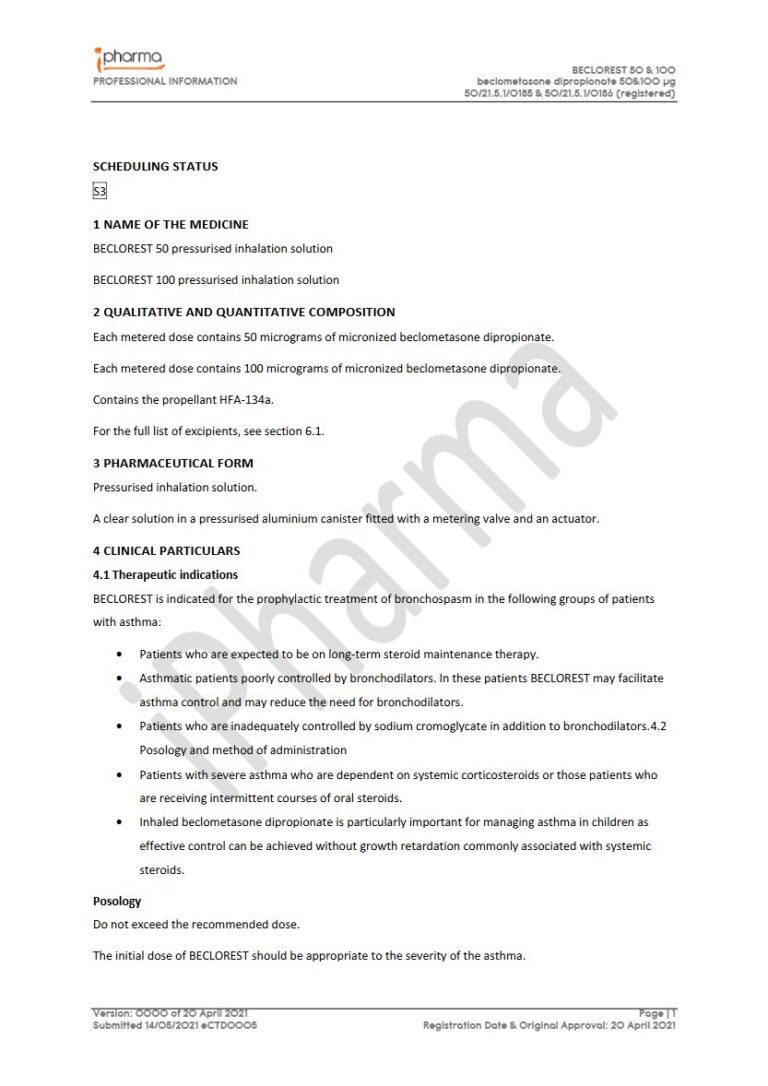
4.1 Therapeutic indications
BECLOREST is indicated for the prophylactic treatment of bronchospasm in the following groups of patients with asthma:
- Patients who are expected to be on long-term steroid maintenance therapy.
- Asthmatic patients poorly controlled by bronchodilators. In these patients BECLOREST may facilitate asthma control and may reduce the need for bronchodilators.
- Patients who are inadequately controlled by sodium cromoglycate in addition to bronchodilators.
4.2 Posology and method of administration
u2022 Patients with severe asthma who are dependent on systemic corticosteroids or those patients who are receiving intermittent courses of oral steroids.
u2022 Inhaled beclometasone dipropionate is particularly important for managing asthma in children as effective control can be achieved without growth retardation commonly associated with systemic steroids.
Posology
Do not exceed the recommended dose. The initial dose of BECLOREST should be appropriate to the severity of the asthma. The dose is then adjusted until control is achieved or reduced to the minimum effective dose according to the individual patientu2019s response.
Adults: The usual dose is 200 u03bcg twice daily. In more severe cases the dosage may be started at or increased to 600 u2013 800 u03bcg per day and subsequently reduced when the patientu2019s asthma has been stabilised. The total daily dose may be administered as two, three or four divided doses. In patients with severe asthma, or those showing only partial response to standard inhalation doses, high dose inhalation therapy may be considered, and dosage of up to 1 mg daily (1 000 u03bcg) in divided doses, may be used. Maximum daily dose: 1 000 u03bcg (1 mg) daily.
Children: 50 u2013 100 u03bcg should be given two, three of four times daily according to the age and response. Alternatively, 100 u03bcg or 200 u03bcg twice daily may be administered. Maximum daily dose: 500 u03bcg daily.
Method of administration
BECLOREST is for oral inhalation use only. An appropriate spacer device should be used in patients who struggle to coordinate aerosol actuation with inspiration of breath.
4.3 Contraindications
- Hypersensitivity to beclomethasone dipropionate or to any of the excipients listed in section 6.1.
- Acute status asthmaticus.
- Safety of BECLOREST in pregnancy has not been established.
4.4 Special warnings and precautions for use
Patients should be instructed on the proper use of the inhaler to ensure that the medicine reaches the target areas within the lungs. Patients should also be informed that BECLOREST should be used on a regular basis, even when they are asymptomatic. BECLOREST does not provide relief of acute asthma symptoms, which require a short-acting inhaled bronchodilator. Patients should have relief medication available.
Severe asthma requires regular medical assessment, including lung-function testing, as there is a risk of severe attacks and even death. Patients should be instructed to seek medical attention if short-acting relief bronchodilator treatment becomes less effective, or more inhalations than usual are required as this may indicate deterioration of asthma control. If this occurs, patients should be assessed and the need for increased anti-inflammatory therapy considered (e.g., Higher doses of inhaled corticosteroid or a course of oral corticosteroid).
Severe exacerbations of asthma must be treated in the usual way, i.e., by increasing the dose of inhaled BECLOREST (see section 4.2), giving a systemic steroid if necessary, and/or an appropriate antibiotic if there is an infection, together with u03b2 -agonist therapy.
Treatment with BECLOREST should not be stopped abruptly. Systemic effects of inhaled corticosteroids may occur, particularly when prescribed at high doses for prolonged periods. These effects are much less likely to occur than with oral corticosteroids. Possible systemic effects include adrenal suppression, growth retardation in children and adolescents, decrease in bone mineral density, cataract, and glaucoma and more rarely, a range of psychological or behavioural effects including psychomotor hyperactivity, sleep disorders, anxiety, depression, or aggression (particularly in children) (see section 4.8). It is important that the dose of inhaled corticosteroid is titrated to the lowest dose at which effective control of asthma is maintained.
It is recommended that the height of children receiving prolonged treatment with inhaled corticosteroids is regularly monitored. If growth is slowed, therapy should be reviewed with the aim of reducing the dose of inhaled corticosteroids, if possible, to the lowest dose at which effective control of asthma is maintained. In addition, consideration should also be given to referring the patient to a paediatric respiratory specialist.
Prolonged treatment with high doses of inhaled corticosteroids may result in clinically significant adrenal suppression. Additional systemic corticosteroid cover should be considered during periods of stress or elective surgery.
The transfer to BECLOREST of patients who have been treated with systemic steroids for long periods of time or at high doses needs special care, since recovery from possible adrenocortical suppression may take considerable time. Reduction of the dose of systemic steroid can be commenced approximately one week after initiating treatment with BECLOREST. The size of the reduction should correspond to the maintenance dose of systemic steroid. For patients receiving maintenance doses of 10 mg daily or less of prednisolone (or equivalent) reductions in dose of not more than 1 mg are suitable. For higher maintenance doses, larger reductions in dose may be appropriate. These oral dosage reductions should be introduced at not less than weekly intervals. Adrenocortical function should be monitored regularly as the dose of systemic steroid is gradually reduced.
Some patients feel unwell during withdrawal of systemic steroids despite maintenance or even improvement of respiratory function. They should be encouraged to persevere with inhaled BECLOREST and to continue withdrawal of systemic steroid unless there are objective signs of adrenal insufficiency.
Patients weaned off oral steroids whose adrenocortical function is impaired should carry a steroid warning card indicating that they may need supplementary systemic steroids during periods of stress, e.g., worsening asthma attacks, chest infections, major intercurrent illness, surgery, trauma, etc.
Replacement of systemic steroid treatment with inhaled therapy sometimes unmasks allergies such as allergic rhinitis or eczema previously controlled by the systemic medicine. These allergies should be symptomatically treated with antihistamine and/or topical preparations, including topical steroids.
Special care is necessary in patients with active or quiescent pulmonary tuberculosis using inhaled corticosteroids.
Visual disturbance may be reported with systemic and topical corticosteroid use. If a patient presents with symptoms such as blurred vision or other visual disturbances, the patient should be considered for referral to an ophthalmologist for evaluation of possible causes which may include cataract, glaucoma, or rare diseases such as central serous chorioretinopathy (CSCR) which have been reported after use of systemic and topical corticosteroids.
Patients should be advised that this product contains small amounts of ethanol (approximately 4,32 mg per actuation). At the normal doses, the amounts of ethanol are negligible and do not pose a risk to patients (see section 4.5, Interaction with other medicines and other forms of interaction).
4.5 Interaction with other medicines and other forms of interaction
BECLOREST contains a small amount of ethanol. There is a theoretical potential for interaction in particularly sensitive patients taking disulfiram or metronidazole. Beclometasone is less dependent on CYP3A metabolism than some other corticosteroids, and in general interactions are unlikely; however, the possibility of systemic effects with concomitant use of strong CYP3A inhibitors (e.g., ritonavir, cobicistat) cannot be excluded, and therefore caution and appropriate monitoring is advised with the use of such medicines.
4.6 Fertility, pregnancy and lactation
Pregnancy
Safety of BECLOREST in pregnancy has not been established (see section 4.3). It should not be used in pregnancy.
Administration of corticosteroids to pregnant animals can cause abnormalities of foetal development including cleft palate and intra-uterine growth retardation. There may, therefore, be a risk of such effects in the human foetus. It should be noted, however, that the foetal changes in animals occur after relatively high systemic exposure. BECLOREST is delivered directly to the lungs by the inhaled route and so avoids the high level of exposure that occurs when corticosteroids are given by systemic routes.
There is no experience with or evidence of safety of propellant HFA-134a in human pregnancy.
Breastfeeding
No specific studies examining the transfer of BECLOREST into the milk of lactating animals have been performed. It is reasonable to assume that BECLOREST is secreted in milk, but at the dosages used for direct inhalation there is low potential for significant levels in breast milk. There is no experience with or evidence of safety of propellant HFA-134a during lactation.
Fertility
Studies of the effect of HFA-134a on reproductive function and embryofoetal development in animals have revealed no clinically relevant adverse effects.
4.7 Effects on ability to drive and use machines
Patients experiencing blurred vision should not drive or operate machines (see section 4.8).
4.8 Undesirable effects
Tabulated summary of adverse reactions
System Organ Class Frequency Description
Infections and infestations Frequent Oral candidiasis (of the mouth and throat)
Immune system disorders Less frequent Hypersensitivity reaction with the following manifestations: rash, urticaria, pruritus, erythema, oedema of the eyes, face, lips, and throat
Endocrine disorders Psychiatric disorders (see section 4.4 Special warnings and precautions for use)
Nervous system disorders Less frequent Adrenal suppression*, growth retardation* (in children and adolescents), bone density decreased*
Frequency unknown Psychomotor hyperactivity, sleep disorders, anxiety, depression, aggression, behavioural disorders (predominantly in children)
Frequency unknown Headache
Eye disorders Respiratory, thoracic, and mediastinal disorders Less frequent Cataract*, glaucoma*, blurred vision (see also section 4.4 and 4.7)
Frequent Hoarseness, throat irritation
Less frequent Paradoxical bronchospasm, wheezing, dyspnoea, cough
Gastrointestinal disorders Frequency unknown Nausea
* Systemic reactions are a possible response to inhaled corticosteroids, especially when a high dose is prescribed for a prolonged time (see section 4.4 Special warnings and precautions for use).
Description of selected adverse reactions
Paradoxical bronchospasm may occur with an immediate increase in wheezing, shortness of breath and cough after dosing. This should be treated immediately with a fast-acting inhaled bronchodilator. BECLOREST should be discontinued immediately, the patient assessed and, if necessary, alternative therapy instituted.
Candidiasis of the mouth and throat occurs in some patients, the incidence increasing with doses greater than 400 micrograms BECLOREST per day. Patients with high blood levels of Candida precipitins, indicating a previous infection, are most likely to develop this complication. Patients may find it helpful to rinse their mouth thoroughly with water after inhalation. Symptomatic oral candidiasis can be treated with topical antifungal therapy while continuing with BECLOREST.
Hoarseness or throat irritation may occur in some patients. These patients should be advised to rinse the mouth out with water immediately after inhalation. Use of a spacer device may be considered.
Reporting of suspected adverse reactions
Reporting suspected adverse reactions after authorisation of the medicine is important. It allows continued monitoring of the benefit/risk balance of the medicine. Healthcare providers are asked to report any suspected adverse reactions to SAHPRA via the u201c6.04 Adverse Drug Reactions Reporting Formu201d, found online under SAHPRAu2019s publications: https://www.sahpra.org.za/Publications/Index/8.
4.9 Overdose
The only harmful effect that follows inhalation of large amounts of the drug over a short time-period is suppression of hypothalamic-pituitary-adrenal (HPA) function. No special emergency action need to be taken. Treatment should be continued at the recommended dose. HPA function recovers in a day or two. In the event of excessive intake of beclomethasone for a long period of time a degree of adrenal suppression could occur in addition to suppression of HPA function. The patient should be treated as steroid dependent and transferred to a suitable maintenance dose of systemic steroids.
