
Sirturo 100 mg Tablets
PDF Leaflet Revision Date: 18 May 2021
Clinical Summary
Quick overview from the medicine insert
Indication
For multi-drug resistant pulmonary tuberculosis in adults.
Dosage (summary)
Weeks 1-2: 400 mg once daily; Weeks 3-24: 200 mg three times per week.
Special Populations
- Hepatic impairment
- Renal impairment
- Elderly
Pregnancy & Breastfeeding
Safety not established; avoid breastfeeding.
Key Drug Interactions
- CYP3A4 inducers
- CYP3A4 inhibitors
- QT prolonging medications
Contraindications
- Hypersensitivity to bedaquiline
- Congenital QT prolongation
- Uncontrolled cardiac dysrhythmias
- Severe hepatic impairment
Common side effects
- Nausea
- Headache
- Dizziness
- Vomiting
- Arthralgia
Counselling Points
- Take with food
- Adhere to dosing schedule
- Report any dizziness or cardiac symptoms
Serious warnings
- QT prolongation
- Increased mortality in trials
- Monitor electrolytes
Important Disclaimer
The Sirturo 100 mg Tablets professional information leaflet below is the property of Janssen Pharmaceutica and is provided on Medinsert exactly as issued, with no.. alterations or editorial changes. We make every effort to keep content current by updating documents as soon as new versions become available. Medinsert serves as a trusted access point for healthcare professionals, but does not replace official sources or clinical judgement. For more details, please read our full disclaimer. read more>>
 Healthcare Professionals Only
This content is for registered healthcare professionals
Sign in or create a free account to read the full package insert.
Free for HPCSA-registered professionals. Powered by Medinsert.
Clinical Particulars
Section 4 of the official insert — extracted exactly as issued, no alterations
4.1 Therapeutic indications
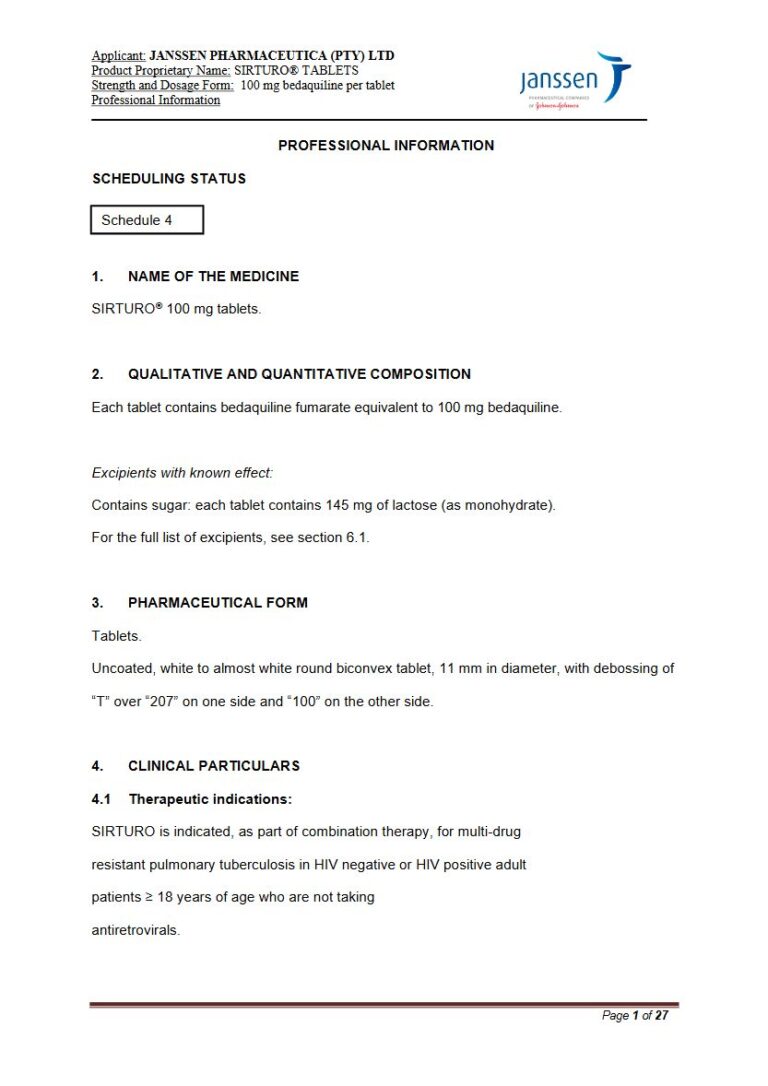
SIRTURO is indicated, as part of combination therapy, for multi-drug resistant pulmonary tuberculosis in HIV negative or HIV positive adult patients u2265 18 years of age who are not taking antiretrovirals. Safety and efficacy of SIRTURO in HIV patients on treatment with antiretroviral (ARV) medicines have not been established. Safety and efficacy of SIRTURO beyond 120 weeks have not been established.
4.2 Posology and method of administration
Posology SIRTURO should only be administered as part of a multi drug resistant tuberculosis (MDR-TB) regimen. It is recommended that SIRTURO is administered by directly observed therapy (DOT). MDR-TB is defined as in vitro resistance of the patientu2019s isolate to at least isoniazid and rifampicin. The recommended dosage of SIRTURO for MDR-TB is:
- Weeks 1 u2013 2: 400 mg (4 tablets of 100 mg) once daily
- Weeks 3 u2013 24: 200 mg (2 tablets of 100 mg) 3 times per week (with at least 48 hours between doses)
The total duration of treatment with SIRTURO is 24 weeks. Data on longer treatment duration is very limited. In patients with extensive drug resistance, where SIRTURO is considered necessary beyond 24 weeks to obtain a curative treatment, a longer duration of therapy may be considered only on a case by case basis and under close safety surveillance (see section 4.8). SIRTURO should be taken with food.
The prescribing medical practitioner should refer to international (e.g. WHO guidelines) and national/local TB treatment guidelines for direction on selection and duration of use of companion medicines with SIRTURO. SIRTURO should only be used in combination with at least 3 medicines to which the patientu2019s isolate has been shown to be susceptible in vitro. If in vitro testing results are unavailable, treatment may be initiated with SIRTURO in combination with at least 4 other medicines to which the patientu2019s isolate is likely to be susceptible. Throughout treatment with, and following the last intake of SIRTURO, patients should continue to take their companion medicines in accordance with international, national/local TB treatment guidelines and local MDR-TB treatment practice. Refer to the prescribing information of the medicines used in combination with SIRTURO for their specific dosing recommendations.
Missed doses Patients should be advised of the need to take SIRTURO as prescribed. Compliance with the full course of therapy must be emphasised. If a dose is missed during the first 2 weeks of treatment, patients should not make up the missed dose but should continue the usual dosing schedule. From week 3 onwards, if a dose is missed, patients should take the missed dose, and adjust the dosing schedule to ensure that the total dose of SIRTURO during the 7 day period does not exceed 600 mg (taken as 3 intakes of 200 mg each, separated by at least 24 hours). Do not exceed the recommended dosages.
Paediatric population The safety and efficacy of SIRTURO in children and adolescents less than 18 years of age have not been established.
Elderly populations There are limited data on the use of SIRTURO in elderly patients.
Hepatic impairment The pharmacokinetics of SIRTURO were assessed after single-dose administration to subjects with moderate hepatic impairment (Child-Pugh B) (see section 5.2). Based on these results, no dose adjustment is necessary for SIRTURO in patients with mild or moderate hepatic impairment. SIRTURO has not been studied in patients with severe hepatic impairment and is not recommended in this population. (see section 4.3).
Renal impairment SIRTURO has been mainly studied in patients with normal renal function. Renal excretion of unchanged SIRTURO is insignificant (< 0,001 %). No dose adjustment is required in patients with mild to moderate renal impairment. In patients with severe renal impairment or end-stage renal disease requiring haemodialysis or peritoneal dialysis, SIRTURO should be used with caution (see section 5.2).
Method of administration: SIRTURO should be taken orally with food, as administration with food increases oral bioavailability (see section 5.2). It is recommended that the SIRTURO tablet be swallowed whole with water.
4.3 Contraindications
- Hypersensitivity to the active substance (i.e. bedaquiline) or any of the excipients listed in section 6.1
- Congenital QT prolongation
- Patients with uncontrolled cardiac dysrhythmias
- Concomitant use with medicines known to prolong the QTc interval to time intervals known to induce serious dysrhythmias
- Patients with severe hepatic impairment (Child Pugh C)
4.4 Special warnings and precautions for use
HIV-TB co-infected patients There are no clinical data on safety and efficacy on the combined use of antiretroviral medicines and SIRTURO in HIV/MDR-TB co-infected patients and only limited clinical data on the use of SIRTURO in HIV/MDR-TB co-infected patients (n = 22) who were not receiving antiretroviral (ARV) therapy (see section 4.5).
There is limited information on interactions between SIRTURO (bedaquiline) and medicines that may increase or decrease bedaquiline concentrations. The use of systemic potent CYP3A4 inhibitors with SIRTURO should be avoided, as there may be an increased risk of SIRTURO associated toxicity (see section 4.5).
General The safety and efficacy of SIRTURO for the treatment of latent infection due to Mycobacterium tuberculosis has not been established. The safety and efficacy of SIRTURO for the treatment of medicine-sensitive TB has not been established. In addition, there are no data on the treatment with SIRTURO of extra-pulmonary TB (e.g. central nervous system). The safety and efficacy of SIRTURO for the treatment of infections caused by non-tuberculous mycobacteria (NTM) have not been established. Therefore, use of SIRTURO in these settings is not recommended.
Cardiovascular safety During clinical trials with SIRTURO a prolongation of QTc interval was observed (see section 4.8). An ECG should be obtained prior to and after initiation of therapy with SIRTURO to monitor the QTc interval. Serum potassium, calcium and magnesium should be obtained at baseline and corrected if abnormal. Follow-up monitoring of electrolytes should be performed if QT prolongation is detected (See sections 4.4 and 4.8).
SIRTURO treatment initiation is not recommended in patients with:
- Heart failure
- QT interval as corrected by the Fridericia method (QTcF) > 450 ms (confirmed by repeat ECG) (see section 4.3)
- A personal or family history of congenital QT prolongation.
- A history of or ongoing hypothyroidism.
- A history of or ongoing bradyarrhythmia.
- A history of Torsade de Pointes.
If necessary, SIRTURO treatment initiation could be considered in these patients after a favourable benefit risk assessment and with frequent ECG monitoring.
SIRTURO treatment must be discontinued if the patient develops:
- Clinically significant ventricular dysrhythmia.
- A QTcF interval of > 500 ms (confirmed by repeat ECG).
An additive or synergistic effect on QT prolongation of SIRTURO when co-administered with other medicines that prolong the QT interval (including delamanid) cannot be excluded (see section 4.5). Caution is recommended when prescribing SIRTURO concomitantly with medications with a known risk of QT prolongation. In the event that co-administration of such medicinal products with SIRTURO is necessary, clinical monitoring including frequent ECG assessment is recommended.
Concomitant administration of SIRTURO with fluoroquinolone antibiotics that have a potential for significant QT prolongation (gatifloxacin, moxifloxacin and sparfloxacin) should be avoided. In an open label Phase IIb trial (C209), mean increases from baseline in QTcF were larger in subjects with concomitant clofazimine use than in subjects without concomitant clofazimine use (see section 4.5). In the event that co-administration of clofazimine with SIRTURO is necessary, clinical monitoring including frequent ECG assessment is recommended.
Warnings on interactions CYP3A4 inducers/inhibitors SIRTURO is metabolised by CY3A4 and its exposure may therefore be reduced during co-administration with inducers of CYP3A4 and increased during co-administration with inhibitors of CYP3A4 (see section 4.5). Co-administration of SIRTURO and medicines that induce CYP3A4 may decrease SIRTURO plasma concentrations and reduce its therapeutic effect. Co-administration of strong CYP3A4 inducers, such as rifamycins (i.e, rifampicin; rifapentine and rifabutin) or moderate CYP3A4 inducers (i.e. efavirenz, St. Johnu2019s wort, carbamazepine, etc.) used systemically should therefore be avoided during treatment with SIRTURO. Co-administration of SIRTURO and moderate or strong CYP3A4 inhibitors may increase the systemic exposure to SIRTURO, which could potentially increase the risk of adverse reactions. Therefore, the combination of SIRTURO and moderate or strong CYP3A4 inhibitors (such as ciprofloxacin, erythromycin, fluconazole, clarithromycin, ketoconazole, itraconazole, ritonavir) used systemically for more than 14 consecutive days should be avoided.
Resistance to bedaquiline Bedaquiline must only be used in an appropriate combination regimen for MDR-TB treatment as recommended by official guidelines, such as from WHO, to reduce the risk of development of resistance to bedaquiline.
Mortality In the 120-week C208 trial where SIRTURO was administered for 24 weeks in combination with a background regimen, more deaths occurred in the SIRTURO treatment group than in the placebo group (see section 4.8). The imbalance in deaths is unexplained; no evidence has been found for a causal relationship with SIRTURO treatment.
Hepatic safety Increases in transaminases or aminotransferase elevations accompanied by total bilirubin u2265 2x ULN were seen in clinical trials during administration of SIRTURO with the background regimen (see section 4.8). Patients should be monitored during treatment. If AST or ALT exceeds 5 times the upper limit of normal, then the regimen should be reviewed and SIRTURO and/or any hepatotoxic background medicine should be discontinued. Other hepatotoxic medicines and alcohol should be avoided while on SIRTURO, especially in patients with diminished hepatic reserve.
Lactose intolerance and lactase deficiency SIRTURO tablets contain lactose. Patients with rare hereditary problems of galactose intolerance, the Lapp lactase deficiency or glucose-galactose malabsorption should not take SIRTURO. Lactose may have an effect on the glycaemic control of patients with diabetes mellitus.
4.5 Interactions with other medicines
CYP3A4 is the major CYP isoenzyme involved in vitro in the metabolism of SIRTURO and the formation of the N-monodesmethyl metabolite (M2). In vitro, SIRTURO does not significantly inhibit the activity of any of the CYP450 enzymes tested (CYP1A2, CYP2A6, CYP2C8/9/10, CYP2C19, CYP2D6, CYP2E1, CYP3A4, CYP3A4/5 and CYP4A) and does not induce CYP1A2, CYP2C9, CYP2C19 or CYP3A4 activities.
CYP3A4 inducers/inhibitors SIRTURO exposure may be reduced during co-administration with inducers of CYP3A4 and increased during co-administration with inhibitors of CYP3A4. In an interaction study of SIRTURO and rifampicin in healthy subjects, the exposure (AUC) to SIRTURO was reduced by 52 % [90 % CI (-57; -46)]. Due to the possibility of a reduction of the therapeutic effect of SIRTURO (bedaquiline) due to a decrease in systemic exposure, co-administration of strong CYP3A4 inducers such as rifamycins (i.e. rifampicin, rifapentine and rifabutin) or moderate CYP3A4 inducers used systemically, such as efavirenz, should be avoided during treatment with SIRTURO (see section 4.4).
Co-administration of SIRTURO and ketoconazole for 4 days in healthy subjects increased the exposure (AUC) to SIRTURO (bedaquiline) by 22 % [90 % CI (12; 32)] and should be avoided. Other antimicrobial medications The combination of SIRTURO with isoniazid/pyrazinamide in healthy subjects did not result in clinically relevant changes in the exposure (AUC) to SIRTURO (bedaquiline), isoniazid or pyrazinamide. No dose-adjustment of isoniazid or pyrazinamide is required during co-administration with SIRTURO. In a placebo-controlled clinical study in patients with MDR-TB, no major impact of co-administration of SIRTURO on the pharmacokinetics of ethambutol, kanamycin, pyrazinamide, ofloxacin or cicloserin was observed.
Antiretroviral medications There is limited data on the interaction between SIRTURO and antiretroviral medicines. Lopinavir/ritonavir In an interaction study of a single dose of SIRTURO and repeated doses of lopinavir/ritonavir, exposure (AUC) to SIRTURO (bedaquiline) was increased by 22 % [90 % CI (11; 34)]. Clinical data on the combined use of lopinavir/ritonavir and SIRTURO in HIV/MDR-TB co-infected patients are not available (see section 4.4). Nevirapine Co-administration of nevirapine with a single dose of SIRTURO did not result in clinically relevant changes in the exposure to SIRTURO. Clinical data on the combined use of nevirapine and SIRTURO in HIV/MDR-TB co-infected patients are not available (see section 4.4).
QT interval prolonging medicines There is limited information available on the potential for a pharmacodynamic interaction between SIRTURO and medicines that prolong the QT interval. In a medicine interaction study of SIRTURO (bedaquiline) and ketoconazole, a greater effect on QTc was observed after repeated dosing with SIRTURO and ketoconazole in combination than after repeated dosing with the individual medicines. An additive or synergistic effect on QT prolongation of SIRTURO when co-administered with other medicines that prolong the QT interval cannot be excluded (see section 4.4).
QT interval and concomitant clofazimine use In an open label Phase IIb trial, mean increases in QTcF were larger in the 17 subjects who were using clofazimine at week 24 (mean change from reference of 31,9 ms) than in subjects who were not using clofazimine at week 24 (mean change from reference of 12,3 ms) (see section 4.4).
Paediatric population Medicine interaction studies have only been performed in adults.
4.6 Fertility, pregnancy and lactation
Safety in pregnancy and lactation has not been established. Breastfeeding It is not known whether bedaquiline or its metabolites are excreted in human milk. In rats, concentrations of SIRTURO in milk were 6- to 12-fold higher than the maximum concentration observed in maternal plasma. Body weight decreases in pups were noted in high dose groups during the lactation period. Women using SIRTURO should not breastfeed their infants.
4.7 Effects on ability to drive and use machines
Adverse reactions, such as dizziness, may affect the ability to drive or use machines, although no studies on this effect with SIRTURO have been performed. Patients should be advised not to drive or operate machinery if they experienced dizziness while taking SIRTURO.
4.8 Undesirable effects
Summary of the safety profile Adverse drug reactions (ADRs) for SIRTURO were identified from pooled Phase IIb clinical trial data (both controlled and uncontrolled) containing 335 patients who received SIRTURO in combination with a background regimen of TB medicines. The basis of assessment of causality between the ADRs and SIRTURO was not restricted to these trials but also on review of the pooled Phase I and Phase IIa safety data. The most frequent ADRs (> 10,0 % of patients) during treatment with SIRTURO in the controlled trials were nausea, arthralgia, headache, vomiting and dizziness. Refer to the prescribing information of the medicines used in combination with SIRTURO for their respective adverse reactions.
Tabulated list of adverse reactions Adverse drug reactions to SIRTURO reported from controlled trials in 102 patients treated with SIRTURO are presented in Table 2. Adverse drug reactions are listed by system organ class (SOC) and frequency:
Very common (u2265 1/10); Common (u2265 1/100 to < 1/10); and Uncommon (u2265 1 / 1000 to 1/100)
Table 2: Adverse drug reactions from controlled trials during treatment with SIRTURO
System Organ Class (SOC) Frequency category ADRs
Nervous system disorders Very common Headache, dizziness
Cardiac disorders Common ECG QT prolonged
Gastrointestinal disorders Very common Common Nausea, vomiting Diarrhoea
Hepatobiliary disorders Common Increased transaminases*
Musculoskeletal and connective tissue disorders Very common Common Arthralgia Myalgia
*Terms represented by u201cincreased transaminasesu201d included, AST increased, ALT increased, hepatic enzyme increased and abnormal hepatic function
No additional ADRs were identified from the uncontrolled study (n=233) nor from the Phase I and II studies. Deaths: In the randomised phase IIb C208 study a higher rate of deaths was seen in the SIRTURO treatment group 12,7 % (10/79) compared to the placebo treatment group 3,7 % (3/81). One death in the SIRTURO group and one death in the placebo group were reported after the week 120 window. In the SIRTURO group, all of the five deaths due to tuberculosis occurred in patients whose sputum culture status at last visit was u2018not convertedu2019. The causes of death in the remaining SIRTURO subjects were alcohol poisoning, hepatitis/hepatic cirrhosis, septic shock/peritonitis, cerebrovascular accident and motor vehicle accident. One of the ten deaths in the SIRTURO group (due to alcohol poisoning) occurred during the 24-week treatment period. The other nine deaths among those treated with SIRTURO occurred after completion of treatment with this agent (range 86 - 911 days post-SIRTURO; median 344 days). The observed imbalance in deaths between the two treatment groups is unexplained. No discernible pattern between death and sputum culture conversion, relapse, sensitivity to other medicinal products used to treat tuberculosis, human immunodeficiency virus status, or severity of disease could be observed. During the trial, there was no evidence of antecedent significant QT prolongation or clinically significant dysrhythmia in any of the patients that died.
In the open-label C209 trial, 6,9 % (16/23) patients died. The most common cause of death as reported by the investigator was TB (9 patients). All but one patient who died of TB had not converted or had relapsed. The causes of death in the remaining patients varied.
Adverse events of special interest Cardiovascular In the controlled Phase IIb study (C208), mean increases in QTcF were observed from the first on-treatment assessment onwards (9,9 ms at week 1 for SIRTURO and 3,5 ms for placebo). The largest mean increase in QTcF during the 24 weeks of SIRTURO treatment was 15,7 ms (at week 18). After the end of SIRTURO treatment (i.e. after week 24), QTcF increases in the SIRTURO group gradually became less pronounced. The largest mean increase in QTcF in the placebo group during the first 24 weeks was 6,2 ms (at week 18) (see section 4.4).
Reporting of suspected adverse reactions: Reporting suspected adverse reactions after authorisation of the medicine product is important. It allows continued monitoring of the benefit/risk balance of the medicine. Healthcare professionals are asked to report any suspected adverse reactions via u201c6. 04 Adverse Drug Reaction Reporting Formu201d found online under SAHPRAu2019s publications: https://www.sahpra.org.za/Publications/index/8. Alternatively, suspected adverse reactions may be reported directly to Janssen Pharmaceutica (see section 7 for contact details or visit www.janssen.com).
4.9 Overdose
Cases of intentional or accidental acute overdose with SIRTURO were not reported during clinical trials. In a study of 44 healthy subjects receiving a single 800 mg dose of SIRTURO, adverse reactions were consistent with those observed in clinical studies at the recommended dose (see section 4.8). There is no experience with the treatment of acute overdose with SIRTURO. General measures to support basic vital functions including monitoring of vital signs and ECG (QT interval) should be taken in case of deliberate or accidental overdose. It is advisable to contact a poison information center to obtain the latest recommendations for the management of an overdose. Since SIRTURO is highly protein-bound, dialysis is not likely to significantly remove SIRTURO from plasma. Clinical monitoring should be considered.
