
Andolex Analgesic Lozenges
PDF Leaflet Revision Date: 10 December 2020
Clinical Summary
Quick overview from the medicine insert
Indication
Symptomatic relief of painful conditions of the mouth and throat.
Dosage (summary)
Suck one lozenge every 1-2 hours, max 12 per day. Not exceed 7 days without supervision.
Special Populations
- Children under 6 years
- Patients with hypersensitivity to salicylic acid or NSAIDs
Pregnancy & Breastfeeding
Safety not established in pregnancy and lactation.
Contraindications
- Hypersensitivity to benzydamine hydrochloride or excipients
Common side effects
- Oral numbness
- Burning or stinging sensation
- Dryness or thirst
Counselling Points
- Do not exceed recommended dosage
- Report any adverse reactions
- Store below 30 u00baC
Serious warnings
- Consider antibacterial therapy for bacterial infections
- Bronchospasm risk in asthma patients
Important Disclaimer
The Andolex Analgesic Lozenges professional information leaflet below is the property of Inova Pharmaceuticals and is provided on Medinsert exactly as issued, with no.. alterations or editorial changes. We make every effort to keep content current by updating documents as soon as new versions become available. Medinsert serves as a trusted access point for healthcare professionals, but does not replace official sources or clinical judgement. For more details, please read our full disclaimer. read more>>
 Healthcare Professionals Only
This content is for registered healthcare professionals
Sign in or create a free account to read the full package insert.
Free for HPCSA-registered professionals. Powered by Medinsert.
Clinical Particulars
Section 4 of the official insert — extracted exactly as issued, no alterations
4.1 Therapeutic indication
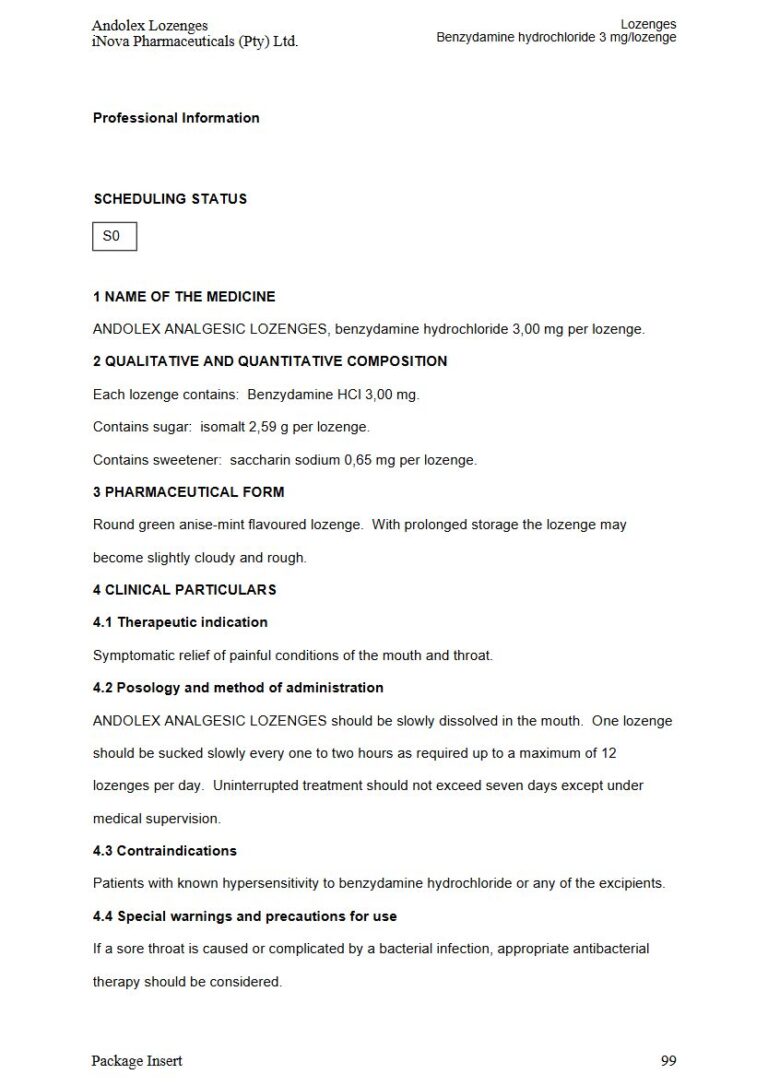
Symptomatic relief of painful conditions of the mouth and throat.
4.2 Posology and method of administration
ANDOLEX ANALGESIC LOZENGES should be slowly dissolved in the mouth. One lozenge should be sucked slowly every one to two hours as required up to a maximum of 12 lozenges per day. Uninterrupted treatment should not exceed seven days except under medical supervision.
4.3 Contraindications
Patients with known hypersensitivity to benzydamine hydrochloride or any of the excipients.
4.4 Special warnings and precautions for use
If a sore throat is caused or complicated by a bacterial infection, appropriate antibacterial therapy should be considered.
Excess consumption of products containing isomalt may have a laxative effect. ANDOLEX ANALGESIC LOZENGES are not recommended in children under 6 years of age. Benzydamine use is not advisable in patient with hypersensitivity to salicylic acid or other NSAIDs. Bronchospasm may be precipitated in patients suffering from or with a previous history of bronchial asthma.
4.5 Interaction with other medicines and other forms of interaction
None known.
4.6 Fertility, pregnancy and lactation
The safety of benzydamine hydrochloride has not been established in pregnancy and lactation.
4.7 Effects on ability to drive and use machines
ANDOLEX ANALGESIC LOZENGES has no or negligible influence on the ability to drive and use machines when it is used at the recommended dose.
4.8 Undesirable effects
The most commonly reported reaction is oral numbness. Burning or stinging sensation has been reported. Other local adverse effects include dryness or thirst, tingling, warm feeling in mouth and altered sense of taste.
The following rate values have been used: Very common (u2265 1/10), Common (u2265 1/100 to <1/10), Uncommon (u2265 1/1,000 to < 1/100), Rare (u2265 1/10,000 to < 1/1,000) and Very rare (< 1/10,000), not known (cannot be estimated from the available data).
Immune system disorders
Not known: Anaphylactic reaction, hypersensitivity reaction.
Respiratory, thoracic and mediastinal disorders
Very rare: Laryngospasm.
Gastrointestinal disorders
Rare: Burning mouth, dry mouth.
Not Known: Hypoaesthesia oral.
Skin and subcutaneous tissue disorders
Uncommon: Photosensitivity.
Very rare: Angioedema.
Reporting of suspected adverse reactions
Reporting suspected adverse reactions after authorisation of the medicine is important. It allows continued monitoring of the benefit/risk balance of the medicine. Health care providers are asked to report any suspected adverse reactions to SAHPRA via the u201c6.04 Adverse Drug Reactions Reporting Formu201d, found online under SAHPRAu2019s publications: https://www.sahpra.org.za/Publications/Index/8. Alternately you can contact iNova Pharmaceuticals (Pty) Ltd at +27 (0) 11 087 0000.
4.9 Overdose
See section 4.8. Adverse central nervous system effects have been reported following over dosage with high doses of benzydamine hydrochloride in solution form. Nausea and vomiting may also occur. Excessive consumption of products containing isomalt may have a laxative effect.
Management
In the event of acute overdosage only symptomatic treatment is possible; the stomach should be emptied by inducing vomiting or by gastric lavage, and the patient carefully observed and given supportive treatment. Adequate hydration must be maintained.
