
Gesoral Oral 15 ml Spray
PDF Leaflet Revision Date: 03 March 2025
Clinical Summary
Quick overview from the medicine insert
Indication
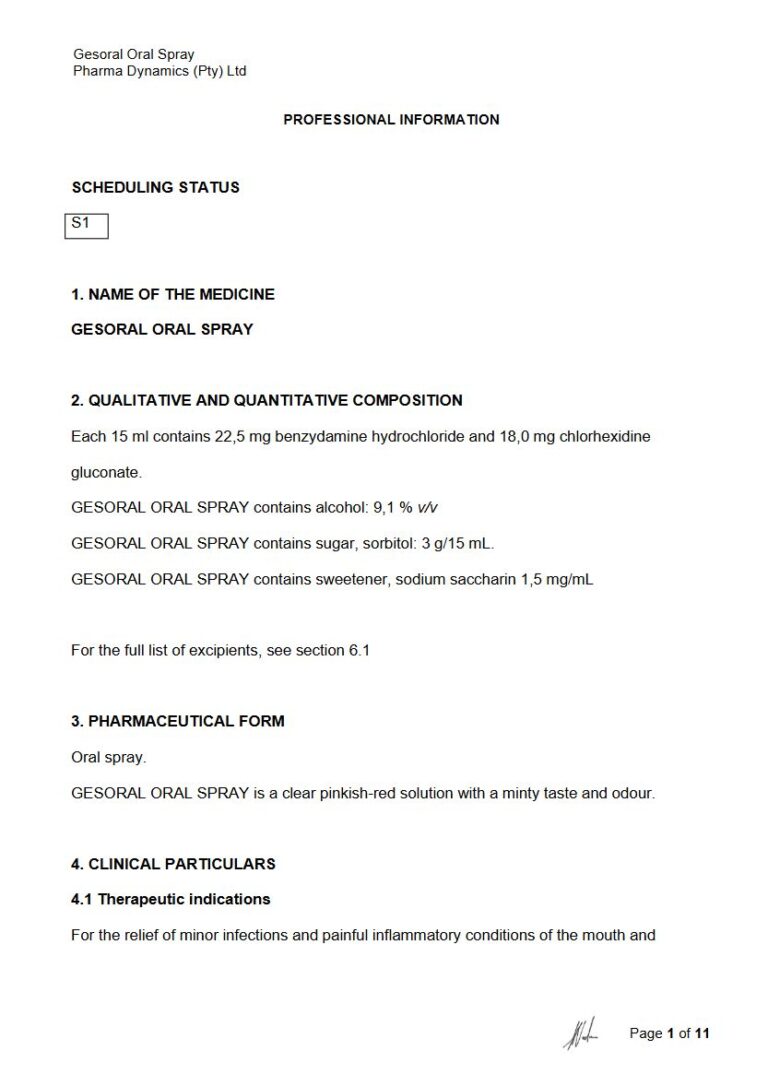
Relief of minor infections and painful inflammatory conditions of the mouth and throat.
Dosage (summary)
Adults and children over 12 years: 5 to 10 sprays every 1u00bd to 3 hours as needed.
Special Populations
- Not indicated for children under 12 years
- Caution in patients with asthma
Pregnancy & Breastfeeding
Contraindicated in pregnancy and lactation; caution advised during first and second trimesters.
Key Drug Interactions
- Anionic surfactants in toothpastes reduce efficacy
- Concomitant use with sorbitol-containing products may affect bioavailability
Contraindications
- Hypersensitivity to ingredients
- Children under 12 years
- Pregnancy and lactation
Common side effects
- Numbness
- Stinging in the mouth
- Gastrointestinal discomfort
Counselling Points
- Shake before use
- Avoid eye contact
- Report any severe allergic reactions
Serious warnings
- Avoid contact with eyes
- Uninterrupted treatment should not exceed 7 days
Important Disclaimer
The Gesoral Oral 15 ml Spray professional information leaflet below is the property of Pharma Dynamics and is provided on Medinsert exactly as issued, with no.. alterations or editorial changes. We make every effort to keep content current by updating documents as soon as new versions become available. Medinsert serves as a trusted access point for healthcare professionals, but does not replace official sources or clinical judgement. For more details, please read our full disclaimer. read more>>
 Healthcare Professionals Only
This content is for registered healthcare professionals
Sign in or create a free account to read the full package insert.
Free for HPCSA-registered professionals. Powered by Medinsert.
Clinical Particulars
Section 4 of the official insert — extracted exactly as issued, no alterations
4.1 Therapeutic indications
For the relief of minor infections and painful inflammatory conditions of the mouth and throat. Chlorhexidine in GESORAL ORAL SPRAY helps to reduce the development of plaque.
4.2 Posology and method of administration
Posology
Adults and children over 12 years: 5 to 10 sprays directly onto the painful or inflamed area and swallow gently. Repeat every 1u00bd to 3 hours, as necessary.
Paediatric population
Not indicated for use in children under 12 years of age.
Method of administration
For oral administration. Shake bottle before use. Avoid contact with the eyes.
4.3 Contraindications
- hypersensitivity to benzydamine, chlorhexidine or to any of the ingredients of GESORAL ORAL SPRAY (see section 6.1)
- children under 12 years of age
- pregnancy and lactation.
4.4 Special warnings and precautions for use
Benzydamine (as in GESORAL ORAL SPRAY) use is not advisable in patients with hypersensitivity to acetylsalicylic acid or other NSAIDs. Bronchospasm may be precipitated in patients suffering from or with a previous history of bronchial asthma. Caution should be exercised in these patients. Avoid contact with the eyes. Should it come in contact with the eyes, wash out thoroughly with water. Uninterrupted treatment should not exceed 7 days except under medical supervision. If the condition is aggravated or not improved, use should cease. GESORAL ORAL SPRAY contains sorbitol which is a source of fructose. Sorbitol may cause gastrointestinal discomfort and a mild laxative effect. Patients with hereditary fructose intolerance (HFI) must not be given this medicine. The additive effect of concomitantly administered products containing sorbitol (or fructose) and dietary intake of sorbitol (or fructose) should be taken into account. The content of sorbitol in medicinal products for oral use may affect the bioavailability of other medicinal products for oral use administered concomitantly. GESORAL ORAL SPRAY contains a small amount of alcohol (see section 2), equivalent to less than 30 mL beer or 12 mL wine. This small amount of alcohol will not have any noticeable effects.
Paediatric population
Not suitable for children aged 12 years or under (see section 4.3).
4.5 Interaction with other medicines and other forms of interaction
Anionic surfactants (contained in toothpastes) are incompatible with chlorhexidine. In order that the antiplaque effect of chlorhexidine is not reduced, it has been recommended that at least 30 minutes should be allowed to elapse between teeth brushing and using GESORAL ORAL SPRAY administration.
4.6 Fertility, pregnancy and lactation
The safety of GESORAL ORAL SPRAY in pregnancy and lactation has not been established (see section 4.3).
Pregnancy
From the 20th week of pregnancy onward, benzydamine may cause oligohydramnios resulting from foetal renal dysfunction. This may occur shortly after treatment initiation and is usually reversible upon discontinuation. In addition, there have been reports of ductus arteriosus constriction following treatment in the second trimester, most of which resolved after treatment cessation. Therefore, during the first and second trimester of pregnancy, GESORAL ORAL SPRAY should not be used unless clearly necessary. If GESORAL ORAL SPRAY is used by a woman attempting to conceive, or during the first and second trimester of pregnancy, the dose should be kept as low and duration of treatment as short as possible. Antenatal monitoring for oligohydramnios and ductus arteriosus constriction should be considered after exposure to benzydamine for several days from gestational week 20 onward. GESORAL ORAL SPRAY should be discontinued if oligohydramnios or ductus arteriosus constriction are found. During the third trimester of pregnancy, all prostaglandin synthesis inhibitors may expose the foetus to:
- cardiopulmonary toxicity (premature constriction/closure of the ductus arteriosus and pulmonary hypertension)
- renal dysfunction (see above)
- possible prolongation of bleeding time, an anti-aggregating effect which may occur even at very low doses
- inhibition of uterine contractions resulting in delayed or prolonged labour.
Breastfeeding
GESORAL ORAL SPRAY is contraindicated during the third trimester of pregnancy (see sections 4.3).
Fertility
There is no data on fertility with GESORAL ORAL SPRAY.
4.7 Effects on ability to drive and use machines
GESORAL ORAL SPRAY has no or negligible influence on the ability to drive and use machines.
4.8 Undesirable effects
Summary of the safety profile
The most common side effects are numbness and a stinging feeling in the mouth.
Tabulated list of adverse effects
System Organ Class
Frequency
Side effects
Immune system disorders
Less frequent
Frequency unknown
Hypersensitivity reactions including urticaria, rash, bronchospasm, or laryngospasm and photodermatitis
Serious allergic reaction (anaphylactic shock) which may be potentially life-threatening, signs of which may include difficulty breathing, chest pain or chest tightness, and/or feeling dizzy/faint, severe itching of the skin or raised lumps on the skin, swelling of the face, lips, tongue and/or throat, and which may be potentially life-threatening
Respiratory, thoracic and mediastinal disorders
Less frequent
Laryngospasm, bronchospasm
Gastrointestinal disorders
Less frequent
Frequency unknown
Oral tissue numbness and a stinging feeling in the mouth. The stinging has been reported to disappear upon continuation of the treatment, however if it persists it is recommended that treatment be discontinued.
Gastro-intestinal disturbances
Skin and subcutaneous tissue disorders
Less frequent
Frequency unknown
Pruritus, urticaria, photosensitivity reaction and rash
Angioedema
General disorders and administrative site conditions
Less frequent
Dryness or thirst, reversible discolouration of the tongue and teeth, transient disturbances of taste, oral desquamation, swelling of the parotid gland
Reporting of suspected adverse reactions
Reporting suspected adverse reactions after authorisation of the medicine is important. It allows continued monitoring of the benefit/risk balance of the medicine. Healthcare professionals are requested to report any suspected adverse drug reactions to SAHPRA via the Med Safety APP (Medsafety X SAHPRA) and eReporting platform (who-umc.org) found on SAHPRA website. An email can be sent directly to the company, [email protected], to ensure safety of the product.
4.9 Overdose
Signs and symptoms:
Most frequent gastrointestinal symptoms are nausea, vomiting, sore throat and abdominal pain. Symptoms of the central nervous system include dizziness, hallucinations, agitation, anxiety, and irritability.
Management of overdose:
There is no specific antidote for benzydamine. Treatment should be symptomatic and supportive. Adequate hydration must be maintained.
