
Betahistine 24 Unicorn Capsule
PDF Leaflet Revision Date: 10 October 2023
Clinical Summary
Quick overview from the medicine insert
Indication
Symptomatic treatment of vertigo associated with Mu00e9niu00e8reu2019s syndrome.
Dosage (summary)
24 mg to 48 mg per day in divided doses; typically one 24 mg tablet twice daily.
Special Populations
- Peptic ulcer history
- Bronchial asthma
- Severe hypotension
- Porphyria
Pregnancy & Breastfeeding
Safety during pregnancy and breastfeeding not established; avoid use during pregnancy.
Key Drug Interactions
- Antihistamines
- MAO inhibitors
Contraindications
- Hypersensitivity to betahistine
- Phaeochromocytoma
Common side effects
- Headache
- Drowsiness
- Nausea
- Dyspepsia
Counselling Points
- Take with food to reduce gastric discomfort
- Avoid driving until effects are known
Serious warnings
- Caution in peptic ulcer
- Monitor asthma patients
Important Disclaimer
The Betahistine 24 Unicorn Capsule professional information leaflet below is the property of Unicorn Pharmaceuticals and is provided on Medinsert exactly as issued, with no.. alterations or editorial changes. We make every effort to keep content current by updating documents as soon as new versions become available. Medinsert serves as a trusted access point for healthcare professionals, but does not replace official sources or clinical judgement. For more details, please read our full disclaimer. read more>>
 Healthcare Professionals Only
This content is for registered healthcare professionals
Sign in or create a free account to read the full package insert.
Free for HPCSA-registered professionals. Powered by Medinsert.
Clinical Particulars
Section 4 of the official insert — extracted exactly as issued, no alterations
4.1 Therapeutic indications
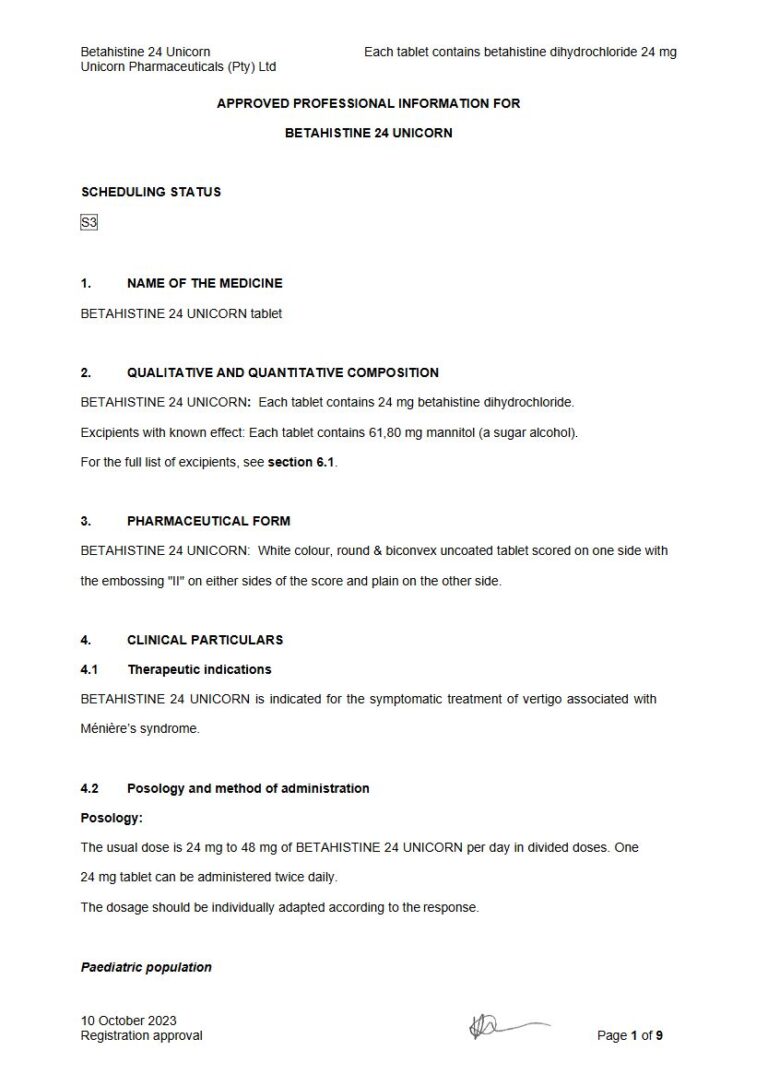
BETAHISTINE 24 UNICORN is indicated for the symptomatic treatment of vertigo associated with Mu00e9niu00e8reu2019s syndrome.
4.2 Posology and method of administration
Posology: The usual dose is 24 mg to 48 mg of BETAHISTINE 24 UNICORN per day in divided doses. One 24 mg tablet can be administered twice daily. The dosage should be individually adapted according to the response.
Paediatric population: BETAHISTINE 24 UNICORN should not be used in children and patients under the age of 18 since safety and efficacy have not yet been established.
Method of administration: For oral use.
4.3 Contraindications
BETAHISTINE 24 UNICORN is contraindicated in:
- Patients with known hypersensitivity to betahistine or to any of the ingredients contained in BETAHISTINE 24 UNICORN (see section 6.1).
- Patients with phaeochromocytoma. Betahistine, a synthetic analogue of histamine, may induce the release of catecholamines from the tumour resulting in severe hypertension.
4.4 Special warnings and precautions for use
- Caution is advised in the treatment of patients with peptic ulcer or a history of peptic ulceration, because of the occasional dyspepsia observed in patients taking betahistine dihydrochloride.
- Patients with bronchial asthma should be monitored carefully for the duration of the treatment with BETAHISTINE 24 UNICORN.
- Caution is advised in prescribing BETAHISTINE 24 UNICORN to patients with either urticaria, rashes or allergic rhinitis, due to the possibility of aggravating these symptoms.
- Caution is advised in patients with severe hypotension.
- Caution is advised in patients with porphyria.
- If BETAHISTINE 24 UNICORN is to be administered subsequent to the treatment with an antihistamine and this treatment is stopped abruptly, withdrawal symptoms such as sleep disorders and agitation could appear due to the sedative action of antihistamines. Treatment with the antihistamine should be tapered over approximately six days.
4.5 Interaction with other medicines and other forms of interaction
There are no studies on the interactions with the following medicines: vasodilators, psychotropic medicines, in particular sedatives, tranquillisers and neuroleptics, parasympatholytics, and vitamins. Based on available data, no inhibition on cytochrome-P450 enzymes is anticipated. As betahistine is an analogue of histamine, BETAHISTINE 24 UNICORN should not be concomitantly administered with antihistamines as betahistine may in theory affect the efficacy of one of these medicines (see section 4.3). The metabolism of BETAHISTINE 24 UNICORN may be inhibited by medicines that inhibit monoamine-oxidase (MAO) including MAO subtype B (e.g. selegiline). Caution is recommended when using BETAHISTINE 24 UNICORN and MAO inhibitors (including MAO-B selective) concomitantly.
4.6 Fertility, pregnancy and lactation
Pregnancy: The safety of BETAHISTINE 24 UNICORN during pregnancy and breastfeeding has not been established. As a precautionary measure, it is preferable to avoid the use of betahistine during pregnancy.
Breastfeeding: It is not known whether betahistine is excreted in human milk, however it has shown to be excreted in rat milk, however studies are limited to very high doses.
Fertility: There is no data on fertility with BETAHISTINE 24 UNICORN.
4.7 Effects on the ability to drive and use machines
Vertigo, tinnitus and hearing loss associated with Mu00e9niu00e8re's syndrome can negatively affect the ability to drive and use machines. Occasional drowsiness may occur as a side effect associated with the use of BETAHISTINE 24 UNICORN. Patients should therefore not drive, use machinery or perform any tasks that require concentration, until they are certain that BETAHISTINE 24 UNICORN does not adversely affect their ability to do so (see section 4.8).
4.8 Undesirable effects
System Organ Class
- Frequent: Immune system disorders - Hypersensitivity reactions, e.g. anaphylaxis
- Frequent: Nervous system disorders - Headache
- Less frequent: Head pressure
- Frequency unknown: Occasional drowsiness
- Frequent: Cardiac disorders - Palpitations, tightness of the chest
- Frequent: Respiratory, thoracic and mediastinal disorders - Exacerbation of pre-existing bronchial asthma
- Frequent: Gastrointestinal disorders - Nausea, dyspepsia
- Less frequent: Retching, heartburn, gastric discomfort and pain, flatulence
- Frequency unknown: Mild gastric disorders including vomiting, gastrointestinal pain, abdominal distension and bloating have been observed. This can normally be avoided by taking BETAHISTINE 24 UNICORN with or after a meal, or by reducing the dosage.
- Frequent: Skin and subcutaneous tissue disorders - Cutaneous and subcutaneous hypersensitivity reactions, in particular angioneurotic oedema, urticaria rash, and pruritus
Reporting of suspected adverse reactions: Reporting suspected adverse reactions after authorisation of BETAHISTINE 24 UNICORN is important. It allows continued monitoring of the benefit/risk balance of BETAHISTINE 24 UNICORN. Health care providers are asked to report any suspected adverse reactions via the u201c6.04 Adverse Drug Reaction Reporting Formu201d, found online under SAHPRAu2019s publications: https://www.sahpra.org.za/Publications/Index/8 Report all side effects to Unicorn Pharmaceuticals (Pty) Ltd to [email protected]
4.9 Overdose
Symptoms: In case of overdose, the following symptoms, similar to histamine overdose, might occur: headache, redness of the face, vertigo, tachycardia, hypotension, bronchial spasm, oedema, in particular oedema of betahistine especially in combination with other overdosed medicines.
Treatment: There is no specific antidote to BETAHISTINE 24 UNICORN. Treatment of overdose should include standard supportive measures.
