
Bisocet 5mg & 10mg Suppositories
PDF Leaflet Revision Date: 03 February 2026
Clinical Summary
Quick overview from the medicine insert
Indication
Relief of occasional constipation.
Dosage (summary)
Adults: 10 mg once daily; Children 1-12 years: 5 mg once daily.
Onset of Action / Duration
Onset: 15-60 mins
Special Populations
- Elderly
- Renal impairment
Pregnancy & Breastfeeding
Safety not established; no adequate studies in pregnant women.
Key Drug Interactions
- Diuretics
- Adreno-corticosteroids
- Other laxatives
Contraindications
- Hypersensitivity to bisacodyl
- Ileus
- Intestinal obstruction
- Severe abdominal pain
- Anal fissures
- Ulcerative proctitis
Common side effects
- Abdominal pain
- Diarrhoea
- Dizziness
- Nausea
Counselling Points
- Use only as directed
- Consult if bowel habits change
- Avoid driving if experiencing dizziness
Serious warnings
- Risk of dependence on laxatives
- Avoid in abdominal pain, nausea, vomiting
- Prolonged use may harm intestinal function
Important Disclaimer
The Bisocet 5mg & 10mg Suppositories professional information leaflet below is the property of Lamar International and is provided on Medinsert exactly as issued, with no.. alterations or editorial changes. We make every effort to keep content current by updating documents as soon as new versions become available. Medinsert serves as a trusted access point for healthcare professionals, but does not replace official sources or clinical judgement. For more details, please read our full disclaimer. read more>>
 Healthcare Professionals Only
This content is for registered healthcare professionals
Sign in or create a free account to read the full package insert.
Free for HPCSA-registered professionals. Powered by Medinsert.
Clinical Particulars
Section 4 of the official insert — extracted exactly as issued, no alterations
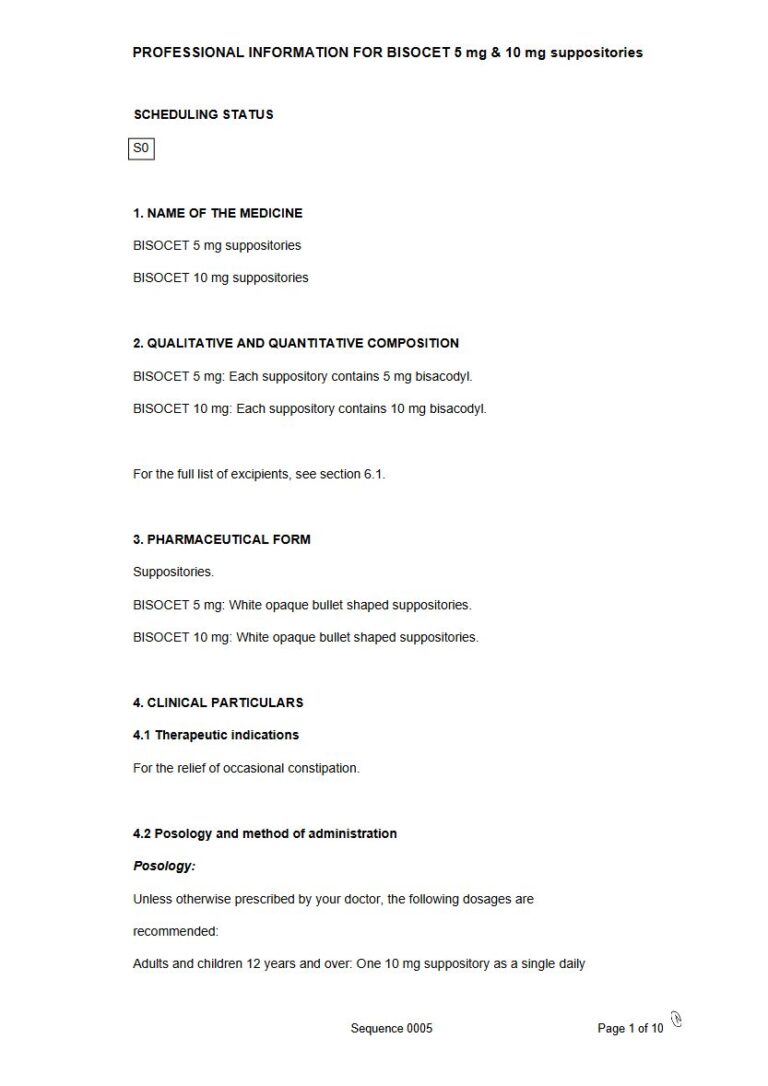
4.1 Therapeutic indications
For the relief of occasional constipation.
4.2 Posology and method of administration
Posology: Unless otherwise prescribed by your doctor, the following dosages are recommended:
- Adults and children 12 years and over: One 10 mg suppository as a single daily dose.
- Children 1 - 12 years: One 5 mg suppository as a single daily dose.
Method of administration: Suppositories: The suppositories should be unwrapped and inserted into the rectum pointed end first. Bowel movement is generally produced within 15 minutes to one hour.
4.3 Contraindications
- Hypersensitivity to bisacodyl or to any of the other ingredients in BISOCET (see section 6.1).
- Ileus, intestinal obstruction, undiagnosed abdominal symptoms or acute surgical abdominal conditions like acute appendicitis, acute inflammatory bowel disease, severe abdominal pain associated with nausea and vomiting which may be indicative of the aforementioned severe conditions and in severe dehydration.
- Presence of anal fissures or ulcerative proctitis with mucosal damage.
4.4 Special warnings and precautions for use
BISOCET should not be used in the presence of abdominal pain, nausea or vomiting. Frequent or prolonged use of BISOCET may result in dependence on laxatives and loss of normal bowel function. If you have noticed a sudden change in the bowel habits that has persisted for a period of greater than 2 weeks, consult a doctor before using the laxative. BISOCET should not be used for a period longer than one week unless directed by a doctor. Long-term everyday use of stimulant laxatives may harm the intestinal function and should be avoided. If a laxative is needed every day, the cause of constipation should be investigated. BISOCET should only be used if a therapeutic effect cannot be achieved by a change of diet or the administration of bulk forming medicines. Prolonged use may lead to diarrhoea with excessive loss of water and electrolytes, particularly potassium, and possible atonic non-functioning colon. Intestinal loss of fluids can promote dehydration. Symptoms may include thirst and oliguria. In patients suffering from fluid loss where dehydration may be harmful (e.g. renal insufficiency, elderly patients) BISOCET should be discontinued and only be restarted under medical supervision. Stimulant laxatives (including BISOCET) do not help with weight loss (see section 5.1). They do not reduce the absorption of calories or nutrients. They cause watery stools (diarrhoea), abdominal cramps and dehydration. Dehydration can seem like weight loss. Overuse of laxatives may damage a patientu2019s health by:
- Causing disturbance of electrolyte and mineral balances. Sodium, potassium, magnesium and phosphorus are electrolytes and minerals that are present in very specific amounts necessary for proper functioning of the nerves and muscles, including those of the colon and the heart. Upsetting this delicate balance can cause incorrect functioning of these vital organs.
- Severe dehydration may cause tremors, weakness, blurry vision, fainting, kidney damage, and, in extreme cases, death. Dehydration often requires medical treatment.
- Overuse of laxatives must be avoided as it may harm the intestinal function. Patients may experience haematochezia (blood in stool) that is generally mild and self-limiting. If the symptoms worsen during the use of BISOCET, a doctor or pharmacist should be consulted. Rectal bleeding or failure to have a bowel movement after use of a laxative may indicate a serious condition. Discontinue use and consult a doctor.
- Dizziness and/or syncope have been reported in patients who have used BISOCET. The details available for these cases suggest that the events would be consistent with defaecation syncope (or syncope attributable to straining at stool), or with a vasovagal response to abdominal pain related to the constipation, and not necessarily to the administration of bisacodyl itself.
- There have been isolated reports of abdominal pain and bloody diarrhoea occurring after taking bisacodyl. Some cases have been shown to be associated with colonic mucosal ischaemia. Administration of suppositories may cause painful sensations and local irritation, especially in patients with anal fissure and ulcerative proctitis. Repeated use may cause proctitis or sloughing of the epithelium. The suppositories should be used with caution in patients with rectal fissures or ulcerated haemorrhoids. Care should be taken in patients with inflammatory bowel disease. Children should not take BISOCET without medical advice.
4.5 Interaction with other medicines and other forms of interaction
The concomitant use of diuretics or adreno-corticosteroids may increase the risk of electrolyte imbalance if excessive doses of BISOCET are taken. Electrolyte imbalance may lead to increased sensitivity to cardiac glycosides. The concomitant use of other laxatives may enhance the gastrointestinal side effects of BISOCET.
4.6 Fertility, pregnancy and lactation
Safety in pregnancy and lactation has not been established.
Pregnancy: There are no adequate and well-controlled studies in pregnant women.
Breastfeeding: Not applicable.
Fertility: No studies on the effect on human fertility have been conducted.
4.7 Effects on ability to drive and use machines
No studies on the effects of BISOCET on the ability to drive and use machines have been performed. However, patients should be advised that due to a vasovagal response (e.g., to abdominal spasm) they may experience dizziness and/or syncope. If patients experience abdominal spasm, they should avoid potentially hazardous tasks such as driving or operating machinery.
4.8 Undesirable effects
The most frequently reported adverse reactions during treatment are abdominal pain and diarrhoea.
System Organ Class Frequency
- Immune system disorders: Less frequent Anaphylactic reactions, angioedema, hypersensitivity (allergic reactions)
- Metabolism and nutrition disorders: Less frequent Dehydration
- Nervous system disorders: Less frequent Dizziness, syncope Dizziness and syncope occurring after taking bisacodyl appear to be consistent with a vasovagal response (e.g. to abdominal spasm, defaecation.
- Gastrointestinal disorders: Frequent Less frequent Abdominal cramps, abdominal pain, diarrhoea, nausea. Haematochezia (blood in stool), vomiting, abdominal discomfort, anorectal discomfort, colitis including ischaemic colitis
Reporting of suspected adverse reactions after authorisation of the medicine is important. It allows continued monitoring of the benefit/risk balance of the medicine. Health care providers are requested to report any suspected adverse drug reactions to SAHPRA via the Med Safety APP (Medsafety X SAHPRA) and eReporting platform (who-umc.org) found on SAHPRA website.
4.9 Overdose
Symptoms: If high doses are taken watery stools (diarrhoea), abdominal cramps and a clinically significant loss of potassium and other electrolytes can occur. Chronic overdose with BISOCET may cause chronic diarrhoea, abdominal pain hypokalaemia, secondary hyperaldosteronism and renal calculi. Renal tubular damage, metabolic alkalosis and muscle weakness secondary to hypokalaemia have also been described in association with chronic laxative abuse.
Treatment: Replacement of fluids and correction of electrolyte imbalance may be required. This is especially important in the elderly and the young. Administration of antispasmodics may be of value.
