
Brimoct Ophthalmic Solution
PDF Leaflet Revision Date: 07 December 2020
Clinical Summary
Quick overview from the medicine insert
Indication
Lowering intraocular pressure in open-angle glaucoma or ocular hypertension.
Dosage (summary)
One drop in affected eye(s) twice daily, 12 hours apart.
Onset of Action / Duration
Onset: 2 hours, Duration: Not specified.
Special Populations
- Children under 2 years
- Renal impairment
- Hepatic impairment
Pregnancy & Breastfeeding
Safety in pregnancy not established; unknown if excreted in breast milk.
Key Drug Interactions
- CNS depressants
- Beta blockers
- Antihypertensives
- Tricyclic antidepressants
Contraindications
- Hypersensitivity to brimonidine or benzalkonium chloride
- MAO inhibitor therapy
Common side effects
- Conjunctival hyperaemia
- Eye pruritus
- Headache
- Dizziness
- Fatigue
Counselling Points
- Wait 15 mins before inserting soft contact lenses
- May cause blurred vision
- Avoid driving until sure of vision
Serious warnings
- Caution in severe cardiovascular disease
- Potential for dry eyes
- Regular ophthalmological examination required
Important Disclaimer
The Brimoct Ophthalmic Solution professional information leaflet below is the property of Gen-Eye and is provided on Medinsert exactly as issued, with no.. alterations or editorial changes. We make every effort to keep content current by updating documents as soon as new versions become available. Medinsert serves as a trusted access point for healthcare professionals, but does not replace official sources or clinical judgement. For more details, please read our full disclaimer. read more>>
 Healthcare Professionals Only
This content is for registered healthcare professionals
Sign in or create a free account to read the full package insert.
Free for HPCSA-registered professionals. Powered by Medinsert.
Clinical Particulars
Section 4 of the official insert — extracted exactly as issued, no alterations
4.1 Therapeutic indications
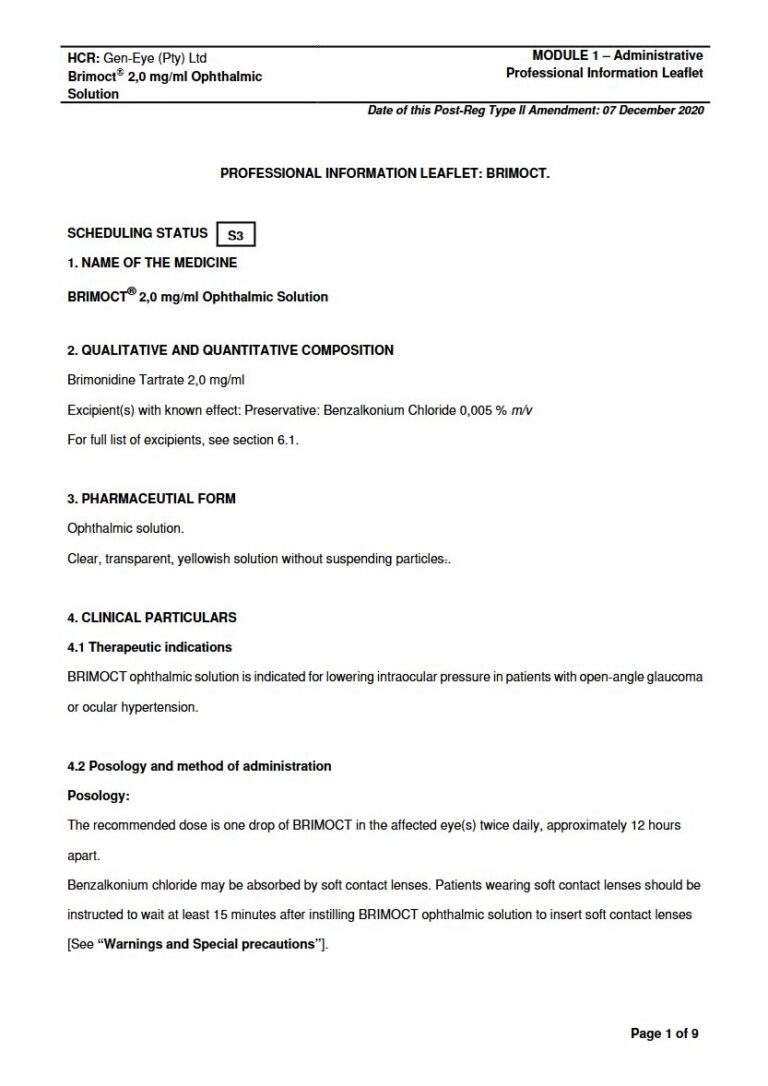
BRIMOCT ophthalmic solution is indicated for lowering intraocular pressure in patients with open-angle glaucoma or ocular hypertension.
4.2 Posology and method of administration
Posology: The recommended dose is one drop of BRIMOCT in the affected eye(s) twice daily, approximately 12 hours apart. Benzalkonium chloride may be absorbed by soft contact lenses. Patients wearing soft contact lenses should be instructed to wait at least 15 minutes after instilling BRIMOCT ophthalmic solution to insert soft contact lenses [See u201cWarnings and Special precautionsu201d].
BRIMOCT may be used concomitantly with other topical ophthalmic medicinal products to lower ocular pressure. The topical ophthalmic products should be administered at least 5 minutes apart if more than one product is being used.
Method of administration: Ocular use.
4.3 Contraindications
BRIMOCT is contraindicated in patients with hypersensitivity to brimonidine tartrate, benzalkonium chloride or any other ingredient in BRIMOCT. BRIMOCT is also contraindicated in patients receiving monoamine oxidase (MAO) inhibitor therapy. Safety and efficacy of BRIMOCT in children younger than 2 years of age have not been established. However due to potentially serious adverse central nervous system effects, including apnoea and lethargy, reported in infants treated with topical brimonidine tartrate, the use of BRIMOCT is not recommended for use in paediatric patients under the age of two.
4.4 Special warnings and precautions for use
As the possibility of adverse effects on the corneal permeability, and the danger of disruption of the corneal epithelium with prolonged or repeated usage of benzalkonium chloride preserved ophthalmological preparations, cannot be excluded, regular ophthalmological examination is required. Caution should be exercised in the use of benzalkonium chloride preserved topical medication over an extended period in patients with extensive ocular surface disease. The use of BRIMOCT may result in dry eyes and therefore should be used with caution in patients with dry eye syndrome. Patients that use intraocular lowering medication should be routinely monitored for intraocular pressure. Brimonidine had minimal effects on the blood pressure of patients in clinical studies however caution should be exercised in treating patients with severe cardiovascular disease. BRIMOCT should be used with caution in patients with Raynaudu2019s phenomenon, cerebral or coronary insufficiency, depression, orthostatic hypotension, or thromboangiitis obliterans.
BRIMOCT ophthalmic solution has not been studied in patients with renal or hepatic impairment and therefore caution should be exercised in treating such patients. Benzalkonium chloride may be absorbed by soft contact lenses. Patients wearing soft contact lenses should be instructed to wait at least 15 minutes after instilling BRIMOCT ophthalmic solution to insert soft contact lenses. The overall difference in safety and efficacy between the elderly and other adult patients has not been observed. BRIMOCT may cause fatigue and/or drowsiness in some patients. Patients who engage in hazardous activities should therefore be cautioned of the potential for a decrease in mental alertness.
4.5 Interaction with other medicines and other forms of interaction
BRIMOCT has the possibility of an additive or potentiating effect when used with CNS depressants (alcohol, sedatives, barbiturates, opiates or anaesthetics). Caution in using concomitant medicines such as beta blockers (ophthalmic and systemic), antihypertensive and/or cardiac glycosides is advised, since alpha agonists as a class, may reduce pulse and blood pressure. The hypotensive effects of systemic clonidine have been reported to be blunted by tricyclic antidepressants. It is not known whether the concurrent use of these agents with BRIMOCT ophthalmic solution can lead to an interference with the IOP lowering effect. There is no information available regarding the level of circulating catecholamines after BRIMOCT administration. However, since tricyclic antidepressants may affect the metabolism and uptake of circulating amines, caution is advised in patients using these antidepressants.
4.6 Fertility, pregnancy and lactation
Pregnancy: The safety and efficacy of BRIMOCT in pregnant women have not been established. Lactation: It has not been established whether BRIMOCT is excreted in human milk. A decision should be made on whether to discontinue BRIMOCT or discontinue breastfeeding, taking into account the importance of the medicine to the mother.
4.7 Effects on ability to drive and use machines
BRIMOCT may sting, burn or cause itchiness and blurred vision just after instillation. Patients should be advised to not drive, use machinery or do any activity that requires clear vision, until they are sure that they can perform such activities safely.
4.8 Undesirable effects
Eye disorders: Frequent: Conjunctival hyperaemia, eye pruritus. Allergic conjunctivitis. Burning sensation, stinging, foreign body sensation, follicular conjunctivitis, photophobia, eye pain, eye dryness, conjunctival oedema, blepharitis, eye irritation, eye discharge, conjunctival haemorrhage. Conjunctival folliculosis, conjunctivitis, epiphora, visual field defects, visual disturbances, worsened visual acuity, superficial punctate keratopathy, vitreous floaters. Less frequent: Corneal erosion. Frequency unknown: Iritis, miosis.
Nervous system disorders: Frequent: Headache, dizziness. Less Frequent: Taste perversion, somnolence in adults and infants.
Psychiatric disorders: Less frequent: Insomnia, depression, anxiety, syncope.
Vascular disorders: Frequent: Hypertension. Frequency unknown: Hypotension in adults and infants.
Musculoskeletal disorders: Frequency unknown: Hypotonia in infants.
Cardiac disorders: Less frequent: Palpitations. Frequency unknown: Bradycardia in adults and infants, tachycardia.
Immune system disorders: Frequent: Allergic reactions.
Skin and subcutaneous tissue disorders: Frequent: Rash. Eyelid erythema, eyelid oedema. Frequency unknown: Eye pruritus, vasodilation.
Respiratory, thoracic and mediastinal disorders: Frequent: Cough, dyspnoea. Less frequent: Nasal dryness. Frequency unknown: Apnoea in infants.
Gastrointestinal disorders: Frequent: Oral dryness, dyspepsia.
Infections and infestations: Frequent: Sinusitis, sinus infection, flu syndrome, bronchitis, rhinitis, pharyngitis.
General disorders and administration site condition: Frequent: Asthenia. Frequency unknown: Hypothermia in infants.
4.9 Overdose
Treatment, in the event of an oral overdose, includes supportive and symptomatic therapy. A patent airway should be maintained.
