
Genfloc 5 mg/ml Ophthalmic Solution
PDF Leaflet Revision Date: 08 December 2020
Clinical Summary
Quick overview from the medicine insert
Indication
Topical treatment of bacterial conjunctivitis.
Dosage (summary)
1 drop in affected eye(s) 3 times a day for 4 days.
Special Populations
- Hepatic impairment
- Renal impairment
- Paediatric population
Pregnancy & Breastfeeding
Use in pregnancy only if benefits outweigh risks; caution in breastfeeding.
Key Drug Interactions
- Warfarin
- Theophylline
- Oral contraceptives
Contraindications
- Hypersensitivity to moxifloxacin or quinolones
Common side effects
- Eye pain
- Eye irritation
- Headache
Counselling Points
- Do not wear contact lenses during infection
- Wait for vision to clear before driving
Serious warnings
- Serious hypersensitivity reactions
- Tendon inflammation and rupture risk
Important Disclaimer
The Genfloc 5 mg/ml Ophthalmic Solution professional information leaflet below is the property of Gen-Eye and is provided on Medinsert exactly as issued, with no.. alterations or editorial changes. We make every effort to keep content current by updating documents as soon as new versions become available. Medinsert serves as a trusted access point for healthcare professionals, but does not replace official sources or clinical judgement. For more details, please read our full disclaimer. read more>>
 Healthcare Professionals Only
This content is for registered healthcare professionals
Sign in or create a free account to read the full package insert.
Free for HPCSA-registered professionals. Powered by Medinsert.
Clinical Particulars
Section 4 of the official insert — extracted exactly as issued, no alterations
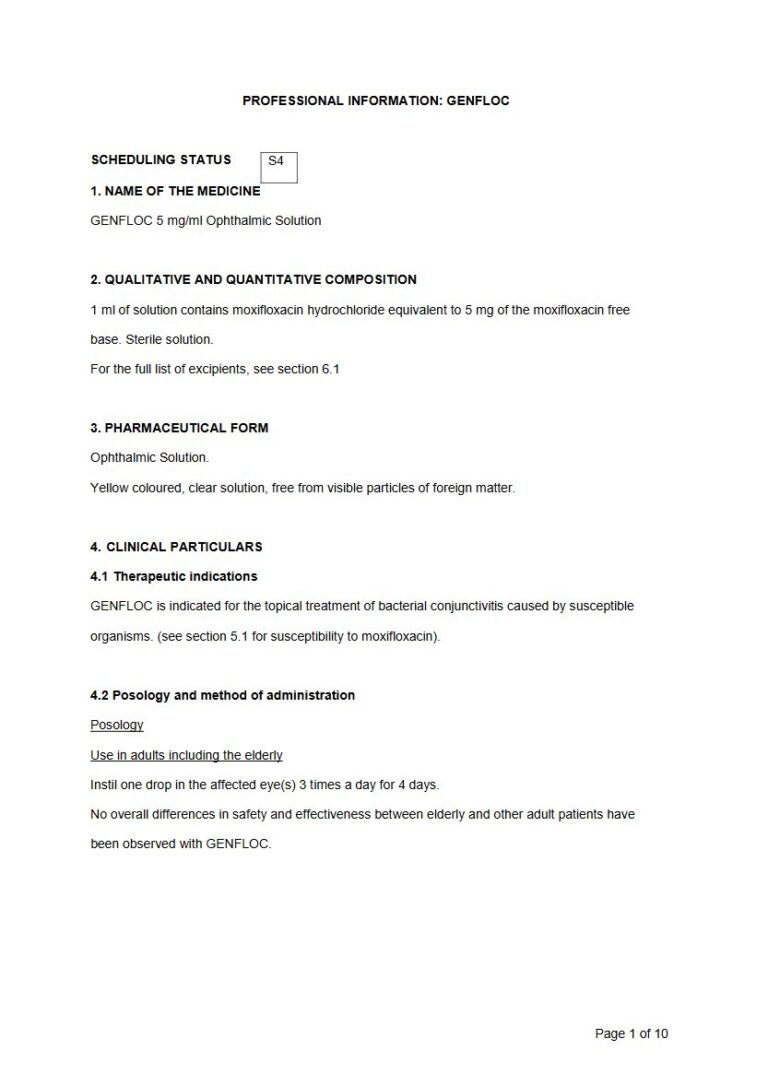
4.1 Therapeutic indications
GENFLOC is indicated for the topical treatment of bacterial conjunctivitis caused by susceptible organisms. (see section 5.1 for susceptibility to moxifloxacin).
4.2 Posology and method of administration
Posology
Use in adults including the elderly
Instil one drop in the affected eye(s) 3 times a day for 4 days. No overall differences in safety and effectiveness between elderly and other adult patients have been observed with GENFLOC.
Special populations
Use in hepatic impairment
Pharmacokinetic parameters of oral moxifloxacin were not significantly altered in patients with mild to moderate hepatic insufficiency (Child Pugh Classes A and B). Studies were not performed in patients with severe hepatic impairment (Child Pugh Class C). Because of the low systemic exposure by the topical route administration, no dosage adjustment of GENFLOC is needed in patients with hepatic impairment.
Use in renal impairment
The pharmacokinetic parameters of oral moxifloxacin are not significantly altered by mild, moderate or severe renal impairment. No dosage adjustment of GENFLOC is necessary in patients with renal impairment.
Paediatric population
GENFLOC has been shown to be safe and effective in paediatric patients including neonates and can be used at the same dose as in adults. There is no evidence that the ophthalmic administration of GENFLOC has any effect on weight bearing joints, even though oral administration of some quinolones has been shown to cause arthropathy in immature animals.
Method of administration
For ocular use only. To prevent contamination of the dropper tip and solution, care must be taken not to touch the eyelids, surrounding areas or other surfaces with the dropper tip of the bottle.
4.3 Contraindications
GENFLOC is contraindicated in patients with a history of hypersensitivity to the active substance moxifloxacin, to other quinolones or to any of the excipients of GENFLOC listed in section 6.1.
4.4 Special warnings and precautions for use
In patients receiving systemically administered quinolones, serious and occasionally fatal hypersensitivity (anaphylactic) reactions have been reported, some following the first dose. Some reactions were accompanied by cardiovascular collapse, loss of consciousness, angioedema (including laryngeal, pharyngeal or facial oedema), airway obstruction, dyspnoea, urticaria, and itching (see section 4.8). If an allergic reaction to GENFLOC occurs, discontinue use of the medicine. Serious acute hypersensitivity reactions to moxifloxacin or any other ingredient may require immediate emergency treatment. Oxygen and airway management should be administered where clinically indicated.
Prolonged use may result in overgrowth of non-susceptible organisms, including fungi. If superinfection occurs, discontinue use and institute alternative therapy.
Tendon inflammation and rupture may occur with systemic fluoroquinolone therapy including moxifloxacin as in GENFLOC, particularly in older patients and those treated concurrently with corticosteroids. Following ophthalmic administration, plasma concentrations of moxifloxacin are much lower than after therapeutic oral doses of moxifloxacin (see section 4.5 and 5.2), however, caution should be exercised and treatment with GENFLOC should be discontinued at the first sign of tendon inflammation (see section 4.8).
GENFLOC should not be used for the prophylaxis or empiric treatment of gonococcal conjunctivitis, including gonococcal ophthalmia neonatorum, because of the prevalence of fluoroquinolone-resistant Neisseria gonorrhoeae. Patients with eye infections caused by Neisseria gonorrhoeae should receive appropriate systemic treatment.
Patients should be advised not to wear contact lenses if they have signs and symptoms of a bacterial ocular infection.
Paediatric population
Neonates with ophthalmia neonatorum should receive appropriate treatment for their condition, e.g. systemic treatment in cases caused by Chlamydia trachomatis or Neisseria gonorrhoeae. GENFLOC is not recommended for the treatment of Chlamydia trachomatis in patients less than 2 years of age as it has not been evaluated in such patients. Patients older than 2 years of age with eye infections caused by Chlamydia trachomatis should receive appropriate systemic treatment.
4.5 Interaction with other medicines and other forms of interaction
While interaction studies have not been conducted with moxifloxacin ophthalmic solution, they have been performed with the oral dosage form at much higher systemic exposures than are achieved by the topical ocular route. No clinically significant interactions between systemically administered moxifloxacin and itraconazole, theophylline, warfarin, digoxin, oral contraceptives, probenecid, ranitidine or glyburide have been observed.
In vitro studies indicate that moxifloxacin does not inhibit CYP3A4, CYP2D6, CYP2C9, CYP2C19 or CYP1A2 indicating that moxifloxacin as in GENFLOC is unlikely to alter the pharmacokinetics of medicines metabolised by these cytochrome P450 isozymes. Given the low systemic concentration of moxifloxacin following topical ocular administration (see Section 5.2), interactions are unlikely to occur.
4.6 Pregnancy and lactation
Pregnancy
Since there are no adequate and well-controlled studies in pregnant women, GENFLOC should be used during pregnancy only if the potential benefit justifies the potential risk to the foetus.
Breastfeeding
Moxifloxacin has not been measured in human milk although it can be presumed to be excreted in human milk. Caution should be exercised when GENFLOC is administered to a nursing mother.
Fertility
Studies have not been performed to evaluate the effect of ocular administration of moxifloxacin on fertility.
4.7 Effects on ability to drive and use machines
Temporary blurred vision or other visual disturbances may occur with GENFLOC. Patients should be advised to wait until their vision clears before driving or using machinery if they experience blurred vision at instillation.
4.8 Undesirable effects
Tabulated summary of adverse reactions
System Organ Class GENFLOC Side Effects
Blood and lymphatic system disorders
- Less frequent: haemoglobin decreased
Immune system disorders
- Less frequent: hypersensitivity
Nervous system disorders
- Less frequent: headache, paraesthesia , dizziness
Eye disorders
- Frequent: eye pain, eye irritation
- Less frequent: punctate keratitis, dry eye, conjunctival haemorrhage, ocular hyperaemia, eye pruritus, eyelid oedema, ocular discomfort, corneal epithelium defect, corneal disorder, conjunctivitis, blepharitis, eye swelling, conjunctival oedema, blurred vision, reduced visual acuity, asthenopia, erythema of eyelid endophthalmitis, ulcerative keratitis, corneal erosion, corneal abrasion, increased intraocular pressure, corneal opacity, corneal infiltrates, corneal deposits, eye allergy, keratitis, corneal oedema, photophobia, eyelid oedema, increased lacrimation, eye discharge, foreign body sensation in eyes
Cardiac disorders
- Less frequent: palpitations
Respiratory, thoracic and mediastinal disorders
- Less frequent: nasal discomfort, pharyngolaryngeal pain, sensation of foreign body (throat), dyspnoea
Gastrointestinal disorders
- Less frequent: Dysgeusia, vomiting, nausea
Hepatobiliary disorders
- Less frequent: increased alanine aminotransferase, increased gamma- glutamyltransferase
Skin and subcutaneous tissue disorders
- Less frequent: erythema, rash, pruritus, urticaria
Reporting of suspected adverse reactions:
Reporting suspected adverse reactions after authorisation of the medicine is important. It allows continued monitoring of the benefit/risk balance of the medicine. Healthcare providers are asked to report any suspected adverse reactions to SAHPRA via the u201c6.04 Adverse Drug Reaction Reporting Formu201d, found online under SAHPRAu2019s publications: https://www.sahpra.org.za/Publications/Index/8. In addition suspected adverse reactions can be reported to Gen-Eye (Pty) Ltd via email: [email protected] or telephonically on 011 312 3812.
4.9 Overdose
The limited holding capacity of the conjunctival sac for ophthalmic medicines practically precludes any overdosing of GENFLOC. Intoxication after inadvertent oral ingestion can also be ruled out. The total amount of moxifloxacin in a single container is too small to induce adverse effects after accidental ingestion.
