
Prodyna 150 Mg/300 Mg Tablets
PDF Leaflet Revision Date: 15 November 2024
Clinical Summary
Quick overview from the medicine insert
Indication
Treatment of depression as per DSM IV criteria.
Dosage (summary)
Initial: 150 mg once daily; may increase to 300 mg once daily after 24 hours if needed.
Special Populations
- Elderly
- Renal impairment
- Hepatic impairment
Pregnancy & Breastfeeding
Not established; avoid breastfeeding during treatment.
Key Drug Interactions
- CYP2B6 inhibitors
- CYP2D6 substrates
- MAOIs
Contraindications
- Hypersensitivity to bupropion
- Seizure disorder
- Patients under 18 years
- Bulimia or anorexia nervosa
- Severe hepatic cirrhosis
Common side effects
- Insomnia
- Agitation
- Dizziness
- Dry mouth
- Increased blood pressure
Counselling Points
- Monitor for worsening depression or suicidal thoughts.
- Avoid alcohol during treatment.
- Do not crush or chew tablets.
Serious warnings
- Risk of seizures
- Suicidal ideation in young adults
- Neuropsychiatric symptoms
Important Disclaimer
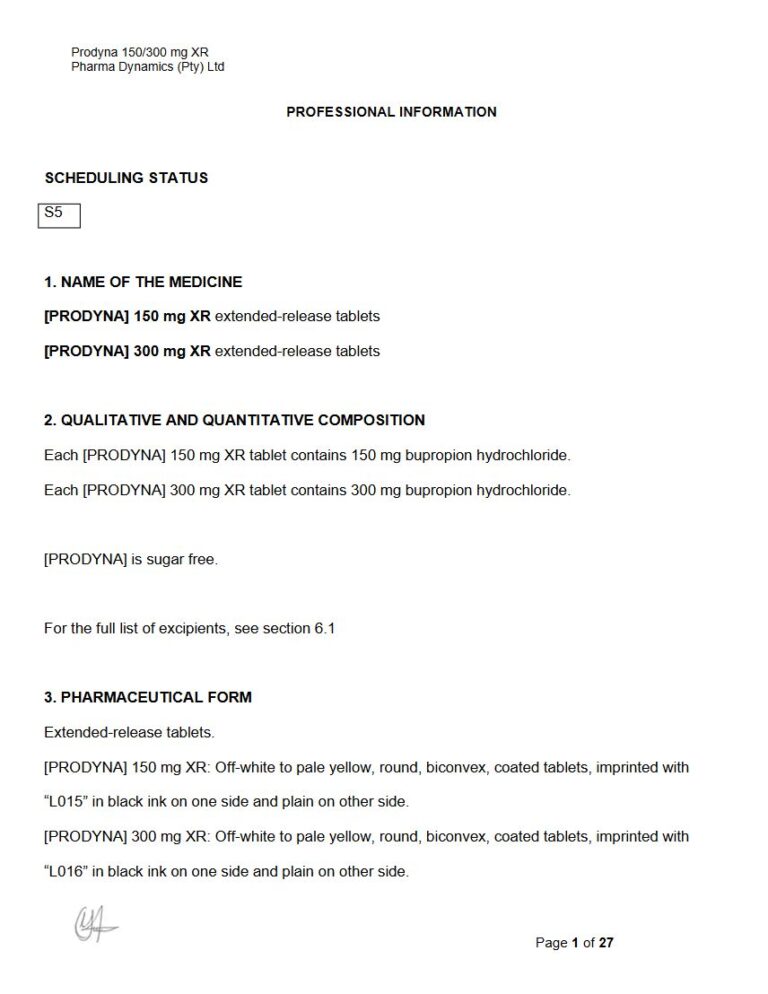
The Prodyna 150 Mg/300 Mg Tablets professional information leaflet below is the property of Pharma Dynamics and is provided on Medinsert exactly as issued, with no.. alterations or editorial changes. We make every effort to keep content current by updating documents as soon as new versions become available. Medinsert serves as a trusted access point for healthcare professionals, but does not replace official sources or clinical judgement. For more details, please read our full disclaimer. read more>>
 Healthcare Professionals Only
This content is for registered healthcare professionals
Sign in or create a free account to read the full package insert.
Free for HPCSA-registered professionals. Powered by Medinsert.
Clinical Particulars
Section 4 of the official insert — extracted exactly as issued, no alterations
4.1 Therapeutic indications
[PRODYNA] is indicated for the treatment of depression as defined by DSM IV Criteria. Following a satisfactory response, continuation with [PRODYNA] therapy is effective in preventing relapse and preventing recurrence of further depressive episodes.
4.2 Posology and method of administration
Therapy should be initiated by medical practitioners experienced in the treatment of depression.
Posology: Initial treatment: The initial dose of [PRODYNA] is 150 mg taken as a single daily dose in the morning. Patients who are not responding adequately to a dose of 150 mg/day may benefit from an increase to the usual adult target dose of 300 mg/day, given once daily. There should be an interval of at least 24 hours between successive doses. Insomnia is a very common adverse event which is often transient. Insomnia may be reduced by avoiding dosing at bedtime (provided there is at least 24 hours between doses) or, if clinically indicated, dose reduction.
Switching patients from sustained release tablets: When switching patients from sustained release tablets to extended release tablets; give the same total daily dose when possible. Patients who are currently being treated with sustained release tablets at 300 mg/day (e.g. 150 mg twice daily) may be switched to extended release tablets 300 mg once daily.
Special populations
- Elderly: Greater sensitivity of some elderly individuals to [PRODYNA] cannot be ruled out, hence a reduced frequency and/or dose may be required (see section 4.4).
- Renal Impairment: Treatment of patients with renal impairment should be initiated at a reduced frequency and/or dose, as bupropion and its metabolites may accumulate in such patients to a greater extent than usual (see section 4.4).
- Liver Impairment: [PRODYNA] should be used with caution in patients with mild liver impairment. Because of increased variability in the pharmacokinetics in patients with mild hepatic cirrhosis, a reduced frequency of dosing should be considered (see sections 4.4 and 4.8). [PRODYNA] is contraindicated in patients with moderate to severe hepatic cirrhosis.
- Paediatric population: [PRODYNA] is not indicated for use in children or adolescents aged less than 18 years (see section 4.3).
Method of administration: [PRODYNA] tablets should be swallowed whole. The tablets should not be cut, crushed or chewed as this may lead to an increased risk of adverse effects including seizures.
4.3 Contraindications
- hypersensitivity to bupropion or to any of the excipients listed in 6.1
- patients under 18 years
- [PRODYNA] is contraindicated in patients with a seizure disorder
- [PRODYNA] should not be administered to patients currently being treated with any other preparation containing bupropion, as the incidence of seizures is dose dependent
- [PRODYNA] is contraindicated in patients undergoing abrupt discontinuation of alcohol or sedatives
- [PRODYNA] is contraindicated in patients with a current or previous diagnosis of bulimia or anorexia nervosa as a higher incidence of seizures was seen in this patient population when bupropion was administered
- concomitant administration of [PRODYNA] with monoamine oxidase inhibitors (MAOls) is contraindicated. At least 14 days should elapse between the discontinuation of MAOls and initiation of treatment with [PRODYNA]
- liver disease, Child-Pugh grades B and C, range 7 - 13.
4.4 Special warnings and precautions for use
Seizures: The recommended dose of [PRODYNA] should not be exceeded, since bupropion is associated with a dose-related risk of seizure. [PRODYNA] should be discontinued promptly if patients experience hypersensitivity reactions during treatment (see section 4.8). Medical practitioners should be aware that symptoms may persist beyond the discontinuation of [PRODYNA] and clinical management should be provided accordingly. The overall incidence of seizure with bupropion hydrochloride in clinical trials was approximately 0,1 %. There is an increased risk of seizures occurring with the use of [PRODYNA] in the presence of predisposing risk factors, which lower the seizure threshold. Therefore, [PRODYNA] should not be administered to patients with one or more conditions predisposing to a lowered seizure threshold, which include:
- history of head trauma
- central nervous system (CNS) tumour
- history of seizures
- concomitant administration of other medications known to lower the seizure threshold, excessive use of alcohol or sedatives (see section 4.3), diabetes treated with hypoglycaemics or insulin and use of stimulants or anorectic medicines.
[PRODYNA] should be discontinued and not recommenced in patients who experience a seizure while on treatment.
Clinical worsening and suicide risk in adults associated with psychiatric disorders: Patients with major depressive disorder, may experience worsening of their depression and or the emergence of suicidal ideation and behaviour, whether or not they are taking antidepressant medicines. This risk may persist until significant remission occurs. A causal role, however, for antidepressant medicine in inducing such behaviour has not been established. As improvement may occur during the first few weeks or more of treatment, patients being treated with [PRODYNA] should, nevertheless, be observed closely for clinical worsening (including development of new symptoms) and suicidality, especially at the beginning of a course of therapy or at any time of dose changes, either increases or decreases. Patients with a history of suicidal behaviour or thoughts, young adults and those patients exhibiting a significant degree of suicidal ideation prior to commencement of treatment are at a greater risk of suicidal thoughts or suicide attempts and should receive careful monitoring during treatment.
The following symptoms have been reported in patients being treated with antidepressants for major depressive disorder as well as for other indications, both psychiatric and non-psychiatric: anxiety, agitation, panic attacks, insomnia, irritability, hostility, aggressiveness, impulsivity, akathisia, hypomania, and mania.
In addition, a meta-analysis of placebo controlled clinical trials of antidepressant medicines in adults with major depressive disorder and other psychiatric disorders showed an increased risk of suicidal thinking and behaviour associated with antidepressant use compared to placebo in patients less than 25 years old.
Patients (and caregivers of patients) should be alerted about the need to monitor for any worsening of their condition (including development of new symptoms) and/or the emergence of suicidal ideation/behaviour or thoughts of harming themselves and to seek medical advice immediately if these symptoms present. It should be recognised that the onset of neuropsychiatric symptoms could be related either to the underlying disease state or the medicine therapy and an appropriate patient assessment should be undertaken (see section 4.8).
Consideration should be given to changing the therapeutic regimen, including possibly discontinuing [PRODYNA], in patients who experience clinical worsening (including development of new symptoms) and/or the emergence of suicidal ideation/behaviour, especially if these symptoms are severe, abrupt in onset, or were not part of the patient's presenting symptoms. Although there is no need to taper [PRODYNA] upon discontinuation, the patient should be monitored for worsening of depressive symptoms following discontinuation.
Neuropsychiatric symptoms including mania and bipolar disorder: Neuropsychiatric symptoms have been reported (see section 4.8). In particular, psychotic and manic symptomatology has been observed, mainly in patients with a known history of psychiatric illness. Aggression, rage and violent behaviour may occur. Additionally, a major depressive episode may be the initial presentation of bipolar disorder. It is generally believed (though not established in controlled trials) that treating such an episode with an antidepressant alone can increase the likelihood of precipitation of a mixed/manic episode in patients at risk for bipolar disorder. Limited clinical data on use of bupropion in combination with mood stabilisers in patients with a history of bipolar disorder suggests a low rate of switch to mania.
Prior to initiating treatment with [PRODYNA], patients should be adequately screened to determine if they are at risk for bipolar disorder; such screening should include a detailed psychiatric history, including a family history of suicide, bipolar disorder, and depression.
Hepatic impairment: Bupropion is extensively metabolised in the liver to active metabolites, which are further metabolised. No statistically significant differences in the pharmacokinetics of bupropion were observed in patients with mild hepatic cirrhosis compared with healthy volunteers, but bupropion plasma levels showed a higher variability between individual patients. Therefore, [PRODYNA] should be used with caution in patients with mild hepatic impairment and reduced frequency of dosing should be considered (see sections 4.3 and 5.2).
Renal impairment and elderly patients: Bupropion is extensively metabolised in the liver to active metabolites which are further metabolised and excreted by the kidneys. Therefore, treatment of patients with renal impairment should be initiated at reduced frequency and/or dose as bupropion and its metabolites may accumulate in such patients to a greater extent than usual. The patient should be closely monitored for possible adverse effects (e.g. insomnia, dry mouth, seizures) that could indicate high bupropion or metabolite levels, toxic effects of elevated blood and tissue levels of bupropion and metabolites.
Clinical experience with [PRODYNA] has not identified any differences in tolerability between elderly and other adult patients, However, greater sensitivity of some elderly individuals cannot be ruled out, hence a reduced frequency and/or dose may be required (see section 5.2).
Cardiovascular disease: There is limited clinical experience of the use of [PRODYNA] to treat depression in patients with cardiovascular disease. A causal relationship between the use of [PRODYNA] and sudden death cannot be excluded. Care should be exercised if [PRODYNA] is used in these patients.
Brugada Syndrome: Cardiac conduction disorders-Bupropion may unmask cardiac conduction syndromes e.g. Brugada syndrome, a rare hereditary disease of the cardiac sodium channel with characteristic ECG changes (right bundle branch block and ST segment elevation in right precordial leads), which may lead to cardiac arrest and or sudden death. Caution is advised in patients with Brugada syndrome or family history of cardiac arrest or sudden death.
Children and Adolescents <18 years: The safety and efficacy with the treatment of [PRODYNA] tablets in patients under 18 years of age have not been established. Treatment with antidepressants is associated with an increased risk of suicidal thinking and behaviour in children and adolescents with major depressive disorder and other psychiatric disorders (see section 4.3).
4.5 Interaction with other medicines and other forms of interaction
Medicines known to affect the CYP2B6 isoenzyme: Bupropion is metabolised to its major active metabolite hydroxybupropion primarily by the cytochrome P450 IIB6 (CYP2B6) (see section 5.2). Care should therefore be exercised when [PRODYNA] is co-administered with medicines known to affect the CYP2B6 isoenzyme (e.g. orphenadrine, cyclophosphamide, ifosfamide, ticlopidine, clopidogrel).
Medicines metabolized by CYP2D6: Although bupropion is not metabolised by the CYP2D6 isoenzyme, in vitro human P450 studies have shown that bupropion and hydroxybupropion are inhibitors of the CYP2D6 pathway. In a human pharmacokinetic study, administration of bupropion increased plasma levels of desipramine. This effect was present for at least 7 days after the last dose of bupropion. Concomitant therapy with medicines predominantly metabolised by this isoenzyme (such as certain beta-blockers, anti-dysrhythmics, selective serotonin re-uptake inhibitors (SSRIs), tricyclic antidepressants (TCAs), antipsychotics) should be initiated at the lower end of the dose range of the concomitant medicine. If [PRODYNA] is added to the treatment regimen of a patient already receiving a medication metabolised by CYP2D6, the need to decrease the dose of the original medication should be considered, particularly for those concomitant medications with a narrow therapeutic index (see section 5.2).
Citalopram: Although citalopram is not primarily metabolised by CYP2D6, in one study, bupropion increased the C max and AUC of citalopram by 30 % and 40 %, respectively.
Medicines known to induce metabolism: Since bupropion is extensively metabolised, the co-administration of medicines known to induce metabolism (e.g. carbamazepine, phenobarbitone, phenytoin) or inhibit metabolism may affect its clinical activity.
Ritonavir: In a series of studies in healthy volunteers, ritonavir (100 mg twice daily or 600 mg twice daily) or ritonavir 100 mg plus lopinavir 400 mg twice daily, reduced the exposure of bupropion and its major metabolites in a dose dependent manner by approximately 20 to 80 %. This effect is thought to be due to the induction of bupropion metabolism. Patients receiving ritonavir may need increased doses of [PRODYNA] but the maximum recommended dose of [PRODYNA] should not be exceeded.
Alcohol: There have been reports of adverse neuropsychiatric events or reduced alcohol tolerance in patients drinking alcohol during bupropion hydrochloride treatment. The consumption of alcohol during [PRODYNA] treatment should be minimised or avoided.
Levodopa or amantadine: Limited clinical data suggest a higher incidence of adverse events in patients receiving concurrent administration of bupropion and levodopa. Administration of [PRODYNA] to patients receiving either levodopa or amantadine concurrently should be undertaken with caution.
Nicotine: Concomitant use of [PRODYNA] and a Nicotine Transdermal System (NTS) may result in elevations of blood pressure.
Monoamine oxidase inhibitors (MAOIs): Bupropion inhibits the reuptake of dopamine and norepinephrine. Concomitant use of monoamine oxidase inhibitors (MAOIs) and bupropion is contraindicated because there is an increased risk of hypertensive reactions if bupropion is used concomitantly with MAOIs. At least 14 days should elapse between discontinuation of an MAOI intended to treat depression and initiation of treatment with [PRODYNA]. Conversely, at least 14 days should be allowed after stopping [PRODYNA] before starting a MAOI antidepressant. Bupropion has been classified as possibly porphyrinogenic. It should be used only when no safe alternative is available, and precautions should be considered in vulnerable patients.
4.6 Fertility, pregnancy and lactation
Safety in pregnancy and lactation has not been established.
Pregnancy: Epidemiological studies of pregnancy outcomes following maternal exposure to bupropion in the first trimester have reported an association with increased risk of some congenital cardiovascular malformations, including ventricular septal defects and left ventricular outflow tract defects. These findings are not consistent across studies.
Breastfeeding: As bupropion and its metabolites are excreted in human breast milk, mothers should be advised not to breastfeed while taking [PRODYNA].
Fertility: There is no data on fertility with [PRODYNA].
4.7 Effects on ability to drive and use machines
Patients should exercise caution before driving or use of machinery until they are reasonably certain [PRODYNA] tablets do not adversely affect their performance as dizziness, visual disturbances and hallucinations have been reported as occurring side effects.
4.8 Undesirable effects
Tabulated list of adverse effects
System Organ Class Frequency Side effects
Blood and lymphatic system disorders Frequency unknown Ecchymosis, anaemia, leukocytosis, leukopenia, lymphadenopathy, pancytopenia, and thrombocytopenia, altered PT and/or INR, associated with haemorrhagic or thrombotic complications, when co-administered with warfarin
Immune system disorders Frequent Less frequent Hypersensitivity reactions such as urticaria More severe hypersensitivity reactions including angioedema, dyspnoea/bronchospasm and anaphylactic shock, arthralgia, myalgia, fever, rash (symptoms resemble serum sickness)
Endocrine disorders Frequency unknown Hyperglycaemia, hypoglycaemia, syndrome of inappropriate antidiuretic hormone secretion
Metabolism and nutrition disorders Frequent Less frequent Frequency unknown Anorexia, weight loss Blood glucose disturbances Glycosuria
Psychiatric disorders Frequent Less frequent Frequency unknown Insomnia, agitation, anxiety Confusion, depression, aggression, hostility, irritability, restlessness, hallucinations, abnormal dreams, depersonalisation, delusions, paranoid ideation Suicide attempt
Nervous system disorders Frequent Less frequent Frequency unknown Headache, tremor, dizziness, taste disorders Concentration disturbances, seizures (see section 4.4), dystonia, ataxia, parkinsonism, incoordination, memory impairment, paraesthesia, syncope Emotional lability, derealization, euphoria, abnormal coordination, hyperkinesia, hypertonia, hyperesthesia, vertigo, amnesia, abnormal electroencephalogram (EEG), akinesia, aphasia, coma, dysarthria, dyskinesia, extrapyramidal syndrome, hypokinesia, increased libido, neuralgia, neuropathy, unmasking tardive dyskinesia
Eye disorders Frequent Frequency unknown Visual disturbance Accommodation abnormality, dry eye, increased intraocular pressure angle-closure glaucoma, mydriasis
Ear and labyrinth disorders Frequent Frequency unknown Tinnitus Deafness
Cardiac disorders Less frequent Frequency unknown Tachycardia, palpitations complete atrioventricular block, extrasystoles, myocardial infarction
Vascular disorders Frequent Less frequent Frequency unknown Increased blood pressure (sometimes severe), flushing Vasodilation, postural hypotension Hypertension, stroke, phlebitis, pulmonary embolism
Respiratory, thoracic and mediastinal disorders Frequency unknown Bronchospasm, pneumonia
Gastrointestinal disorders Frequent Frequency unknown Dry mouth, gastrointestinal disturbance including nausea and vomiting, abdominal pain, constipation Gastric reflux, stomatitis, thirst, colitis, esophagitis, gastrointestinal haemorrhage, intestinal perforation, stomach ulcer
Hepato-biliary disorders Less frequent Frequency unknown Elevated liver enzymes, jaundice, hepatitis Abnormal liver function, liver damage, pancreatitis
Skin and subcutaneous tissue disorders Frequent Less frequent Frequency unknown Rash, pruritus, sweating Erythema multiforme and Stevens-Johnson syndrome Maculopapular rash, alopecia, angioedema, exfoliative dermatitis and hirsutism
Musculoskeletal, connective tissue and bone disorders Less frequent Frequency unknown Twitching Leg cramps, fever/rhabdomyolysis, and muscle weakness
Renal and urinary disorders Less frequent Frequency unknown Urinary frequency and/or retention Dysuria, urinary incontinence, cystitis
Reproductive system and breast disorders Frequency unknown Impotence, prostate disorder, abnormal ejaculation, dyspareunia, gynaecomastia, menopause, painful erection, salpingitis, vaginitis
General disorders and administrative site conditions Frequent Frequency unknown Fever, asthenia, chest pain Bruxism, gingivitis, glossitis, increased salivation, mouth ulcers, oedema of tongue, gum haemorrhage
Reporting of suspected adverse reactions: Reporting suspected adverse reactions after authorisation of the medicine is important. It allows continued monitoring of the benefit/risk balance of the medicine. Healthcare professionals are asked to report any suspected adverse reactions to SAHPRA via the online service for adverse drug reaction reporting by following the link: https://www.sahpra.org.za/Publications/Index/8. An email can be sent directly to the company, [email protected] to ensure safety of the product.
4.9 Overdose
Signs and symptoms: Drowsiness, loss of consciousness and ECG changes such as conduction disturbances (including QRS prolongation) or dysrhythmias. Acute ingestion of doses in excess of 10 times the maximum therapeutic dose has been reported.
Management of overdose: In the event of overdose, hospitalisation is advised. ECG and vital signs should be monitored. Ensure an adequate airway, oxygenation and ventilation. The use of activated charcoal is recommended. No specific antidote for bupropion is known. Further management should be as clinically indicated or as recommended by the national poisons centre, where available.
