
Calcipotriol/Betamethasone 0.005 %/0.064 % Suspension
PDF Leaflet Revision Date: 8 May 2025
Clinical Summary
Quick overview from the medicine insert
Indication
Topical treatment of psoriasis vulgaris in patients 18 years and older.
Dosage (summary)
Apply once daily to affected areas for up to 4 weeks; max 15 g/day, 100 g/week.
Special Populations
- Severe hepatic disorder
- Severe renal insufficiency
Pregnancy & Breastfeeding
Contraindicated in pregnancy; caution in breastfeeding.
Contraindications
- Hypersensitivity to components
- Erythrodermic and pustular psoriasis
- Disorders of calcium metabolism
- Viral, fungal, bacterial infections
- Severe hepatic or renal insufficiency
Common side effects
- Pruritus
- Burning sensation
- Skin irritation
- Hypercalcaemia
Counselling Points
- Wash hands after application
- Avoid contact with eyes
- Do not use on face or groin
- Limit sun exposure during treatment
Serious warnings
- Risk of HPA axis suppression
- Potential for Cushingu2019s syndrome
- Avoid use on sensitive areas
Important Disclaimer
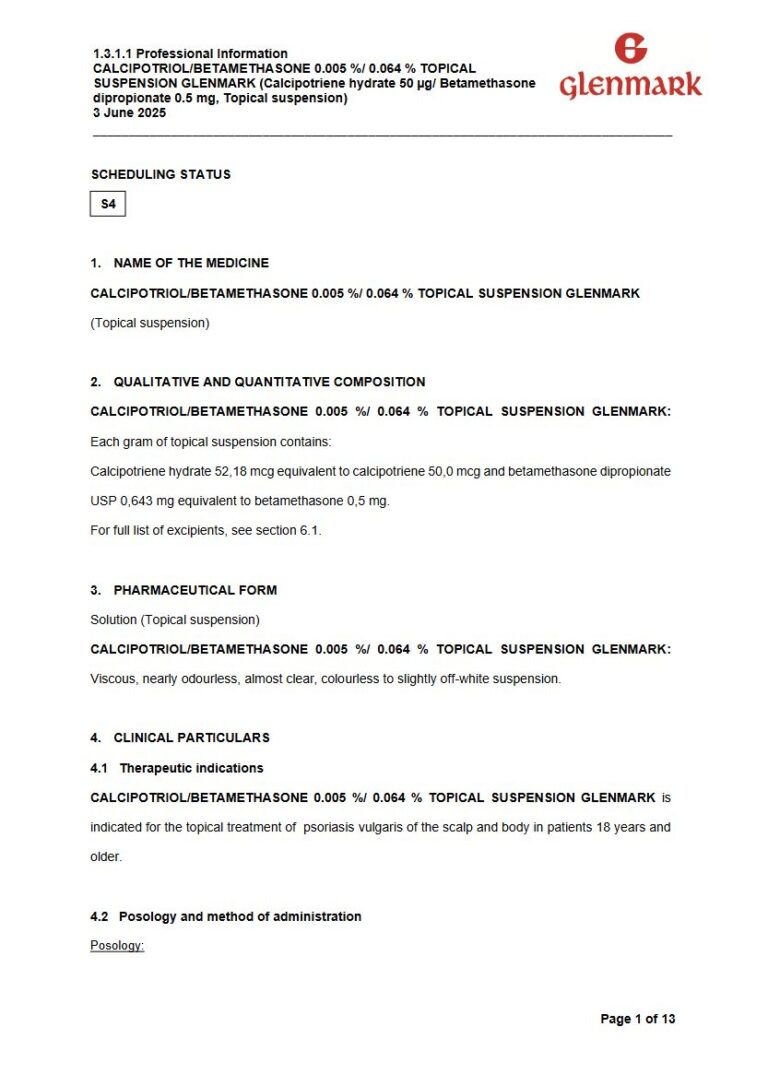
The Calcipotriol/Betamethasone 0.005 %/0.064 % Suspension professional information leaflet below is the property of Glenmark Pharmaceuticals South Africa and is provided on Medinsert exactly as issued, with no.. alterations or editorial changes. We make every effort to keep content current by updating documents as soon as new versions become available. Medinsert serves as a trusted access point for healthcare professionals, but does not replace official sources or clinical judgement. For more details, please read our full disclaimer. read more>>
 Healthcare Professionals Only
This content is for registered healthcare professionals
Sign in or create a free account to read the full package insert.
Free for HPCSA-registered professionals. Powered by Medinsert.
Clinical Particulars
Section 4 of the official insert — extracted exactly as issued, no alterations
4.1 Therapeutic indications
CALCIPOTRIOL/BETAMETHASONE 0.005 %/ 0.064 % TOPICAL SUSPENSION GLENMARK is indicated for the topical treatment of psoriasis vulgaris of the scalp and body in patients 18 years and older.
4.2 Posology and method of administration
Posology: CALCIPOTRIOL/BETAMETHASONE 0.005 %/ 0.064 % TOPICAL SUSPENSION GLENMARK should be applied to affected areas on the scalp and body once daily. The recommended treatment period is 4 weeks. CALCIPOTRIOL/BETAMETHASONE 0.005 %/ 0.064 % TOPICAL SUSPENSION GLENMARK should be discontinued when control is achieved. If it is necessary to continue or restart treatment after 4 weeks, treatment should be continued under medical review and under regular medical supervision. The maximum daily dose should not exceed 15 g, and the maximum weekly dose should not exceed 100 g. The treated area should not be more than 30 % of the body surface.
Children: There is no experience of use in children and adolescents below the age of 18 years.
Method of administration: Patients should shake bottle prior to using calcipotriene and betamethasone dipropionate topical suspension. Patients should wash their hands after applying the product. Patients should not take a bath or shower or wash their hair right after application of CALCIPOTRIOL/BETAMETHASONE 0.005 %/ 0.064 % TOPICAL SUSPENSION GLENMARK.
CALCIPOTRIOL/BETAMETHASONE 0.005 %/ 0.064 % TOPICAL SUSPENSION GLENMARK should not be:
- Used with occlusive dressings unless directed by a healthcare provider.
- Used on the face, groin, or axillae, or if skin atrophy is present at the treatment site.
- Applied to the scalp in the 12 hours before or after any chemical treatments to the hair.
CALCIPOTRIOL/BETAMETHASONE 0.005 %/ 0.064 % TOPICAL SUSPENSION GLENMARK is not for oral, ophthalmic, or intravaginal use.
4.3 Contraindications
CALCIPOTRIOL/BETAMETHASONE 0.005 %/ 0.064 % TOPICAL SUSPENSION GLENMARK is contra-indicated:
- In individuals with known hypersensitivity to calcipotriene and betamethasone or any of the excipients listed in section 6.1.
- In erythrodermic and pustular psoriasis.
- In patients with known disorders of calcium metabolism due to content of calcipotriene.
- In viral (e.g., herpes or varicella) lesions of the skin, fungal, bacterial or parasitic skin infection, skin manifestations in relation to tuberculosis, perioral dermatitis, atrophic skin, striae atrophicae, fragility of skin veins, ichthyosis, acne vulgaris, acne rosacea, rosacea, ulcers, and wounds (see section 4.4) due to the corticosteroid, betamethasone, in CALCIPOTRIOL/BETAMETHASONE 0.005 %/ 0.064 % TOPICAL SUSPENSION GLENMARK.
- In patients with severe hepatic disorder or severe renal insufficiency.
- In pregnancy and lactation, as the use of CALCIPOTRIOL/BETAMETHASONE 0.005 %/ 0.064 % TOPICAL SUSPENSION GLENMARK has not been established. Corticosteroids have been shown to be teratogenic in animals following dermal application. As these agents are absorbed percutaneously, teratogenicity following topical application cannot be excluded.
4.4 Special warnings and precautions for use
Hypercalcaemia and Hypercalciuria: Hypercalcemia and hypercalciuria have been observed with use of calcipotriene and betamethasone dipropionate topical suspension. If hypercalcemia or hypercalciuria develop, discontinue treatment until parameters of calcium metabolism have normalized. The incidence of hypercalcemia and hypercalciuria following calcipotriene and betamethasone dipropionate topical suspension treatment of more than 8 weeks has not been evaluated.
Effects on Endocrine System: Hypothalamic-Pituitary-Adrenal Axis Suppression: Calcipotriene and betamethasone dipropionate topical suspension can cause reversible hypothalamic-pituitary-adrenal (HPA) axis suppression with the potential for clinical glucocorticosteroid insufficiency. This may occur during treatment or upon withdrawal of treatment. Factors that predispose a patient to HPA axis suppression include the use of high potency steroids, large treatment surface areas, prolonged use, use of occlusive dressings, altered skin barrier, liver failure, and young age. Evaluation for HPA axis suppression may be done by using the adrenocorticotropic hormone (ACTH) stimulation test. If HPA axis suppression is documented, gradually withdraw calcipotriene and betamethasone dipropionate topical suspension, reduce the frequency of application, or substitute with a less potent corticosteroid.
Cushingu2019s Syndrome and Hyperglycaemia: Cushingu2019s syndrome and hyperglycaemia may occur due to the systemic effects of the topical corticosteroid. These complications are rare and generally occur after prolonged exposure to excessively large doses, especially of high-potency topical corticosteroids.
Additional Considerations for Endocrine Adverse Reactions: Use of more than one corticosteroid-containing product at the same time may increase the total systemic corticosteroid exposure. CALCIPOTRIOL/BETAMETHASONE 0.005 %/ 0.064 % TOPICAL SUSPENSION GLENMARK is not recommended for use in children younger than 18 years.
Allergic Contact Dermatitis with Topical Corticosteroids: Allergic contact dermatitis to a topical corticosteroid is usually diagnosed by observing a failure to heal rather than a clinical exacerbation. Such an observation should be corroborated with appropriate diagnostic patch testing.
Allergic Contact Dermatitis with Topical Calcipotriene: Allergic contact dermatitis has been observed with use of topical calcipotriene. Such an observation should be corroborated with appropriate diagnostic patch testing.
Ophthalmic Adverse Reactions: Use of topical corticosteroids, including calcipotriene and betamethasone dipropionate topical suspension, may increase the risk of posterior subcapsular cataracts and glaucoma. Cataracts and glaucoma have been reported with the post marketing use of topical corticosteroid products (see section 4.8). Avoid contact of calcipotriene and betamethasone dipropionate topical suspension with eyes. Calcipotriene and betamethasone dipropionate topical suspension may cause eye irritation. Advise patients to report any visual symptoms and consider referral to an ophthalmologist for evaluation.
Local adverse reactions: CALCIPOTRIOL/BETAMETHASONE 0.005 %/ 0.064 % TOPICAL SUSPENSION GLENMARK contains a potent group III-steroid and concurrent treatment with other steroids on the same treatment area must be avoided. Skin of the face and genitals are very sensitive to corticosteroids. CALCIPOTRIOL/BETAMETHASONE 0.005 %/ 0.064 % TOPICAL SUSPENSION GLENMARK should not be used in these areas. The patient must be instructed in correct use of CALCIPOTRIOL/BETAMETHASONE 0.005 %/ 0.064 % TOPICAL SUSPENSION GLENMARK to avoid application and accidental transfer to the face, scalp, mouth or eyes. Hands must be washed after each application to avoid accidental transfer to these areas.
Concomitant skin infections: When lesions become secondarily infected, they should be treated with anti-microbiological therapy. However, if infection worsens, treatment with CALCIPOTRIOL/BETAMETHASONE 0.005 %/ 0.064 % TOPICAL SUSPENSION GLENMARK should be stopped (see section 4.3).
Discontinuation of treatment: When treating psoriasis with topical corticosteroids, such as contained in CALCIPOTRIOL/BETAMETHASONE 0.005 %/ 0.064 % TOPICAL SUSPENSION GLENMARK, there may be a risk of generalised pustular psoriasis or of rebound effects when discontinuing treatment. Medical supervision should therefore continue in the post-treatment period.
Long-term use: With long-term use there is an increased risk of local and systemic corticosteroid adverse reactions. The treatment should be discontinued in case of adverse reactions related to long-term use of corticosteroid (see section 4.8).
Unevaluated use: There is no experience with the use of CALCIPOTRIOL/BETAMETHASONE 0.005 %/ 0.064 % TOPICAL SUSPENSION GLENMARK in guttate psoriasis.
Concurrent treatment and UV exposure: There is limited experience for the use of CALCIPOTRIOL/BETAMETHASONE 0.005 %/ 0.064 % TOPICAL SUSPENSION GLENMARK in combination with other topical anti-psoriatic products at the same treatment area, other anti-psoriatic medicines administered systemically or with phototherapy. During CALCIPOTRIOL/BETAMETHASONE 0.005 %/ 0.064 % TOPICAL SUSPENSION GLENMARK treatment, patients should limit or avoid excessive exposure to either natural or artificial sunlight.
4.5 Interaction with other medicines and other forms of interaction
No interaction studies have been performed with CALCIPOTRIOL/BETAMETHASONE 0.005 %/ 0.064 % TOPICAL SUSPENSION GLENMARK.
4.6 Fertility, pregnancy and lactation
Safety and efficacy in pregnancy and lactation have not been established (see section 4.3).
Pregnancy: CALCIPOTRIOL/BETAMETHASONE 0.005 %/ 0.064 % TOPICAL SUSPENSION GLENMARK is contraindicated in pregnancy (See Section 4.3). Calcipotriene and betamethasone dipropionate topical suspension may increase the potential risk of having a low-birth-weight infant.
Breastfeeding: Caution should be exercised when prescribing [CALCIPOTRIOL/BETAMETHASONE 0.005 %/ 0.064 % TOPICAL SUSPENSION GLENMARK] to women who are breast feeding. The patient should be instructed not to use CALCIPOTRIOL/BETAMETHASONE 0.005 %/ 0.064 % TOPICAL SUSPENSION GLENMARK on the breast when breastfeeding or directly to the nipple and areola to avoid direct infant exposure.
4.7 Effects on ability to drive and use machines
CALCIPOTRIOL/BETAMETHASONE 0.005 %/ 0.064 % TOPICAL SUSPENSION GLENMARK has no or negligible influence on the ability to drive and to use machines.
4.8 Undesirable effects
Because clinical trials are conducted under widely varying conditions, adverse reaction rates observed in the clinical trials of a drug cannot be directly compared to rates in the clinical trials of another drug and may not reflect the rates observed in practice.
Tabulated summary of post-marketing adverse reactions: The adverse reactions are listed by system organ class and absolute frequency.
System Organ Class Adverse Reactions Frequency Category Infection and infestations Folliculitis, skin infection, furuncle Less frequent Immune system disorders Hypersensitivity Less frequent Endocrine disorders Hirsutism, Cushings syndrome Less frequent Metabolism and nutrition disorders Hypercalcaemia Frequency unknown Eye disorders Blurred vision Frequency unknown Skin and subcutaneous tissue disorders Pruritus Frequent Burning sensation of skin, skin pain or irritation, folliculitis, dermatitis, erythema, acne, dry skin, exacerbation of psoriasis, rash, pustular rash, pustular psoriasis, skin hypopigmentation Less frequent Hair colour changes Frequency unknown General disorders and administration site conditions Rebound effect, application site pruritus Less frequent Betamethasone Skin and subcutaneous tissue disorders Skin atrophy, telangiectasia, striae, folliculitis, hypertrichosis, perioral dermatitis, allergic contact dermatitis, depigmentation, colloid milia, pustular psoriasis Less frequent General disorders and administration site conditions Adrenocortical suppression, cataract, infections, impaired glycaemic control of diabetes mellitus, increase of intra- ocular pressure Frequency unknown Calcipotriene General disorders and administration site conditions Hypercalcaemia, inhibition of the adrenal cortex, application site reactions, pruritus, skin irritation, burning and stinging sensation, dry skin, erythema, rash, dermatitis, psoriasis aggravated, photosensitivity and hypersensitivity reactions, angioedema, facial oedema, hypercalcaemia, hypercalciuria.
Reporting of suspected adverse reactions: Reporting suspected adverse reactions after authorisation of the medicine is important. It allows continued monitoring of the benefit/risk balance of the medicine. Health care providers are asked to report any suspected adverse reactions to SAHPRA via the Med Safety APP (Medsafety X SAHPRA) and eReporting platform (who-umc.org) found on SAHPRA website.
4.9 Overdose
Usage above the recommended dose may cause elevated serum calcium which subsides when treatment is discontinued. The symptoms of hypercalcaemia include polyuria, constipation, muscle weakness, confusion, and coma. Excessive prolonged use of topical corticosteroids may result in adrenocortical suppression which is usually reversible. Symptomatic and supportive treatment may be indicated. In case of systemic toxicity due to chronic use, CALCIPOTRIOL/BETAMETHASONE 0.005 %/ 0.064 % TOPICAL SUSPENSION GLENMARK treatment must be discontinued gradually.
