
Mylacand Plus 16/12,5 mg Tablets
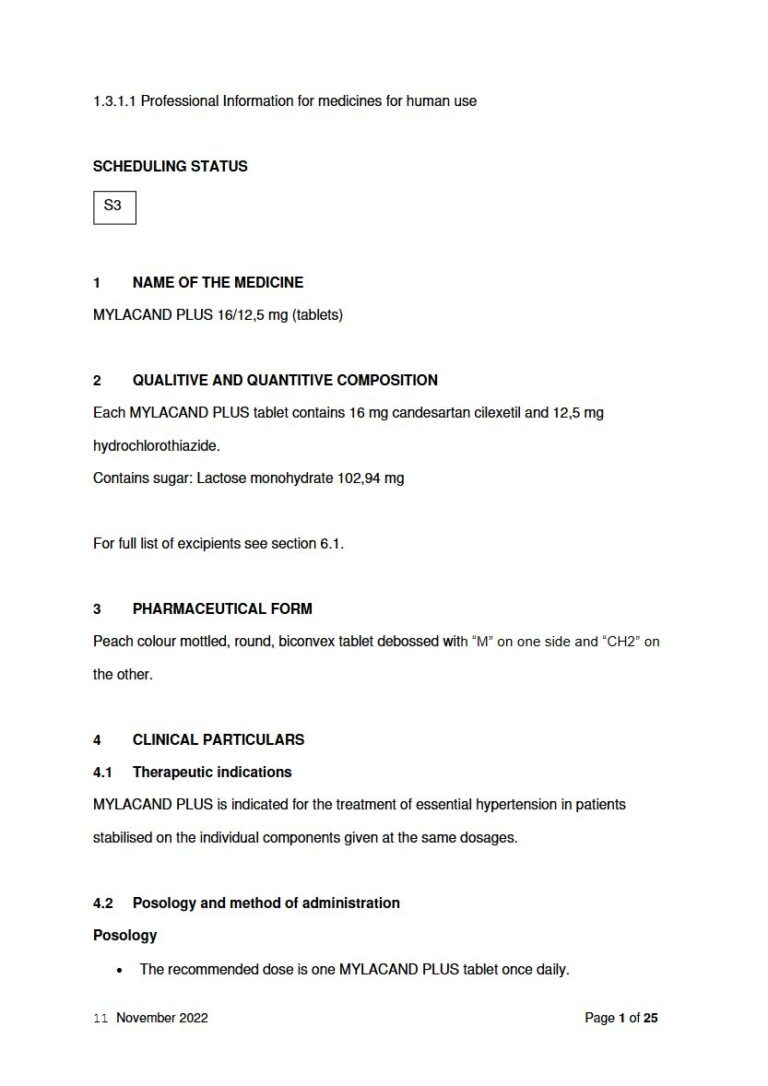
PDF Leaflet Revision Date: 11 November 2022
Clinical Summary
Quick overview from the medicine insert
Indication
Treatment of essential hypertension in stabilized patients.
Dosage (summary)
One tablet once daily.
Onset of Action / Duration
Maximal effect in 4 weeks.
Special Populations
- Elderly population
- Renal impairment
- Hepatic impairment
Pregnancy & Breastfeeding
Contraindicated in pregnancy; safety in lactation not established.
Key Drug Interactions
- Lithium
- Potassium-sparing diuretics
- NSAIDs
Contraindications
- Hypersensitivity
- Severe renal impairment
- Moderate to severe hepatic impairment
- Bilateral renal artery stenosis
Common side effects
- Dizziness
- Hypotension
- Hyperkalaemia
Counselling Points
- Monitor for skin lesions due to risk of non-melanoma skin cancer.
- Avoid potassium supplements.
- Report any signs of hypotension.
Serious warnings
- Embryonal toxicity in pregnancy
- Risk of hypotension with dual RAAS blockade
Important Disclaimer
The Mylacand Plus 16/12,5 mg Tablets professional information leaflet below is the property of Mylan and is provided on Medinsert exactly as issued, with no.. alterations or editorial changes. We make every effort to keep content current by updating documents as soon as new versions become available. Medinsert serves as a trusted access point for healthcare professionals, but does not replace official sources or clinical judgement. For more details, please read our full disclaimer. read more>>
 Healthcare Professionals Only
This content is for registered healthcare professionals
Sign in or create a free account to read the full package insert.
Free for HPCSA-registered professionals. Powered by Medinsert.
Clinical Particulars
Section 4 of the official insert — extracted exactly as issued, no alterations
4.1 Therapeutic indications
MYLACAND PLUS is indicated for the treatment of essential hypertension in patients stabilised on the individual components given at the same dosages.
4.2 Posology and method of administration
Posology
- The recommended dose is one MYLACAND PLUS tablet once daily.
- The maximal antihypertensive effect is attained within 4 weeks of initiation of treatment.
Special populations:
- Elderly population: No special dosage recommendations.
- Renal impairment: No initial dosage adjustment is necessary in patients with mild to moderate renal impairment (i.e. creatinine clearance u2265 30 ml/min/1,73 m2 BSA) (see section 4.3). MYLACAND PLUS should not be used in patients with moderate to severe renal impairment (i.e. creatinine clearance < 60 ml/min/1,73 m2 BSA).
- Hepatic impairment: No dosage adjustment is necessary in patients with mild hepatic impairment. MYLACAND PLUS is contraindicated in patients with moderate to severe hepatic impairment and/or cholestasis.
- Paediatric population: The safety and efficacy of MYLACAND PLUS have not been established in children.
Method of administration
- For oral use.
- MYLACAND PLUS should be taken once daily with or without food.
4.3 Contraindications
- Hypersensitivity to the active substance, candesartan cilexetil or hydrochlorothiazide or to any of the excipients of MYLACAND PLUS or to sulphonamide medicines.
- Hereditary or idiopathic angioedema. A history of angioedema related to previous therapy with angiotensin-converting-enzyme (ACE) inhibitors or angiotensin receptor blockers (ARBs): These patients must never again be given these medicines.
- Hypertrophic obstructive cardiomyopathy (HOCM) (see section 4.4).
- Severe renal function impairment (creatinine clearance less than 30 ml/min).
- Bilateral renal artery stenosis.
- Renal artery stenosis in patients with a single kidney.
- Aortic stenosis.
- Concomitant therapy with potassium sparing diuretics such as spironolactone, triamterene, amiloride (see section 4.5).
- Porphyria.
- Lithium therapy: Concomitant administration with MYLACAND PLUS may lead to toxic blood concentrations of lithium (see section 4.5).
- Pregnancy and lactation (see section 4.6).
- Moderate to severe hepatic impairment and/or cholestasis.
- MYLACAND PLUS contains a thiazide diuretic in (fixed dose) and therefore should not be given to patients with Addisonu2019s disease.
- Anuria.
- Gout.
- The concomitant use of MYLACAND PLUS with aliskiren-containing products is contraindicated (see section 4.4 & 4.5).
- Concomitant use of fluoroquinolones with ACE inhibitors/Renin-Angiotensin blockers is contraindicated in patients with moderate to severe renal impairment.
- Patients with a history of previous and/or current basal cell carcinomas and/or squamous cell carcinomas of the skin and lip.
4.4 Special warnings and precautions for use
Pregnancy:
- Should a woman become pregnant while receiving MYLACAND PLUS, the treatment should be stopped promptly and switched to a different class of antihypertensive medicine (see section 4.3 and 4.6).
Renal impairment:
- When MYLACAND PLUS is used in hypertensive patients with renal impairment, periodic monitoring of serum potassium and creatinine levels should be considered.
- When administering MYLACAND PLUS to patients with severe renal impairment, periodic monitoring of serum potassium and creatinine levels should be considered. There is very limited experience in patients with very severe or end-stage renal impairment (creatinine clearance < 30 ml/min/1,73 m2 BSA) (see section 4.3).
- Prolongation of INR and bleeding complications with concomitant warfarin therapy may occur.
- Concomitant use of fluoroquinolones and ACE inhibitors/renin-angiotensin receptor blockers may precipitate acute kidney injury in patients, especially those with moderate to severe renal impairment and elderly patients (see section 4.3). Renal function should be assessed before initiating treatment, and monitored during treatment, with fluoroquinolones or ACE inhibitors/renin-angiotensin receptor blockers.
Dual blockade of the renin-angiotensin-aldosterone system (RAAS):
- There is evidence that the concomitant use of ACE-inhibitors, angiotensin II receptor blockers (ARBs) or aliskiren may increase the risk of hypotension, hyperkalaemia and decreases renal function (including acute renal failure). Dual blockade of RAAS through the combined use of MYLACAND PLUS and aliskiren is therefore contraindicated (see section 4.3).
- MYLACAND PLUS should not be used concomitantly with aliskiren (see section 4.3).
Renal artery stenosis:
- Medicines that affect the renin-angiotensin-aldosterone system such as MYLACAND PLUS may increase blood urea and serum creatinine in patients with bilateral renal artery stenosis or stenosis of the artery to a solitary kidney (see section 4.3).
Intravascular volume depletion:
- In patients with intravascular volume and/or sodium depletion, symptomatic hypotension may occur. Therefore, the use of MYLACAND PLUS is contraindicated until this condition has been corrected.
Kidney transplantation:
- There is no experience regarding the administration of MYLACAND PLUS in patients with recent kidney transplantation.
Hepatic impairment:
- There is no experience in patients with moderate to severe hepatic impairment and/or cholestasis.
Aortic and mitral valve stenosis (obstructive hypertrophic cardiomyopathy):
- MYLACAND PLUS is contraindicated in patients suffering from haemodynamically relevant aortic or mitral valve stenosis, or obstructive hypertrophic cardiomyopathy (see section 4.3).
Electrolyte imbalance:
- Periodic determination of serum electrolytes should be performed at appropriate intervals.
- Hydrochlorothiazides can cause fluid or electrolyte imbalance.
- Caution should be observed when initiating therapy and correction of hypovolaemia should be attempted.
Hyperkalaemia:
- Concomitant use of MYLACAND PLUS with potassium-sparing diuretics, potassium supplements, salt substitutes containing potassium or other medicines that may increase potassium levels (e.g. heparin) may lead to increases in serum potassium in hypertensive patients.
- In heart failure patients treated with MYLACAND PLUS, hyperkalaemia may occur. During treatment with MYLACAND PLUS in patients with heart failure, periodic monitoring of serum potassium is recommended, especially when taken concomitantly with ACE inhibitors and potassium-sparing diuretics such as spironolactone.
Anaesthesia and surgery:
- Hypotension may occur during anaesthesia and surgery in patients treated with MYLACAND PLUS due to blockade of the renin-angiotension system.
- Hypotension may be severe such that it may warrant the use of intravenous fluids and/or vasopressors.
Primary Hyperaldosteronism:
- Patients with primary hyperaldosteronism will not generally respond to antihypertensive medicines acting through inhibition of the renin-angiotensin-aldosterone system. Therefore, the use of ATACAND PLUS in these patients is not recommended.
Patients receiving hydrochlorothiazide (HCTZ) as contained in MYLACAND PLUS should take caution with the following:
Non-melanoma skin cancer:
- An increased risk of non-melanoma skin cancer (NMSC) [basal cell carcinoma (BCC) and squamous cell carcinoma (SCC)] with increasing cumulative dose of hydrochlorothiazide (HCTZ) exposure has been observed in two epidemiological studies. Photosensitizing actions of HCTZ could act as a possible mechanism for NMSC.
- Patients taking MYLACAND PLUS should be informed of the risk of NMSC and advised to regularly check their skin for any new lesions and promptly report any suspicious skin lesions. Possible preventive measures such as limited exposure to sunlight and UV rays and, in the case of exposure, adequate protection should be advised to the patients to minimize the risk of skin cancer. Suspicious skin lesions should be promptly examined potentially including histological examinations of biopsies. MYLACAND PLUS should not be used by patients who have had previous and/or current basal cell carcinomas and/or squamous cell carcinomas of the skin and/or lip (see section 4.3).
- Patients should also be advised to avoid the use of indoor tanning equipment and to use adequate protection (e.g. a broad spectrum sunscreen with a SPF of 30 or higher, clothing, and a hat) when exposed to sunlight or UV light to minimize the risk of skin cancer.
- Alternatives to MYLACAND PLUS may be considered for patients who are at a particularly high risk for NMSC (e.g. light coloured skin, known personal or family history of skin cancer, ongoing immunosuppressive therapy, etc.).
Endocrine and Metabolism:
- Hydrochlorothiazide (HCTZ) as contained in MYLACAND PLUS, should be carefully observed for clinical signs of fluid and electrolyte imbalance (hyponatremia, hypochloremic alkalosis and hypokalemia).
- Periodic determinations of serum electrolytes, to detect possible electrolyte disturbance, should be performed at appropriate intervals. Warning signs or symptoms of fluid and electrolyte imbalance include dryness of the mouth, thirst, weakness, lethargy, drowsiness, restlessness, muscle pain or cramps, muscle fatigue, hypotension, oliguria, tachycardia and gastrointestinal disturbances such as nausea and vomiting.
- Hypokalemia may develop, especially with brisk diuresis, when severe cirrhosis is present, or after prolonged therapy.
- Interference with adequate oral electrolyte intake will also contribute to hypokalemia. Hypokalemia can sensitize or exaggerate the response of the heart to the toxic effects of digitalis (e.g. increased ventricular irritability).
- Any chloride deficit during thiazide therapy is generally mild and usually does not require specific treatment except under extraordinary circumstances (as in liver disease or renal disease). Dilutional hyponatremia may occur in edematous patients in hot weather. Appropriate therapy is water restriction rather than administration of salt, except in rare instances, when the hyponatremia is life threatening. In actual salt depletion, appropriate replacement is the therapy of choice.
- Hyperuricemia may occur or acute gout may be precipitated in certain patients receiving thiazide therapy.
- Thiazides may decrease serum PBI (protein bound iodine) levels without signs of thyroid disturbance.
- Thiazides have been shown to increase excretion of magnesium; this may result in hypomagnesemia.
- Thiazides may decrease urinary calcium excretion and may cause intermittent and slight elevation of serum calcium in the absence of known disorders of calcium metabolism. Marked hypercalcemia may be evidence of hidden hyperparathyroidism.
- Treatment with a thiazide diuretic may impair glucose tolerance.
Immune:
- Hypersensitivity Reactions: Sensitivity reactions to hydrochlorothiazide may occur in patients with or without a history of allergy or bronchial asthma.
- Systemic Lupus Erythematosus: The possibility of exacerbation or activation of systemic lupus erythematosus has been reported in patients treated with hydrochlorothiazide as contained in MYLACAND PLUS.
Ophthalmologic:
- Hydrochlorothiazide, a sulfonamide, can cause an idiosyncratic reaction, resulting in choroidal effusion, acute transient myopia and/or acute angle-closure glaucoma. Symptoms include acute onset of decreased visual acuity, blurred vision or ocular pain and typically occur within hours to weeks of medicine initiation. Untreated acute angle-closure glaucoma can lead to permanent vision loss.
- Discontinue MYLACAND PLUS as rapidly as possible.
Peri-Operative Considerations:
- Thiazides as contained in MYLACAND PLUS may increase the responsiveness to tubocurarine.
General:
- In patients whose vascular tone and renal function depend predominantly on the activity of the renin-angiotensin-aldosterone system (e.g. patients with severe congestive heart failure or underlying renal disease, including renal artery stenosis), treatment with medicines that affect this system has been associated with acute hypotension, uraemia, azotemia, oliguria or rarely, acute renal failure. Excessive blood pressure decreases in patients with ischaemic cardiopathy or ischaemic cerebrovascular disease could result in a myocardial infarction or stroke.
Lactose warning: MYLACAND PLUS contains lactose which may have an effect on the glycaemic control of patients with diabetes mellitus. Patients with rare hereditary problems of galactose intolerance, the Lapp lactase deficiency or glucose-galactose malabsorption should not take MYLACAND PLUS.
4.5 Interaction with other medicines and other forms of Interaction
- No interactions of clinical significance have been identified. Medicines which have been investigated in clinical pharmacokinetic studies include hydrochlorothiazide, digoxin, oral contraceptives (ethinylestradiol/levonorgestrel), glibenclamide, nifedipine.
- Post marketing reports suggest a rare but significant interaction with prolongation of INR and bleeding, with concomitant warfarin therapy.
- The bioavailability of candesartan is not affected by food.
- The antihypertensive effect of MYLACAND PLUS may be enhanced by other antihypertensives.
- The potassium-depleting effect of hydrochlorothiazide could be expected to be potentiated by other medicines associated with potassium loss and hypokalaemia (e.g. other kaliuretic diuretics, laxatives, amphotericin, carbenoxolone, penicillin G sodium, salicylic acid derivatives).
- Diuretic-induced hypokalaemia and hypomagnesaemia predisposes to the potential cardiotoxic effect of digoxin and anti-dysrhythmics. Periodic monitoring of serum potassium is recommended when MYLACAND PLUS is administered with such medicines.
- Concurrent use with lithium is a contraindication due to increases to toxic levels (see section 4.3).
- Diuretic, natriuretic and antihypertensive effect of hydrochlorothiazide is blunted by non-steroid anti-inflammatory drugs (NSAIDs).
- Hydrochlorothiazide absorption is reduced by colestipol or cholestyramine.
- Effect of non-depolarising skeletal muscle relaxants may be potentiated by hydrochlorothiazide.
- Hydrochlorothiazide may increase serum calcium levels due to decreased excretion. If calcium supplements or Vitamin D is prescribed, serum calcium levels should be monitored, and dosage adjusted accordingly.
- The hyperglycaemic effect of beta-blockers and diazoxide may be enhanced by hydrochlorothiazide.
- Anticholinergic medicines (e.g. atropine, biperiden) may increase the bioavailability of hydrochlorothiazide by decreasing gastro-intestinal motility and stomach-emptying rate.
- Hydrochlorothiazide may increase the risk of adverse effects caused by amantadine.
- Hydrochlorothiazide may reduce the renal excretion of cytotoxic medicines (e.g. cyclophosphamide, methotrexate) and potentiate their myelosuppressive effects.
- The risk for hypokalaemia may be increased during concomitant use of steroids or adrenocorticotropic hormone.
- Postural hypotension may become aggravated by simultaneous intake of alcohol, barbiturates or anaesthetics.
- Treatment with hydrochlorothiazide may impair glucose tolerance. Dosage adjustment of antidiabetic medicines, including insulin, may be required.
- Hydrochlorothiazide may cause the arterial response to pressor amines (e.g. epinephrine (adrenaline)) to decrease but not enough to exclude a pressor effect.
- Hydrochlorothiazide may increase the risk of acute renal insufficiency especially with high doses of iodinated contrast media.
- There is no clinically significant interaction between hydrochlorothiazide and food.
- Gout medications (allopurinol, uricosurics, xanthine oxidase inhibitors) (see section 4.3).
- Dual blockade of the RAAS with ARBs, ACE inhibitors, or aliskiren:
- Clinical trial data has shown that dual blockade of the renin-angiotensin-aldosterone- system (RAAS) through the combined use of ACE inhibitors, angiotensin II receptor blockers or aliskiren is associated with a higher frequency of adverse events such as hypotension, hyperkalaemia and decreased renal function (see section 4.3 & 4.4).
- Concomitant use of fluoroquinolones and ACE inhibitors/renin-angiotensin receptor blockers may precipitate acute kidney injury (see section 4.3).
4.6 Fertility, pregnancy and lactation
Women of childbearing potential/ Contraception in males and females
- Women of childbearing age should ensure effective contraception.
Pregnancy
- Safety in pregnancy and lactation has not been established (see section 4.3). When pregnancy is planned or confirmed MYLACAND PLUS should be discontinued.
- Medicines affecting the renin-angiotensin system, such as MYLACAND PLUS, can cause embryonal toxicity, foetal and neonatal morbidity and mortality when administered to pregnant women.
- Hydrochlorothiazide can reduce the plasma volume as well as the uteroplacental blood flow. It may also cause neonatal thrombocytopenia.
Breastfeeding
- Candesartan as contained in MYLACAND PLUS is excreted in breast milk.
- Hydrochlorothiazide passes into motheru2019s milk. The safety during lactation has not been established (see section 4.3).
4.7 Effects on ability to drive and use machines
MYLACAND PLUS may cause dizziness or weariness and have no or negligible effect on mental and/or physical abilities to perform or execute tasks or activities requiring mental alertness, judgment and/or sound coordination and vision.
4.8 Undesirable effects
a. Tabulated list of adverse reactions
Body System Undesirable effect Candesartan cilexetil/hydrochlorothiazide: Candesartan cilexetil Hydrochlorothiazide
- Infections and Infestations: Frequent: Less frequent: Nasopharyngitis, bronchitis Respiratory infection
- Blood and the lymphatic system disorders: Less frequent: Leukopenia, neutropenia, agranulocytosis Leukopenia, neutropenia, agranulocytosis, thrombocytopenia, aplastic anaemia, bone marrow depression, haemolytic anaemia
- Immune system disorders: Less frequent: Angioedema Anaphylactic reactions
- Metabolism and nutrition disorders: Frequent: Less frequent: Dyslipidaemia Hyperkalaemia Hyponatraemia Hyperglycaemia, hyperuricaemia, electrolyte imbalance (including hyponatraemia and hypokalaemia), gout, hypochloraemic alkalosis
- Psychiatric disorders: Less frequent: Sleep disturbances, depression, restlessness
- Nervous system disorders: Frequent: Less frequent: Dizziness, headache Dizziness/vertigo, headache Light-headedness, vertigo, headache Paraesthesia
- Eye disorders: Less frequent: Transient blurred vision, yellow vision
- Cardiac disorders: Less frequent: Frequency unknown: Tachycardia Cardiac dysrhythmias
- Vascular disorders: Frequent: Less frequent: Hypotension Postural hypotension, necrotising angitis (vasculitis, cutaneous vasculitis)
- Respiratory, thoracic and mediastinal disorders: Less frequent: Respiratory infection, bronchitis, pharyngitis. sinusitis, cough Respiratory distress (including pneumonitis and pulmonary oedema)
- Gastrointestinal disorders: Less frequent: Abdominal pain, nausea Nausea Anorexia, loss of appetite, gastric irritation, diarrhoea, constipation, pancreatitis
- Hepato-biliary disorders: Less frequent: Increased liver enzymes, abnormal hepatic function or hepatitis Jaundice (intrahepatic cholestatic jaundice)
- Skin and subcutaneous tissue disorders: Less frequent: Frequency not known: Rash, urticaria, pruritus Rash, urticaria, photosensitivity reactions, toxic epidermal necrolysis, cutaneous lupus erythematosus-like reactions, reactivation of cutaneous lupus erythematosus Non-melanoma skin cancer
- Musculoskeletal, connective tissue and bone disorders: Less frequent: Back pain Back pain, arthralgia, myalgia Muscle spasm
- Renal and urinary disorders: Frequent: Less frequent: Renal impairment, including renal failure in susceptible patients (see section 4.4) Laboratory findings: In patients with renal impairment, periodic monitoring of serum potassium and creatinine levels is recommended ((see section 4.4) Glycosuria Renal dysfunction and interstitial nephritis
- General disorders and administrative site conditions: Frequent: Less frequent: Influenza-like symptoms, urinary tract infection, inflicted injury, fatigue Weakness Fever
- Investigations: Frequent: Less frequent: Increases in cholesterol and triglycerides Increases in urea and serum creatinine
Description of selected adverse reactions
Laboratory findings: Increases in serum uric acid, serum creatinine, serum urea, serum potassium, blood glucose and serum alanine transaminase (ALT) may occur. Decreases in haemoglobin and increases in serum aspartate transaminase (AST) have been observed in patients receiving candesartan plus hydrochlorothiazide, as in MYLACAND PLUS. In patients with renal impairment, periodic monitoring of serum potassium and creatinine levels is recommended (see section 4.4).
Post-marketing Adverse Reactions:
Candesartan cilexetil
- Angioedema, (involving swelling of the face, lips and/or tongue) has been reported rarely in patients treated with candesartan cilexetil.
- In other post-marketing experience, renal impairment, including renal failure in susceptible patients, has been observed (see Renal Impairment).
- Very rare cases of abnormal hepatic function or hepatitis have also been reported.
- Other adverse events reported for candesartan cilexetil where a causal relationship could not be established include very rare cases of leukopenia, neutropenia and agranulocytosis.
- Cases of muscle pain, muscle weakness, myositis and rhabdomyolysis have been reported in patients receiving angiotensin II receptor blockers.
Hydrochlorothiazide
Potentially serious clinical adverse events have been reported to occur with hydrochlorothiazide, such as:
- Blood and lymphatic system disorders: aplastic anemia; hemolytic anemia; leukopenia; neutropenia/agranulocytosis; thrombocytopenia.
- Eye Disorders: acute angle-closure glaucoma; acute myopia; choroidal effusion.
- Endocrine and Metabolism: hypokalemia.
- Gastrointestinal disorders: pancreatitis.
- Hepatobiliary disorders: jaundice (intrahepatic cholestatic jaundice).
- Immune system disorders: anaphylactic reactions; photosensitivity reactions.
- Musculoskeletal and connective tissue disorders: cutaneous lupus erythematosus; systemic lupus erythematosus.
- Respiratory, thoracic and mediastinal disorders: respiratory distress (including pneumonitis and pulmonary edema).
- Renal and urinary disorders: interstitial nephritis; renal dysfunction.
- Skin and subcutaneous tissue disorders: toxic epidermal necrolysis.
- Vascular disorders: necrotising angitis (vasculitis).
Reporting of suspected adverse reactions
Reporting suspected adverse reactions after authorisation of the medicine is important. It allows continued monitoring of the benefit/risk balance of the medicine. Health care providers are asked to report any suspected adverse reactions to SAHPRA on the SAHPRA website at: https://medsafety.sahpra.org.za/#download1, via email at: [email protected] or via telephone at: 0125010311.
4.9 Overdose
In overdose, side effects can be precipitated and/or be of increased severity (see section 4.8).
Symptoms:
- Based on pharmacological considerations, the main manifestation of an overdose of candesartan cilexetil is likely to be symptomatic hypotension and dizziness.
- The main manifestation of an overdose of hydrochlorothiazide is acute loss of fluid and electrolytes. Symptoms such as dizziness, hypotension, thirst, tachycardia, ventricular arrhythmias, sedation/impairment of consciousness and muscle cramps can also be observed.
Treatment:
- No specific information is available on the treatment of overdosage with MYLACAND PLUS. The following measures are, however, suggested in case of overdosage.
- When indicated, induction of vomiting or gastric lavage should be considered. If symptomatic hypotension should occur, symptomatic treatment should be instituted, and vital signs monitored.
- Candesartan is not removed by haemodialysis. It is not known to what extent hydrochlorothiazide is removed by haemodialysis.
