
Ivecas 50 mg/70 mg Solution
PDF Leaflet Revision Date: 26 February 2025
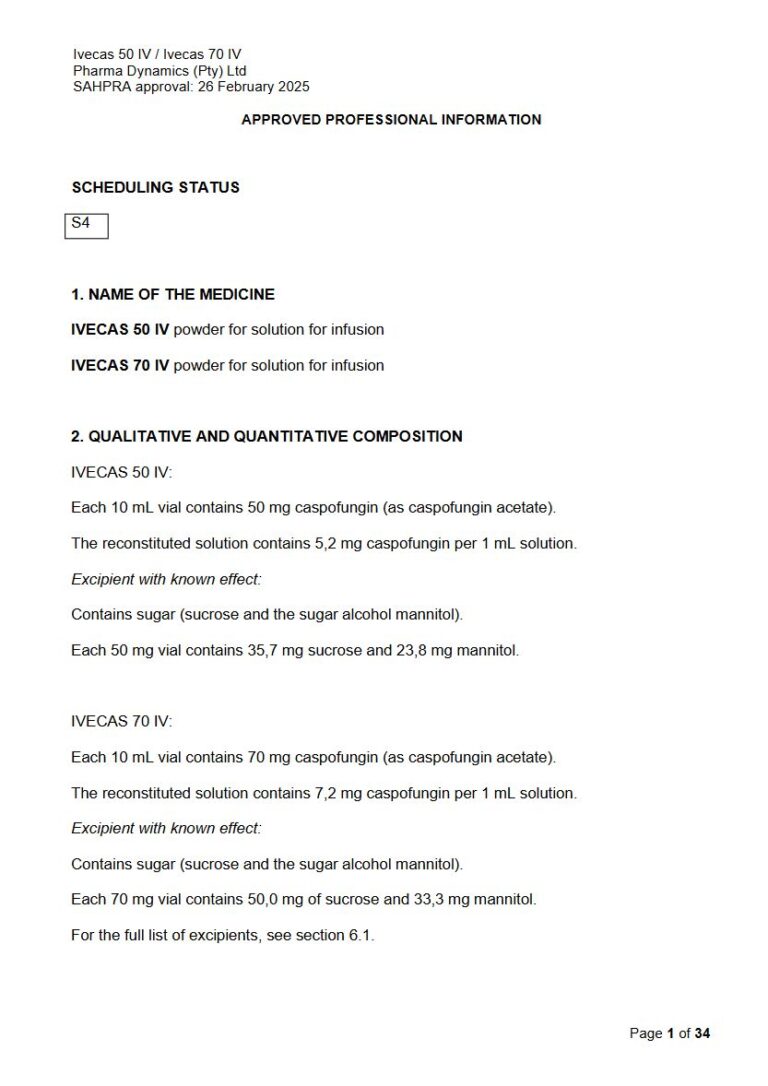
Clinical Summary
Quick overview from the medicine insert
Indication
Empirical therapy for presumed fungal infections and treatment of invasive candidiasis.
Dosage (summary)
70 mg loading dose on Day 1, followed by 50 mg daily.
Special Populations
- Elderly
- Hepatic impairment
Pregnancy & Breastfeeding
Not recommended during pregnancy; unknown if excreted in breast milk.
Key Drug Interactions
- Ciclosporin
- Rifampicin
- Dexamethasone
Contraindications
- Hypersensitivity to caspofungin
- Severe hepatic insufficiency
Common side effects
- Hypersensitivity reactions
- Phlebitis
- Nausea
- Headache
Counselling Points
- Monitor for hypersensitivity reactions
- Avoid driving until effects are known
- Inform about potential liver enzyme changes
Serious warnings
- Anaphylaxis
- Stevens-Johnson syndrome
- Toxic epidermal necrolysis
Important Disclaimer
The Ivecas 50 mg/70 mg Solution professional information leaflet below is the property of Pharma Dynamics and is provided on Medinsert exactly as issued, with no.. alterations or editorial changes. We make every effort to keep content current by updating documents as soon as new versions become available. Medinsert serves as a trusted access point for healthcare professionals, but does not replace official sources or clinical judgement. For more details, please read our full disclaimer. read more>>
 Healthcare Professionals Only
This content is for registered healthcare professionals
Sign in or create a free account to read the full package insert.
Free for HPCSA-registered professionals. Powered by Medinsert.
Clinical Particulars
Section 4 of the official insert — extracted exactly as issued, no alterations
4.1 Therapeutic indications
IVECAS is indicated in adults for:
- empirical therapy for presumed fungal infections in febrile, neutropenic patients
- treatment of invasive candidiasis, including candidaemia
- treatment of oesophageal candidiasis, where IV antifungal therapy is appropriate
- treatment of oropharyngeal candidiasis, where IV antifungal therapy is appropriate
- treatment of invasive aspergillosis in patients who are refractory to, or intolerant of other therapies, including amphotericin B, lipid formulations of amphotericin B and itraconazole.
Paediatric use
The safety and effectiveness of IVECAS in paediatric patients 3 months to 17 years of age are supported by evidence from adequate and well-controlled studies in adults, pharmacokinetic data in paediatric patients, and additional data from prospective studies in paediatric patients, 3 months to 17 years of age. The efficacy and safety of IVECAS have not been adequately studied in prospective clinical trials involving neonates and infants under 3 months of age. IVECAS has not been studied in paediatric patients with endocarditis, osteomyelitis and meningitis due to Candida. IVECAS has also not been studied as initial therapy for invasive aspergillosis in paediatric patients.
4.2 Posology and method of administration
Posology
General recommendations in adult patients
Empirical therapy
A single 70 mg loading dose should be administered on day 1, followed by 50 mg daily thereafter. Duration of treatment should be based on the patient's clinical response. Empirical therapy should be continued until resolution of neutropenia. Patients found to have a fungal infection should be treated for a minimum of 14 days; treatment should continue for at least 7 days after both neutropenia and clinical symptoms are resolved. If the 50 mg is well tolerated but does not provide an adequate clinical response, the daily dose can be increased to 70 mg. Although an increase in efficacy with 70 mg daily has not been demonstrated, safety data suggest that an increase in dose to 70 mg daily is well tolerated.
Invasive candidiasis
A single 70 mg loading dose should be administered on Day 1, followed by 50 mg daily thereafter. Duration of treatment of invasive candidiasis should be dictated by the patientu2019s clinical and microbiological response. In general, antifungal therapy should continue for at least 14 days after the last positive culture. Patients who remain persistently neutropenic may warrant a longer course of therapy pending resolution of the neutropenia.
Oesophageal and oropharyngeal candidiasis
Fifty (50) mg should be administered daily.
Invasive aspergillosis
A single 70 mg loading dose should be administered on Day 1, followed by 50 mg daily thereafter. Duration of treatment should be based upon the severity of the patientu2019s underlying disease, recovery from immunosuppression, and clinical response. The efficacy of doses above 70 mg is not known. Safety data suggests that an increase in dose to 70 mg daily is well tolerated. The efficacy of doses above 70 mg has not been adequately studied in patients with invasive aspergillosis.
Special populations
No dosage adjustment is necessary for elderly patients (65 years of age or more). No dosage adjustment is necessary based on gender or renal impairment. When co-administering IVECAS in adult patients with the metabolic inducers efavirenz, nevirapine, rifampicin, dexamethasone, phenytoin, or carbamazepine, use of a daily dose of 70 mg of IVECAS, should be considered (see section 4.5).
Patients with hepatic insufficiency
Adult patients with mild hepatic insufficiency (Child - Pugh score 5 to 6): No dose adjustment is required. Adult patients with moderate hepatic impairment (Child Pugh score 7 to 9): 35 mg IVECAS per day is recommended. However, where recommended, a 70 mg loading dose should still be administered on day 1. Severe hepatic impairment: There is no clinical experience in adult patients with severe hepatic insufficiency (Child- Pugh score > 9) (see section 4.3) and in paediatric patients with any degree of hepatic insufficiency.
Paediatric population
IVECAS should be administered in children and adolescents by slow IV infusion over approximately 1 hour. Dosing in children and adolescents (3 months to 17 years of age) should be based on the patientu2019s body surface area (see section 6.1 u201cInstructions for use in paediatric patientsu201d, Mosteller formula). For all indications a single 70 mg/m2 loading dose (not to exceed an actual dose of 70 mg) should be administered on day 1, followed by 50 mg/m2 daily thereafter (not to exceed an actual dose of 70 mg daily). Duration of treatment should be individualised to the indication, as described for each indication in adults (see u201cGeneral recommendation in adult patientsu201d, above).
If the 50 mg/m2 daily dose is well tolerated but does not provide an adequate clinical response, the daily dose can be increased to 70 mg/m2 daily (not to exceed an actual daily dose of 70 mg). Although an increase in efficacy with 70 mg/m2 has not been demonstrated, limited safety data suggest that an increase in dose to 70 mg/m2 daily is well tolerated. When co-administering caspofungin, as in IVECAS, to paediatric patients with metabolic inducers such as efavirenz, nevirapine, rifampicin, dexamethasone, phenytoin, or carbamazepine, use of a daily dose of 70 mg/m2 of IVECAS (not to exceed an actual daily dose of 70 mg), should be considered (see section 4.5).
Method of administration
IVECAS SOLUTION should be administered in by slow intravenous infusion over approximately 1 hour. For instructions for reconstitution and further dilution, see section 6.6. IVECAS should be given as a single infusion.
4.3 Contraindications
- hypersensitivity to caspofungin or to any of the ingredients of IVECAS, listed in section 6.1
- severe hepatic insufficiency, as caspofungin as in IVECAS has not been studied in these patients.
4.4 Special warnings and precautions for use
Limited data suggest that less common non- Candida yeasts and non- Aspergillus moulds are not covered by caspofungin (contained in IVECAS). The efficacy of caspofungin against these fungal pathogens has not been established.
Hypersensitivity reactions
Anaphylaxis has been reported during administration of caspofungin, as in IVECAS. If this occurs, IVECAS should be discontinued and appropriate treatment administered. Possible histamine-mediated adverse reactions, including rash, facial swelling, angioedema, pruritus, sensation of warmth, or bronchospasm have been reported and may require discontinuation and/or administration of appropriate treatment (see section 4.8).
Cases of Stevens-Johnson syndrome (SJS) and toxic epidermal necrolysis (TEN) have been reported after post marketing use of caspofungin (as in IVECAS). Caution should apply in patients with history of allergic skin reactions (see section 4.8).
Concomitant use with ciclosporin
Transient increases in alanine transaminase (ALT) and aspartate transaminase (AST) of less than or equal to 3-fold the upper limit of normal (ULN) may occur when caspofungin, as in IVECAS, is given concomitantly with ciclosporin. These increases can be resolved with discontinuation of these medicines (see section 4.5). There is an increase of approximately 35 % in the AUC of caspofungin when IVECAS and ciclosporin are co-administered; blood levels of ciclosporin remain unchanged. IVECAS should only be used in patients receiving ciclosporin when the potential benefit outweighs the potential risk. Close monitoring of liver enzymes should be considered if IVECAS and ciclosporin are used concomitantly.
Hepatic impairment
In adult patients with mild and moderate hepatic impairment, the AUC can be increased by about 20 % and 75 %, respectively (see sections 5.2 and 4.2). A reduction of the daily dose to 35 mg is recommended for adults with moderate hepatic impairment (see section 4.2). There is no clinical experience in adults with severe hepatic impairment or in paediatric patients with any degree of hepatic impairment. A higher exposure than in moderate hepatic impairment is expected and IVECAS should not be used in these patients (see section 4.3).
Laboratory abnormalities in liver function tests have been seen in healthy volunteers and adult and paediatric patients treated with caspofungin (as in IVECAS). In some adult and paediatric patients with serious underlying conditions who were also receiving multiple concomitant medicines, cases of clinically significant hepatic dysfunction, hepatitis and hepatic failure have been reported; a causal relationship to caspofungin (as in IVECAS) has not been established.
Patients who develop abnormal liver function tests during treatment with IVECAS should be monitored for evidence of worsening hepatic function and the risk/benefit of continuing therapy should be re-evaluated.
Sucrose
IVECAS contains sucrose. Patients with rare hereditary problems of fructose intolerance, glucose-galactose malabsorption or sucrase-isomaltase insufficiency should not receive IVECAS.
4.5 Interaction with other medicines and other forms of interaction
In vitro, caspofungin is not an inhibitor of any enzyme in the cytochrome P450 (CYP) system and does not induce the CYP3A4 metabolism of other medicines. Caspofungin is not a substrate for P-glycoprotein and is a poor substrate for cytochrome P450 enzymes. However, caspofungin did interact with other medicines in pharmacological and clinical studies (see below).
Limited data from population pharmacokinetics show that concomitant use of IVECAS with the inducers efavirenz, nevirapine, dexamethasone, phenytoin, or carbamazepine may result in a decrease in caspofungin AUC. When co-administering inducers of metabolic enzymes, an increase in the daily dose of caspofungin to 70 mg following the 70 mg loading dose, should be considered in adult patients (see section 4.2).
In vitro and in vivo studies of caspofungin in combination with amphotericin B, does not result in antagonism of antifungal activity against either A. fumigatus or C. albicans. Results from in vitro studies suggest that there was some evidence of additive/indifferent or synergistic activity against A. fumigatus and additive/indifferent activity against C. albicans. The clinical significance of these results is unknown.
Ciclosporin
Ciclosporin A increases the AUC of caspofungin (as in IVECAS) by approximately 35 %. The increase in AUC is probably due to reduced uptake of caspofungin by the liver. Caspofungin does not increase the plasma levels of ciclosporin. There are transient increases in liver ALT and AST of less than or equal to 3-fold the ULN when IVECAS and ciclosporin are co-administered, which should resolve with discontinuation of both these medicines (see section 4.4). Close monitoring of liver enzymes should be considered if the two medicines are used concomitantly.
Tacrolimus
Caspofungin, as in IVECAS, reduces the trough concentration of tacrolimus by 26 % in healthy subjects. For patients receiving both therapies, standard monitoring of tacrolimus blood concentrations and appropriate tacrolimus dosage adjustments are essential.
Rifampicin
IVECAS does not influence the pharmacokinetics of rifampicin, however rifampicin may cause a 60 % increase in AUC and 170 % increase in trough concentration of caspofungin on the first day of co-administration when both medicines are initiated together. Caspofungin trough levels gradually decrease upon repeated administration. After two weeks' administration rifampicin has limited effect on AUC, but trough levels are 30 % lower than in adult patients who receive IVECAS alone. The mechanism of interaction may possibly be due to an initial inhibition and subsequent induction of transport proteins. A similar effect could be expected for other medicines that induce metabolic enzymes.
Data suggest that the inducible medicine clearance mechanism involved in caspofungin disposition is likely an uptake transport process, rather than metabolism. Therefore, when IVECAS is co-administered to adult patients with inducers of medicine clearance, such as efavirenz, nevirapine, rifampicin, dexamethasone, phenytoin or carbamazepine, use of a daily dose of 70 mg of IVECAS should be considered (see section 4.2).
Clinical studies in adult healthy volunteers show that medicines such as itraconazole, amphotericin B, mycophenolate, nelfinavir or tacrolimus do not alter the pharmacokinetics of caspofungin. IVECAS has no effect on the pharmacokinetics of itraconazole, amphotericin B, rifampicin, or the active metabolite of mycophenolate.
All adult drug-drug interaction studies were conducted at a 50 or 70 mg daily caspofungin dose. The interaction of higher doses of caspofungin with other medicines has not been formally studied.
Paediatric population
In paediatric patients, co-administration of dexamethasone with caspofungin, as in IVECAS, may result in clinically meaningful reductions in caspofungin trough concentrations. Paediatric patients may possibly have similar reductions with inducers as seen in adults. When caspofungin as in IVECAS is co-administered to paediatric patients (12 months to 17 years of age) with inducers of medicine clearance, such as rifampicin, efavirenz, nevirapine, phenytoin, dexamethasone, or carbamazepine, an IVECAS dose of 70 mg/m2 daily (not to exceed an actual daily dose of 70 mg) should be considered.
4.6 Fertility, pregnancy and lactation
Pregnancy
IVECAS should not be used during pregnancy as there is no clinical experience involving pregnant women. Animal studies have shown developmental toxicity. Caspofungin has been shown to cross the placental barrier in animal studies.
Breastfeeding
It is not known whether caspofungin as in IVECAS is excreted in human milk; therefore, women receiving IVECAS should not breastfeed their babies. Available pharmacodynamic/ toxicological data in animals have shown excretion of caspofungin in milk.
Fertility
There are no clinical data for caspofungin, as in IVECAS, to assess its impact on fertility.
4.7 Effects on ability to drive and use machines
IVECAS may cause dizziness, somnolence and blurred vision. Patients should be advised not to drive or operate machinery or tools until they know how treatment with IVECAS affects them.
4.8 Undesirable effects
Summary of the safety profile
Hypersensitivity reactions (anaphylaxis and possibly histamine-mediated adverse reactions) have been reported (see section 4.4). Also reported in patients with invasive aspergillosis were pulmonary oedema, adult respiratory distress syndrome (ARDS), and radiographic infiltrates.
a. Adult patients
Phlebitis was a commonly reported local injection-site adverse reaction in all patient populations. Other local reactions included erythema, pain/tenderness, itching, discharge, and a burning sensation. Reported clinical and laboratory abnormalities among all adults treated with caspofungin were typically mild and rarely led to discontinuation.
Tabulated list of adverse effects
System Organ Class Frequency Side effects
Blood and lymphatic system disorders Frequent Less frequent Decreased haemoglobin, decreased haematocrit, anaemia, decreased white blood cell count Thrombocytopenia, coagulopathy, leucopenia, eosinophil count increased, decreased platelet count, increased platelet count, decreased lymphocyte count, increased white blood cell count, decreased neutrophil count
Immune system disorders Frequency unknown Hypersensitivity reactions (anaphylaxis and possibly histamine-mediated adverse reactions) (see section 4.4)
Metabolism and nutrition disorders Frequent Less frequent Hypokalaemia Fluid overload, hypomagnesaemia, anorexia, electrolyte imbalance, hyperglycaemia, hypocalcaemia, metabolic acidosis
Psychiatric disorders Less frequent Anxiety, disorientation, insomnia
Nervous system disorders Frequent Less frequent Headache Dizziness, dysgeusia, paraesthesia, somnolence, tremor, hypaesthesia
Eye disorders Less frequent Ocular icterus, vision blurred, eyelid oedema, increased lacrimation
Cardiac disorders Less frequent palpitations, tachycardia, dysrhythmia, atrial fibrillation, congestive cardiac failure
Vascular disorders Frequent Less frequent Frequency unknown Phlebitis Thrombophlebitis, flushing, hot flush, hypertension, hypotension Swelling, peripheral oedema
Respiratory, thoracic and mediastinal disorders Frequent Less frequent Frequency unknown Dyspnoea Nasal congestion, pharyngolaryngeal pain, tachypnoea, bronchospasm, cough, dyspnoea paroxysmal nocturnal, hypoxia, rales, wheezing Pulmonary oedema, adult respiratory distress syndrome (ARDS) and radiographic infiltrates
Gastrointestinal disorders Frequent Less frequent Nausea, diarrhoea, vomiting Abdominal pain, abdominal pain upper, dry mouth, dyspepsia, stomach discomfort, abdominal distension, ascites, constipation, dysphagia, flatulence
Hepatobiliary disorders Frequent Less frequent Frequency unknown Elevated liver values (alanine aminotransferase (ALT), aspartate aminotransferase (AST), blood alkaline phosphatase, conjugated bilirubin, blood bilirubin) Cholestasis, hepatomegaly, hyperbilirubinaemia, jaundice, abnormal hepatic function, hepatotoxicity, liver disorder, increased gamma-glutamyltransferase (GGT) Hepatic dysfunction
Skin and subcutaneous tissue disorders Frequent Less frequent Frequency unknown Rash, pruritus, erythema, hyperhidrosis Erythema multiforme, macular rash, maculopapular rash, pruritic rash, urticaria, allergic dermatitis, generalised pruritus, erythematous rash, generalised rash, morbilliform rash, skin lesion Toxic epidermal necrolysis and Stevens-Johnson syndrome (see section 4.4)
Musculoskeletal, connective tissue and bone disorders Frequent Less frequent Arthralgia Back pain, pain in extremity, bone pain, muscular weakness, myalgia
Renal and urinary disorders Less frequent Renal failure, acute renal failure
General disorders and administrative site conditions Frequent Less frequent Pyrexia, chills, infusion site pruritus Pain, catheter site pain, fatigue, feeling cold, feeling hot, infusion site erythema, infusion site induration, infusion site pain, infusion site swelling, injection site phlebitis, oedema peripheral, tenderness, chest discomfort, chest pain, face oedema, feeling of body temperature change, induration, infusion site extravasation, infusion site irritation, infusion site phlebitis, infusion site rash, infusion site urticaria, injection site erythema, injection site oedema, injection site pain, injection site swelling, malaise, oedema
Investigations Frequent Less frequent Decreased blood potassium, decreased blood albumin Increased blood creatinine, positive red blood cells urine, decreased total protein, protein urine present, prolonged prothrombin time, shortened prothrombin time, decreased blood sodium, increased blood sodium, increased blood calcium, decreased blood chloride, decreased blood phosphorus, increased blood phosphorus, increased blood urea, prolonged activated partial thromboplastin time, decreased blood bicarbonate, increased blood chloride, increased blood potassium, decreased blood uric acid, blood urine present, abnormal breath sounds, decreased carbon dioxide, increased immunosuppressant medicine level, international normalised ratio increased, urinary casts, positive white blood cells urine, and increased pH urine.
b. Paediatric patients
The most common medicine related clinical adverse experiences reported in paediatric patients treated with caspofungin (as in IVECAS) were pyrexia, rash and headache.
Tabulated list of adverse effects
System Organ Class Frequency Side effects
Blood and lymphatic system disorders Frequent Eosinophil counts increased
Nervous system disorders Frequent Headache
Cardiac disorders Frequent Tachycardia
Vascular disorders Frequent Flushing, hypotension
Hepatobiliary disorders Frequent Elevated liver enzyme levels (AST, ALT)
Skin and subcutaneous tissue disorders Frequent Rash, pruritus
General disorders and administration site conditions Frequent Fever, chills, catheter site pain
Investigations Frequent Decreased potassium, hypomagnesaemia, increased glucose, decreased phosphorus, and increased phosphorus
4.9 Overdose
Signs and symptoms: In overdose, side effects can be precipitated and/or be of increased severity (see section 4.8). In clinical studies, the highest dose was 210 mg, which was administered as a single dose to 6 adult subjects and was generally well tolerated. In addition, a dose of 150 mg once daily up to 51 days has been administered to 100 adult patients and was generally well tolerated.
Management of overdose: Caspofungin is not dialysable.
