
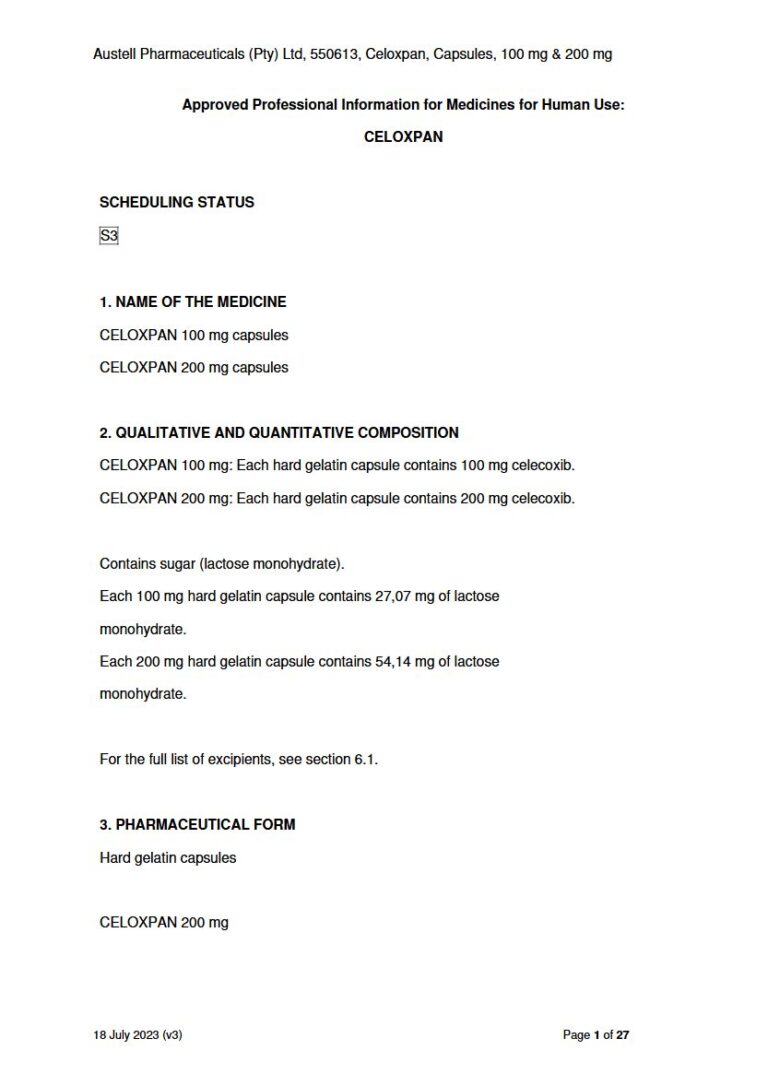
Celoxpan 100 & 200 100 mg, 200 mg Capsule
PDF Leaflet Revision Date: 18 July 2023
Clinical Summary
Quick overview from the medicine insert
Indication
Symptomatic treatment of inflammation and pain in various conditions.
Dosage (summary)
200 mg daily for osteoarthritis; 100-200 mg twice daily for rheumatoid arthritis.
Special Populations
- Elderly
- Renal impairment
- Hepatic impairment
Pregnancy & Breastfeeding
Contraindicated in pregnancy and breastfeeding.
Key Drug Interactions
- Warfarin
- NSAIDs
- ACE-inhibitors
Contraindications
- Hypersensitivity to celecoxib
- Severe hepatic impairment
- Severe renal impairment
- Ischaemic heart disease
- Active peptic ulceration
Common side effects
- Nausea
- Headache
- Hypertension
- Dizziness
Counselling Points
- Take with or without food
- Monitor blood pressure
- Report any skin reactions
Serious warnings
- Increased cardiovascular risk
- Gastrointestinal complications
- Serious skin reactions
Important Disclaimer
The Celoxpan 100 & 200 100 mg, 200 mg Capsule professional information leaflet below is the property of Austell Pharmaceuticals and is provided on Medinsert exactly as issued, with no.. alterations or editorial changes. We make every effort to keep content current by updating documents as soon as new versions become available. Medinsert serves as a trusted access point for healthcare professionals, but does not replace official sources or clinical judgement. For more details, please read our full disclaimer. read more>>
 Healthcare Professionals Only
This content is for registered healthcare professionals
Sign in or create a free account to read the full package insert.
Free for HPCSA-registered professionals. Powered by Medinsert.
Clinical Particulars
Section 4 of the official insert — extracted exactly as issued, no alterations
4.1 Therapeutic indications
- Symptomatic treatment of inflammation and pain in osteoarthritis and rheumatoid arthritis.
- Treatment of pain post dental surgery.
- Treatment of mild to moderate post-operative pain.
- Treatment of mild to moderate musculoskeletal pain.
- Treatment of mild to moderate primary dysmenorrhoea.
- Relief of signs and symptoms of ankylosing spondylitis.
4.2 Posology and method of administration
As the cardiovascular risks of CELOXPAN may increase with dose and duration of exposure, the shortest duration possible and the lowest effective daily dose should be used.
Posology
Osteoarthritis
The recommended daily dose is 200 mg, administered as a single dose or as two divided doses. Doses up to 400 mg per day have been studied.
Rheumatoid arthritis
The recommended daily dose is 100 mg or 200 mg twice per day.
Pain post dental surgery
The recommended dose is 100 mg to 200 mg, up to a maximum daily dose of 400 mg. Dosing intervals should not be less than 4 hours.
Mild to moderate post-operative pain
The recommended dose is 200 mg once daily. Some patients may benefit from an additional 200 mg dose.
Mild to moderate musculoskeletal pain
The recommended dose is 200 mg twice daily.
Mild to moderate primary dysmenorrhea
The recommended dose is 400 mg initially, followed by an additional 200 mg dose if needed on the first day. On subsequent days, the recommended dose is 200 mg twice daily.
Ankylosing spondylitis
The recommended daily dose is 200 mg, administered as a single dose or as 100 mg twice per day. Some patients may benefit from a total daily dose of 400 mg.
Special populations
Elderly population
No dosage adjustment is necessary. However, for elderly patients with a lower than average body weight (50 kg), it is advisable to initiate therapy at the lowest recommended dose.
Renal impairment
No dosage adjustment is necessary in patients with mild or moderate renal impairment. There is no clinical experience in patients with severe renal impairment (see section 4.3).
Hepatic impairment
No dosage adjustment is necessary in patients with mild hepatic impairment. Introduce CELOXPAN at the lowest recommended dose in patients with moderate hepatic impairment. There is no clinical experience in patients with severe hepatic impairment (see section 4.3).
Paediatric population
CELOXPAN is not indicated for use in children under 18 years old.
Method of administration
CELOXPAN is for oral administration and may be taken with or without food.
4.3 Contraindications
- Hypersensitivity to celecoxib or to any of the excipients listed in section 6.1.
- Known sulphonamide hypersensitivity.
- Severe impairment of hepatic function.
- Severe impairment of renal function.
- Established ischaemic heart disease and/or cerebrovascular disease (stroke) and peripheral arterial disease.
- Peri-operative analgesia in the setting of coronary artery bypass surgery (CABG).
- Active peptic ulceration or gastrointestinal (GI) bleeding.
- Patients who have experienced asthma, acute rhinitis, nasal polyps, angioneurotic oedema, urticaria or other allergic type reactions after taking acetylsalicylic acid (aspirin) or other non-steroidal anti-inflammatory drugs (NSAIDs) including COX-2 inhibitors.
- In pregnancy and in women of childbearing potential unless using an effective method of contraception (see section 4.6).
- Celecoxib has been shown to cause malformations in the two animal species studied (see sections 4.6 and 5.3). The potential for human risk in pregnancy is unknown but cannot be excluded.
- Breastfeeding (see sections 4.6).
- Inflammatory bowel disease.
- Congestive heart failure (NYHA II-IV).
4.4 Special warnings and precautions for use
Gastrointestinal (GI) effects
Upper and lower gastrointestinal complications (perforations, ulcers or bleedings [PUBs]), some of them resulting in fatal outcome, have occurred in patients treated with celecoxib. Caution is advised with treatment of patients most at risk of developing a gastrointestinal complication with NSAIDs; the elderly, patients using any other NSAID or antiplatelet medicines (such as acetylsalicylic acid), or glucocorticoids concomitantly, patients using alcohol, or patients with a prior history of gastrointestinal disease, such as ulceration and GI bleeding.
There is further increase in the risk of gastrointestinal adverse effects for celecoxib (gastrointestinal ulceration or other gastrointestinal complications), when celecoxib is taken concomitantly with acetylsalicylic acid (even at low doses). A significant difference in GI safety between selective COX-2 inhibitors + acetylsalicylic acid vs. NSAIDs + acetylsalicylic acid has not been demonstrated in long-term clinical trials (see section 5.1).
Concomitant NSAID use
The concomitant use of celecoxib and a non-aspirin NSAID should be avoided.
Cardiovascular effects
Increased number of serious cardiovascular (CV) events, mainly myocardial infarction, has been found in a long-term placebo-controlled study in subjects with sporadic adenomatous polyps treated with celecoxib at doses of 200 mg twice daily and 400 mg twice daily compared to placebo (see section 5.1). As the cardiovascular risks of celecoxib may increase with dose and duration of exposure, the shortest duration possible and the lowest effective daily dose should be used. NSAIDs, including COX-2 selective inhibitors, have been associated with increased risk of cardiovascular and thrombotic adverse events when taken long term. The exact magnitude of the risk associated with a single dose has not been determined, nor has the exact duration of therapy associated with increased risk. The patient's need for symptomatic relief and response to therapy should be re-evaluated periodically, especially in patients with osteoarthritis (see sections 4.2, 4.3, 4.8 and 5.1). Patients with significant risk factors for cardiovascular events (e.g. hypertension, hyperlipidaemia, diabetes mellitus, smoking) should only be treated with celecoxib after careful consideration (see section 5.1).
COX-2 selective inhibitors are not a substitute for acetylsalicylic acid for prophylaxis of cardiovascular thrombo-embolic diseases because of their lack of antiplatelet effects. Therefore, antiplatelet therapies should not be discontinued (see section 5.1).
Fluid retention and oedema
Fluid retention and oedema have been observed in patients taking celecoxib. Therefore, CELOXPAN should be used with caution in patients with history of cardiac failure, left ventricular dysfunction or hypertension, and in patients with pre-existing oedema from any other reason, since prostaglandin inhibition may result in deterioration of renal function and fluid retention. Caution is also required in patients taking diuretic treatment or otherwise at risk of hypovolaemia.
Hypertension
Celecoxib can lead to the onset of new hypertension or worsening of pre-existing hypertension, either of which may contribute to the increased incidence of cardiovascular events. Therefore, blood pressure should be monitored closely during the initiation of therapy with CELOXPAN and throughout the course of therapy.
Hepatic and renal effects
Compromised renal or hepatic function and especially cardiac dysfunction are more likely in the elderly and therefore medically appropriate supervision should be maintained. NSAIDs, including celecoxib, may cause renal toxicity. Clinical trials with celecoxib have shown renal effects similar to those observed with comparator NSAIDs. Patients at greatest risk for renal toxicity are those with impaired renal function, heart failure, liver dysfunction, those taking diuretics, angiotensin converting enzyme (ACE)-inhibitors, angiotensin II receptor antagonists, and the elderly (see section 4.5). Such patients should be carefully monitored while receiving treatment with CELOXPAN. Some cases of severe hepatic reactions, including fulminant hepatitis (some with fatal outcome), liver necrosis and, hepatic failure (some with fatal outcome or requiring liver transplant), have been reported with celecoxib. Among the cases that reported time to onset, most of the severe adverse hepatic events developed within one month after initiation of celecoxib treatment (see section 4.8). If during treatment, patients deteriorate in any of the organ system functions described above, appropriate measures should be taken and discontinuation of CELOXPAN therapy should be considered.
CYP2D6 inhibition
Celecoxib inhibits CYP2D6. Although it is not a strong inhibitor of this enzyme, a dose reduction may be necessary for individually dose-titrated medicines that are metabolised by CYP2D6 (see section 4.5).
CYP2C9 poor metabolisers
Patients known to be CYP2C9 poor metabolisers should be treated with caution (see section 5.2).
Skin and systemic hypersensitivity reactions
Serious skin reactions, some of them fatal, including exfoliative dermatitis, Stevens-Johnson syndrome, and toxic epidermal necrolysis, have been reported in association with the use of celecoxib (see section 4.8). Patients appear to be at highest risk for these reactions early in the course of therapy: the onset of the reaction occurring in the majority of cases within the first month of treatment. Serious hypersensitivity reactions (including anaphylaxis, angioedema and medicine rash with eosinophilia and systemic symptoms (DRESS), or hypersensitivity syndrome), have been reported in patients receiving celecoxib (see section 4.8). Patients with a history of sulfonamide allergy or any medicine allergy may be at greater risk of serious skin reactions or hypersensitivity reactions (see section 4.3). CELOXPAN should be discontinued at the first appearance of skin rash, mucosal lesions, or any other sign of hypersensitivity.
General
Celecoxib may mask fever and other signs of inflammation.
Use with oral anticoagulants
In patients on concurrent therapy with warfarin, serious bleeding events, some of them fatal, have been reported. Increased prothrombin time (INR) with concurrent therapy has been reported. Therefore, this should be closely monitored in patients receiving warfarin/coumarin-type oral anticoagulants, particularly when therapy with celecoxib is initiated or celecoxib dose is changed (see section 4.5). Concomitant use of anticoagulants with NSAIDS may increase the risk of bleeding. Caution should be exercised when combining celecoxib with warfarin or other oral anticoagulants, including novel anticoagulants (e.g. apixaban, dabigatran, and rivaroxaban).
4.5 Interaction with other medicines and other forms of interaction
Pharmacodynamic interactions
Anticoagulants
Anticoagulant activity should be monitored particularly in the first few days after initiating or changing the dose of celecoxib in patients receiving warfarin or other anticoagulants since these patients have an increased risk of bleeding complications. Therefore, patients receiving oral anticoagulants should be closely monitored for their prothrombin time INR, particularly in the first few days when therapy with celecoxib is initiated or the dose of celecoxib is changed (see section 4.4). Bleeding events in association with increases in prothrombin time have been reported, predominantly in the elderly, in patients receiving celecoxib concurrently with warfarin, some of them fatal.
Anti-hypertensives
NSAIDs may reduce the effect of anti-hypertensive medicines including ACE-inhibitors, angiotensin II receptor antagonists, diuretics and beta-blockers. As for NSAIDs, the risk of acute renal insufficiency, which is usually reversible, may be increased in some patients with compromised renal function (e.g. dehydrated patients, patients on diuretics, or elderly patients) when ACE-inhibitors, angiotensin II receptor antagonists, and/or diuretics are combined with NSAIDs, including celecoxib (see section 4.4). Therefore, the combination should be administered with caution, especially in the elderly. Patients should be adequately hydrated and consideration should be given to monitoring of renal function after initiation of concomitant therapy, and periodically thereafter.
Ciclosporin and tacrolimus
Co-administration of NSAIDs and ciclosporin or tacrolimus may increase the nephrotoxic effect of ciclosporin or tacrolimus, respectively. Renal function should be monitored when celecoxib and any of these medicines are combined.
Acetylsalicylic acid
Celecoxib can be used with low-dose acetylsalicylic acid but is not a substitute for acetylsalicylic acid for CV prophylaxis. Studies indicated an increased risk of gastrointestinal ulceration or other gastrointestinal complications compared to use of celecoxib alone was shown for concomitant administration of low-dose acetylsalicylic acid (see section 5.1).
Pharmacokinetic interactions
Effects of celecoxib on other medicines
CYP2D6 inhibition
Celecoxib is an inhibitor of CYP2D6. The plasma concentrations of medicines that are substrates of this enzyme may be increased when celecoxib is used concomitantly. Examples of medicines which are metabolised by CYP2D6 are antidepressants (tricyclics and SSRIs), neuroleptics, anti-dysrhythmic medicines, etc. The dose of individually dose-titrated CYP2D6 substrates may need to be reduced when treatment with CELOXPAN is initiated or increased if treatment with CELOXPAN is terminated. Co-administration of celecoxib 200 mg twice daily resulted in 2.6-fold and 1.5-fold increases in plasma concentrations of dextromethorphan and metoprolol (CYP2D6 substrates), respectively. These increases are due to celecoxib inhibition of the CYP2D6 substrate metabolism.
CYP2C19 inhibition
In vitro studies have shown some potential for celecoxib to inhibit CYP2C19 catalysed metabolism. The clinical significance of this in vitro finding is unknown. Examples of medicines which are metabolised by CYP2C19 are diazepam, citalopram and imipramine.
Methotrexate
In patients with rheumatoid arthritis celecoxib had no statistically significant effect on the pharmacokinetics (plasma or renal clearance) of methotrexate (in rheumatologic doses). However, adequate monitoring for methotrexate-related toxicity should be considered when combining these two medicines.
Lithium
In healthy subjects, co-administration of celecoxib 200 mg twice daily with 450 mg twice daily of lithium resulted in a mean increase in Cmax of 16 % and in area under the curve (AUC) of 18 % of lithium. Therefore, patients on lithium treatment should be closely monitored when CELOXPAN is introduced or withdrawn.
Oral contraceptives
In an interaction study, celecoxib had no clinically relevant effects on the pharmacokinetics of oral contraceptives (1 mg norethisterone /35 micrograms ethinylestradiol).
Glibenclamide /tolbutamide
Celecoxib does not affect the pharmacokinetics of tolbutamide (CYP2C9 substrate), or glibenclamide to a clinically relevant extent.
Effects of other medicines on celecoxib
CYP2C9 poor metabolisers
In individuals who are CYP2C9 poor metabolisers and demonstrate increased systemic exposure to celecoxib, concomitant treatment with CYP2C9 inhibitors such as fluconazole could result in further increases in celecoxib exposure. Such combinations should be avoided in known CYP2C9 poor metabolisers (see sections 4.2 and 5.2).
CYP2C9 inhibitors and inducers
Since celecoxib is predominantly metabolised by CYP2C9 it should be used at half the recommended dose in patients receiving fluconazole. Concomitant use of 200 mg single dose of celecoxib and 200 mg once daily of fluconazole, a potent CYP2C9 inhibitor, resulted in a mean increase in celecoxib Cmax of 60 % and in AUC of 130 %. Concomitant use of inducers of CYP2C9 such as rifampicin, carbamazepine and barbiturates may reduce plasma concentrations of celecoxib.
Ketoconazole and antacids
Ketoconazole or antacids have not been observed to affect the pharmacokinetics of celecoxib.
Paediatric population
Interaction studies have only been performed in adults.
4.6 Fertility, pregnancy and lactation
Pregnancy
Celecoxib is contraindicated in pregnancy and in women who can become pregnant (see sections 4.3 and 4.4). If a woman becomes pregnant during treatment, celecoxib should be discontinued. Studies in animals (rats and rabbits) have shown reproductive toxicity, including malformations (see sections 4.3). Inhibition of prostaglandin synthesis might adversely affect pregnancy. Data from epidemiological studies suggest an increased risk of spontaneous abortion after use of prostaglandin synthesis inhibitors in early pregnancy. The potential for human risk in pregnancy is unknown, but cannot be excluded. Celecoxib may cause uterine inertia and premature closure of the ductus arteriosus during the last trimester. During the second or third trimester of pregnancy, NSAIDs including celecoxib may cause foetal renal dysfunction which may result in reduction of amniotic fluid volume or oligohydramnios in severe cases. Such effects may occur shortly after treatment initiation and are usually reversible.
Breastfeeding
Celecoxib is excreted in the milk of lactating rats at concentrations similar to those in plasma. Administration of celecoxib to a limited number of lactating women has shown a transfer of celecoxib into breast milk. Women who take CELOXPAN should not breastfeed.
Fertility
Based on the mechanism of action, the use of NSAIDs, including celecoxib, may delay or prevent rupture of ovarian follicles, which has been associated with reversible infertility in some women.
4.7 Effects on ability to drive and use machines
Patients who experience dizziness, vertigo or somnolence while taking CELOXPAN should refrain from driving or operating machinery.
4.8 Undesirable effects
Adverse reactions are listed by system organ class and ranked by frequency in Table 1.
Table 1. Adverse medicine reactions in celecoxib clinical trials and surveillance experience (MedDRA preferred terms)
Frequency estimate: Frequent, Less frequent, Not known
System Organ Class Frequency
Frequent, Less Frequent, Not known
Infections and infestations
Sinusitis, upper respiratory tract infection, pharyngitis, urinary tract infection
Blood and lymphatic system disorders
Anaemia, Leukopenia, Thrombocytopenia, Pancytopenia
Immune system disorders
Hypersensitivity, Anaphylactic shock, anaphylactic reaction
Metabolism and nutrition disorders
Hyperkalaemia
Psychiatric disorders
Insomnia, Anxiety, depression, fatigue, Confusional state, hallucinations
Nervous system disorders
Dizziness, hypertonia, headache, Cerebral infarction, paraesthesia, Somnolence, Ataxia, Dysgeusia, Haemorrhage intracranial (including fatal intracranial haemorrhage), meningitis aseptic, epilepsy (including aggravated epilepsy), ageusia, anosmia
Eye disorders
Vision blurred, conjunctivitis, Eye haemorrhage, Retinal artery occlusion, retinal vein occlusion
Ear and labyrinth disorders
Tinnitus, hypoacusis
Cardiac disorders
Myocardial infarction, Cardiac failure, palpitations, Tachycardia, dysrhythmia
Vascular disorders
Hypertension (including aggravated hypertension), Pulmonary embolism, flushing, Vasculitis
Respiratory, thoracic and mediastinal disorders
Rhinitis, cough, dyspnoea, Bronchospasm, Pneumonitis
Gastrointestinal disorders
Nausea, abdominal pain, diarrhoea, dyspepsia, flatulence, vomiting, dysphagia, Constipation, gastritis, stomatitis, Gastrointestinal inflammation (including aggravation of gastrointestinal inflammation), eructation, Gastrointestinal haemorrhage, duodenal ulcer, gastric ulcer, oesophageal ulcer, intestinal ulcer, large intestinal ulcer, intestinal perforation, oesophagitis, melaena, pancreatitis, colitis
Hepatobiliary disorders
Hepatic function abnormal, hepatic enzyme increased (including increased SGOT and SGPT), Hepatitis, Hepatic failure (sometimes fatal or requiring liver transplant), hepatitis fulminant (some with fatal outcome), hepatic necrosis, cholestasis, hepatitis cholestatic, jaundice
Skin and subcutaneous tissue disorders
Rash, pruritus (includes pruritus generalised), Urticaria, ecchymosis, Angioedema, alopecia, photosensitivity, Dermatitis exfoliative, erythema multiforme, Stevens-Johnson syndrome, toxic Epidermal necrolysis, medicine reaction with eosinophilia and systemic symptoms (DRESS), acute generalised exanthematous pustulosis (AGEP), dermatitis bullous
Musculoskeletal and connective tissue disorders
Arthralgia, Muscle spasms (leg cramps), Myositis
Renal and urinary disorders
Blood creatinine increased, blood urea increased, Renal failure acute, hypo-natraemia, Tubulointerstitial nephritis, nephrotic syndrome, glomerulonephritis minimal lesion
Reproductive system and breast disorders
Menstrual disorder, Infertility female (female fertility decreased)
General disorders and administration site conditions
Influenza-like illness, Oedema peripheral/fluid retention, Face oedema, chest pain
Injury, poisoning and procedural complications
Injury (accidental injury)
Reporting of suspected adverse reactions
Reporting suspected adverse reactions after authorisation of the medicine is important. It allows continued monitoring of the benefit/risk balance of the medicine. Healthcare professionals are asked to report any suspected adverse reactions to SAHPRA via the u201c6.04 Adverse Drug Reaction Reporting Formu201d, found online under SAHPRAu2019s publications: https://www.sahpra.org.za/Publications/Index/8
4.9 Overdose
There is no clinical experience of overdose. Single doses up to 1200 mg and multiple doses up to 1200 mg twice daily have been administered to healthy subjects for nine days without clinically significant adverse effects. In the event of suspected overdose, appropriate supportive medical care should be provided e.g. by eliminating the gastric contents, clinical supervision and, if necessary, the institution of symptomatic treatment. Dialysis is unlikely to be an efficient method of medicine removal due to high protein binding.
