
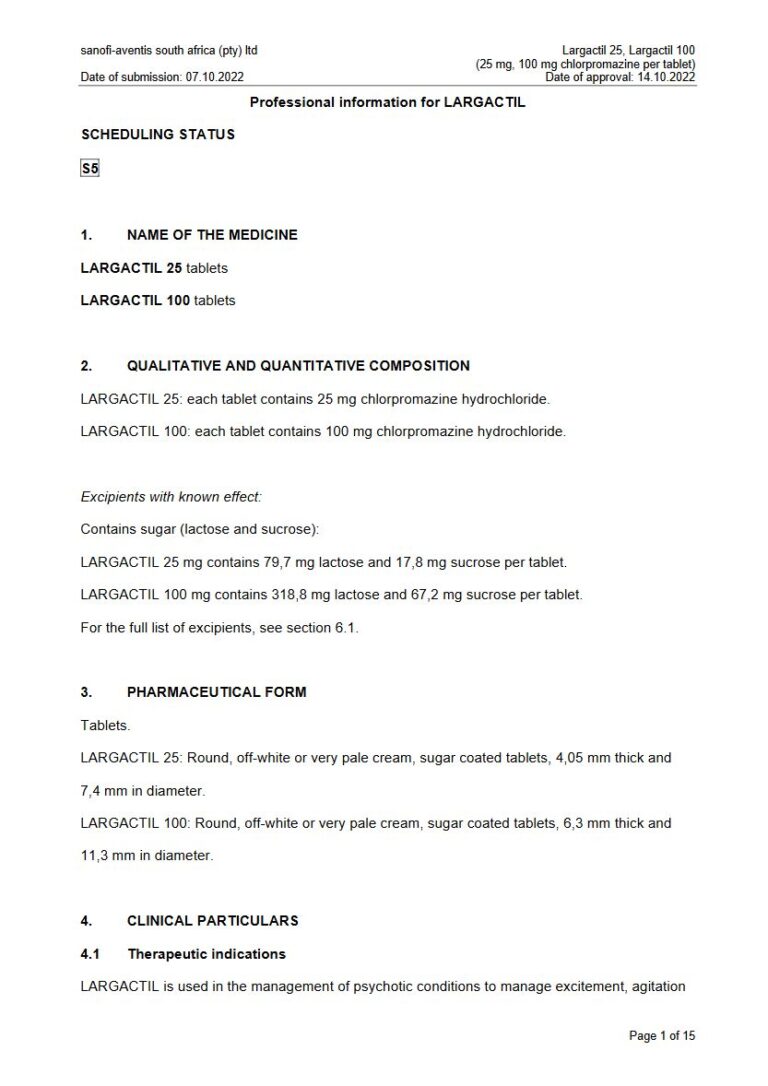
Largactil 25 mg, 100 mg Tablets.
PDF Leaflet Revision Date: 14 October 2022
Clinical Summary
Quick overview from the medicine insert
Indication
Management of psychotic conditions and manic phase of bipolar disorder.
Dosage (summary)
Initial: 25-50 mg three times daily; elderly: 1/3 to 1/2 normal dose.
Special Populations
- Elderly
- Debilitated patients
Pregnancy & Breastfeeding
Not recommended during pregnancy; may be excreted in breast milk.
Key Drug Interactions
- CYP1A2 inhibitors
- Amitriptyline
- QT-prolonging medicines
Contraindications
- Hypersensitivity to chlorpromazine
- CNS depression
- QT prolongation
Common side effects
- Drowsiness
- Hypotension
- Extrapyramidal symptoms
Counselling Points
- Avoid abrupt withdrawal
- Monitor for signs of liver toxicity
- Caution with CNS depressants
Serious warnings
- Increased risk of cerebrovascular events in elderly
- Severe liver toxicity
- Venous thromboembolism risk
Important Disclaimer
The Largactil 25 mg, 100 mg Tablets. professional information leaflet below is the property of Sanofi-Aventis South Africa and is provided on Medinsert exactly as issued, with no.. alterations or editorial changes. We make every effort to keep content current by updating documents as soon as new versions become available. Medinsert serves as a trusted access point for healthcare professionals, but does not replace official sources or clinical judgement. For more details, please read our full disclaimer. read more>>
 Healthcare Professionals Only
This content is for registered healthcare professionals
Sign in or create a free account to read the full package insert.
Free for HPCSA-registered professionals. Powered by Medinsert.
Clinical Particulars
Section 4 of the official insert — extracted exactly as issued, no alterations
4.1 Therapeutic indications
LARGACTIL is used in the management of psychotic conditions to manage excitement, agitation and other psychomotor disturbances in schizophrenic patients and in the treatment of the manic phase of bipolar disorder. It is used to control hyperkinetic states and aggression and is sometimes given in other psychiatric conditions for the control of anxiety and tension. LARGACTIL has been used in the alleviation of intractable hiccups.
4.2 Posology and method of administration
Dosage varies with both the individual and the purpose for which the medicine is being used. Oral: In most patients oral treatment may be used from the start, commencing with a dosage of 25 to 50 mg three times daily and increasing as necessary; daily doses of 75 mg may be given as a single dose at night. Lower doses (25 mg every 4 to 6 hours) may be sufficient in some cases. Intractable hiccups: 25 to 50 mg three or four times daily by mouth for 2 to 3 days. Elderly and debilitated: Initial doses of LARGACTIL of one-third to one-half the normal adult dose have been recommended for elderly and debilitated patients; doses should be increased more gradually. Paediatric population: This formulation is not suitable for use in children.
4.3 Contraindications
LARGACTIL is contraindicated in patients with:
- Hypersensitivity to chlorpromazine or to any of the ingredients of LARGACTIL (see section 6.1).
- Pre-existing central nervous system (CNS) depression or coma, bone-marrow suppression or phaeochromocytoma.
- Impaired liver, kidney, cardiovascular, cerebrovascular and respiratory function and in those with closed-angle glaucoma, parkinsonism, diabetes mellitus, hyperthyroidism, myasthenia gravis, prostatic hypertrophy or epilepsy.
- Congenital and acquired QT prolongation.
4.4 Special warnings and precautions for use
Epilepsy: Care is required in epileptic patients receiving anticonvulsant therapy as LARGACTIL may lower the seizure threshold. QT-interval prolongation:
- Concomitant therapy with other medicines prolonging QT-interval (see section 4.5).
- LARGACTIL may potentiate QT-interval prolongation which increases the risk of onset of serious ventricular dysrhythmias of the Torsades de Pointes type, which is potentially fatal (sudden death). QT-prolongation is exacerbated, in particular, in the presence of bradycardia, hypokalaemia, and congenital or acquired (i.e. medicine induced) QT-prolongation. If the clinical situation permits, medical and laboratory evaluations should be performed to rule out possible risk factors before initiating treatment with LARGACTIL and as deemed necessary during treatment (see section 4.8). LARGACTIL is contraindicated in congenital or acquired QT prolongation (see 4.3).
Stroke: In randomised clinical trials versus placebo performed in a population of elderly patients with dementia and treated with certain atypical antipsychotic medicines, a 3-fold increase of the risk of cerebrovascular events has been observed. The mechanism of such risk increase is not known. An increase in the risk with other antipsychotic medicines or other populations of patients cannot be excluded. LARGACTIL should be used with caution in patients with stroke risk factors.
Treatment should be discontinued immediately, and another antipsychotic medicine should be considered as an alternative in the following situations: Elderly patients with dementia: Elderly patients with dementia-related psychosis treated with antipsychotic medicines, such as LARGACTIL, are at an increased risk of death. Although the causes of death in clinical trials with atypical antipsychotics were varied, most of the deaths appeared to be either cardiovascular (e.g., heart failure, sudden death) or infectious (e.g. pneumonia) in nature. Observational studies suggest that, similar to atypical antipsychotic medicines, treatment with conventional antipsychotic medicines may increase mortality. The extent to which the findings of increased mortality in observational studies may be attributed to the antipsychotic medicine as opposed to some characteristic(s) of the patients is not clear.
Severe liver toxicity: Severe liver toxicity, resulting sometimes in death, has been reported with LARGACTIL use. Patients or caregivers should be instructed to immediately report signs and symptoms, such as asthenia, anorexia, nausea, vomiting, abdominal pain or icterus to a doctor. Investigations including clinical examination and biological assessment of liver function should be undertaken immediately (see section 4.8).
Eosinophilia: The presence of eosinophilia may indicate an allergic reaction to LARGACTIL. A thorough clinical examination and a repeat complete blood count (CBC) with differential count to confirm the presence of eosinophilia should be performed.
Venous thromboembolism: Cases of venous thromboembolism, sometimes fatal, have been reported with antipsychotic medicines including LARGACTIL. Therefore, LARGACTIL should be used with caution in patients with risk factors for thromboembolism (see section 4.8).
Hyperglycaemia or intolerance to glucose: Hyperglycaemia or intolerance to glucose has been reported in patients treated with LARGACTIL. Patients with an established diagnosis of diabetes mellitus or with risk factors for the development of diabetes who are started on LARGACTIL, should get appropriate glycaemic monitoring during treatment (see section 4.8). LARGACTIL tablets also contain sucrose and lactose (see section 6.1) which may also have an effect on the glycaemic control of patients with diabetes mellitus.
CNS depression: Symptoms of CNS depression may be enhanced by other medicines with CNS-depressant properties including alcohol, general anaesthetics, hypnotics, anxiolytics and sedatives, and opioid anaesthetics.
Effects on the vomiting centre and impaired body temperature regulation: LARGACTILu2019s effects on the vomiting centre may mask the symptoms of overdosage of other medicines, or of disorders such as gastrointestinal obstruction. Administration at extremes of temperature may be hazardous since body temperature regulation is impaired by phenothiazines, including LARGACTIL.
Other: Regular eye examinations are advisable for patients receiving long-term LARGACTIL therapy and avoidance of undue exposure to direct sunlight is recommended. Haematological parameters should also be monitored periodically.
Withdrawal: Abrupt withdrawal of LARGACTIL therapy is best avoided.
Lactose/fructose and sucrose intolerance: LARGACTIL contains lactose and sucrose. Patients with rare hereditary problems of galactose intolerance, total lactase deficiency, glucose-galactose malabsorption, sucrase-isomaltase insufficiency or fructose intolerance, should not take LARGACTIL tablets.
4.5 Interaction with other medicines and other forms of interaction
CYP1A2 inhibitors: Administration of LARGACTIL with CYP1A2 inhibitors, in particular strong (such as ciprofloxacin, fluvoxamine, pipemidic acid or zafirlukast) or moderate (such as oral contraceptives or phenylpropanolamine) inhibitors leads to an increase of chlorpromazine plasma concentrations. Therefore patients may experience any LARGACTIL dose-dependent adverse reaction.
Amitriptyline (a CYP2D6 substrate): Phenothiazines, such as LARGACTIL, are potent inhibitors of CYP2D6. Co-administration of LARGACTIL with amitriptyline, a CYP2D6 substrate, may lead to an increase in the plasma levels of amitriptyline. Patients must be monitored for dose-dependent adverse reactions associated with amitriptyline.
The most common interactions encountered with LARGACTIL are adverse effects resulting from concomitant administration of medicines with similar pharmacological actions.
Postural hypotension: When given with other medicines that produce postural hypotension, dosage adjustments may be necessary. However, it should be noted that LARGACTIL has been reported to reduce the antihypertensive action of adrenergic receptor blockers.
Antimuscarinic actions and extrapyramidal effects: As LARGACTIL possesses antimuscarinic actions, it may potentiate the adverse effects of other antimuscarinics, including the antimuscarinic, antiparkinsonian medicines which may be given to treat phenothiazine-induced extrapyramidal effects. In theory, neuroleptics with dopamine-blocking activity and dopaminergic medicines, such as those used to treat parkinsonism, may be mutually antagonistic.
Metoclopramide: Concomitant administration of metoclopramide may increase the risk of neuroleptic-induced extrapyramidal effects.
QT- prolonging medicines: There is an increased risk of dysrhythmias when LARGACTIL is used concomitantly with medicines that prolong the QT-interval, including certain antidysrhythmics, antidepressants and other antipsychotics, some non-sedating antihistamines, and antimalarials; use with diuretics that cause electrolyte imbalance (particularly hypokalaemia) may also have the same effect. There is also an increased risk of dysrhythmias when tricyclic antidepressants are used with antipsychotics that prolong the QT- interval, such as LARGACTIL.
CNS depression: CNS depression may be enhanced by medicines with similar activity, such as general anaesthetics, hypnotics, anxiolytics and sedatives, opioid anaesthetics and alcohol (see section 4.4).
Antidiabetic medicines: Since chlorpromazine may cause hyperglycaemia or impair glucose tolerance, the dose of antidiabetic medicines may need to be increased in diabetic patients. Close monitoring of the blood glucose levels is required and adjustment of the antidiabetic dosage may be required during or after discontinuation of treatment with LARGACTIL.
Antacids: Antacids, such as magnesium trisilicate and aluminium hydroxide, decreases gastrointestinal absorption of LARGACTIL and should be administered at least 2 hours apart.
Lithium: Combinations of LARGACTIL and lithium should be used with care. Lithium can reduce plasma concentrations of chlorpromazine and chlorpromazine has also been reported to enhance the excretion of lithium.
4.6 Fertility, pregnancy and lactation
Pregnancy: The safety of LARGACTIL in pregnant women has not been established. LARGACTIL may prolong labour and should be withheld until the cervix is dilated 3 to 4 cm. The following effects have been reported (in post-marketing surveillance) in neonates exposed in utero to phenothiazines, such as LARGACTIL, during the third trimester of pregnancy:
- various degrees of respiratory disorders ranging from tachypnoea to respiratory distress; bradycardia, and hypotonia, most often when other medicines such as psychotropic or antimuscarinic medicines were co-administered
- signs related to the atropinic properties of phenothiazines such as meconium ileus, delayed meconium passage, initial feeding difficulties, abdominal bloating, tachycardia
- neurological disorders such as extrapyramidal symptoms including tremor and hypertonia, somnolence, agitation
Lactation: LARGACTIL may be excreted in milk, therefore it should not be used in lactating mothers.
Fertility: In humans, because of the interaction with dopamine receptors, LARGACTIL may cause hyperprolactinaemia which can be associated with impaired fertility in women. In men, data on consequences of hyperprolactinaemia are insufficient with regard to fertility.
4.7 Effects on ability to drive and use machines
The sedative effects of LARGACTIL are marked; patients should not drive or operate machinery.
4.8 Undesirable effects
Blood and lymphatic system disorders: Less frequent: haematological disorders, including haemolytic anaemia, aplastic anaemia, thrombocytopenic purpura, eosinophilia, leucocytosis and a potentially fatal agranulocytosis (they may be manifestations of a hypersensitivity reaction). Most cases of agranulocytosis have occurred within 4 to 10 weeks of starting treatment and symptoms such as sore throat or fever should be watched for and white cell counts instituted should they appear. Frequency unknown: mild leucopenia (has been stated to occur in up to 30 % of patients on prolonged, high dosage LARGACTIL), thrombocytopenia
Endocrine disorders: Frequency unknown: amenorrhoea, hyperprolactinaemia, galactorrhoea, gynaecomastia
Metabolism and nutrition disorders: Frequency unknown: hyperglycaemia and intolerance to glucose (see section 4.4), hypertriglyceridaemia, hyponatraemia, inappropriate antidiuretic hormone secretion, weight gain
Psychiatric disorders: Frequent: drowsiness Less frequent: catatonic-like states, insomnia, nightmares and depression Frequency unknown: delirium, agitation
Nervous system disorders: Frequency unknown: extrapyramidal dysfunction (including acute dystonia, a parkinsonism-like syndrome, and akathisia; late effects include tardive dyskinesia and perioral tremor.); neuroleptic malignant syndrome (clinical features include hyperthermia, severe extrapyramidal symptoms including muscular rigidity, autonomic dysfunction, and altered levels of consciousness; skeletal muscle damage may occur and resulting myoglobinuria may lead to renal failure.); electroencephalogram (EEG) changes and convulsions
Eye disorders: Less frequent: pigment retinopathy Frequency unknown: deposition of pigment in the eyes (with prolonged therapy); corneal and lens opacities, miosis, blurred vision, mydriasis
Cardiac disorders: Frequent: hypotension (usually postural) Less frequent: cardiac dysrhythmias Frequency unknown: tachycardia, electrocardiographic changes (particularly QT-interval prolongation), sudden death (possible causes include cardiac dysrhythmias (see sections 4.3 and 4.4) or aspiration and asphyxia due to suppression of the cough and gag reflexes), unexplained sudden death
Vascular disorders: Frequency unknown: venous thromboembolism, pulmonary embolism (sometimes fatal) and deep vein thrombosis (see section 4.4)
Respiratory, thoracic and mediastinal disorders: Frequency unknown: nasal congestion
Gastrointestinal disorders: Frequency unknown: ischaemic colitis, intestinal obstruction, gastrointestinal necrosis, necrotising colitis (sometimes fatal), intestinal perforation (sometimes fatal), dry mouth, constipation
Hepatobiliary disorders: Frequency unknown : abnormal liver function tests, cholestatic jaundice; hepatocellular, cholestatic and mixed liver injury, sometimes resulting in death (see section 4.4)
Skin and subcutaneous tissue disorders: Frequency unknown: hypersensitivity reactions include angioedema, urticaria, exfoliative dermatitis, erythema multiforme and contact sensitivity, deposition of pigment in the skin (with prolonged therapy), systemic lupus erythematosus (in some cases, positive anti-nuclear antibodies may be seen without evidence of clinical disease), photosensitivity reactions
Renal and urinary tract disorders: Frequency unknown: difficulty with micturition
Reproductive system and breast disorders: Frequency unknown: inhibition of ejaculation, impotence, priapism
General disorders and administration site conditions: Frequency unknown: withdrawal symptoms after prolonged use and abrupt withdrawal, impaired body temperature regulation (hypo- or hyperthermia)
Reporting of suspected adverse reactions: Reporting suspected adverse reactions after authorisation of LARGACTIL is important. It allows continued monitoring of the benefit/risk balance of LARGACTIL. Health care providers are asked to report any suspected adverse reactions to:
- The Pharmacovigilance Unit at Sanofi: [email protected] (email) or 011 256-3700 (tel), or
- SAHPRA via the u201c6.04 Adverse Drug Reaction Reporting Formu201d, found online under SAHPRAu2019s publications: https://www.sahpra.org.za/Publications/Index/8
4.9 Overdose
In the event of an overdose convulsions and other side effects listed may occur. See section 4.8 above. Following recent ingestion of an overdose of LARGACTIL activated charcoal should be administered. Patients should be managed with intensive symptomatic and supportive therapy. Dialysis is of little or no value in poisoning by LARGACTIL.
