
Dovate Ointment 2,5 mg/5,0 g OINTMENT
PDF Leaflet Revision Date: 13 November 2023
Clinical Summary
Quick overview from the medicine insert
Indication
Short term treatment of steroid responsive dermatoses.
Dosage (summary)
Apply once or twice daily until improvement; max 4 weeks without review.
Special Populations
- Children
- Pregnant women
Pregnancy & Breastfeeding
Safety in pregnancy not established; avoid use during breastfeeding on breasts.
Contraindications
- Hypersensitivity to clobetasol or excipients
- Bacterial, fungal, or viral skin infections
- Ulcerative skin lesions
- Long-term use in diabetes or tuberculosis
Common side effects
- Hypersensitivity
- Skin atrophy
- Pruritus
- Blurred vision
Counselling Points
- Use sparingly and avoid occlusive dressings
- Monitor for signs of infection
- Limit use on face to 5 days
Serious warnings
- Risk of systemic absorption and side effects
- Caution in psoriasis
- Potential for local damage on sensitive areas
Important Disclaimer
The Dovate Ointment 2,5 mg/5,0 g OINTMENT professional information leaflet below is the property of Pharmacare and is provided on Medinsert exactly as issued, with no.. alterations or editorial changes. We make every effort to keep content current by updating documents as soon as new versions become available. Medinsert serves as a trusted access point for healthcare professionals, but does not replace official sources or clinical judgement. For more details, please read our full disclaimer. read more>>
 Healthcare Professionals Only
This content is for registered healthcare professionals
Sign in or create a free account to read the full package insert.
Free for HPCSA-registered professionals. Powered by Medinsert.
Clinical Particulars
Section 4 of the official insert — extracted exactly as issued, no alterations
4.1. Therapeutic indications
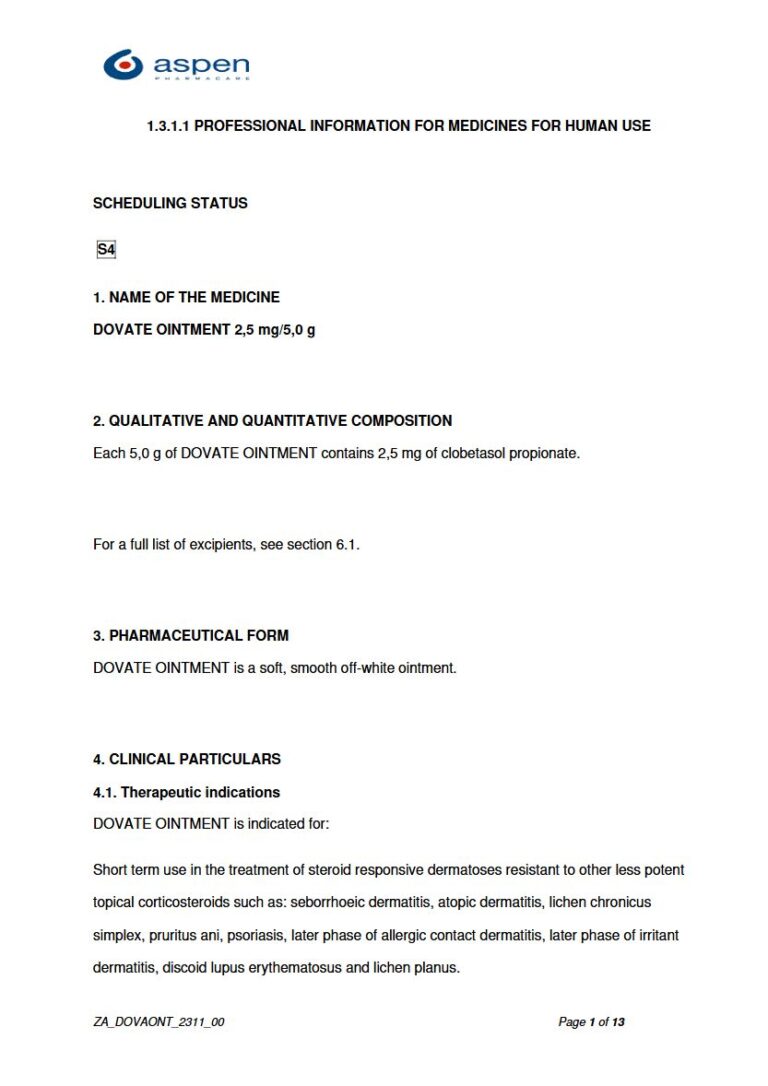
DOVATE OINTMENT is indicated for: Short term use in the treatment of steroid responsive dermatoses resistant to other less potent topical corticosteroids such as: seborrhoeic dermatitis, atopic dermatitis, lichen chronicus simplex, pruritus ani, psoriasis, later phase of allergic contact dermatitis, later phase of irritant dermatitis, discoid lupus erythematosus and lichen planus.
4.2. Posology and method of administration
Posology
Adults
Apply once or twice daily sparingly to the affected area until improvement occurs. Therapy should be discontinued when control is achieved. In the more responsive conditions this may be within a few days. If a longer course is necessary, it is recommended that treatment should not be continued for longer than four weeks without the patientu2019s condition being reviewed. Repeated short courses of DOVATE OINTMENT may be used to control exacerbations. If continuous steroid treatment is necessary, a less potent preparation should be used. In very resistant lesions, especially where there is hyperkeratosis, the treatment area must be occluded for part of each 24 hours. Thereafter improvement can usually be maintained by application without occlusion.
Method of administration
For topical administration.
4.3. Contraindications
DOVATE OINTMENT is contraindicated in:
u2022 Patients with hypersensitivity to clobetasol propionate or to any excipients in DOVATE OINTMENT (see section 6.1).
u2022 Known sensitivity to corticosteroids.
u2022 The presence of bacterial (including tuberculous), fungal or viral infections of the skin.
u2022 Use in ulcerative skin lesions and in rosacea.
u2022 Application to ulcers of the leg.
u2022 Long-term use is contraindicated in patients with diabetes mellitus or tuberculosis.
u2022 Pregnancy (see section 4.6).
4.4. Special warnings and precautions for use
Hypersensitivity
DOVATE OINTMENT should be used with caution in patients with a history of local hypersensitivity to other corticosteroids or to any of the excipients in the preparation. Local hypersensitivity reactions (see section 4.8) may resemble symptoms of the condition under treatment.
Product related warnings
Cases of osteonecrosis serious infections (including necrotizing fasciitis) and systemic immunosuppression (sometimes resulting in reversible Kaposi's sarcoma lesions) have been reported with long-term use of clobetasol propionate, as in DOVATE OINTMENT, beyond the recommended doses. DOVATE OINTMENT may under certain circumstances, be absorbed through the skin in sufficient amounts to produce systemic effects, since the pharmacokinetic pathway is similar to systemically administered corticosteroids. As DOVATE OINTMENT contains a highly potent corticosteroid, the risk associated with systemic absorption is enhanced.
Absorption (and risk of subsequent toxicity) is also enhanced by application for prolonged periods under occlusive dressings, by application to extensive areas or where skin is broken or other conditions where the skin barrier may be impaired. Manifestations of hypercortisolism (Cushing's syndrome) and reversible hypothalamic-pituitary-adrenal (HPA) axis suppression, leading to glucocorticosteroid insufficiency, can occur in some individuals as a result of increased systemic absorption of topical steroids. If either of the above are observed, withdraw the drug gradually by reducing the frequency of application, or by substituting a less potent corticosteroid. Abrupt withdrawal of treatment may result in glucocorticosteroid insufficiency (see section 4.8). Areas of body most likely to suffer local damage are the face and eyelids; the intertriginous areas, the neck, axillae, etc. are more permeable. If used on the face, treatment should be limited to only 5 days. Use with care in porphyria.
Infection risk with occlusion
Bacterial infection is encouraged by the warm, moist conditions within skin folds or caused by occlusive dressings. When using occlusive dressings, the skin should be cleansed before a fresh dressing is applied.
Use in psoriasis
Topical corticosteroids should be used with caution in psoriasis as rebound relapses, development of tolerances, risk of generalised pustular psoriasis and development of local or systemic toxicity due to impaired barrier function of the skin have been reported in some cases. If used in psoriasis careful patient supervision is important.
Concomitant infection
Appropriate antimicrobial therapy should be used whenever treating inflammatory lesions which have become infected. Any spread of infection requires withdrawal of topical corticosteroid therapy and administration of appropriate antimicrobial therapy.
Chronic leg ulcers
Topical corticosteroids should not be used to treat the dermatitis around chronic leg ulcers as this use may be associated with a higher occurrence of local hypersensitivity reactions and an increased risk of local infection (see section 4.3).
Application to the eyelids
If applied to the eyelids, care is needed to ensure that the preparation does not enter the eye, as cataract and glaucoma might result from repeated exposure. If DOVATE OINTMENT does enter the eye, the affected eye should be bathed in copious amounts of water.
Visual disturbance
Visual disturbance has been reported with systemic and topical corticosteroid use. If a patient presents with symptoms such as blurred vision or other visual disturbances, the patient should be considered for referral to an ophthalmologist for evaluation of possible causes which may include cataract, glaucoma or rare diseases such as central serous chorioretinopathy (CSCR) which have been reported after use of systemic and topical corticosteroids.
Topical steroid withdrawal syndrome
Long term continuous or inappropriate use of topical steroids can result in the development of rebound flares after stopping treatment (topical steroid withdrawal syndrome). A severe form of rebound flare can develop which takes the form of a dermatitis with intense redness, stinging and burning that can spread beyond the initial treatment area. It is more likely to occur when delicate skin sites such as the face and flexures are treated. Should there be a reoccurrence of the condition within days to weeks after successful treatment a withdrawal reaction should be suspected. Reapplication should be with caution and specialist advice is recommended in these cases or other treatment options should be considered.
Paediatric population
Special care should be exercised in infants and children. Long-term topical use is best avoided, especially in children. Children may absorb proportionally larger amounts of DOVATE OINTMENT because of a larger skin surface area to body-mass ratio, and thus be more susceptible to systemic toxicity. Children are more susceptible to develop atrophic changes with the use of topical corticosteroids.
Tight-fitting nappies or plastic pants should not be used on an infant being treated in the nappy area, as these garments may constitute occlusive dressings.
Excipients
DOVATE OINTMENT contains propylene glycol and stearyl alcohol which may cause skin irritation and/or local skin reactions (e.g) contact dermatitis.
4.5. Interaction with other medicines and other forms of interaction
Not known.
4.6. Fertility, pregnancy and lactation
The more potent corticosteroids have been shown to be teratogenic in animals following dermal application. As these agents are absorbed percutaneously, teratogenicity following topical application cannot be excluded.
Pregnancy
The safety of DOVATE OINTMENT in pregnancy has not been established (see section 4.3).
Breast feeding
The safe use of topical corticosteroids during lactation has not been established. If used during lactation clobetasol, as in DOVATE OINTMENT, should not be applied to the breasts to avoid accidental ingestion by the infant.
Fertility
There are no data available.
4.7 Effects on ability to drive and use machines
DOVATE OINTMENT has minor influence on the ability to drive or operate machinery. Since adverse reactions such as blurred vision have been reported in patients using DOVATE OINTMENT, patients should not drive, use machinery or perform any tasks that require concentration, until they are certain that DOVATE OINTMENT does not adversely affect their ability to do so (see section 4.4 and/or 4.8).
4.8. Undesirable effects
a) Tabulated list of adverse reactions
System organ class
Frequent
Less frequent
Frequency unknown (cannot be estimated from the available data)
Infections and infestations
Opportunistic infection.
Immune system disorders
Hypersensitivity, generalised rash.
Endocrine disorders
HPA- Axis depression with adrenal gland suppression
Cushingoid features: (e.g. moon face, central obesity), delayed weight gain/ growth retardation in children, osteoporosis, hyperglycaemia/glucosuria, hypertension, increased weight/obesity, decreased endogenous cortisol levels, alopecia, trichorrhexis.
Nervous system disorders
Benign intracranial hypertension.
Eye disorders
Cataract, central serous chorioretinopathy, glaucoma.
Blurred vision, corneal ulcers, raised intra-ocular pressure, and reduced visual function.
Skin and subcutaneous tissue disorders
Pruritus, local skin burning /skin pain.
Skin atrophy*, striae*, telangiectasias, skin thinning*, skin wrinkling*, skin dryness*, hypopigmentation, hypertrichosis, exacerbation of underlying symptoms, allergic contact dermatitis/dermatitis, general pustular psoriasis, erythema, rash, urticaria, acne.
Fragility of cutaneous vessels resulting in bruising and purpura. Rosacea-like dermatitis, perioral dermatitis withdrawal reactions - redness of the skin which may extend to areas beyond the initial affected area, burning or stinging sensation, itch, skin peeling, oozing pustules. (see section 4.4).
General disorders and administrative site conditions
Application site irritation/pain.
Spreading and worsening of local infections.
* Skin features secondary to local and/or systemic effects of hypothalamic-pituitary adrenal (HPA) axis suppression.
b) Description of selected adverse reactions
Skin and subcutaneous tissue disorders
Occlusive dressings are associated with maceration of the skin and miliaria.
Reporting of suspected adverse reactions
Reporting suspected adverse reactions after authorisation of the medicine is important. It allows continued monitoring of the benefit/risk balance of the medicine. Healthcare providers are asked to report any suspected adverse reactions to SAHPRA via the u201c6.04 Adverse Drug Reactions Reporting Formu201d, found online under SAHPRAu2019s publications:
4.9. Overdose
Symptoms
Topically applied DOVATE OINTMENT may be absorbed in sufficient amounts to produce systemic effects. Acute overdosage is very unlikely to occur, however, in the case of chronic overdosage or misuse the features of hypercortisolism may occur (see section 4.8).
Treatment
Treatment is symptomatic and supportive. In the event of overdose, DOVATE OINTMENT should be withdrawn gradually by reducing the frequency of application or by substituting a less potent corticosteroid because of the risk of glucocorticosteroid insufficiency.
