
Glencosol Shampoo 0,5 mg Liquid
PDF Leaflet Revision Date: 1 April 2022
Clinical Summary
Quick overview from the medicine insert
Indication
Topical management of moderate to severe plaque-type psoriasis in adults.
Dosage (summary)
Apply twice daily to affected areas for up to 4 weeks.
Special Populations
- Paediatric use not recommended
- Elderly use with caution
Pregnancy & Breastfeeding
Not established for pregnancy; contraindicated in breastfeeding.
Contraindications
- Hypersensitivity to clobetasol or excipients
- Bacterial, viral, fungal infections
- Acne vulgaris, rosacea
- Application near eyes
- Ulcerous wounds
- Peri-anal and genital pruritis
Common side effects
- Application site burning
- Atrophy
- Telangiectasia
- Folliculitis
- Stinging
- Pruritus
Counselling Points
- Wash hands after application
- Limit use to 50g per week
- Monitor for signs of local intolerance
- Avoid contact with eyes
Serious warnings
- Risk of HPA axis suppression
- Potential for Cushing's syndrome
- Use with caution in extensive areas
Important Disclaimer
The Glencosol Shampoo 0,5 mg Liquid professional information leaflet below is the property of Glenmark Pharmaceuticals South Africa and is provided on Medinsert exactly as issued, with no.. alterations or editorial changes. We make every effort to keep content current by updating documents as soon as new versions become available. Medinsert serves as a trusted access point for healthcare professionals, but does not replace official sources or clinical judgement. For more details, please read our full disclaimer. read more>>
 Healthcare Professionals Only
This content is for registered healthcare professionals
Sign in or create a free account to read the full package insert.
Free for HPCSA-registered professionals. Powered by Medinsert.
Clinical Particulars
Section 4 of the official insert — extracted exactly as issued, no alterations
4.1 Therapeutic indications
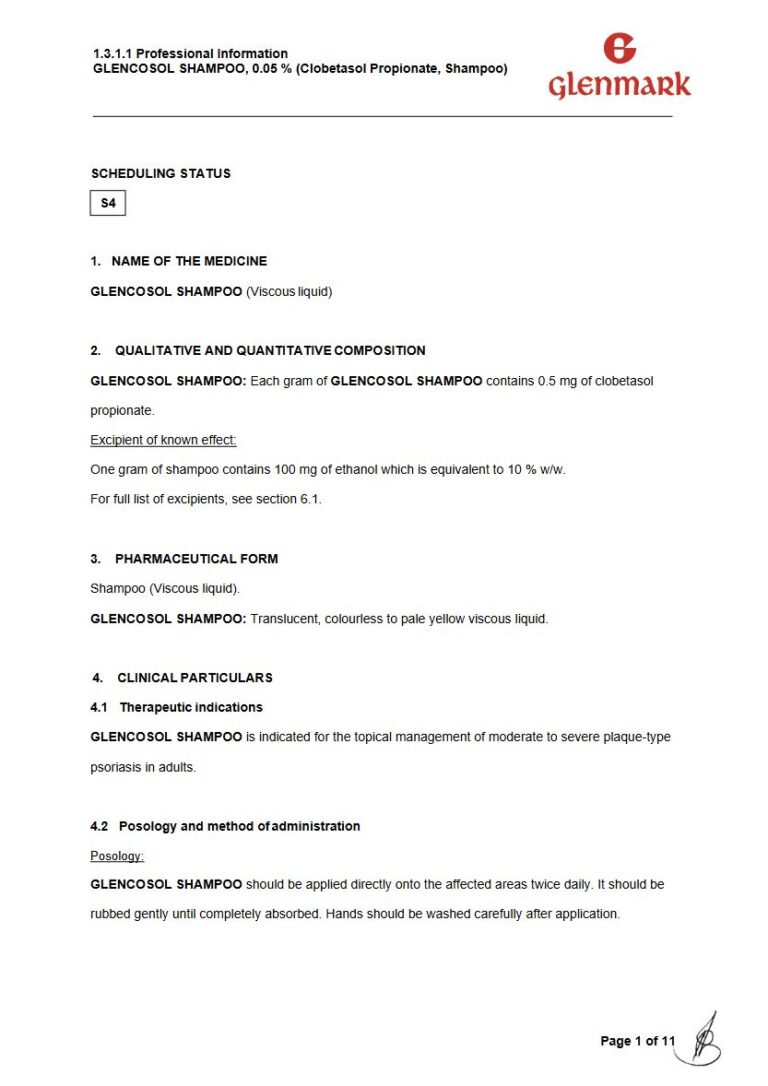
GLENCOSOL SHAMPOO is indicated for the topical management of moderate to severe plaque-type psoriasis in adults.
4.2 Posology and method of administration
Posology: GLENCOSOL SHAMPOO should be applied directly onto the affected areas twice daily. It should be rubbed gently until completely absorbed. Hands should be washed carefully after application.
The period of treatment should be limited to 4 weeks and must be adjusted to suit the individual patient (see section 4.4). If further treatment with a topical corticosteroid is required after 4 weeks of treatment with GLENCOSOL SHAMPOO, a less potent steroid should be used. Treatment with GLENCOSOL SHAMPOO should be stopped if disease control is achieved. After a period of treatment with GLENCOSOL SHAMPOO, the treatment may be repeated to treat exacerbations of psoriasis. Not more than 50 g of GLENCOSOL SHAMPOO should be used per week.
Paediatric population: The safety and efficacy of GLENCOSOL in children and adolescents younger than 18 years of age have not been established.
Method of administration: For application to the skin.
4.3 Contraindications
- GLENCOSOL SHAMPOO is contraindicated in patients with a known hypersensitivity to clobetasol propionate or to any of the excipients in the GLENCOSOL SHAMPOO formulation (see section 6.1)
- Skin areas affected by bacterial, viral (varicella, herpes simplex, herpes zoster), fungal or parasitic infections and specific skin diseases (skin tuberculosis, skin disease caused by syphilis)
- Acne vulgaris, rosacea or perioral dermatitis (see section 4.8)
- Application near the eyes (risk of glaucoma)
- GLENCOSOL SHAMPOO should not be applied to ulcerous wounds
- Peri-anal and genital pruritis
- Safety and efficacy have not been established in children younger than 18 years
4.4 Special warnings and precautions for use
GLENCOSOL SHAMPOO should be used with caution for a number of reasons including post-treatment rebound, relapses, development of tolerance (tachyphylaxis) and development of local or systemic toxicity such as atrophy and teliangectasia of the skin or hypothalamic-pituitary-adrenal (HPA) axis suppression.
Pustular psoriasis: Treatment of psoriasis with GLENCOSOL SHAMPOO (or its withdrawal) may provoke generalised pustular psoriasis in case of intensive and prolonged topical use. Hypersensitivity to GLENCOSOL SHAMPOO may occur. This can be suspected in case of resistance to treatment.
Hypothalamic-pituitary-adrenal (HPA) axis suppression: GLENCOSOL SHAMPOO contains a highly potent topical corticosteroid (clobetasol propionate) that has been shown to suppress the HPA axis at the lowest doses tested. Systemic absorption of topical corticosteroids, as contained in GLENCOSOL SHAMPOO, can produce reversible HPA axis suppression with the potential for glucocorticosteroid insufficiency after withdrawal of treatment. Manifestations of Cushingu2019s syndrome, hyperglycaemia, and glucosuria can also be produced in some patients by systemic absorption of topical corticosteroids while on treatment.
Conditions which increase systemic absorption include the application of the more potent corticosteroids, use over large surface areas, long-term continuous therapy with GLENCOSOL SHAMPOO, and the addition of occlusive dressings or use on occluded areas. Therefore, patients applying GLENCOSOL SHAMPOO to a large surface area or to areas under occlusion should be evaluated periodically for evidence of HPA axis suppression. If HPA axis suppression is noted, an attempt should be made to withdraw the medicine, to reduce the frequency of application, or to substitute with a less potent steroid.
Recovery of HPA axis function is generally complete upon discontinuation of topical corticosteroids as in PN. Signs and symptoms of glucocorticosteroid insufficiency may occur, requiring supplemental systemic corticosteroids. For information on systemic supplementation, see professional information for those medicines. Medical supervision should be increased, and patients should be evaluated periodically for evidence of HPA axis suppression. Such systemic effects usually resolve when treatment is stopped.
Areas of application: Although GLENCOSOL SHAMPOO is intended for the topical treatment of moderate to severe scalp psoriasis, it should be noted that certain areas of the body, such as the eyelids, face, groin, axillae and genito-anal regions, are more prone to atrophic changes such as telangectasia or cortico-induced dermatitis than other areas of the body following treatment with corticosteroids. GLENCOSOL SHAMPOO should not be used on the face, groin or axillae. Avoid any contact of the GLENCOSOL SHAMPOO with the eyes and lips. If GLENCOSOL SHAMPOO does enter the eye, the affected eye should be rinsed with copious amounts of water.
Liver dysfunction and diabetes mellitus: Patients with severe liver dysfunction and severe diabetes mellitus should be treated with special caution and closely monitored for adverse effects.
Irritation and allergic reactions: If irritation develops, GLENCOSOL SHAMPOO should be discontinued and appropriate therapy instituted. Allergic contact dermatitis with corticosteroids is usually diagnosed by observing a failure to heal rather than noting a clinical exacerbation. Such an observation should be corroborated with appropriate diagnostic patch testing.
Laboratory tests: The cortrosyn stimulation test may be helpful in evaluating patients for HPA axis suppression.
Paediatric use: The use of GLENCOSOL SHAMPOO in patients younger than 18 years old is not recommended due to potential for HPA axis suppression. Because of a higher ratio of skin surface area to body mass, paediatric patients are at a greater risk than adults of HPA axis suppression and Cushingu2019s syndrome when they are treated with GLENCOSOL SHAMPOO. They are therefore also at greater risk of adrenal insufficiency during and/or after withdrawal of treatment. Adverse effects including striae have been reported with inappropriate use of topical corticosteroids in infants and children. HPA axis suppression, Cushingu2019s syndrome, linear growth retardation, delayed weight gain, and intracranial hypertension have been reported in children receiving GLENCOSOL SHAMPOO. Manifestations of adrenal suppression in children include low plasma cortisol levels and an absence of response to ACTH stimulation. Manifestations of intracranial hypertension include bulging fontanelles, headaches, and bilateral papilledema.
Elderly use: Clinical studies of GLENCOSOL SHAMPOO did not include sufficient numbers of patients aged 65 and older to determine whether they respond differently than younger patients. In general, dose selection for an elderly patient should be made with caution, usually starting at the low end of the dosing range, reflecting the greater frequency of decreased hepatic, renal or cardiac function, and of concomitant disease or other medicine therapy.
4.5 Interaction with other medicines and other forms of interaction
No interaction studies have been performed.
4.6 Fertility, pregnancy and lactation
Pregnancy: Safety in pregnancy has not been established. There are no adequate and well-controlled studies of the teratogenic potential of GLENCOSOL SHAMPOO in pregnant women. Studies in laboratory animals have shown reproductive toxicity when administered systemically at relatively low dosage levels. The potential risk for humans is unknown. As a precautionary measure, GLENCOSOL SHAMPOO should not be used during pregnancy.
Lactation: Systemically administered corticosteroids appear in human milk. GLENCOSOL SHAMPOO should not be prescribed to women breastfeeding their infants.
Fertility: Clobetasol propionate decreased fertility when administered intravenously to rats.
4.7 Effects on ability to drive and use machines
As a topical corticosteroid, GLENCOSOL SHAMPOO has no or negligible influence on the ability to drive and use machines.
4.8 Undesirable effects
a. Summary of the safety profile: The most commonly reported adverse reaction in clinical trials was application site burning, experienced in subjects with GLENCOSOL SHAMPOO. Less frequent adverse reactions were application site atrophy, telangiectasia, application site folliculitis, which occurred in subjects treated with GLENCOSOL SHAMPOO. All these reactions usually resolved spontaneously. Other reported adverse reactions in clinical trials included stinging, pruritus, oedema, acne, dry skin, irritant dermatitis and urticaria. If signs of local intolerance appear, application should be suspended until they disappear. If signs of hypersensitivity appear, application should be stopped immediately.
b. Tabulated summary of adverse reactions: Adverse reactions reported in clinical trials, ordered by System Organ Class (SOC) are tabulated below.
Table 1: GLENCOSOL SHAMPOO undesirable effects
MedDRA SOC Frequency Adverse events Infections and infestations Less frequent Opportunistic infection Immune system disorders Less frequent Hypersensitivity, generalised rash Endocrine disorders Less frequent Hypothalamic - pituitary adrenal (HPA) axis suppression: Cushingoid features: (e.g. moon face, central obesity), delayed weight gain/ growth retardation in children, osteoporosis, glaucoma, hyperglycaemia/ glucosuria, cataract, hypertension, increased weight/ obesity, decreased endogenous cortisol levels, alopecia, trichorrhexis Eye disorders Not known Blurred vision Skin and subcutaneous tissue disorders Frequent Skin discomfort, pruritus Less frequent Application site dryness, hypopigmentation, perioral dermatitis, allergic contact dermatitis, secondary infection, striae, milliaria, Skin thinning, skin wrinkling, hypertrichosis, exacerbation of underlying symptoms, dermatitis, pustular psoriasis, erythema, rash, urticaria, acne General disorders and administration site disorders Frequent Application site burning, Telangiectasia, application site atrophy, application site folliculitis, application site pain, application site irritation, headache
c. Selected adverse reactions: Systemic absorption: Prolonged use of GLENCOSOL SHAMPOO treatment of extensive areas or use of large amounts can result in sufficient systemic absorption to produce the features of hypercortisolism (Cushingu2019s syndrome) or HPA axis suppression. Such effects are more likely to occur if occlusive dressings or bandages are used. Prolonged treatment: Prolonged and/or intensive treatment with GLENCOSOL SHAMPOO may cause local changes, such as local skin atrophy, striae, telangiectasia, erythema, purpura and contact dermatitis, especially with the use of occlusive dressings. Use in the face: When applied to the face, GLENCOSOL SHAMPOO can induce perioral dermatitis, skin atrophy or worsen rosacea. There are reports of pigmentation changes, acne, pustular eruptions and hypertrichosis with GLENCOSOL SHAMPOO.
Reporting of suspected adverse reactions: Reporting suspected adverse reactions after authorisation of the medicine is important. It allows continued monitoring of the benefit/ risk balance of the medicine. Health care providers are asked to report any suspected adverse reactions to SAHPRA via the u201c6.04 Adverse Drug Reactions Reporting Formu201d, found online under SAHPRAu2019s publications: https://www.sahpra.org.za/Publications/Index/8
4.9 Overdose
Acute overdose is unlikely to occur, however, in the case of chronic overdose or misuse, the features of hypercortisolism may appear and in this situation, treatment should be discontinued gradually. However, because of the risk of acute adrenal suppression, this should be done under medical supervision. Treatment is symptomatic and supportive.
In cases where GLENCOSOL SHAMPOO is accidentally swallowed, a healthcare professional should be consulted immediately.
