
Desvenlafaxine 100 mg Tablets
PDF Leaflet Revision Date: 06 May 2025
Clinical Summary
Quick overview from the medicine insert
Indication
Treatment of major depressive disorder.
Dosage (summary)
50 mg once daily, max 100 mg/day; gradual dose increase.
Special Populations
- Renal impairment
- Hepatic impairment
- Elderly patients
Pregnancy & Breastfeeding
Contraindicated in pregnancy and lactation.
Key Drug Interactions
- MAOIs
- CNS-active medicines
- Alcohol
Contraindications
- Hypersensitivity
- MAOI use
- Children under 18
Common side effects
- Nausea
- Dizziness
- Insomnia
- Fatigue
Counselling Points
- Monitor for worsening depression
- Avoid alcohol
- Gradual tapering recommended
Serious warnings
- Risk of suicidality
- Serotonin syndrome
- Increased blood pressure
Important Disclaimer
The Desvenlafaxine 100 mg Tablets professional information leaflet below is the property of Zydus Healthcare Sa and is provided on Medinsert exactly as issued, with no.. alterations or editorial changes. We make every effort to keep content current by updating documents as soon as new versions become available. Medinsert serves as a trusted access point for healthcare professionals, but does not replace official sources or clinical judgement. For more details, please read our full disclaimer. read more>>
 Healthcare Professionals Only
This content is for registered healthcare professionals
Sign in or create a free account to read the full package insert.
Free for HPCSA-registered professionals. Powered by Medinsert.
Clinical Particulars
Section 4 of the official insert — extracted exactly as issued, no alterations
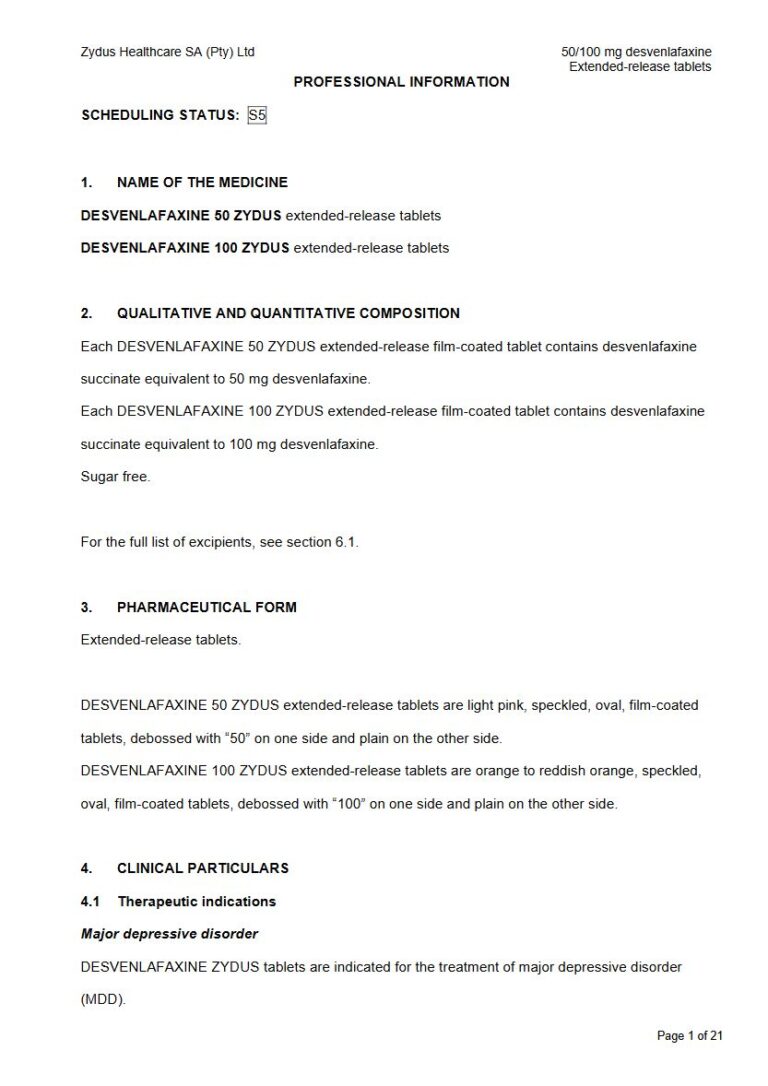
4.1 Therapeutic indications
Major depressive disorder
DESVENLAFAXINE ZYDUS tablets are indicated for the treatment of major depressive disorder (MDD).
4.2 Posology and method of administration
Posology:
Major depressive disorder
The recommended dose for DESVENLAFAXINE ZYDUS is 50 mg once daily, with or without food, with a maximum dose of 100 mg per day. The dose increase should occur gradually and at an interval of not less than 7 days.
Discontinuing DESVENLAFAXINE ZYDUS
Symptoms associated with discontinuation of DESVENLAFAXINE ZYDUS, other serotonin and norepinephrine reuptake inhibitors (SNRIs) and selective serotonin reuptake inhibitors (SSRIs) have been reported. Patients should be monitored for these symptoms when discontinuing treatment. A gradual reduction in the dose rather than abrupt cessation is recommended whenever possible. If intolerable symptoms occur following a decrease in the dose, or upon discontinuation of treatment, then resuming the previously prescribed dose may be considered. Subsequently, the medical practitioner may continue decreasing the dose but at a more gradual rate (see sections 4.4 and 4.8).
Switching patients from other antidepressants to DESVENLAFAXINE ZYDUS
Discontinuation symptoms have been reported when switching patients from other antidepressants, including venlafaxine, to DESVENLAFAXINE ZYDUS. Tapering of the initial antidepressant may be necessary to minimise discontinuation symptoms.
Special populations
Use in patients with renal impairment
The recommended starting dose in patients with severe renal impairment (24-hour creatinine clearance < 30 mL/min) or end-stage renal disease (ESRD) is 50 mg every other day. Because of individual variability in clearance in these patients, individualisation of dosage may be desirable. Supplemental doses should not be given to patients after dialysis (see section 5.2).
Use in patients with hepatic impairment
No dosage adjustment is necessary for patients with hepatic impairment (see section 5.2).
Use in elderly patients
No dosage adjustment is required solely on the basis of age; however, possible reduced renal clearance of DESVENLAFAXINE ZYDUS should be considered when determining the dose (see section 5.2).
Paediatric population
Safety and efficacy in patients less than 18 years of age have not been established.
Method of administration:
For oral use. The film-coated tablet should not be broken because the coating is intended to ensure an extended release.
4.3 Contraindications
- Hypersensitivity to desvenlafaxine succinate, venlafaxine hydrochloride or to any of the excipients in DESVENLAFAXINE ZYDUS (see section 6).
- DESVENLAFAXINE ZYDUS is an inhibitor of both norepinephrine and serotonin reuptake. DESVENLAFAXINE ZYDUS must not be used in combination with a monoamine oxidase inhibitor (MAOI), or within at least 14 days of discontinuing treatment with an MAOI. Based on the half-life of DESVENLAFAXINE ZYDUS, at least 7 days should be allowed after stopping DESVENLAFAXINE ZYDUS before starting an MAOI. Severe adverse reactions have been reported when therapy is initiated with SSRI/SNRI medicines, such as DESVENLAFAXINE ZYDUS, soon after discontinuation of an MAOI and when an MAOI is initiated soon after discontinuation of SSRI/SNRI medicines. These reactions have included tremor, myoclonus, diaphoresis, nausea, vomiting, flushing, dizziness, hyperthermia with features resembling neuroleptic malignant syndrome, seizures and death (see section 4.5).
- Children less than 18 years of age, as safety and efficacy have not been established (see sections 4.4 and 4.8).
- Pregnancy and lactation (see section 4.6).
4.4 Special warnings and precautions for use
SSRIs/SNRIs may increase the risk of postpartum haemorrhage (see sections 4.6 and 4.8).
Clinical worsening of depressive symptoms, unusual changes in behaviour and suicidality
Patients with major depressive disorder may experience worsening of their depression and/or the emergence of suicidal ideation and behaviour, whether or not they are taking antidepressant medicines. This risk may persist until significant remission occurs. A causal role, however, for antidepressant medicine in inducing such behaviour has not been established. Patients being treated with DESVENLAFAXINE ZYDUS should, nevertheless, be observed closely for clinical worsening and suicidality, especially at the beginning of a course of therapy or at any time of dose changes, either increases or decreases. Because of the possibility of co-morbidity between major depressive disorder and other psychiatric and nonpsychiatric disorders, the same precautions observed when treating patients with major depressive disorders should be observed when treating patients with other psychiatric and non-psychiatric disorders. The following symptoms have been reported in patients being treated with antidepressants for major depressive disorder as well as for other indications, both psychiatric and non-psychiatric: anxiety, agitation, panic attacks, insomnia, irritability, hostility, aggressiveness, impulsivity, akathisia, hypomania and mania. Although a causal link between the emergence of suicidal impulses has not been established, consideration should be given to changing the therapeutic regimen, including possibly discontinuing DESVENLAFAXINE ZYDUS in patients for whom such symptoms are severe, abrupt in onset, or were not part of the patientu2019s presenting symptoms. If the decision is made to discontinue treatment, DESVENLAFAXINE ZYDUS should be tapered (see section 4.2).
Short-term trials have not shown an increase in the risk of suicidality with antidepressants compared to placebo in adults beyond the age of 24 years; there was a reduction in the risk of suicidality with antidepressants compared to placebo in adults aged 65 years and older.
Mania/hypomania
There have been reports of mania in patients treated with desvenlafaxine, as in DESVENLAFAXINE ZYDUS. Activation of mania/hypomania has also been reported in a small proportion of patients with major affective disorder who were treated with other marketed antidepressants. DESVENLAFAXINE ZYDUS should be used cautiously in patients with a history or family history of mania or hypomania (see section 4.8).
Serotonin syndrome
The development of a potentially life-threatening serotonin syndrome may occur with DESVENLAFAXINE ZYDUS treatment, particularly with concomitant use of other serotonergic medicines (including SSRIs, SNRIs and triptans) and with medicines that impair metabolism of serotonin (including MAOIs). Serotonin syndrome symptoms may include mental status changes (e.g. agitation, hallucinations and coma), autonomic instability (e.g. tachycardia, labile blood pressure and hyperthermia), neuromuscular aberrations (e.g. hyperreflexia, incoordination) and/or gastrointestinal symptoms (e.g. nausea, vomiting and diarrhoea) (see section 4.5). The concomitant use of DESVENLAFAXINE ZYDUS with serotonin precursors (such as tryptophan supplements) is not recommended.
Narrow-angle glaucoma
Mydriasis has been reported in association with DESVENLAFAXINE ZYDUS; therefore, patients with raised intraocular pressure, or those at risk of acute narrow-angle glaucoma (angle-closure glaucoma), should be monitored (see section 4.8).
Ischaemic cardiac adverse events
Ischaemic cardiac adverse events have been reported less frequently including myocardial ischaemia, myocardial infarction, and coronary occlusion requiring revascularisation; these patients had multiple underlying cardiac risk factors. More patients experienced these events during desvenlafaxine treatment as compared to placebo.
Discontinuation symptoms
Adverse reactions reported in association with abrupt discontinuation, dose reduction or tapering of treatment include dizziness, withdrawal syndrome, nausea and headache. In general, discontinuation symptoms occurred more frequently with longer duration of therapy (see section 4.2).
Adverse reactions leading to discontinuation of therapy
The most common adverse reaction leading to discontinuation was nausea.
Adverse reactions reported with other SNRIs
Although gastrointestinal bleeding is not considered an adverse reaction for DESVENLAFAXINE ZYDUS, it is an adverse reaction for other SNRIs and may also occur with DESVENLAFAXINE ZYDUS.
Abuse and dependence
Physical and psychological dependence
Although DESVENLAFAXINE ZYDUS has not been systematically studied for its potential for abuse, no indication of medicine-seeking behaviour has been seen.
Co-administration of medicines containing venlafaxine and/or other medicines containing desvenlafaxine
DESVENLAFAXINE ZYDUS is the major active metabolite of venlafaxine, a medicine used to treat major depressive, generalised anxiety, social anxiety and panic disorders. DESVENLAFAXINE ZYDUS should not be used concomitantly with medicines containing venlafaxine hydrochloride or other medicines containing DESVENLAFAXINE ZYDUS (see section 4.5).
Effects on blood pressure
Increased blood pressure
Increases in blood pressure were observed in some patients, particularly with higher doses. Pre-existing hypertension should be controlled before treatment with DESVENLAFAXINE ZYDUS. Patients receiving DESVENLAFAXINE ZYDUS should have regular monitoring of blood pressure. Cases of elevated blood pressure requiring immediate treatment have been reported with DESVENLAFAXINE ZYDUS. Sustained blood pressure increases could have adverse consequences. For patients who experience a sustained increase in blood pressure while receiving DESVENLAFAXINE ZYDUS, either dose reduction or discontinuation should be considered. Caution should be exercised in treating patients with underlying conditions that might be compromised by increases in blood pressure (see section 4.8).
Cardiovascular/cerebrovascular disorders
Caution is advised in administering DESVENLAFAXINE ZYDUS to patients with cardiovascular, cerebrovascular or lipid metabolism disorders. Increases in blood pressure and heart rate have been observed in patients using DESVENLAFAXINE ZYDUS. DESVENLAFAXINE ZYDUS has not been evaluated systematically in patients with a recent history of myocardial infarction, unstable heart disease, uncontrolled hypertension or cerebrovascular disease. Patients with these diagnoses, except for cerebrovascular disease, were excluded from clinical trials (see section 4.8).
Serum lipids
Dose-related elevations in fasting serum total cholesterol, LDL (low density lipoprotein) cholesterol and triglycerides have been observed. Measurement of serum lipids should be considered during treatment with DESVENLAFAXINE ZYDUS (see section 4.8).
Seizures
Cases of seizures were reported in premarketing clinical trials with desvenlafaxine. DESVENLAFAXINE ZYDUS has not been systematically evaluated in patients with a seizure disorder. Patients with a history of seizures were excluded from premarketing clinical trials. DESVENLAFAXINE ZYDUS should be prescribed with caution in patients with a seizure disorder (see section 4.8).
Discontinuation effects
During marketing of SNRIs and SSRIs, such as DESVENLAFAXINE ZYDUS, there have been spontaneous reports of adverse events occurring upon discontinuation of these medicines, particularly when abrupt, including the following: dysphoric mood, irritability, agitation, dizziness, sensory disturbances (e.g. paraesthesia such as electric shock sensations), anxiety, confusion, headache, lethargy, emotional lability, insomnia, hypomania, tinnitus and seizures. While these events are generally self-limiting, there have been reports of serious discontinuation symptoms. Patients should be monitored when discontinuing treatment with DESVENLAFAXINE ZYDUS. A gradual reduction in the dose rather than abrupt cessation is recommended whenever possible. If intolerable symptoms occur following a decrease in the dose or upon discontinuation of treatment, then resuming the previously prescribed dose may be considered (see sections 4.2 and 4.8).
Abnormal bleeding
Medicines that inhibit serotonin uptake in platelets may lead to abnormalities of platelet aggregation. As with other medicines that inhibit serotonin reuptake, DESVENLAFAXINE ZYDUS should be used cautiously in patients predisposed to bleeding.
Hyponatraemia
Cases of hyponatraemia and/or the syndrome of inappropriate antidiuretic hormone (SIADH) secretion have been described with SNRIs and SSRIs, including DESVENLAFAXINE ZYDUS, usually in volume-depleted or dehydrated patients, including elderly patients and patients taking diuretics (see section 4.8).
Interstitial lung disease and eosinophilic pneumonia
Interstitial lung disease and eosinophilic pneumonia associated with venlafaxine (the parent medicine of DESVENLAFAXINE ZYDUS) therapy have been reported. The possibility of these adverse events should be considered in patients treated with DESVENLAFAXINE ZYDUS who present with progressive dyspnoea, cough or chest discomfort. Such patients should undergo a prompt medical evaluation, and discontinuation of DESVENLAFAXINE ZYDUS should be considered.
4.5 Interactions with other medicines and other forms of interaction
Monoamine oxidase inhibitors (MAOI)
Adverse reactions, some of which were serious, have been reported in patients who have recently been discontinued from a monoamine oxidase inhibitor (MAOI) and started on antidepressants with pharmacological properties similar to DESVENLAFAXINE ZYDUS (SNRIs or SSRIs), or who have recently had SNRI or SSRI therapy discontinued prior to initiation of an MAOI. These reactions have included tremor, myoclonus, diaphoresis, nausea, vomiting, flushing, dizziness, hyperthermia with features resembling neuroleptic malignant syndrome, seizures and death. Concomitant use of DESVENLAFAXINE ZYDUS in patients taking MAOIs, including selegiline and linezolid (an antibiotic which is a reversible non-selective MAOI), is contraindicated (see sections 4.3 and 4.4).
Central nervous system (CNS)-active medicines
The risk of using DESVENLAFAXINE ZYDUS in combination with other CNS-active medicines has not been systematically evaluated. Consequently, caution is advised when DESVENLAFAXINE ZYDUS is taken in combination with other CNS-active medicines.
Serotonin syndrome
Serotonin syndrome, a potentially life-threatening condition, may occur with DESVENLAFAXINE ZYDUS treatment, particularly with concomitant use of other medicines that may affect the serotonergic neurotransmitter system (including triptans, SSRIs, other SNRIs, lithium, sibutramine, tramadol, St Johnu2019s wort [Hypericum perforatum], pethidine), with medicines that impair metabolism of serotonin (such as MAOIs, including linezolid [see section 4.3]) or with serotonin precursors (such as tryptophan supplements). Serotonin syndrome symptoms may include mental status changes, autonomic instability, neuromuscular aberrations and/or gastrointestinal symptoms (see section 4.4).
Ethanol
Patients should be advised to avoid alcohol consumption while taking DESVENLAFAXINE ZYDUS.
Potential for other medicines to affect DESVENLAFAXINE ZYDUS
Inhibitors of CYP3A4
CYP3A4 is involved in DESVENLAFAXINE ZYDUS elimination. Concomitant use of DESVENLAFAXINE ZYDUS with potent inhibitors of CYP3A4 may result in higher exposure to DESVENLAFAXINE ZYDUS.
Inhibitors of other CYP enzymes
Based on in vitro data, medicines that inhibit CYP isozymes 1A1, 1A2, 2A6, 2D6, 2C8, 2C9, 2C19 and 2E1 are not expected to have significant impact on the pharmacokinetic profile of DESVENLAFAXINE ZYDUS.
Potential for DESVENLAFAXINE ZYDUS to affect other medicines
Medicines metabolised by CYP2D6
Clinical trials have shown that desvenlafaxine is a weak inhibitor of CYP2D6 at a dose of 100 mg daily. Concomitant use of DESVENLAFAXINE ZYDUS with a medicine metabolised by CYP2D6 may result in increased concentrations of that medicine and decreased concentrations of its CYP2D6 metabolites.
Medicines metabolised by CYP3A4
In vitro, desvenlafaxine does not inhibit or induce the CYP3A4 isozymes. Concomitant use of DESVENLAFAXINE ZYDUS with a medicine metabolised by CYP3A4 may result in lower exposures to that medicine.
Medicines metabolised by a combination of both CYP2D6 and CYP3A4 (tamoxifen and aripiprazole)
Clinical studies have shown that desvenlafaxine (100 mg daily) does not have a clinically relevant effect on medicines metabolised by a combination of both CYP2D6 and CYP3A4 enzymes.
Medicines metabolised by CYP1A2, 2A6, 2C8, 2C9 and 2C19
In vitro, desvenlafaxine does not inhibit CYP1A2, 2A6, 2C8, 2C9 and 2C19 isozymes and would not be expected to affect the pharmacokinetics of medicines that are metabolised by these CYP isozymes.
P-glycoprotein transporter
In vitro, desvenlafaxine is not a substrate or an inhibitor of the P-glycoprotein transporter.
4.6 Fertility, pregnancy and lactation
Pregnancy
DESVENLAFAXINE ZYDUS must not be administered to pregnant women. Safety during pregnancy has not been established (see section 4.3). If DESVENLAFAXINE ZYDUS is used until, or shortly before birth, discontinuation effects in the newborn may occur. Complications, including the need for respiratory support, tube feeding or prolonged hospitalisation, have been reported in neonates exposed to SNRIs or SSRIs late in the third trimester. Such complications can arise immediately upon delivery. Patients should be advised to notify their doctor if they become pregnant or intend to become pregnant during therapy. Observational data indicate an increased risk (less than 2-fold) of postpartum haemorrhage following SSRI/SNRI exposure within the month prior to birth (see sections 4.4 and 4.8).
Breastfeeding
DESVENLAFAXINE ZYDUS must not be administered to lactating women. Safety during lactation has not been established (see section 4.3). DESVENLAFAXINE ZYDUS (O-desmethylvenlafaxine) is excreted in human milk. Because of the potential for serious adverse reactions in nursing infants from DESVENLAFAXINE ZYDUS, a decision should be made whether or not to discontinue nursing or to discontinue DESVENLAFAXINE ZYDUS, taking into account the importance of DESVENLAFAXINE ZYDUS to the mother.
Fertility
No data on male or female fertility is available.
4.7 Effects on ability to drive and use machines
DESVENLAFAXINE ZYDUS may impair judgement, thinking and motor skills. Therefore, patients should be cautioned about their ability to drive a vehicle or operate hazardous machinery (see section 4.4).
4.8 Undesirable effects
Tabulated summary of adverse reactions
| SYSTEM ORGAN CLASS | FREQUENCY | ADVERSE REACTIONS |
|---|---|---|
| Immune system disorders | Less frequent | Hypersensitivity. |
| Metabolism and nutritional disorders | Frequent | Decreased appetite. |
| Less frequent | Hyponatraemia. | |
| Psychiatric disorders | Frequent | Insomnia, anxiety, abnormal dreams, nervousness, decreased libido, anorgasmia. |
| Less frequent | Withdrawal syndrome, abnormal orgasm, depersonalisation, hypomania, hallucinations. | |
| Nervous system disorders | Frequent | Dizziness, headache, somnolence, tremor, paraesthesia, dysgeusia, disturbance in attention, vertigo. |
| Less frequent | Syncope, convulsion, dystonia. | |
| Eye disorders | Frequent | Blurred vision, mydriasis. |
| Ear and labyrinth disorders | Frequent | Tinnitus. |
| Cardiac disorders | Frequent | Palpitations, tachycardia. |
| Vascular disorders | Frequent | Hot flush. |
| Less frequent | Orthostatic hypotension, peripheral coldness. | |
| Respiratory, thoracic and mediastinal disorders | Frequent | Yawning. |
| Less frequent | Epistaxis. | |
| Gastrointestinal disorders | Frequent | Nausea, dry mouth, constipation, diarrhoea, vomiting. |
| Frequency unknown | Acute pancreatitis. | |
| Skin and subcutaneous tissue disorders | Frequent | Hyperhidrosis, rash. |
| Less frequent | Alopecia, photosensitivity reaction, angioedema. | |
| Frequency unknown | Stevens-Johnson syndrome**. | |
| Musculoskeletal and connective tissue disorders | Frequent | Musculoskeletal stiffness. |
| Renal and urinary disorders | Frequent | Urinary hesitation, proteinuria, urinary retention. |
| Reproductive system and breast disorders | Frequent | Erectile dysfunction*, delayed ejaculation*, ejaculation failure*. |
| Less frequent | Ejaculation disorder*, sexual dysfunction. | |
| Frequency unknown | Postpartum haemorrhage***. | |
| General disorders and administration site conditions | Frequent | Fatigue, chills, asthenia, feeling jittery, irritability. |
| Investigations | Frequent | Increased weight, increased blood pressure, decreased weight. |
| Less frequent | Increased blood cholesterol, increased blood triglycerides, abnormal liver function test, increased blood prolactin. |
* Frequency is calculated based on men only. ** Adverse reaction identified during post-approval use. *** This event has been reported for the therapeutic class of SSRIs/SNRIs (see sections 4.4 and 4.6).
Reporting of suspected adverse reactions
Reporting suspected adverse reactions after authorisation of DESVENLAFAXINE ZYDUS is important. It allows continued monitoring of the benefit/risk balance of DESVENLAFAXINE ZYDUS. Health care providers are requested to report any suspected adverse reactions to SAHPRA via the Med Safety APP (Medsafety X SAHPRA) and eReporting platform (who-umc.org) found on SAHPRA website.
4.9 Overdose
There is limited clinical experience with desvenlafaxine overdosage in humans. No specific antidotes for DESVENLAFAXINE ZYDUS are known. Induction of emesis is not recommended. Because of the moderate volume of distribution of DESVENLAFAXINE ZYDUS, forced diuresis, dialysis, haemoperfusion and exchange transfusion is unlikely to be of benefit.
Treatment should consist of those general measures employed in the management of overdosage with any SSRI/SNRI. Ensure an adequate airway, oxygenation and ventilation. Monitor cardiac rhythm and vital signs. General supportive and symptomatic measures are also recommended. Activated charcoal should be administered.
