
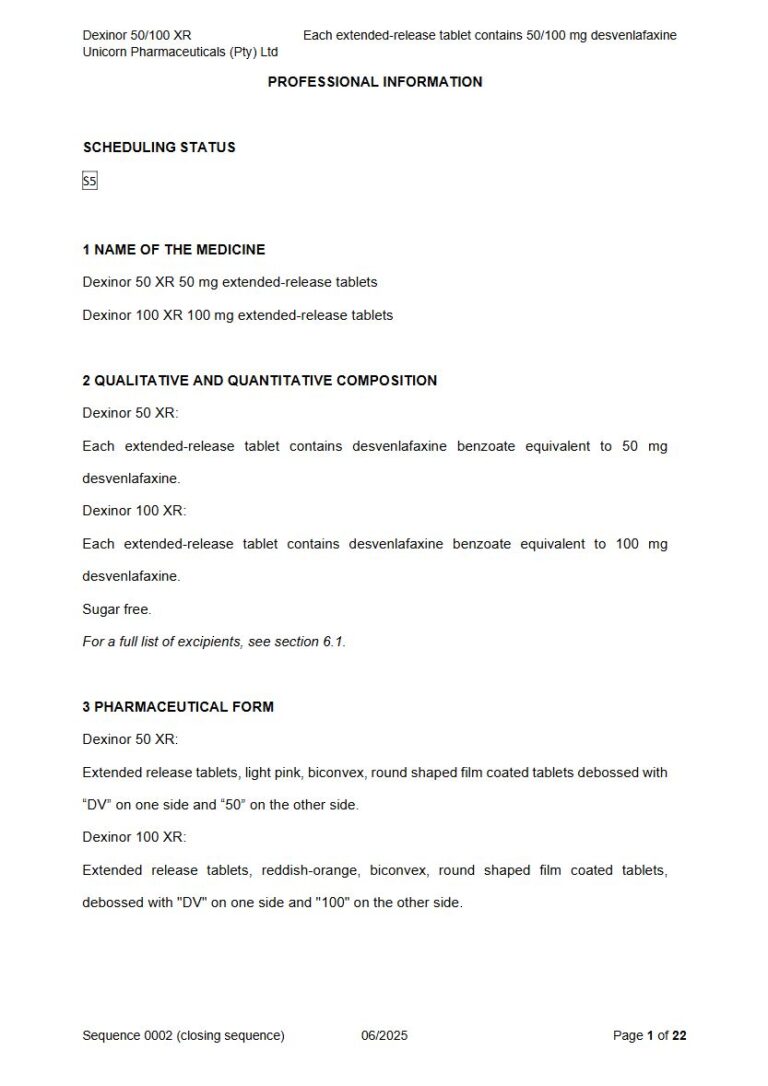
Dexinor 50 XR And 100 XR 50 mg and 100 mg XR tablet
PDF Leaflet Revision Date: 20 May 2025
Clinical Summary
Quick overview from the medicine insert
Indication
Treatment of major depressive disorder.
Dosage (summary)
50 mg once daily, max 100 mg/day; adjust gradually.
Special Populations
- Renal impairment
- Hepatic impairment
- Elderly
Pregnancy & Breastfeeding
Not recommended during pregnancy or lactation.
Key Drug Interactions
- MAOIs
- CNS-active agents
- Ethanol
Contraindications
- Hypersensitivity
- MAOI use
- Children under 18
Common side effects
- Dizziness
- Nausea
- Insomnia
- Fatigue
- Increased blood pressure
Counselling Points
- Monitor for worsening depression
- Avoid alcohol
- Caution with driving
Serious warnings
- Risk of serotonin syndrome
- Suicidality risk
- Postpartum hemorrhage
Important Disclaimer
The Dexinor 50 XR And 100 XR 50 mg and 100 mg XR tablet professional information leaflet below is the property of Unicorn Pharmaceuticals and is provided on Medinsert exactly as issued, with no.. alterations or editorial changes. We make every effort to keep content current by updating documents as soon as new versions become available. Medinsert serves as a trusted access point for healthcare professionals, but does not replace official sources or clinical judgement. For more details, please read our full disclaimer. read more>>
 Healthcare Professionals Only
This content is for registered healthcare professionals
Sign in or create a free account to read the full package insert.
Free for HPCSA-registered professionals. Powered by Medinsert.
Clinical Particulars
Section 4 of the official insert — extracted exactly as issued, no alterations
4.1 Therapeutic indications
Major depressive disorder: Dexinor XR tablets are indicated for the treatment of major depressive disorder (MDD).
4.2 Posology and method of administration
Posology
Major depressive disorder: The recommended dose for Dexinor XR is 50 mg once daily, with or without food, with a maximum dose of 100 mg per day. The dose increase should occur gradually and at an interval of not less than 7 days.
Discontinuing Dexinor XR: Symptoms associated with discontinuation of Dexinor XR, other Serotonin-norepinephrine reuptake inhibitors (SNRIs) and Selective Serotonin Reuptake Inhibitors (SSRIs) have been reported. Patients should be monitored for these symptoms when discontinuing treatment. A gradual reduction in the dose rather than abrupt cessation is recommended whenever possible. If intolerable symptoms occur following a decrease in the dose or upon discontinuation of treatment, then resuming the previously prescribed dose may be considered. Subsequently, the medical practitioner may continue decreasing the dose but at a more gradual rate (see section 4.4 and section 4.8).
Switching patients from other antidepressants to Dexinor XR: Discontinuation symptoms have been reported when switching patients from other antidepressants, including venlafaxine, to Dexinor XR. Tapering of the initial antidepressant may be necessary to minimise discontinuation symptoms.
Special populations
Use in patients with renal impairment: The recommended starting dose in patients with severe renal impairment (24-hr CrCl < 30 ml/min) or end-stage renal disease (ESRD) is 50 mg every other day. Because of individual variability in clearance in these patients, individualisation of dosage may be desirable. Supplemental doses should not be given to patients after dialysis (see section 5.2).
Use in patients with hepatic impairment: No dosage adjustment is necessary for patients with hepatic impairment (see section 5.2).
Use in elderly patients: No dosage adjustment is required solely on the basis of age; however, possible reduced renal clearance of Dexinor XR should be considered when determining dose (see section 5.2).
Paediatric population: Safety and efficacy in patients less than 18 years of age has not been established.
Method of administration
For oral use. Tablets must be swallowed whole with fluid and not divided, crushed, chewed, or dissolved (see section 4.4).
4.3 Contraindications
- Hypersensitivity to Dexinor XR, venlafaxine hydrochloride or to any excipients in the Dexinor XR formulation.
- Dexinor XR is an inhibitor of both norepinephrine and serotonin reuptake. Dexinor XR must not be used in combination with a monoamine oxidase inhibitor (MAOI), or within at least 14 days of discontinuing treatment with an MAOI. Based on the half-life of Dexinor XR at least 7 days should be allowed after stopping Dexinor XR before starting an MAOI. Severe adverse reactions have been reported when therapy is initiated with SSRI/SNRI medicines such as Dexinor XR soon after discontinuation of an MAOI and when an MAOI is initiated soon after discontinuation of SSRI/SNRI medicines. These reactions have included tremor, myoclonus, diaphoresis, nausea, vomiting, flushing, dizziness, hyperthermia with features resembling neuroleptic malignant syndrome, seizures and death (see section 4.5).
- Children less than 18 years of age, as safety and efficacy have not been established (see section 4.4 and section 4.8).
- Pregnancy and lactation (see section 4.6).
4.4 Special warnings and precautions for use
SSRIs/SNRIs may increase the risk of postpartum haemorrhage (see section 4.6 and 4.8).
Clinical worsening of depressive symptoms, unusual changes in behaviour, and suicidality: Patients with major depressive disorder may experience worsening of their depression and/or the emergence of suicidal ideation and behaviour, whether or not they are taking antidepressant medicines. This risk may persist until significant remission occurs. A causal role, however, for antidepressant medicine in inducing such behaviour has not been established. Patients being treated with Dexinor XR should, nevertheless, be observed closely for clinical worsening and suicidality, especially at the beginning of a course of therapy or at any time of dose changes, either increases or decreases.
Due to the possibility of co-morbidity between major depressive disorder and other psychiatric and non-psychiatric disorders, the same precautions observed when treating patients with major depressive disorders should be observed when treating patients with other psychiatric and non-psychiatric disorders.
The following symptoms have been reported in patients being treated with antidepressants for major depressive disorder as well as for other indications, both psychiatric and non-psychiatric: anxiety, agitation, panic attacks, insomnia, irritability, hostility, aggressiveness, impulsivity, akathisia, hypomania, and mania. Although a causal link between the emergence of suicidal impulses has not been established, consideration should be given to changing the therapeutic regimen, including possibly discontinuing Dexinor XR in patients for whom such symptoms are severe, abrupt in onset, or were not part of the patientu2019s presenting symptoms. If the decision is made to discontinue treatment, Dexinor XR should be tapered (see section 4.2).
There have been reports of hostility, suicidal ideation and self-harm with use of SSRIs in children under the age of 18 years.
Mania/hypomania: Activation of mania/hypomania has been reported in a small proportion of patients with major affective disorder who were treated with other marketed antidepressants. Patients with depressive symptoms should be adequately screened to determine if they are at risk for bipolar disorder; such screening should include a detailed psychiatric history, including a family history of suicide, bipolar disorder, and depression. Dexinor XR should be used cautiously in patients with a history or family history of mania or hypomania (see section 4.8).
Serotonin syndrome or Neuroleptic Malignant Syndrome (NMS)-like Reactions: The development of a potentially life-threatening serotonin syndrome may occur with Dexinor XR treatment, particularly with concomitant use of other serotonergic medicines (including SSRIs, SNRIs and triptans) and with medicines that impair metabolism of serotonin (including MAOIs) or with antipsychotics or other dopamine antagonists (see section 4.3). Serotonin syndrome symptoms may include mental status changes (e.g. agitation, hallucinations, and coma), autonomic instability (e.g. tachycardia, labile blood pressure, and hyperthermia), neuromuscular aberrations (e.g. hyperreflexia, incoordination) and/or gastrointestinal symptoms (e.g. nausea, vomiting, and diarrhoea) (see section 4.5).
Serotonin syndrome, in its most severe form can resemble NMS, which includes hyperthermia, muscle rigidity, autonomic instability with possible rapid fluctuation of vital signs and mental status changes (see section 4.5). The concomitant use of Dexinor XR with serotonin precursors (such as tryptophan supplements) is not recommended. Treatment with Dexinor XR should be discontinued if serotonin syndrome or NMS-Like reactions occur and supportive symptomatic treatment initiated.
Narrow-angle glaucoma: Mydriasis has been reported in association with Dexinor XR; therefore, patients with raised intraocular pressure or those at risk of acute narrow-angle glaucoma (angle-closure glaucoma) should be monitored (see section 4.8).
Ischaemic cardiac adverse events: There have been uncommon reports of ischaemic cardiac adverse events, including myocardial ischaemia, myocardial infarction, and coronary occlusion requiring revascularisation; these patients had multiple underlying cardiac risk factors.
Discontinuation symptoms: Adverse reactions reported in association with abrupt discontinuation, dose reduction or tapering of treatment include: dizziness, withdrawal syndrome, nausea headache, irritability, diarrhoea, anxiety, abnormal dreams, fatigue, and hyperhidrosis. In general, discontinuation symptoms occurred more frequently with longer duration of therapy (see section 4.2).
4.5 Interactions with other medicines
Monoamine oxidase inhibitors (MAOI): Adverse reactions, some of which were serious, have been reported in patients who have recently been discontinued from a monoamine oxidase inhibitor (MAOI) and started on antidepressants with pharmacological properties similar to Dexinor XR (SNRIs or SSRIs), or who have recently had SNRI or SSRI therapy discontinued prior to initiation of an MAOI. These reactions have included tremor, myoclonus, diaphoresis, nausea, vomiting, flushing, dizziness, hyperthermia with features resembling neuroleptic malignant syndrome, seizures and death. Concomitant use of Dexinor XR in patients taking monoamine oxidase inhibitors (MAOIs), including selegiline and linezolid (an antibiotic which is a reversible non-selective MAOI) is contraindicated (see section 4.3 and section 4.4).
Central nervous system (CNS)-active agents: The risk of using Dexinor XR in combination with other CNS-active medicines has not been systematically evaluated. Consequently, caution is advised when Dexinor XR is taken in combination with other CNS-active medicines.
Serotonin syndrome: Serotonin syndrome, a potentially life-threatening condition, may occur with Dexinor XR treatment, particularly with concomitant use of other agents that may affect the serotonergic neurotransmitter system (including triptans, SSRIs, other SNRIs, lithium, sibutramine, tramadol, St. Johnu2019s Wort [Hypericum perforatum], pethidine), with medicines that impair metabolism of serotonin (such as MAOIs, including linezolid [an antibiotic which is a reversible non-selective MAOI], (see section 4.3), or with serotonin precursors (such as tryptophan supplements). Serotonin syndrome symptoms may include mental status changes, autonomic instability, neuromuscular aberrations and/or gastrointestinal symptoms (see section 4.4). If concomitant treatment with desvenlafaxine and other agents that may affect the serotonergic neurotransmitter system (such as an SSRI, another SNRI or a 5-hydroxytryptamine receptor agonist (triptan)) is clinically warranted, careful observation of the patient is advised, particularly during treatment initiation and dose increases. The concomitant use of desvenlafaxine with serotonin precursors (such as tryptophan supplements) is not recommended (see section 4.4).
Ethanol: Patients should be advised to avoid alcohol consumption while taking Dexinor XR.
4.6 Fertility, pregnancy and lactation
Dexinor XR must not be administered to pregnant or lactating women. Safety during human pregnancy and lactation has not been established (see section 4.3).
Pregnancy
The safety of Dexinor XR in human pregnancy has not been established. If Dexinor XR is used until, or shortly before birth, discontinuation effects in the newborn may occur. Complications, including the need for respiratory support, tube feeding or prolonged hospitalisation, have been reported in neonates exposed to SNRIs or SSRIs late in the third trimester. Such complications can arise immediately upon delivery. Patients should be advised to notify their doctor if they become pregnant or intend to become pregnant during therapy. Epidemiological data have suggested that the use of SSRIs in pregnancy, particularly in late pregnancy, may increase the risk of persistent pulmonary hypertension in the new born (PPHN). This potential risk cannot be ruled out with desvenlafaxine taking into account the related mechanism of action (inhibition of the re-uptake of serotonin).
Breastfeeding
Dexinor XR (O-desmethylvenlafaxine) is excreted in human milk. Because of the potential for serious adverse reactions in nursing infants from Dexinor XR, a decision should be made whether or not to discontinue nursing or to discontinue Dexinor XR, taking into account the importance of the medicine to the mother.
Fertility
There is no information available on fertility with Dexinor XR.
4.7 Effects on ability to drive and use machines
Dexinor XR may impair judgement, thinking and motor skills. Therefore, patients should be cautioned about their ability to drive or operate hazardous machinery.
4.8 Undesirable effects
Summary of the safety profile (See section 4.4)
Tabulated list of adverse reactions
System Organ Class Frequency Side effect
Immune system disorders Less frequent Hypersensitivity
Metabolism and nutritional disorders Frequent Decreased appetite
Less frequent Hyponatraemia
Psychiatric disorders Frequent Insomnia, anxiety, abnormal dreams, nervousness, decreased libido, anorgasmia, abnormal orgasm, withdrawal syndrome
Less frequent Depersonalisation, hypomania, hallucinations, mania
Nervous system disorders Frequent Dizziness, headache, somnolence, tremor, paraesthesia, dysgeusia, disturbance in attention
Less frequent Syncope, extrapyramidal disorder, dyskinesia, convulsion, dystonia, serotonin syndrome
Eye disorders Frequent Blurred vision, mydriasis
Ear and labyrinth disorders Frequent Tinnitus, vertigo
Cardiac disorders Frequent Palpitations, tachycardia
Less frequent Stress cardiomyopathy (Takotsubo cardiomyopathy)
Vascular disorders Frequent Hot flush, blood pressure increased
Less frequent Orthostatic hypotension (see section 4.4), peripheral coldness
Respiratory, thoracic and mediastinal disorders Frequent Yawning
Less frequent Epistaxis
Gastrointestinal disorders Frequent Nausea, dry mouth, constipation, diarrhoea, vomiting
Less frequent Acute pancreatitis
Skin and subcutaneous tissue disorders Frequent Hyperhidrosis, rash
Less frequent Alopecia, photosensitivity reaction, angioedema, Stevens-Johnson syndrome
Musculoskeletal, connective tissue and bone disorders Frequent Musculoskeletal stiffness
Renal and urinary disorders Frequent Urinary hesitation
Less frequent Proteinuria, urinary retention
Reproductive system and breast disorders Frequent Erectile dysfunction, delayed ejaculation, ejaculation failure, ejaculation disorder
Less frequent Sexual dysfunction
General disorders and administration site conditions Frequent Fatigue, chills, asthenia, feeling jittery, irritability
Investigations Frequent Increased weight, increased blood pressure, decreased weight, blood cholesterol increased, abnormal liver function test
Less frequent Increased blood triglycerides, increased blood prolactin
Reporting of suspected adverse reactions
Reporting suspected adverse reactions after authorisation of the medicine is important. It allows continued monitoring of the benefit/risk balance of the medicine. Health care providers are requested to report any suspected adverse drug reactions to SAHPRA via the Med Safety APP (Medsafety X SAHPRA) and eReporting platform (who-umc.org) found on SAHPRA website. Side effects must also be reported to Unicorn Pharmaceuticals (Pty) Ltd to [email protected].
4.9 Overdose
There is limited experience with Dexinor XR overdosage in humans. No specific antidotes for Dexinor XR are known. Induction of emesis is not recommended. Because of the moderate volume of distribution of this medicine, forced diuresis, dialysis, haemoperfusion, and exchange transfusion are unlikely to be of benefit. Treatment should consist of those general measures employed in the management of overdosage with any SSRI/SNRI. Ensure an adequate airway, oxygenation, and ventilation. Monitor cardiac rhythm and vital signs. General supportive and symptomatic measures are also recommended. Activated charcoal should be administered.
