
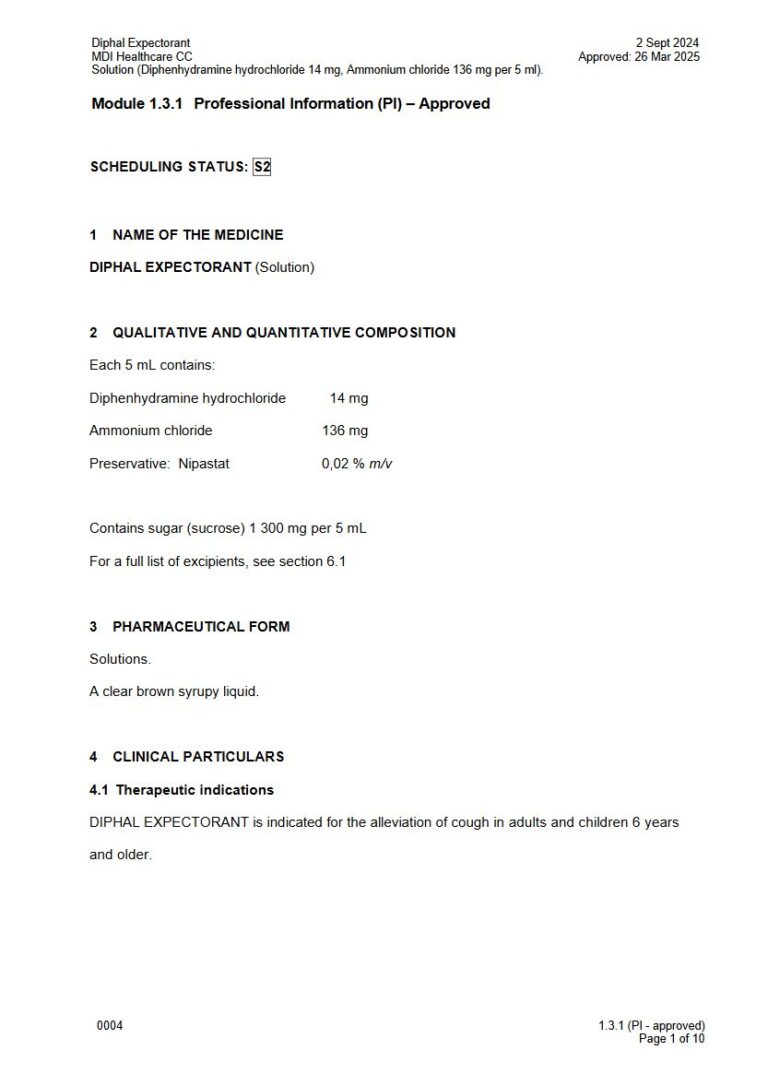
Diphal Expectorant 5 ml Solution
PDF Leaflet Revision Date: 26 March 2025
Clinical Summary
Quick overview from the medicine insert
Indication
Alleviation of cough in adults and children 6 years and older.
Dosage (summary)
Adults: 5-10 mL every 3-4 hours; Max 4 doses/day. Children 6-12 years: 2.5-5 mL every 4 hours.
Special Populations
- Elderly
- Hepatic impairment
- Renal impairment
Pregnancy & Breastfeeding
Safety during pregnancy not established; contraindicated in breastfeeding.
Key Drug Interactions
- CNS depressants
- Monoamine oxidase inhibitors
Contraindications
- Hypersensitivity
- Impaired hepatic or renal function
- Asthma
- COPD
- Children under 6 years
Common side effects
- Drowsiness
- Dry mouth
- Dizziness
- Nausea
Counselling Points
- Avoid alcohol
- Do not drive or operate machinery
- Monitor for paradoxical reactions in children
Serious warnings
- May cause drowsiness
- Use with caution in cardiovascular disease
- Not for persistent cough with smoking or asthma
Important Disclaimer
The Diphal Expectorant 5 ml Solution professional information leaflet below is the property of Mdi Healthcare Cc and is provided on Medinsert exactly as issued, with no.. alterations or editorial changes. We make every effort to keep content current by updating documents as soon as new versions become available. Medinsert serves as a trusted access point for healthcare professionals, but does not replace official sources or clinical judgement. For more details, please read our full disclaimer. read more>>
 Healthcare Professionals Only
This content is for registered healthcare professionals
Sign in or create a free account to read the full package insert.
Free for HPCSA-registered professionals. Powered by Medinsert.
Clinical Particulars
Section 4 of the official insert — extracted exactly as issued, no alterations
4.1 Therapeutic indications
DIPHAL EXPECTORANT is indicated for the alleviation of cough in adults and children 6 years and older.
4.2 Posology and method of administration
A maximum of four doses per day should not be exceeded. Shake the bottle before use.
Adults: one to two medicine measures (5 to 10 mL) every three to four hours.
Children 6 to 12 years: half to one medicine measure (2,5 to 5 mL) every four hours.
Paediatric population: The safety in children under 6 years has not been established (see section 4.3).
4.3 Contraindications
- Hypersensitivity to diphenhydramine hydrochloride, ammonium chloride or any of the ingredients of DIPHAL EXPECTORANT.
- DIPHAL EXPECTORANT is contra-indicated in the presence of impaired hepatic or renal function, and in patients with asthma and COPD (see section 4.4).
- DIPHAL EXPECTORANT should not be used with monoamine oxidase inhibitors including linezolid or within 14 days of stopping monoamine oxidase inhibitor including linezolid treatment (see section 4.4 and section 4.5).
- DIPHAL EXPECTORANT should not be used in children under the age of 6 years.
4.4 Special warnings and precautions for use
The use of DIPHAL EXPECTORANT solution leads to drowsiness and impaired concentration which is aggravated by the simultaneous intake of alcohol. DIPHAL EXPECTORANT should be used cautiously in:
- patients with cardiac failure, hypertension, peripheral and pulmonary oedema and toxaemia of pregnancy.
- patients with cardiovascular disease, glaucoma, prostatic hypertrophy and patients with urinary retention.
- elderly patients are most susceptible to the central nervous system depressant and hypotensive effects.
The positive results of skin allergy tests may be suppressed. Extreme caution should be exercised with patients taking DIPHAL EXPECTORANT in conjunction with nervous system depressants such as alcohol, barbiturates, hypnotics, narcotics analgesic sedatives and tranquillisers and anticholinergic medicines and tricyclic antidepressants as their effects may be enhanced by diphenhydramine. Monoamine-oxidase inhibitors may enhance the anticholinergic effects of diphenhydramine hydrochloride. The warning signs of damage caused by ototoxic medicines such as aminoglycosides may be masked by diphenhydramine hydrochloride.
DIPHAL EXPECTORANT should not be taken for a persistent cough that occurs with smoking, asthma or emphysema. Children who take DIPHAL EXPECTORANT may experience paradoxical hyperexcitability, nervousness, irritability or insomnia. DIPHAL EXPECTORANT contains sucrose. Patient with rare hereditary conditions such as fructose intolerance, glucose-galactose mal-absorption or sucrose-isomaltase insufficiency should not take DIPHAL EXPECTORANT. DIPHAL EXPECTORANT contains sucrose which may have an effect on the glycaemic control of patients with diabetes mellitus. DIPHAL EXPECTORANT contains less than 1 mmol sodium (23 mg) per 5 mL, that is to say essentially u201csodium-freeu201d.
DIPHAL EXPECTORANT contains 20 mg propylene glycol in each 5 mL solution. If you suffer from a liver or kidney disease, do not take this medicine unless recommended by your doctor. Your doctor may carry out extra checks while you are taking this medicine.
4.5 Interaction with other medicines and other forms of interaction
- DIPHAL EXPECTORANT may enhance the sedative effects of CNS depressants including alcohol, barbiturates, hypnotics, opioid analgesics, anxiolytic sedatives and antipsychotics.
- DIPHAL EXPECTORANT should not be used simultaneously with monoamine oxidase inhibitors including linezolid (see section 4.3).
- Warning signs of damage caused by ototoxic medicines such as aminoglycoside antibiotics may be masked by DIPHAL EXPECTORANT (see section 4.4).
- DIPHAL EXPECTORANT may suppress the cutaneous histamine response to allergen extracts. The use of DIPHAL EXPECTORANT should be stopped at least 72 hours before testing begin.
4.6 Fertility, pregnancy and lactation
Pregnancy: Safety during pregnancy has not been established.
Lactation: Diphenhydramine crosses the placenta and is excreted into breast milk. Mothers on DIPHAL EXPECTORANT should not breastfeed their infants.
4.7 Effects on ability to drive and use machines
The use of DIPHAL EXPECTORANT solution leads to drowsiness and impaired concentration and it is unsafe to drive a vehicle or be in charge of machinery while using DIPHAL EXPECTORANT, as impaired decision making could lead to accidents.
4.8 Undesirable effects
The following side effects are for diphenhydramine and ammonium chloride and the frequencies are estimated from spontaneous reporting rates.
Blood and lymphatic system disorders: Less frequent: Agranulocytosis, leucopenia, haemolytic anaemia and thrombocytopenia.
Immune system disorders: Less frequent: Angioedema, hypersensitivity, allergic reactions and anaphylaxis.
Metabolism and nutrition disorders: Less frequent: Increased appetite, anorexia.
Psychiatric disorders: Less frequent: Confusional state, irritability, hallucinations, euphoria and nervousness.
Nervous system disorders: Frequent: Sedation varying from slight drowsiness to deep sleep including lassitude, dizziness, and incoordination, headache and antimuscarinic effects, such as dry mouth and thickened respiratory tract secretions. Less frequent: Agitation, abnormal coordination, convulsions (large doses may precipitate fits in epileptics), headache, insomnia, paraesthesia, sedation, somnolence, deepening coma, extrapyramidal effects and tremor. DIPHAL EXPECTORANT may act as a cerebral stimulant in infants and children. Symptoms of stimulation include insomnia, nervousness, tachycardia, tremors and convulsions. Elderly patients are more susceptible to central nervous system effects.
Eye disorders: Less frequent: Blurred vision.
Ear and labyrinth disorders: Less frequent: Tinnitus.
Cardiac disorders: Less frequent: Palpitations and tachycardia.
Vascular disorders: Less frequent: Hypotension. Elderly patients are more susceptible to hypotensive effects.
Respiratory, thoracic and mediastinal disorders: Less frequent: Chest discomfort, chest tightness, dry throat and nasal dryness.
Gastrointestinal disorders: Less frequent: Abdominal pain, epigastric pain, application site reaction (burning sensation, glossitis, glossodynia, oral hypoaesthesia, lip blister, dry lip, lip pain, mouth ulceration, oral discomfort, oral disorder, erythema of oral mucosa, oropharyngeal blistering, stomatitis, tongue disorder, tongue eruption), dry mouth, diarrhoea, constipation, dyspepsia, nausea and vomiting.
Skin and subcutaneous tissue disorders: Less frequent: Pruritus, rash, photosensitisation and urticaria.
Musculoskeletal and connective tissue disorders: Less frequent: Muscular weakness.
Renal and urinary disorders: Less frequent: Urinary retention, dysuria, difficulty in micturition.
General disorders and administration site conditions: Less frequent: Asthaenia.
Investigations: Frequency unknown: Suppression of positive skin test results.
Reporting of suspected adverse reactions: Reporting suspected adverse reactions after authorisation of the medicine is important. It allows continued monitoring of the benefit/risk balance of the medicine. Health care providers are requested to report any suspected adverse drug reactions to SAHPRA via the Med Safety APP (Medsafety X SAHPRA) and eReporting platform (who-umc.org) found on SAHPRA website.
4.9 Overdose
Symptoms of hypernatraemia may include restlessness, weakness, thirst, reduced salivation and lachrymation, swollen tongue, flushing of the skin, pyrexia, dizziness, headache, oliguria, hypotension, tachycardia, delirium, hyperpnoea and respiratory arrest. Other symptoms of overdosage are gastrointestinal upset, drowsiness, hypochloraemic acidosis and hypokalaemia.
Diphenhydramine hydrochloride: Overdosage may be fatal, especially in children in whom main symptoms are central nervous system stimulation and antimuscarinic effects, including ataxia, excitement, hypotension, drowsiness, hallucinations, muscle tremor, convulsions, dilated pupils, dry mouth, flushed face and hyperpyrexia, respiratory collapse, death may occur from respiratory failure. Treatment is symptomatic and supportive.
