
Lomida 50/300 mg FC tablets
PDF Leaflet Revision Date: 20 February 2024
Clinical Summary
Quick overview from the medicine insert
Indication
Treatment of HIV-1 infection in treatment-nau00efve adults aged 18 and older.
Dosage (summary)
One tablet (50/300 mg) once daily.
Special Populations
- Renal impairment
- Hepatic impairment
- Elderly
Pregnancy & Breastfeeding
Use during pregnancy may increase risk of neural tube defects; avoid breastfeeding to prevent HIV transmission.
Key Drug Interactions
- Dofetilide
- Pilsicainide
- Trimethoprim
Contraindications
- Hypersensitivity to components
- Severe hepatic impairment
- Severe renal impairment (CrCl < 50 mL/min)
Common side effects
- Upper abdominal pain
- Diarrhea
- Vomiting
Counselling Points
- Take with or without food
- Monitor for signs of liver dysfunction
- Regular follow-up for HIV management
Serious warnings
- Hypersensitivity reactions
- Lactic acidosis
- Immune reconstitution inflammatory syndrome (IRIS)
Important Disclaimer
The Lomida 50/300 mg FC tablets professional information leaflet below is the property of Cipla Medpro Manufacturing and is provided on Medinsert exactly as issued, with no.. alterations or editorial changes. We make every effort to keep content current by updating documents as soon as new versions become available. Medinsert serves as a trusted access point for healthcare professionals, but does not replace official sources or clinical judgement. For more details, please read our full disclaimer. read more>>
 Healthcare Professionals Only
This content is for registered healthcare professionals
Sign in or create a free account to read the full package insert.
Free for HPCSA-registered professionals. Powered by Medinsert.
Clinical Particulars
Section 4 of the official insert — extracted exactly as issued, no alterations
4.1 Therapeutic indications
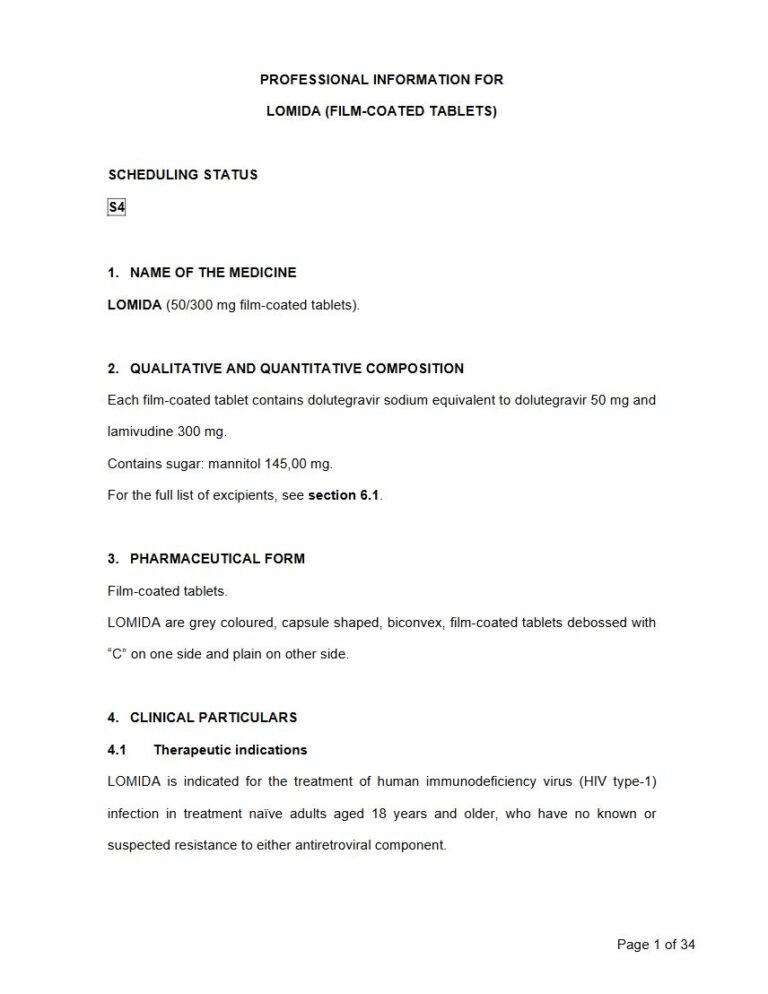
LOMIDA is indicated for the treatment of human immunodeficiency virus (HIV type-1) infection in treatment nau00efve adults aged 18 years and older, who have no known or suspected resistance to either antiretroviral component.
4.2 Posology and method of administration
Posology Therapy should be initiated by a doctor experienced in the management of HIV infection. LOMIDA is a fixed-dose tablet and should not be prescribed for patients requiring dosage adjustments, such as those with creatinine clearance less than 50 mL/min. A separate preparation of dolutegravir is available where a dose adjustment is required due to interactions (see section 4.5). For patients with integrase inhibitor resistance, LOMIDA is not recommended. In this case, the doctor should refer to the dolutegravir tablet product information. The recommended adult dose of LOMIDA in treatment nau00efve, treatment experienced, and integrase inhibitor nau00efve patients is one tablet (50/300 mg) once daily.
Special populations Renal impairment Whilst no dosage adjustment of dolutegravir is necessary in patients with renal impairment, a dose reduction of lamivudine is required due to decreased clearance. LOMIDA is not recommended for use in patients with a creatinine clearance less than 50 mL/min (see section 5.2). Hepatic impairment No dosage adjustment is necessary in patients with mild to moderate liver disease (Child-Pugh grade A or B) unless accompanied by renal impairment. There is no data on the use of LOMIDA in patients with severe hepatic impairment, therefore caution should be exercised.
Elderly There are limited data on the use of LOMIDA in patients aged 65 years and older. However, there is no evidence that elderly patients require a different dose than younger adult patients (see section 5.2). When treating elderly patients, consideration needs to be given to greater frequency of decreased hepatic and renal function, hematological abnormalities and concomitant medicines or disease.
Method of administration LOMIDA is for oral administration and should be swallowed whole. LOMIDA can be taken with or without food.
4.3 Contraindications
LOMIDA is contraindicated:
- in patients with known hypersensitivity to dolutegravir, lamivudine, or any of its excipients (listed in section 6.1)
- in combination with dofetilide and pilsicainide
- in patients with severe hepatic impairment
- in patients with severe renal impairment (with a creatinine clearance of < 50 mL/min due to the lamivudine component (see section 5.1 u2013 Renal impairment).
4.4 Special warnings and precautions for use
Clinical studies were not conducted with the fixed dose combination (FDC) of dolutegravir (DTG) and lamivudine (3TC). Only the mono-components were used in the clinical studies.
Hypersensitivity reactions Hypersensitivity reactions such as rash, constitutional findings, and sometimes organ dysfunction, including liver injury may occur with LOMIDA administration. Discontinuation of LOMIDA may be considered should serious hypersensitivity reactions occur (including, but not limited to, severe rash or rash accompanied by fever, general malaise, fatigue, muscle or joint aches, blisters, oral lesions, conjunctivitis, facial oedema, hepatitis, eosinophilia, angioedema). Clinical status including liver aminotransferases should be monitored and appropriate therapy initiated. Delay in stopping treatment with LOMIDA or other suspect agents after the onset of hypersensitivity may result in a life-threatening reaction.
Lactic acidosis/hyperlactatemia Lamivudine, which is an active constituent of LOMIDA, can cause potentially fatal lactic acidosis as a consequence of mitochondrial dysfunction. Clinical features include nausea, abdominal pain, dyspnoea, fatigue, and weight loss. The venous lactate level (normal 2 mmol/L) and the serum bicarbonate level in patients with suspicious symptoms and biochemistry should be measured and handled as follows:
- Lactate 2 - 5 mmol/L with minimum symptoms: switch to medicines that are less likely to cause lactic acidosis.
- Lactate 5 - 10 mmol/L with symptoms and/or reduced standard bicarbonate: Change NRTIs and change treatment option. Once lactate has settled, use medicines that are less likely to cause lactic acidosis. Other possible causes such as sepsis, uraemia, diabetic ketoacidosis, thyrotoxicosis, and hyperthyroidism should be excluded.
- Lactate > 10 mmol/L: Stop all therapy (80% mortality).
Caution should be exercised when treating patients with known risk factors for liver disease. Treatment with LOMIDA should be suspended in any patient who develops clinical or laboratory findings suggestive of lactic acidosis or hepatotoxicity.
...
4.5 Interactions with other medicines
Effect of LOMIDA on other medicines Dolutegravir, which is in LOMIDA, has no direct, or weak inhibition of the enzymes cytochrome P450 (CYP) 1A2, CYP 2A6, CYP 2B6, CYP 2C8, CYP 2C9, CYP 2C19, CYP 2D6, CYP 3A, uridine diphosphate glucuronosyl transferase (UGT) 1A1 or UGT2B7, or transporters P-gp, BCRP, OATP1B3, OCT1 or MRP2. It also does not induce CYP 1A2, CYP 2B6 or CYP 3A4. Dolutegravir is therefore not expected to have an impact on the pharmacokinetics of medicines that are substrates of these enzymes or transporters, such as reverse transcriptase and protease inhibitors, opioid analgesics, antidepressants, statins, azole antifungals, proton pump inhibitors and medicines used to treat erectile dysfunction.
Dolutegravir does not have a clinically relevant effect on the following medicines: tenofovir, methadone, efavirenz, lopinavir, atazanavir, darunavir, etravirine, fosamprenavir, rilpivirine, telaprevir and oral contraceptives containing norgestimate and ethinyl estradiol. Dolutegravir inhibits the renal organic cation transporter 2 (OCT2) as well as MATE-1 and therefore may increase plasma concentrations of medicines in which excretion is dependent upon OCT2, such as dofetilide, pilsicainide or metformin.
Effect of other medicines on LOMIDA Dolutegravir, an active constituent of LOMIDA, is mainly metabolised by UGT1A1. It is also a substrate of UGT1A3, UGT1A9, CYP3A4, P-gp, and BCRP. Medicines that induce these enzymes may decrease plasma concentrations of dolutegravir, thereby reducing the therapeutic effect of LOMIDA. Co-administration of LOMIDA with medicines that inhibit UGT1A3, UGT1A9, CYP3A4 and/or P-gp may decrease dolutegravir plasma concentrations. Efavirenz, nevirapine, rifampicin and tipranavir when combined with LOMIDA reduce plasma concentrations of dolutegravir. Etravirine also reduces plasma concentrations of dolutegravir, but this effect is mitigated by co-administration of the CYP3A4 inhibitors lopinavir/ritonavir, darunavir/ritonavir and is expected to be mitigated by atazanavir/ritonavir, therefore there is no need for an increase in dolutegravir intake with LOMIDA.
...
4.6 Fertility, pregnancy and lactation
Women of childbearing potential should be counselled about the potential risk of neural tube defects with dolutegravir (see below), including consideration of using effective contraceptive measures. Perform pregnancy testing before initiation of LOMIDA in women of childbearing potential to exclude inadvertent (unintentional) use of LOMIDA during the first trimester of pregnancy. If a woman plans pregnancy, the benefits, and the risks of starting or continuing treatment with dolutegravir versus using another antiretroviral regimen should be discussed with her.
Pregnancy Use of dolutegravir, as contained in LOMIDA, during pregnancy was associated with a small increase in the prevalence of neural tube defects (0.19%) compared to non-dolutegravir regimens (0.11%). Most neural tube defects occur within the first 4 weeks of embryonic development after conception (approximately 6 weeks after the last menstrual period). If a pregnancy is confirmed in the first trimester while on LOMIDA, the benefits and risks of continuing LOMIDA versus switching to another antiretroviral regimen should be discussed with the patient, taking the gestational age and the critical time period of neural tube defect development into account. LOMIDA may be used during the second and third trimester of pregnancy when the expected benefit outweighs the potential risk to the foetus. Dolutegravir was shown to cross the placenta in humans, leading to significant exposure to the foetus, but the implications of such exposure are not yet known.
...
4.7 Effects on ability to drive and use machines
LOMIDA has no or negligible impact on the ability to drive and operate machinery. However, it has been reported that LOMIDA causes dizziness, associated with dolutegravir, therefore the patient should be cautioned against driving and/or operating heavy machinery.
4.8 Undesirable effects
Summary of side effect profile In a bioequivalence study done with LOMIDA, a total of one (01) adverse event (vomiting) was reported during the entire course of the study. The reported adverse event was mild in severity, possibly related to LOMIDA. No serious or significant adverse events were reported during the entire course of the study. The most common adverse events associated with combinations of dolutegravir and lamivudine, such as LOMIDA, include upper abdominal pain, diarrhoea, and vomiting.
Tabulated list of adverse reactions The following adverse reactions have been classified in the following way: u201cFrequent, less frequent and frequency not known.u201d They have been listed according to the active component with which they are associated.
...
4.9 Overdose
No specific signs and symptoms have been identified for the overdose of LOMIDA. An overdose could result in the increased severity of undesirable effects (see section 4.8).
Management of overdosage There is no specific treatment for an overdose with LOMIDA. If an overdose occurs, the patient should be monitored and treated supportively. Since lamivudine can be removed with dialysis, haemodialysis could be used in the treatment of an overdose. As dolutegravir is highly bound by plasma proteins, it is unlikely that it will be removed by dialysis.
