
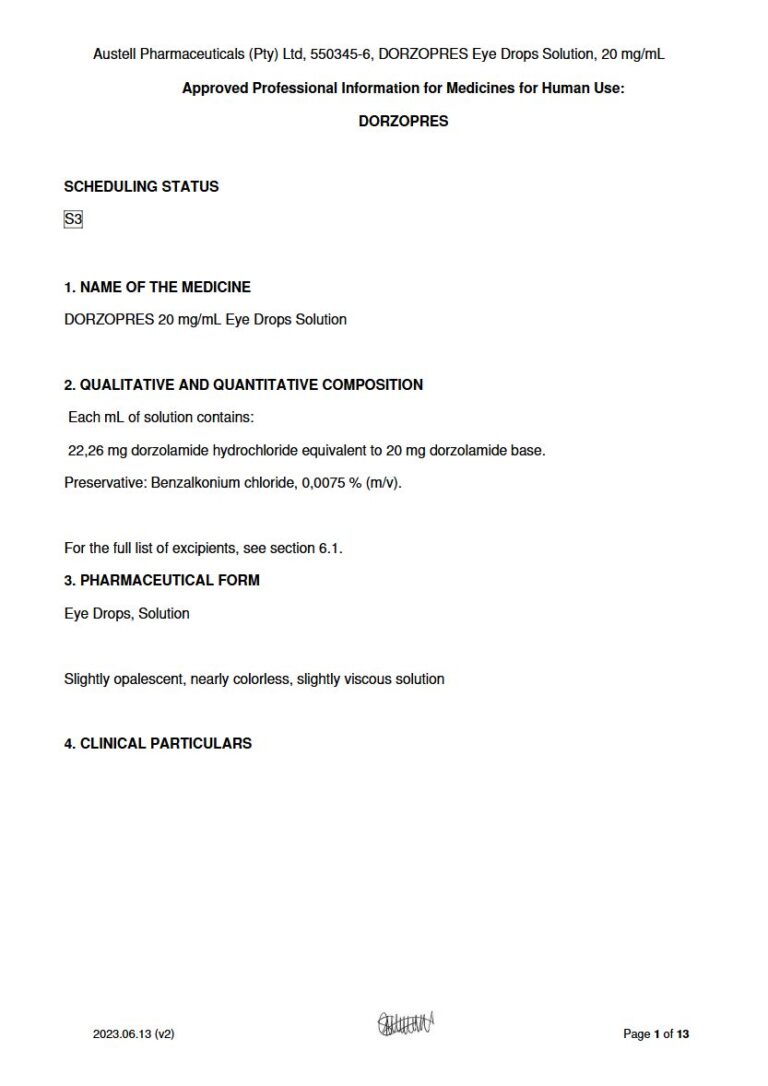
Dorzopres 20 mg Eye Drops
PDF Leaflet Revision Date: 13 June 2023
Clinical Summary
Quick overview from the medicine insert
Indication
Treatment of elevated intraocular pressure in glaucoma and ocular hypertension.
Dosage (summary)
1 drop in affected eye(s) 3 times daily as monotherapy; 2 times daily with beta-blockers.
Special Populations
- Hepatic impairment
- Renal impairment
Pregnancy & Breastfeeding
Not recommended during pregnancy; safety in breastfeeding not established.
Key Drug Interactions
- Timolol
- Betaxolol
- ACE inhibitors
- Calcium-channel blockers
Contraindications
- Hypersensitivity to dorzolamide
- Moderate to severe renal impairment
- Contact lens wear
Common side effects
- Burning
- Stinging
- Headache
- Dizziness
- Nausea
Counselling Points
- Remove contact lenses before use
- Monitor for allergic reactions
- Use with caution in dry eye patients
Serious warnings
- Risk of severe allergic reactions
- Caution in patients with renal calculi history
Important Disclaimer
The Dorzopres 20 mg Eye Drops professional information leaflet below is the property of Austell Pharmaceuticals and is provided on Medinsert exactly as issued, with no.. alterations or editorial changes. We make every effort to keep content current by updating documents as soon as new versions become available. Medinsert serves as a trusted access point for healthcare professionals, but does not replace official sources or clinical judgement. For more details, please read our full disclaimer. read more>>
 Healthcare Professionals Only
This content is for registered healthcare professionals
Sign in or create a free account to read the full package insert.
Free for HPCSA-registered professionals. Powered by Medinsert.
Clinical Particulars
Section 4 of the official insert — extracted exactly as issued, no alterations
4.1 Therapeutic indications
DORZOPRES is indicated in the treatment of elevated intraocular pressure in patients with:
- ocular hypertension
- open -angle glaucoma
- pseudoexfoliative glaucoma and other secondary open angle glaucomas
- and in the short -term treatment of paediatric glaucomas as adjunctive therapy to beta-blockers and for monotherapy.
4.2 Posology and method of administration
Posology
When used as monotherapy, the dose is one drop of DORZOPRES in the affected eye(s) 3 times daily.
When used as adjunctive therapy with an ophthalmic beta-blocker, the dose is one drop of DORZOPRES in the affected eye(s) 2 times daily.
When substituting DORZOPRES for another ophthalmic anti-glaucoma medicine, discontinue the other medicine after proper dosing in one day, and start DORZOPRES on the next day. If more than one topical ophthalmic medicine is being used, the medicines should be administered at least 10 minutes apart.
4.3 Contraindications
- Hypersensitivity to the dorzolamide hydrochloride or to any of the excipients listed in section 6.1.
- DORZOPRES has not been studied in patients with moderate progressing to severe renal impairment (CrCl < 30 mL/min). Because DORZOPRES and its metabolite are excreted predominantly by the kidney, DORZOPRES is not recommended in such patients.
- DORZOPRES has not been studied in patients wearing contact lenses. DORZOPRES contains the preservative, benzalkonium chloride, which may be absorbed by soft contact lenses. Therefore, DORZOPRES should not be administered while wearing soft contact lenses.
4.4 Special warnings and precautions for use
Dorzolamide as in DORZOPRES has not been studied in patients with hepatic impairment and should therefore be used with caution in such patients.
The management of patients with acute angle-closure glaucoma requires therapeutic interventions in addition to ocular hypotensive medicines. Dorzolamide as in DORZOPRES has not been studied in patients with acute angle-closure glaucoma.
Dorzolamide as in DORZOPRES contains a sulphonamide group, which also occurs in sulphonamides and although administered topically, is absorbed systemically. Therefore, the same types of adverse reactions that are attributable to sulphonamides may occur with DORZOPRES, including severe reactions such as Stevens-Johnson syndrome and toxic epidermal necrolysis. Sensitisation may occur when a sulphonamide is re-administered irrespective of route of administration. If signs of serious reactions or hypersensitivity occur, discontinue the use of this preparation.
Therapy with oral carbonic anhydrase inhibitors has been associated with urolithiasis as a result of acid-base disturbances, especially in patients with a prior history of renal calculi. Although no acid-base disturbances have been observed with dorzolamide as in DORZOPRES, urolithiasis has been reported infrequently. Because dorzolamide is a topical carbonic anhydrase inhibitor that is absorbed systemically, patients with a prior history of renal calculi may be at increased risk of urolithiasis while using DORZOPRES. The concomitant administration of DORZOPRES and oral carbonic anhydrase inhibitors is not recommended.
If allergic reactions (e.g., conjunctivitis and eye-lid reactions) are observed, discontinuation of treatment should be considered.
Corneal oedemas and irreversible corneal decompensations have been reported in patients with pre-existing chronic corneal defects and/or a history of intra-ocular surgery while using Dorzolamide. DORZOPRES should be used with caution in such patients.
Choroidal detachment concomitant with ocular hypotony have been reported after filtration procedures with administration of Dorzolamide.
Use in the Elderly
No overall differences in effectiveness or safety were observed between patients 65 u2013 75 years old and younger patients, but greater sensitivity of some older individuals to DORZOPRES cannot be rules out.
Benzalkonium chloride
Benzalkonium chloride has been reported to cause eye irritation, symptoms of dry eyes and may affect the tear film and corneal surface. Should be used with caution in dry eye patients and in patients where the cornea may be compromised. Patients should be monitored in case of prolonged use.
Contact Lens Use
DORZOPRES contains benzalkonium chloride as preservative. Contact lenses should be removed prior to application and wait at least 15 minutes before reinsertion. Benzalkonium chloride is known to discolour soft contact lenses.
Paediatric population
Dorzolamide has not been studied in patients less than 36 weeks gestational age and less than 1 week of age.
4.5 Interaction with other medicines and other forms of interaction
Specific drug interaction studies have not been performed with dorzolamide as in DORZOPRES. In clinical studies, dorzolamide was used concomitantly with the following medications without evidence of adverse interactions: timolol ophthalmic solution, betaxolol ophthalmic solution and systemic medications, including ACE- inhibitors, calcium-channel blockers, diuretics, non-steroidal anti-inflammatory drugs including aspirin, and hormones (e.g. oestrogen, insulin, thyroxine). Association between dorzolamide as in DORZOPRES and miotics and adrenergic agonists has not been fully evaluated during glaucoma therapy.
4.6 Fertility, pregnancy and lactation
Pregnancy
Dorzolamide should not be used during pregnancy. There are no or limited amount of data from the use of dorzolamide in pregnant women. In rabbits, dorzolamide produced teratogenic effects at maternotoxic doses.
Breastfeeding
Safety during breastfeeding has not been established.
Fertility
Human data are lacking.
4.7 Effects on ability to drive and use machines
No studies on the effects on the ability to drive and use machines have been performed. Possible side effects such as dizziness and visual disturbances may affect the ability to drive and use machines.
4.8 Undesirable effects
Tabulated list of adverse reactions. The following adverse reactions have been reported either during clinical trials or during post-marketing experience with dorzolamide:
[Very common: (u2265 1/10), Common: (u2265 1/100 to <1/10), Uncommon: (u2265 1/1,000 to <1/100), Rare: (u2265 1/10,000 to <1/1,000), Not known: (cannot be estimated from the available data)]
System Organ Class
| Frequency | Frequent | Less Frequent | Not known |
|---|---|---|---|
| Nervous system disorders | Headache | Dizziness, paraesthesia | -- |
| Eye disorders | Burning and stinging, superficial punctate keratitis, tearing, conjunctivitis, eyelid inflammation, eye itching, eyelid irritation, blurred vision | Iridocyclitis, irritation including redness, pain, eyelid crusting, transient myopia (which resolved upon discontinuation of therapy), corneal oedema, ocular hypotony, choroidal detachment following filtration surgery. | Foreign body sensation in eye |
| Cardiac disorders | -- | -- | palpitations |
| Respiratory, thoracic and mediastinal disorders | -- | Epistaxis | Dyspnoea |
| Gastrointestinal disorders | Nausea, bitter taste | Throat irritation, dry mouth | -- |
| Skin and subcutaneous tissue disorders | -- | Contact dermatitis, Stevens-Johnson syndrome, toxic epidermal necrolysis | -- |
| Renal and urinary disorders | -- | Urolithiasis | -- |
| General disorders and administration site conditions | Asthenia/fatigue | Hypersensitivity: signs and symptoms of local reactions (palpebral reactions) and systemic allergic reactions, including angioedema, urticaria and pruritus, rash, shortness of breath, rarely bronchospasm | -- |
| Investigations | Dorzolamide was not associated with clinically meaningful electrolyte disturbances. | -- | -- |
Paediatric population
See section 5.1.
Reporting of suspected adverse reactions
Reporting suspected adverse reactions after authorisation of the medicine is important. It allows continued monitoring of the benefit/risk balance of the medicine. Healthcare professionals are asked to report any suspected adverse reactions to SAHPRA via the u201c6.04 Adverse Drug Reaction Reporting Formu201d, found online under SAHPRAu2019s publications: https://www.sahpra.org.za/Publications/Index/8
4.9 Overdose
Only limited information is available with regard to human overdose by accidental or deliberate ingestion of dorzolamide hydrochloride.
Symptoms
The following have been reported with oral ingestion: somnolence; topical application: nausea, dizziness, headache, fatigue, abnormal dreams, and dysphagia.
Treatment
Treatment should be symptomatic and supportive. Electrolyte imbalance, development of an acidotic state, and possible central nervous system effects may occur. Serum electrolyte levels (particularly potassium) and blood pH levels should be monitored.
