
Tabucym 30 mg. 60 mg Capsules
PDF Leaflet Revision Date: 13 April 2021
Clinical Summary
Quick overview from the medicine insert
Indication
Treatment of depression and diabetic peripheral neuropathic pain.
Dosage (summary)
60 mg once daily for adults; 30 mg for mild to moderate renal impairment.
Special Populations
- Renal impairment
- Hepatic impairment
- Elderly
Pregnancy & Breastfeeding
Contraindicated in pregnancy and breastfeeding; potential risks include neonatal withdrawal symptoms.
Key Drug Interactions
- MAOIs
- CYP1A2 inhibitors
- CYP2D6 inhibitors
- Serotonergic agents
Contraindications
- Hypersensitivity to duloxetine
- Severe hepatic impairment
- Advanced renal impairment
- Concomitant MAOIs
- Children under 18
Common side effects
- Nausea
- Headache
- Dry mouth
- Somnolence
- Dizziness
Counselling Points
- Avoid abrupt discontinuation
- Monitor for suicidal thoughts
- Caution with alcohol and CNS depressants
Serious warnings
- Increased risk of suicidal thoughts
- Serotonin syndrome
- Hypertension
- Withdrawal symptoms
Important Disclaimer
The Tabucym 30 mg. 60 mg Capsules professional information leaflet below is the property of Aurogen Sa and is provided on Medinsert exactly as issued, with no.. alterations or editorial changes. We make every effort to keep content current by updating documents as soon as new versions become available. Medinsert serves as a trusted access point for healthcare professionals, but does not replace official sources or clinical judgement. For more details, please read our full disclaimer. read more>>
 Healthcare Professionals Only
This content is for registered healthcare professionals
Sign in or create a free account to read the full package insert.
Free for HPCSA-registered professionals. Powered by Medinsert.
Clinical Particulars
Section 4 of the official insert — extracted exactly as issued, no alterations
4.1. Therapeutic indications
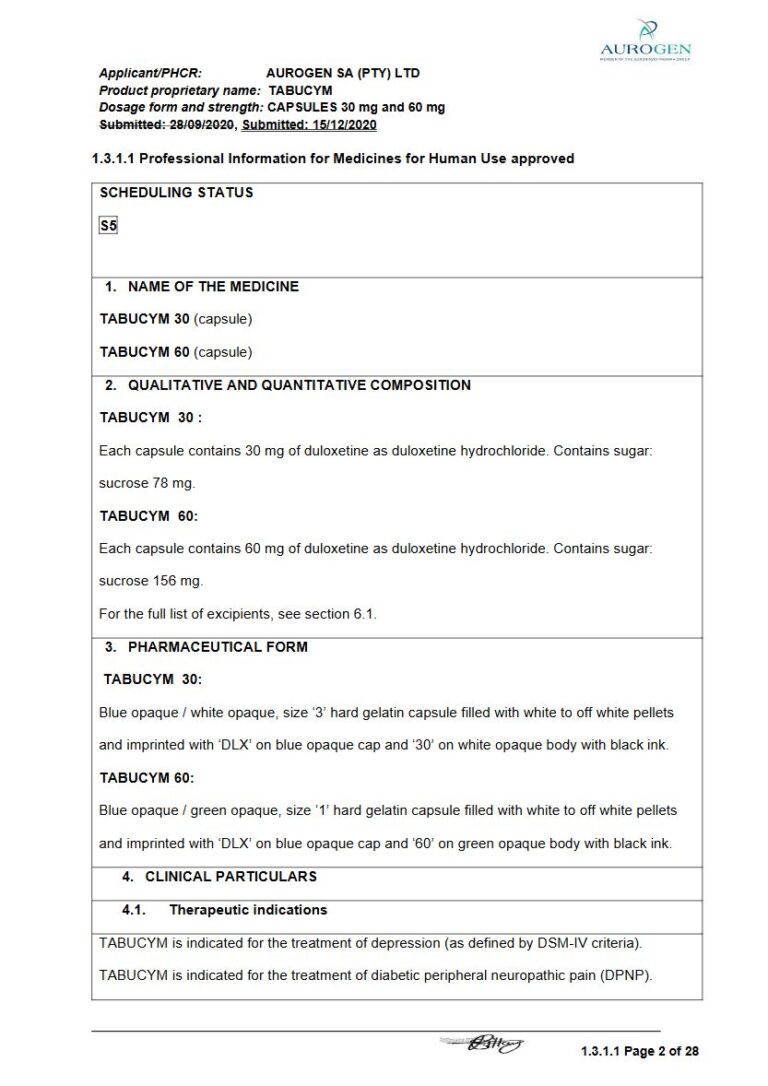
TABUCYM is indicated for the treatment of depression (as defined by DSM - IV criteria). TABUCYM is indicated for the treatment of diabetic peripheral neuropathic pain (DPNP).
4.2. Posology and method of administration
Posology
Depression: TABUCYM should be initiated and maintained at a dose of 60 mg once daily without regard to meals. Although doses up to 120 mg per day have been used the efficacy of the 120 mg dose was not statistically different from that of the 60 mg once daily dose and the adverse event rate was higher with the 120 mg dose.
Diabetic peripheral neuropathic pain: TABUCYM should be administered at a dose of 60 mg once daily without regard to meals. Although doses up to 120 mg per day have been used the efficacy of the 120 mg dose was not statistically significantly different from that of the 60 mg once daily dose and the adverse event rate was higher with the 120 mg dose.
Discontinuation of treatment: Abrupt discontinuation of TABUCYM should be avoided. When stopping treatment with TABUCYM the dose should be gradually reduced over a period of at least two weeks to reduce the risk of withdrawal reactions (see sections 4.4 and 4.8). If intolerable symptoms occur following a decrease in the dose or upon discontinuation of treatment, then resuming the previously prescribed dose may be considered. Subsequently, the doctor may continue decreasing the dose, but at a more gradual rate.
Special populations: Renal impairment: Initial dose should be 30 mg once daily in patients with mild to moderate impairment of renal function. (See sections 4.4, 5.2 and 4.3). Hepatic impairment: Initial dose should be lower or less frequent in patients with mild to moderate impairment of hepatic function. (See sections 4.4, 5.2 and 4.3). Elderly population: No dosage adjustment is recommended for elderly patients on the basis of age. Pediatric population: Safety and efficacy have not been established in patients under the age of 18 years (see section 4.3).
Method of administration
For oral use
4.3. Contraindications
TABUCYM is contra - indicated in patients:
u2022 with a known hypersensitivity to duloxetine or to any of the excipients
u2022 who are pregnancy and/or breastfeeding
u2022 have severe impairment of hepatic function
u2022 have advanced renal impairment (creatinine clearance <30 mL /min)
u2022 where there is concomitant use of monoamine oxidase inhibitors (MAOIs). (See also section 4.4)
u2022 Children under 18 years as the safety in children has not been established (see section 4.4).
4.4. Special warnings and precautions for use
Suicide
Major Depressive Disorder: Depression is associated with an increased risk of suicidal thoughts, self - harm, and suicide (suicide - related events). This risk persists until significant remission occurs. As improvement may not occur during the first few weeks or more of treatment, patients should be closely monitored until such improvement occurs. It is general clinical experience that the risk of suicide may increase in the early stages of recovery.
Patients with a history of suicide - related events or those exhibiting a significant degree of suicidal thoughts prior to commencement of treatment, are known to be at greater risk of suicidal thoughts or suicidal behaviour, and should receive careful monitoring during treatment. A meta - analysis of placebo - controlled clinical trials of antidepressant medicinal products in psychiatric disorders showed an increased risk of suicidal behaviour with antidepressants compared to placebo in patients less than 25 years old. Cases of suicidal thoughts and suicidal behaviours have been reported during therapy or early after treatment discontinuation (see sections 4.5 and 4.8). Close supervision of patients, and in particular those at high risk should accompany medicinal product therapy, especially in early treatment and following dose changes. Patients with major depressive disorder, both adults and children, may experience worsening of their depression. This risk may persist until significant remission occurs. A casual role, however, for antidepressant medicine in inducing such behaviour has not been established. Patients (and caregivers of patients) should be alerted about the need to monitor for any clinical worsening, suicidal behaviour or thoughts and unusual changes in behaviour and to seek medical advice immediately if these symptoms present.
Because of the possibility of co - morbidity between major depressive disorder and other psychiatric and non - psychiatric disorders, the same precautions observed when treating patients with major depressive disorders should be observed when treating patients with other psychiatric and non - psychiatric disorders.
The following symptoms have been reported in patients being treated with antidepressants for major depressive disorder as well as for other indications, both psychiatric and non - psychiatric: anxiety, agitation, panic attacks, insomnia, irritability, hostility (aggressiveness, impulsivity, akathisia, hypomania, and mania. Although a causal link between the emergence of suicidal impulses has not been established, consideration should be given to changing the therapeutic regimen, including possibly discontinuing TABUCYM, in patients for whom such symptoms are severe, abrupt in onset, or were not part of the patientu2019s presenting symptoms. If the decision is made to discontinue treatment, TABUCYM should be tapered (see below and section 4.2).
Suicidal behaviour
As with other medicinal products with similar pharmacological action (antidepressants), isolated cases of suicidal ideation and suicidal behaviours have been reported during TABUCYM therapy or early after treatment discontinuation. Concerning risk factors for suicidality in depression, see above. Medical practitioners should encourage patients to report any distressing thoughts or feelings at any time.
Use in Children and Adolescents Under 18 Years of Age
TABUCYM should not be used in the treatment of children and adolescents under the age of 18 years as safety and efficacy has not been established (see section 4.3). Suicide - related behaviours (suicide attempts and suicidal thoughts), self - harm and hostility (predominantly aggression, oppositional behaviour, and anger) were more frequently observed in clinical trials among children and adolescents treated with antidepressants compared to those treated with placebo. If, based on clinical need, a decision to treat is nevertheless taken, the patient should be carefully monitored for the appearance of suicidal symptoms (see section 5.2). In addition, long - term safety data in children and adolescents concerning growth, maturation, and cognitive and behavioural development are lacking (see section 4.8).
Mania and Seizures
TABUCYM should be used with caution in patients with a history of mania or a diagnosis of bipolar disorder, and/or seizures.
Mydriasis
Mydriasis has been reported in association with duloxetine, therefore, caution should be used when prescribing TABUCYM to patients with increased intra - ocular pressure or those at risk of acute narrow - angle glaucoma.
Blood Pressure and Heart Rate
TABUCYM has been associated with an increase in blood pressure, and clinically significant hypertension in some patients. This may be due to the noradrenergic effect of duloxetine. Cases of hypertensive crisis have been reported with TABUCYM, especially in patients with pre - existing hypertension. Therefore, in patients with known hypertension and/or other cardiac disease, blood pressure monitoring is recommended, especially during the first month of treatment. TABUCYM should be used with caution in patients whose conditions could be compromised by an increased heart rate or by an increase in blood pressure. Caution should also be exercised when TABUCYM is used with medicinal products that may impair its metabolism (see section 4.5). For patients who experience a sustained increase in blood pressure while receiving TABUCYM, either dose reduction or gradual discontinuation should be considered (see section 4.8). In patients with uncontrolled hypertension, TABUCYM should not be initiated.
Renal Impairment
Increased plasma concentrations of TABUCYM occur in patients with severe renal impairment on haemodialysis (creatinine clearance <30 mL /min). For patients with severe renal impairment, see section 4.3 and 4.2 for information on patients with mild or moderate renal dysfunction.
Hepatic impairment: Increased plasma concentrations of duloxetine occur in patients with hepatic impairment. (See sections 4.2 and 4.3).
4.5. Interaction with other medicines and other forms of interaction
Monoamine Oxidase Inhibitors (MAOIs): Due to the risk of serotonin syndrome, duloxetine should not be used in combination with monoamine oxidase inhibitors (MAOIs) or within at least 14 days of discontinuing treatment with an MAOI. Based on the half - life of duloxetine, at least 5 days should be allowed after stopping TABUCYM before starting an MAOI (see section 4.3).
Inhibitors of CYP1A2: Because CYP1A2 is involved in duloxetine metabolism, concomitant use of duloxetine with potent inhibitors of CYP1A2 is likely to result in higher concentrations of duloxetine. Fluvoxamine (100 mg once daily), a potent inhibitor of CYP1A2, decreased the apparent plasma clearance of duloxetine by about 77% and increased AUC 0 - t 6 - fold. Caution is advised if administering TABUCYM with inhibitors of CYP1A2 and a lower TABUCYM dose should be used.
CNS Medicinal Products: The risk of using TABUCYM in combination with other CNS - active medicinal products has not been systematically evaluated, except in the cases described in this section. Consequently, caution is advised when TABUCYM is taken in combination with other centrally - acting medicinal products or substances, including alcohol and sedative medicinal products (e.g., benzodiazepines, morphinomimetics, antipsychotics, phenobarbital, sedative antihistamines).
Serotonergic medicines: In rare cases, serotonin syndrome has been reported in patients using SSRIs/ SNRIs concomitantly with serotonergic medicines. Caution is advisable if TABUCYM is used concomitantly with serotonergic agents like SSRIs, SNRIs, tricyclic antidepressants like clomipramine or amitriptyline, St John's Wort (Hypericum perforatum) or triptans, tramadol, pethidine, and tryptophan (see section 4.4). Concomitant use with MOAIu2019s, including moclobemide or linezolid, is contraindicated (see above and section 4.3)
Effect of duloxetine on other medicinal products
Medicinal products metabolised by CYP1A2: The pharmacokinetics of theophylline, a CYP1A2 substrate, were not significantly affected by co - administration with TABUCYM (60 mg twice daily).
Medicinal products metabolised by CYP2D6: Duloxetine is a moderate inhibitor of CYP2D6. When TABUCYM was administered at a dose of 60 mg twice daily with a single dose of desipramine, a CYP2D6 substrate, the AUC of desipramine increased 3 - fold. The co - administration of duloxetine (40 mg twice daily) increases steady - state AUC of tolterodine (2 mg twice daily) by 71%, but does not affect the pharmacokinetics of its active 5 - hydroxyl metabolite and no dosage adjustment is recommended. Caution is advised if TABUCYM is co - administered with medicinal products that are predominantly metabolised by CYP2D6 (risperidone, tricyclic antidepressants [TCAs], such as nortriptyline, amitriptyline, and imipramine), particularly if they have a narrow therapeutic index (such as flecainide, propafenone, and metoprolol).
Oral contraceptives and other steroidal medicines: Results of in vitro studies demonstrate that duloxetine does not induce the catalytic activity of CYP3A. Specific in vivo drug interaction studies have not been performed.
Anticoagulants and antiplatelet medicines: Caution should be exercised when TABUCYM is combined with oral anticoagulants or antiplatelet medicines due to a potential increased risk of bleeding attributable to a pharmacodynamic interaction. Furthermore, increases in INR values have been reported when TABUCYM was co - administered to patients treated with warfarin. However, concomitant administration of TABUCYM with warfarin under steady state conditions, in healthy volunteers, as part of a clinical pharmacology study, did not result in a clinically significant change in INR from baseline or in the pharmacokinetics of R - or S - warfarin.
Inhibitors of CYP2D6: Because CYP2D6 is involved in TABUCYM metabolism, concomitant use of TABUCYM with inhibitors of CYP2D6 may result in higher concentrations of TABUCYM. Paroxetine (20 mg once daily) decreased the apparent plasma clearance of TABUCYM by about 37%. Caution is advised if administering TABUCYM with inhibitors of CYP2D6 (e.g. SSRIs).
4.6. Fertility, pregnancy and lactation
Pregnancy
The safety of TABUCYM in pregnancy has not been established (see section 4.3). Studies in animals have shown reproductive toxicity at systemic exposure levels (AUC) of TABUCYM lower than the maximum clinical exposure. The potential risk for humans is unknown. Epidemiological data have suggested that the use of SSRIs in pregnancy, particularly in late pregnancy, may increase the risk of persistent pulmonary hypertension in the newborn (PPHN). Although no studies have investigated the association of PPHN to SNRI treatment, this potential risk cannot be ruled out with TABUCYM, taking into account the related mechanism of action (inhibition of the re - uptake of serotonin). As with other serotonergic medicinal products, discontinuation symptoms may occur in the neonate after maternal TABUCYM use near term. Discontinuation symptoms seen with TABUCYM may include hypotonia, tremor, and jitteriness, feeding difficulty, respiratory distress and seizures. The majority of cases have occurred either at birth or within a few days of birth.
Breastfeeding
TABUCYM is excreted into human milk. The use of TABUCYM while breastfeeding is contraindicated (see section 4.3).
Fertility
In animal studies, TABUCYM had no effect on male fertility, and effects in females were only evident at doses that caused maternal toxicity.
4.7. Effects on ability to drive and use machines
No studies of the effects on the ability to drive and use machines have been performed. TABUCYM may be associated with sedation and dizziness. Patients should be instructed that if they experience sedation or dizziness they should avoid potentially hazardous tasks such as driving or operating machinery.
4.8. Undesirable effects
a. Summary of the safety profile
The most commonly reported adverse reactions in patients treated with TABUCYM were nausea, headache, dry mouth, somnolence and dizziness. However, the majority of common adverse reactions were mild to moderate; they usually started early in therapy, and most tended to subside even as therapy was continued. Hostility, suicidal ideation and self - harm have been reported in children treated with SSRIs or SNRIs like TABUCYM.
b. Tabulated summary of adverse reactions
Frequent
Less frequent
Frequency unknown
Infections and Infestations
Laryngitis
Immune System Disorders
Anaphylactic reaction
Hyper - sensitivity disorder
Angioedema
Endocrine Disorders
Hypo - thyroidism
Metabolism and Nutrition Disorders
Decreased appetite
Hyperglycaemia (reported especially in diabetic patients)
Dehydration
Hyponatraemia
SIADH
Psychiatric Disorders
Insomnia
Agitation
Libido decreased,
Anxiety
Orgasm abnormal
Abnormal dreams
Suicidal ideation
Sleep disorder
Bruxism
Disorientation
Apathy
Suicidal behaviour
Mania
Hallucinations
Aggression and anger
Nervous System Disorders
Headache
Somnolence
Dizziness
Lethargy
Tremor
Myoclonus
Akathisia
Nervousness
Disturbance in attention
Paraesthesia
Dysgeusia
Dyskinesia
Restless legs syndrome
Poor quality sleep
Serotonin syndrome
Convulsions
Psychomotor restlessness
Extra - pyramidal symptoms
Eye Disorders
Blurred vision
Mydriasis
Visual impairment
Glaucoma
Ear and Labyrinth Disorders
Tinnitus
Vertigo
Ear pain
Cardiac Disorders
Palpitations
Tachycardia
Supra - ventricular Dys rhythmia, mainly atrial fibrillation
Vascular Disorders
Blood pressure increase
Flushing
Hot flush
Syncope
Hypertension
Orthostatic hypotension
Peripheral coldness
Hypertensive crisis
Respiratory, Thoracic and Mediastinal Disorders
Yawning
Throat tightness
Epistaxis
Interstitial lung disease
Eosinophilic pneumonia
Gastrointestinal Disorders
Nausea
Dry mouth
Constipation
Diarrhoea
Abdominal pain
Vomiting
Dyspepsia
Flatulence
Gastrointestinal haemorrhage
Gastroenteritis
Eructation
Gastritis
Dysphagia
Stomatitis
Haematochezia
Breath odour
Microscopic colitis
Hepato - biliary Disorders
Hepatitis
Elevated liver enzymes (ALT, AST, alkaline phosphatase)
Acute liver injury
Hepatic failure
Jaundice
Skin and Subcutaneous Tissue Disorders
Sweating increased
Rash
Night sweats
Urticaria
Dermatitis contact
Cold sweat
Photo - sensitivity reactions
Increased tendency to bruise
Stevens - Johnson Syndrome
Cutaneous vasculitis
Musculoskeletal and Connective Tissue Disorders
Musculo - skeletal pain
Muscle spasm
Muscle tightness
Muscle twitching
Trismus
Renal and Urinary Disorders
Dysuria
Pollakiuria
Urinary retention
Urinary hesitation
Nocturia
Polyuria
Urine flow decreased
Urine odour abnormal
Reproductive System and Breast Disorders
Erectile dysfunction
Ejaculation disorder
Ejaculation delayed
Gynaecological haemorrhage
Menstrual disorder
Sexual dysfunction
Testicular pain
Menopausal symptoms
Galactorrhoea
Hyper - prolactinaemia
General Disorders and Administration Site Conditions
Falls
Fatigue
Chest pain
Feeling abnormal
Feeling cold
Thirst
Chills
Malaise
Feeling hot
Gait disturbance
Increased blood pressure
Hepatic lab findings
Investigations
Weight decrease
Weight increase
Blood creatine phosphokinase increased
Blood potassium increased
Blood cholesterol increased
c. Description of selected adverse reactions
Discontinuation of TABUCYM (particularly when abrupt) commonly leads to withdrawal symptoms. Dizziness, sensory disturbances (including paraesthesia or electric shock - like sensations, particularly in the head), sleep disturbances (including insomnia and intense dreams), fatigue, somnolence, agitation or anxiety, nausea and/or vomiting, tremor, headache, myalgia, irritability, diarrhoea, hyperhydrosis and vertigo are the most commonly reported reactions. Generally, for SSRIs and SNRIs, these events are mild to moderate and self - limiting; however, in some patients they may be severe and/or prolonged. It is therefore advised that when TABUCYM treatment is no longer required, gradual discontinuation by dose tapering should be carried out (see section 4.2 and 4.4). In the 12 - week acute phase of three clinical trials of duloxetine in patients with diabetic neuropathic pain, small but statistically significant increases in fasting blood glucose were observed in duloxetine - treated patients. HbA1c was stable in both duloxetine - treated and placebo - treated patients. In the extension phase of these studies, which lasted up to 52 weeks, there was an increase in HbA1c in both the duloxetine and routine care groups, but the mean increase was 0.3% greater in the duloxetine - treated group. There was also a small increase in fasting blood glucose and in total cholesterol in duloxetine - treated patients, while those laboratory tests showed a slight decrease in the routine care group. The heart rate - corrected QT interval in duloxetine - treated patients did not differ from that seen in placebo - treated patients. No clinically significant differences were observed for QT, PR, QRS, or QTcB measurements between duloxetine - treated and placebo - treated patients.
4.9. Overdose
Cases of overdoses, alone or in combination with other medicinal products, with duloxetine doses of 5400 mg were reported. Some fatalities have occurred, primarily with mixed overdoses, but also with duloxetine alone at a dose of approximately 1 000 mg. Signs and symptoms of overdose duloxetine alone or in combination with other medicinal products) included somnolence, coma, serotonin syndrome, seizures, vomiting and tachycardia. No specific antidote is known for duloxetine, but if serotonin syndrome ensues, specific treatment (such as with cyproheptadine and/or temperature control) may be considered. A free airway should be established. Monitoring of cardiac and vital signs is recommended, along with appropriate symptomatic and supportive measures. Activated charcoal may be useful in limiting absorption. Duloxetine has a large volume of distribution and forced diuresis, haemoperfusion, and exchange perfusion are unlikely to be beneficial.
