
Armitraz 1mg Tablets
PDF Leaflet Revision Date: 15-Mar-2023
Clinical Summary
Quick overview from the medicine insert
Indication
Treatment of early and advanced breast cancer in postmenopausal women.
Dosage (summary)
1 mg orally once daily for adults and elderly.
Special Populations
- Renal impairment
- Hepatic impairment
Pregnancy & Breastfeeding
Contraindicated in pregnancy and lactation; no data available.
Key Drug Interactions
- Avoid co-administration with tamoxifen or oestrogen therapies
Contraindications
- Hypersensitivity to anastrozole
- Pre-menopausal women
- Pregnant/lactating women
- Severe renal impairment
- Moderate or severe hepatic disease
Common side effects
- Headache
- Hot flushes
- Nausea
- Rash
- Arthralgia
- Asthenia
Counselling Points
- Take daily at the same time
- Monitor for signs of osteoporosis
- Report any unusual bleeding
Serious warnings
- May reduce bone mineral density
- Caution in patients with osteoporosis
Important Disclaimer
The Armitraz 1mg Tablets professional information leaflet below is the property of Aurogen Sa and is provided on Medinsert exactly as issued, with no.. alterations or editorial changes. We make every effort to keep content current by updating documents as soon as new versions become available. Medinsert serves as a trusted access point for healthcare professionals, but does not replace official sources or clinical judgement. For more details, please read our full disclaimer. read more>>
 Healthcare Professionals Only
This content is for registered healthcare professionals
Sign in or create a free account to read the full package insert.
Free for HPCSA-registered professionals. Powered by Medinsert.
Clinical Particulars
Section 4 of the official insert — extracted exactly as issued, no alterations
4.1. Therapeutic indications
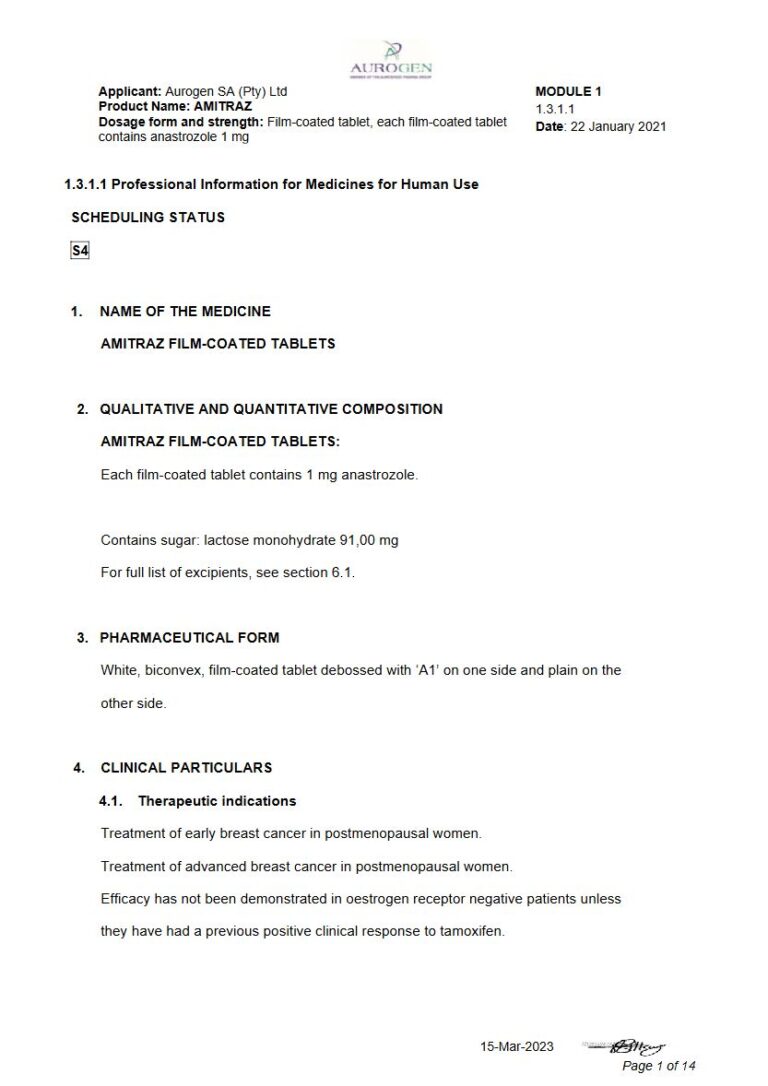
Treatment of early breast cancer in postmenopausal women.
Treatment of advanced breast cancer in postmenopausal women.
Efficacy has not been demonstrated in oestrogen receptor negative patients unless they have had a previous positive clinical response to tamoxifen.
4.2. Posology and method of administration
Posology
Adults including the elderly: One 1 mg tablet to be taken orally once a day.
Special Population
- Patients with renal impairment: No dose change is recommended in patients with mild or moderate renal impairment.
- Patients with hepatic impairment: No dose change is recommended in patients with mild hepatic disease.
- Elderly patients: No specific dosage adjustments of AMITRAZ are recommended based on patient age.
- Paediatric population: The safety and efficacy of AMITRAZ in children under the age of 18 years has not been established. Not recommended for use in children.
Method of administration
AMITRAZ should be taken orally.
4.3. Contraindications
AMITRAZ is contraindicated in:
- patients with hypersensitivity to anastrazole or to any of the ingredients of AMITRAZ
- pre-menopausal women
- pregnant/lactating women
- patients with severe renal impairment (creatinine clearance less than 20 mL/min)
- patients with moderate or severe hepatic disease
4.4. Special warnings and precautions for use
AMITRAZ should not be used in premenopausal women. The menopause should be defined biochemically (luteinizing-hormone [LH], follicle stimulating hormone [FSH], and/or oestradiol levels) in any patient where there is doubt about menopausal status. There are no data to support the use of AMITRAZ with LHRH analogues.
Co-administration of tamoxifen or oestrogen-containing therapies with AMITRAZ should be avoided as this may diminish its pharmacological action (see section 4.5 and 5.1).
Effect on bone mineral density
As AMITRAZ lowers circulating oestrogen levels it may cause a reduction in bone mineral density with a possible consequent increased risk of fracture (see section 4.8). Women with osteoporosis or at risk of osteoporosis, should have their bone mineral density formally assessed at the commencement of treatment and at regular intervals thereafter. Treatment or prophylaxis for osteoporosis should be initiated as appropriate and carefully monitored. The use of specific treatments, e.g. bisphosphonates, may stop further bone mineral loss caused by AMITRAZ in postmenopausal women and could be considered (see section 4.8).
Hepatic impairment
AMITRAZ has not been investigated in breast cancer patients with moderate or severe hepatic impairment. Exposure to anastrozole can be increased in subjects with hepatic impairment (see section 5.2); administration of AMITRAZ in patients with moderate and severe hepatic impairment is contraindicated (see section 4.3).
Renal impairment
AMITRAZ has not been investigated in breast cancer patients with severe renal impairment. Exposure to anastrozole is not increased in subjects with severe renal impairment (GRF < 30mL/min, see section 5.2); in patients with severe renal impairment (creatinine clearance less than 20 mL/min), administration of AMITRAZ (see section 4.3).
Paediatric population
AMITRAZ is not recommended for use in children and adolescents as safety and efficacy have not been established in this group of patients (see section 5.1). AMITRAZ should not be used in boys with growth hormone deficiency in addition to growth hormone treatment. In the pivotal clinical trial, efficacy was not demonstrated and safety was not established (see section 5.1). Since anastrozole reduces oestradiol levels, AMITRAZ must not be used in girls with growth hormone deficiency in addition to growth hormone treatment. Long-term safety data in children and adolescents are not available.
Hypersensitivity to lactose
AMITRAZ contains lactose. Patients with rare hereditary problems of galactose intolerance, total lactase deficiency or glucose-galactose malabsorption should not take AMITRAZ.
4.5. Interaction with other medicines and other forms of interaction
AMITRAZ inhibits CYPs 1A2, 2C8/9 and 3A4 in vitro. Clinical studies with antipyrine and warfarin showed that anastrozole at a 1 mg dose did not significantly inhibit the metabolism of antipyrine and Ru2013 and S- warfarin indicating the co-administration of AMITRAZ with other medicinal products is unlikely to result in clinically significant medicinal product interactions mediated by CYP enzymes. The enzymes mediating metabolism of anastrozole have not been identified. Cimetidine, a weak, unspecific inhibitor of CYP enzymes, did not affect the plasma concentrations of anastrozole. The effect of potent CYP inhibitors is unknown. A review of the clinical trial safety database did not reveal evidence of clinically significant interaction in patients treated with AMITRAZ who also received other commonly prescribed medicinal products. There were no clinically significant interactions with bisphosphonates (see section 5.1). Co-administration of tamoxifen or oestrogen-containing therapies with AMITRAZ should be avoided as this may diminish its pharmacological action (see section 4.4 and 5.1).
4.6. Fertility, pregnancy and lactation
Pregnancy
AMITRAZ is contraindicated during pregnancy (see section 4.3). There is no data from the use of AMITRAZ in pregnant women. Studies in animals have shown reproductive toxicity.
Breastfeeding
AMITRAZ is contraindicated during pregnancy (see section 4.3). There is no data on the use of AMITRAZ during lactation.
Fertility
The effects of AMITRAZ on fertility in humans have not been studied. Studies in animals have shown reproductive toxicity.
4.7. Effects on ability to drive and use machines
Asthenia and somnolence have been reported with the use of AMITRAZ and caution should be observed when driving or operating machinery while such symptoms persist.
4.8. Undesirable effects
a. Summary of the safety profile
The most frequently reported adverse reactions were headache, hot flushes, nausea, rash, arthralgia, joint stiffness, arthritis, and asthenia.
b. Tabulated list of adverse reactions
Frequency groupings are defined according to the following convention: Frequent = more frequent, very common and common; Less frequent = single report or isolated reports, uncommon, rare, very rare
Table 1 : Adverse reactions by System Organ Class and frequency
System Organ Class Frequency Adverse reactions
Metabolism and nutrition disorders Frequent Anorexia, Hypercholesterolaemia Less frequent Hypercalcaemia (with or without an increase in parathyroid hormone)
Nervous system disorders Frequent Headache, Somnolence, Carpal Tunnel Syndrome* , Sensory disturbances (including paraesthesia, taste loss and taste perversion)
Vascular disorders Frequent Hot flushes
Gastrointestinal disorders Frequent Nausea, Diarrhoea, Vomiting
Hepatobiliary disorders Frequent Increases in alkaline phosphatase, alanine aminotransferase and aspartate aminotransferase Less frequent Increases in gamma-GT and bilirubin, Hepatitis
Skin and subcutaneous tissue disorders Frequent Rash, Hair thinning (alopecia), Allergic reactions
Less frequent Urticaria, Erythema multiforme, Anaphylactoid reaction, Cutaneous vasculitis (including some reports of Henoch-Schu00f6nlein purpura)** , Stevens-Johnson syndrome, Angioedema
Musculoskeletal and connective tissue disorders Frequent Arthralgia/joint stiffness, Arthritis, Osteoporosis, Bone pain, Myalgia
Less frequent Trigger finger
Reproductive system and breast disorders Frequent Vaginal dryness, Vaginal bleeding ***
General disorders and administration site conditions Frequent Asthenia
*Events of Carpal Tunnel Syndrome have been reported in patients receiving AMITRAZ treatment in clinical trials in greater numbers than those receiving treatment with tamoxifen. However, the majority of these events occurred in patients with identifiable risk factors for the development of the condition.
**Since cutaneous vasculitis and Henoch-Schu00f6nlein purpura was not observed in ATAC (the Arimidex, Tamoxifen, Alone or in Combination) study, the frequency category for these events can be considered as 'Rare' (u2265 0 , 01 % and < 0,1 %) based on the worst value of the point estimate.
***Vaginal bleeding has been reported commonly, mainly in patients with advanced breast cancer during the first few weeks after changing from existing hormonal therapy to treatment with AMITRAZ. If bleeding persists, further evaluation should be considered.
c. Description of selected adverse reactions
Cardiovascular events
In a study conducted in postmenopausal women with operable breast cancer treated for 5 years, ischaemic cardiovascular events were reported more frequently in patients treated with AMITRAZ compared to those treated with tamoxifen, although the difference was not statistically significant. The observed difference was mainly due to more reports of angina pectoris and was associated with a sub-group of patients with pre-existing ischaemic heart disease. Thromboembolism, fluid retention and dizziness have also been observed in clinical trials with AMITRAZ.
Bone fractures
Fracture rates of 22 per 1000 patient-years and 15 per 1000 patient-years were observed for the AMITRAZ and tamoxifen groups, respectively, after a median follow-up of 68 months. The observed fracture rate for AMITRAZ is similar to the range reported in age-matched postmenopausal populations. The incidence of osteoporosis was 10,5 % in patients treated with AMITRAZ and 7,3 % in patients treated with tamoxifen. It has not been determined whether the rates of fracture and osteoporosis seen in ATAC in patients on AMITRAZ treatment reflect a protective effect of tamoxifen, a specific effect of AMITRAZ, or both.
Reporting of suspected adverse reactions
Reporting suspected adverse reactions after authorisation of the medicinal product is important. It allows continued monitoring of the benefit/risk balance of the medicinal product. Healthcare professionals are asked to report any suspected adverse reactions to SAHPRA via the u20186.04 Adverse Drug Reactions Reporting Formu2019. Found under SAHPRAu2019s publications: https://www/sahpra.org.za/Publications/Index/8
4.9. Overdose
Symptoms
There is limited clinical experience of accidental overdose. In animal studies, anastrozole demonstrated low acute toxicity. Clinical trials have been conducted with various dosages of AMITRAZ, up to 60 mg in a single dose given to healthy male volunteers and up to 10 mg daily given to postmenopausal women with advanced breast cancer; these dosages were well tolerated. A single dose of AMITRAZ that results in life-threatening symptoms has not been established. Refer to possible side effects in the case of an overdose.
Treatment
There is no specific antidote to overdose and treatment must be symptomatic. In the management of an overdose, consideration should be given to the possibility that multiple substances may have been taken. Dialysis may be helpful because AMITRAZ is not highly protein bound. General supportive care, including frequent monitoring of vital signs and close observation of the patient, is indicated.
