
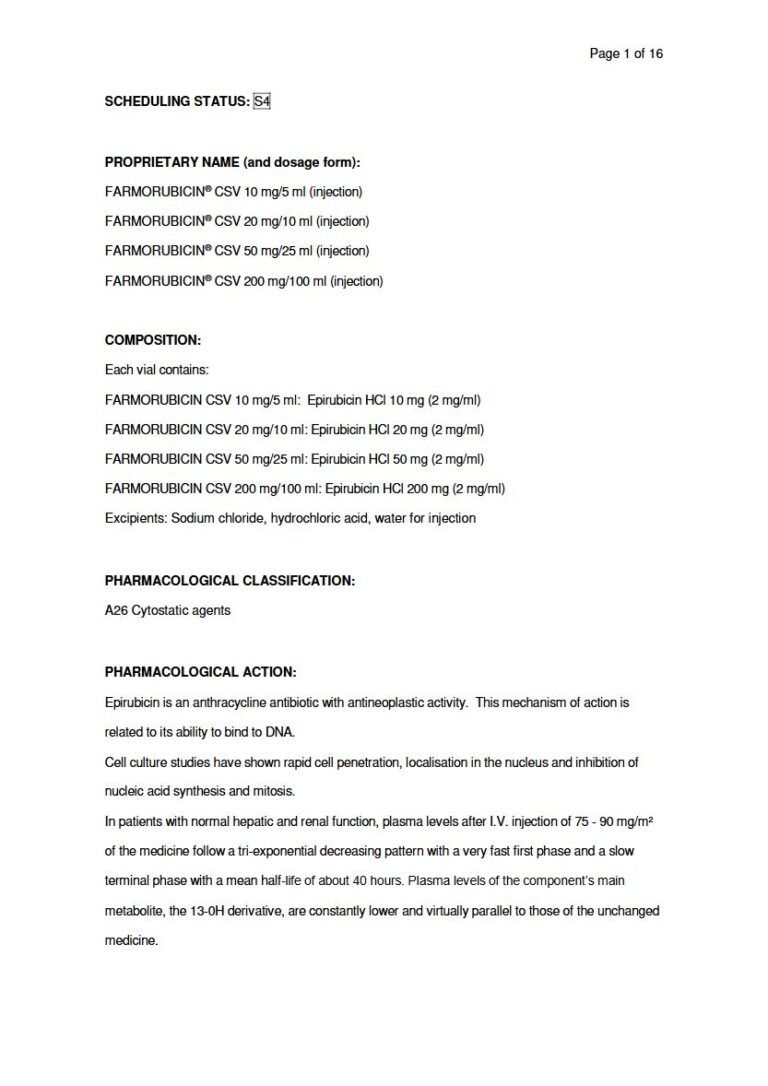
Farmorubicin 10 mg/5 ml/20 mg/10 ml/50 mg/25 ml/200 mg/100 ml
PDF Leaflet Revision Date: 07 December 2012
Clinical Summary
Quick overview from the medicine insert
Indication
Treatment of various cancers including breast and lung cancer.
Dosage (summary)
60-90 mg/mu00b2 IV every 3-4 weeks; adjust for hepatic/renal impairment.
Special Populations
- Elderly
- Hepatic impairment
- Renal impairment
Pregnancy & Breastfeeding
Contraindicated in pregnancy; may cause amenorrhoea in women and chromosomal damage in sperm.
Key Drug Interactions
- Cimetidine increases AUC by 50%
- Additive toxicity with other cytotoxic agents
Contraindications
- Hypersensitivity
- Severe hepatic impairment
- Severe myocardial insufficiency
- Persistent myelosuppression
Common side effects
- Leukopenia
- Neutropenia
- Anaemia
- Congestive heart failure
- Nausea
- Vomiting
Counselling Points
- Monitor blood counts regularly
- Avoid live vaccines
- Use effective contraception during treatment
Serious warnings
- Severe local tissue necrosis on extravasation
- Risk of cardiotoxicity
- Secondary acute myelogenous leukaemia
Important Disclaimer
The Farmorubicin 10 mg/5 ml/20 mg/10 ml/50 mg/25 ml/200 mg/100 ml professional information leaflet below is the property of Pfizer and is provided on Medinsert exactly as issued, with no.. alterations or editorial changes. We make every effort to keep content current by updating documents as soon as new versions become available. Medinsert serves as a trusted access point for healthcare professionals, but does not replace official sources or clinical judgement. For more details, please read our full disclaimer. read more>>
 Healthcare Professionals Only
This content is for registered healthcare professionals
Sign in or create a free account to read the full package insert.
Free for HPCSA-registered professionals. Powered by Medinsert.
Clinical Particulars
Section 4 of the official insert — extracted exactly as issued, no alterations
4.1 Therapeutic indications
FARMORUBICIN CSV is indicated for the treatment of the following:
- Breast cancer
- Gastric cancer
- Non small cell lung carcinoma
- Non- Hodgkinu2019s lymphoma
- Hodgkinu2019s lymphoma
- Ovarian cancer
- Colorectal cancer
- Soft tissue sarcomas
- Malignant melanoma
4.2 Posology and method of administration
FARMORUBICIN CSV is usually administered by intravenous injection. It is not active when given orally and should not be injected intramuscularly or intrathecally.
Standard starting dose regimen: When FARMORUBICIN CSV is used as a single agent, the recommended dosage in adults is 60 - 90 mg/mu00b2 body area. The total starting dose per cycle may be given as a single dose or divided over 2 - 3 successive days. The medicine should be injected I.V. in 3 - 5 minutes and, depending on the patient's haematological status, the dose should be repeated at 21-day intervals (every 3 - 4 weeks).
Higher starting dose regimen: Doses of 90 to 135 mg/mu00b2 as single agent and 90 to 120 mg/mu00b2 in combination therapy, every 3 - 4 weeks may be used in the treatment of advanced breast cancer and lung cancer.
Lower doses, 60 - 75 mg/mu00b2 are recommended for patients whose bone marrow function has already been impaired by earlier chemotherapy or radiotherapy, by age, or by bone marrow neoplastic infiltrations. The total dosage per cycle may be divided over 2 - 3 successive days. When FARMORUBICIN CSV is used in association with other anti-tumour agents, the doses need to be adequately reduced.
Hepatic dysfunction: Since the major route of elimination of FARMORUBICIN CSV is the hepatobiliary system the dosage should be reduced in patients with impaired liver function, in order to avoid an increase of overall toxicity. The dosage should be adjusted as follows:
- (a) Moderate liver impairment u2013 Bilirubin 24 - 51,3 mmol/l (1,4 - 3 mg/100 ml) or BSP retention: 9 - 15 % - requires a 50 % reduction of dose.
- (b) Severe liver impairment u2013 Bilirubin >51,3 mmol/l (>3 mg/100 ml) or BSP retention: >15 % - necessitates a dose reduction of 75 %.
Renal dysfunction: Moderate renal impairment does not appear to call for a dose reduction in view of the limited amount of FARMORUBICIN CSV excreted via this route. Lower starting doses should be considered in patients with severe renal impairment (serum creatinine > 5 mg/dl).
4.3 Contraindications
Hypersensitivity to FARMORUBICIN CSV or any other component of the product, other anthracyclines or anthracenediones.
Intravenous use:
- persistent myelosuppression
- severe hepatic impairment
- severe myocardial insufficiency
- recent myocardial infarction
- severe dysrhythmias
- previous treatments with maximum cumulative doses of epirubicin and/or other anthracyclines and anthracenediones (see WARNINGS)
4.4 Special warnings and precautions for use
1. Severe local tissue necrosis will occur if there is extravasation during administration (See SPECIAL PRECAUTIONS). FARMORUBICIN CSV must not be given by the intramuscular or subcutaneous route.
2. Myocardial toxicity, manifested in its most severe form by potentially fatal congestive heart failure (CHF), may occur either during therapy with FARMORUBICIN CSV or months to years after termination of therapy. The probability of developing clinically evident CHF is estimated as approximately 0,9 % at a cumulative dose of 550 mg/mu00b2, 1,6 % at 700 mg/mu00b2, and 3,3 % at 900 mg/mu00b2. In the adjuvant treatment of breast cancer, the maximum cumulative dose used in clinical trials was 720 mg/mu00b2. The risk of developing CHF increases rapidly with increasing total cumulative doses of FARMORUBICIN CSV in excess of 900 mg/mu00b2; this cumulative dose should only be exceeded with extreme caution. Active or dormant cardiovascular disease, prior or concomitant radiotherapy to the mediastinal/pericardial area, previous therapy with other anthracyclines or anthracenediones, or concomitant use of other cardiotoxic drugs may increase the risk of cardiac toxicity. Cardiac toxicity with FARMORUBICIN CSV may occur at lower cumulative doses whether or not cardiac risk factors are present.
3. Secondary acute myelogenous leukaemia (AML) has been reported in patients with breast cancer treated with anthracyclines, including FARMORUBICIN CSV. The occurrence of refractory secondary leukaemia is more common when such medicines are given in combination with DNA-damaging antineoplastic agents, when patients have been heavily pretreated with cytotoxic medicines, or when doses of FARMORUBICIN CSV have been escalated. The cumulative risk of developing treatment-related AML, in 3844 patients with breast cancer who received adjuvant treatment with epirubicin-containing regimens, was estimated as 0,2 % at 3 years and 0,8 % at 5 years.
4. Dosage should be reduced in patients with impaired hepatic function (see DOSAGE AND DIRECTIONS FOR USE).
5. Severe myelosuppression may occur.
6. FARMORUBICIN CSV should be administered only under the supervision of a medical practitioner who is experienced in the use of cancer chemotherapeutic agents.
4.5 Interactions with other medicines
FARMORUBICIN CSV is mainly used in combination with other cytotoxic medicines. Additive toxicity may occur especially with regard to bone marrow/haematologic and gastro-intestinal effects (see WARNINGS). The use of FARMORUBICIN CSV in combination chemotherapy with other potentially cardiotoxic medicines, as well as the concomitant use of other cardioactive compounds (e.g. calcium channel blockers), requires monitoring of cardiac function throughout treatment.
Cimetidine increased the AUC of Farmorubicin CSV by 50 % and should be stopped during treatment with FARMORUBICIN CSV.
FARMORUBICIN CSV is extensively metabolised by the liver. Changes in hepatic function induced by concomitant therapies may affect FARMORUBICIN CSV metabolism, pharmacokinetics, therapeutic efficacy and/or toxicity.
When given prior to FARMORUBICIN CSV, paclitaxel can cause increased plasma concentrations of unchanged FARMORUBICIN CSV and its metabolites, the latter being, however, neither toxic nor active. Coadministration of paclitaxel or docetaxel did not affect the pharmacokinetics of FARMORUBICIN CSV when FARMORUBICIN CSV was administered prior to the taxane.
4.6 Fertility, pregnancy and lactation
FARMORUBICIN CSV is teratogenic to animals and is contra-indicated in pregnancy, and to mothers who are breastfeeding.
Impairment of Fertility: FARMORUBICIN CSV could induce chromosomal damage in humansu2019 spermatozoa. Men undergoing treatment with FARMORUBICIN CSV should use effective contraceptive methods. FARMORUBICIN CSV may cause amenorrhoea or premature menopause in premenopausal women.
Lactation: It is not known whether FARMORUBICIN CSV is excreted in human milk. Because many medicines, including other anthracyclines, are excreted in human milk and because of the potential for serious adverse reactions in breastfeeding infants from FARMORUBICIN CSV, mothers should discontinue breastfeeding prior to taking FARMORUBICIN CSV.
4.8 Undesirable effects
FARMORUBICIN CSV causes pronounced bone-marrow depression. The other side effects were categorised utilising the incidence rate as follows:
Very common: u2265 1/10 ( u2265 10%)
Common: u2265 1/100 and <1/10 ( u2265 1% and <10%)
Uncommon: u2265 1/1000 and <1/100 ( u2265 0,1% and <1%)
Serious drug-related adverse events that occurred during clinical trials are tabulated below:
| System Organ Class | Frequency | Adverse Events |
|---|---|---|
| Blood and lymphatic system disorders | Very common | Leukopenia, neutropenia, anaemia, thrombocytopenia |
| Cardiac disorders | Common | Asymptomatic drops in left ventricular ejection fraction (LVEF), congestive heart failure (CHF) |
| Reproductive system and breast disorders | Common | Amenorrhoea |
| Eye disorders | Uncommon | Conjunctivitis/keratitis |
| Gastrointestinal disorders | Common | Nausea/vomiting, mucositis/stomatitis, diarrhoea |
| Metabolism and nutrition disorders | Common | Anorexia |
| Infections and infestations | Very common | Infection |
| Neoplasms benign and malignant | Uncommon | Acute lymphocytic leukaemia, acute myelogenous leukaemia |
| Skin and subcutaneous tissue disorders | Common | Alopecia, local toxicity, rash/itch, skin changes |
| Vascular disorders | Uncommon | Hot flushes |
| General disorders and administrative site conditions | Common | Malaise/asthenia, fever |
| Investigations | Rare | Changes in transaminase levels |
Adverse events which occurred during postmarketing surveillance:
| System Organ Class | Frequency | Adverse Events |
|---|---|---|
| Gastrointestinal disorders | Common | Pain or burning sensation, erythema, dehydration |
| Uncommon | Erosions, ulceration, bleeding, hyperpigmentation of the oral mucosa | |
| Immune system disorders | Uncommon | Anaphylaxis |
| Renal and urinary disorders | Common | Red colouration of urine for 1 to 2 days after administration |
| Skin and subcutaneous tissue disorders | Uncommon | Flushes, skin and nail hyperpigmentation, hypersensitivity to irradiated skin (radiation recall reaction), photosensitivity, urticaria |
| Vascular disorders | Uncommon | Phlebitis, thrombophlebitis, thromboembolism, shock |
| Metabolism and nutrition disorders | Rare | Dehydration |
4.9 Overdose
Acute overdosage with FARMORUBICIN CSV will result in severe myelosuppression (mainly leukopenia and thrombocytopenia), gastrointestinal toxic effects (mainly mucositis) and acute cardiac complications. Treatment is supportive and symptomatic.
