
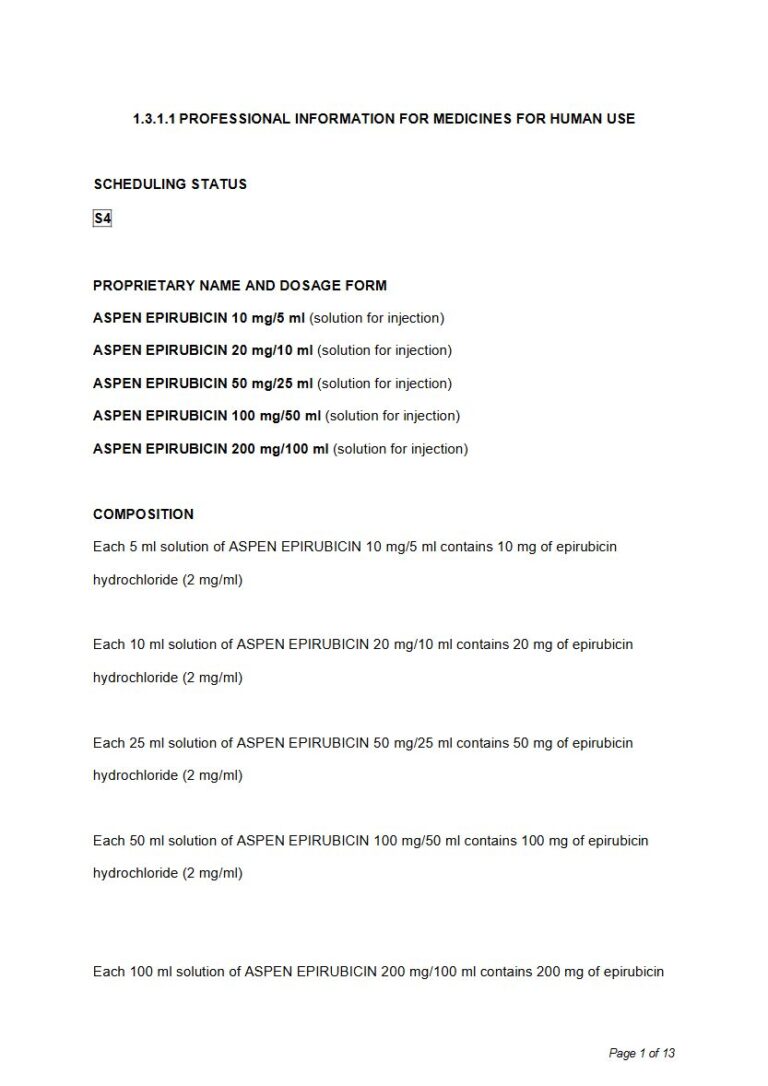
Aspen Epirubicin Injection
PDF Leaflet Revision Date: 12 June 2009
Clinical Summary
Quick overview from the medicine insert
Indication
Monotherapy for various neoplasms including breast and gastric carcinomas.
Dosage (summary)
60 to 90 mg/mu00b2 body surface area, repeated every 21 days; up to 135 mg/mu00b2 for advanced breast cancer.
Special Populations
- Elderly
- Hepatic impairment
Pregnancy & Breastfeeding
Not established; avoid pregnancy and breastfeeding.
Key Drug Interactions
- Cimetidine increases epirubicin concentration
- Avoid mixing with heparin
- Cardio-active compounds may increase cardiotoxicity
Common side effects
- Leucopenia
- Nausea
- Vomiting
- Alopecia
- Cardiotoxicity
Counselling Points
- Monitor for signs of infection
- Avoid contact sports
- Report any bleeding or bruising
Serious warnings
- Cardiac monitoring required
- Risk of myelosuppression
- Avoid immunisations without approval
Important Disclaimer
The Aspen Epirubicin Injection professional information leaflet below is the property of Aspen Pharmacare and is provided on Medinsert exactly as issued, with no.. alterations or editorial changes. We make every effort to keep content current by updating documents as soon as new versions become available. Medinsert serves as a trusted access point for healthcare professionals, but does not replace official sources or clinical judgement. For more details, please read our full disclaimer. read more>>
 Healthcare Professionals Only
This content is for registered healthcare professionals
Sign in or create a free account to read the full package insert.
Free for HPCSA-registered professionals. Powered by Medinsert.
Clinical Particulars
Section 4 of the official insert — extracted exactly as issued, no alterations
4.1 Therapeutic indications
ASPEN EPIRUBICIN is indicated as mono chemotherapy for the treatment of a wide spectrum of neoplasms including breast and gastric carcinomas, malignant lymphomas and soft tissue sarcomas. It may have some benefit in advanced colorectal carcinoma and in malignant melanoma. When given in combination with other chemotherapeutic agents, ASPEN EPIRUBICIN has been used in the treatment of lung and ovarian cancer.
4.2 Posology and method of administration
Safety and efficacy in paediatric patients has not been established.
Regular testing of the haemoglobin, leukocyte count, platelet count and albumin are recommended at the start of therapy and before each subsequent dose. ASPEN EPIRUBICIN should be administered by intravenous injection only, not intrathecally or intramuscularly. The medicine is not pharmacologically active if given orally.
Monotherapy: 60 to 90 mg/m2 body surface area. ASPEN EPIRUBICIN should be given by slow intravenous injection over 3 to 5 minutes and, depending on the bone marrow response, can be repeated after a 21 day cycle. In the treatment of advanced breast cancer doses of up to 135 mg/m2 body surface area can be used every 3 to 4 weeks. Patients with inadequate marrow reserves (e.g. the elderly, doses given prior to other chemotherapy or radiotherapy and patients with neoplastic bone marrow infiltration) should be given lower doses of 60 to 75 mg/m2 body surface area. In these cases, the total dose per cycle can be divided over 2 to 3 consecutive days.
Combination therapy: When used in combination with other chemotherapeutic agents, the dose of ASPEN EPIRUBICIN needs to be adjusted appropriately. In advanced breast cancer, when used in combination, doses of up to 120 mg/m2 body surface area can be used every 3 to 4 weeks.
Hepatic dysfunction: Moderate liver impairment: Total serum bilirubin of 24 to 51,3 mmol/l requires a dose reduction of 50 %.
Renal dysfunction: Moderate renal impairment does not require a dosage adjustment for ASPEN EPIRUBICIN because of the limited amount excreted by this route.
Concomitant or previous radiation to the mediastinal or pericardial area: The maximum cumulative dose should be lowered to 400 to 450 mg/m2.
Administration precautions: Skin reactions with accidental exposure to the solution may occur and use of gloves and masks is recommended. If ASPEN EPIRUBICIN does contact skin or mucosae, the area should be washed copiously with soap and warm water. Eyes should be irrigated with 0,9 % saline. Any unused portion of the solution should be discarded. ASPEN EPIRUBICIN should be administered into the tubing of a freely running intravenous infusion set containing normal saline, after checking that the needle is well placed in the vein. If extravasation into the surrounding tissue occurs, severe tissue lesions, including necrosis may occur. Venous sclerosis may result from injections into small calibre veins or from repeated injections into the same vein.
4.3 Contraindications
Not known.
4.4 Special warnings and precautions for use
ASPEN EPIRUBICIN should be given with great care in reduced doses in the elderly and in those with hepatic impairment. Liver function testing should be performed before commencing treatment, and at regular intervals whilst on therapy.
ASPEN EPIRUBICIN has been associated with:
- Bone marrow suppression - Myelosuppression may occur, particularly in those who have previously had chemotherapy or radiotherapy. The nadir in the white cell count is approximately 10 days post administration and usually recovers by day 21. If thrombocytopenia occurs as a consequence of administration of ASPEN EPIRUBICIN, patients should be observed carefully for signs of bleeding (skin, intravenous puncture sites, mucosae, unusual bruising, melaena stools, haematuria). Intramuscular injections, alcohol, aspirin and contact sports should be avoided. Platelet transfusions may be required. ASPEN EPIRUBICIN should be administered under supervision of a doctor experienced in the use of cancer chemotherapeutic agents. Initiation and maintenance of treatment requires careful monitoring of baseline parameters and cardiac function (see WARNINGS AND SPECIAL PRECAUTIONS).
- Patients who develop leucopenia should be carefully observed for signs of infection.
- Antibiotic support may be necessary. In neutropenic patients who develop fever, empiric broad spectrum antibiotics should be initiated, pending bacterial culture results.
- Immunisations should be avoided unless approved by the attending doctor.
- Cardiac toxicity - The risk of cardiotoxicity appears to be related to prior mediastinal radiation therapy, pre-existing cardiac disease and a total cumulative dose of ASPEN EPIRUBICIN that exceeds 550 mg/m2 body surface area. Cardiac monitoring is strongly recommended with the use of non-invasive techniques such as ECG, echocardiography and if indicated, measurement of ejection fraction by radionuclide angiography. An ECG should be performed before and after each treatment cycle. Alterations in the ECG tracing like flattening or inversion of the T wave, new onset arrhythmias, S-T segment depression may occur, but are not necessarily indicators to stop treatment. Anthracycline-induced cardiomyopathy is characterised by a persistent reduction in the QRS voltages on ECG, prolonged systolic intervals (PEP/LVET) and a diminished ejection fraction. The benefit derived from exceeding the cumulative dose of ASPEN EPIRUBICIN, versus the risk of anthracycline-induced cardiomyopathy and congestive heart failure should be carefully weighed.
- Hyperuricaemia - Administration of ASPEN EPIRUBICIN may induce hyperuricaemia from lysis of tumour cells. Uric acid levels should be monitored and appropriately treated if indicated.
4.5 Interactions with other medicines
ASPEN EPIRUBICIN should not be mixed with heparin as incompatibility and precipitation of the medicines has been reported.
Concomitant administration of ASPEN EPIRUBICIN with medicines causing blood dyscrasia, bone marrow suppressants or radiation therapy may potentiate the risk of bone marrow suppression.
Cimetidine - concomitant administration with ASPEN EPIRUBICIN increases the concentration of ASPEN EPIRUBICIN, by reducing plasma clearance by as much as 30 %.
Cardio-active compounds such as calcium channel blockers may contribute to cardio toxicity and may precipitate cardiac failure.
Use of ASPEN EPIRUBICIN in a patient who has previously received daunorubicin, doxorubicin, idarubicin, mitoxantrone or radiation therapy to the mediastinal area may increase the risk of cardiotoxicity.
4.6 Fertility, pregnancy and lactation
Safety and efficacy in pregnancy and lactation have not been established. Women of childbearing age should be advised not to fall pregnant while taking ASPEN EPIRUBICIN and to consider using contraception. It is unknown whether ASPEN EPIRUBICIN is excreted into breast milk. Other anthracycline derivatives are excreted into breast milk and breastfeeding is therefore not recommended because of potential harm to the infant.
4.7 Effects on ability to drive and use machines
Not specified.
4.8 Undesirable effects
ASPEN EPIRUBICIN causes pronounced bone-marrow depression. The other side effects are categorised as follows: Very common: > 1/10. Common: > 1/100 and 1/1 000 and 1/10 000 and < 1/1 000.
Haematological
- Very common: Leucopenia, neutropenia, anaemia, thrombocytopenia, bleeding.
Cardiovascular
- Common: Asymptomatic drops left in left ventricular ejection fraction (LVEF), congestive heart failure.
- Rare: Cardiotoxicity (may manifest as an acute, transient alteration of normal cardiac function, or as a delayed, potentially fatal chronic congestive cardiac failure and may occur up to 6 months after administration). The following side effects have been reported and the frequencies are unknown: Hypotension, acute life-threatening arrhythmias (during or within a few hours of intravenous administration).
Nervous System
- The following side effects have been reported and the frequencies are unknown: Headache.
Endocrine/Metabolic
- Common: Suppression of ovarian function leading to amenorrhoea.
- Uncommon: Hot flashes.
- Rare: Hyperuricaemia. The following side effects have been reported and the frequencies are unknown: Gynaecomastia, suppression of testicular function leading to inhibition of spermatogenesis.
Gastrointestinal
- Common: Nausea, vomiting, mucositis / stomatitis, diarrhoea, anorexia. Pain or burning sensation, erythema, dehydration.
- Uncommon: Erosions, gastrointestinal bleeding, ulceration or perforation, hyperpigmentation of the oral mucosa. Less frequent: Oesophagitis. The following side effects have been reported and the frequencies are unknown: Buccal ulceration, abdominal pain.
Infections and infestations
- Very common: Infection.
Neoplasms
- Uncommon: Acute lymphocytic leukaemia, acute myelogenous leukaemia.
Kidney/Genitourinary
- Common: Red discolouration of the urine for 1 to 2 days after administration. The following side effects have been reported and the frequencies are unknown: Acute renal failure due to uric acid nephropathy as a result of rapid tumour lysis causing hyperuricaemia. Nephrotoxicity.
Musculoskeletal
- Common: Weakness, malaise.
Ocular
- Uncommon: Conjunctivitis, keratitis. Less frequent: Increased lacrimation.
Skin
- Common: Alopecia, rashes, pruritus, local toxicity and skin changes.
- Uncommon: Facial flushing, darkening of the soles, palms or nails, erythema (often at sites of prior irradiation), photosensitivity.
- Rare: Tissue necrosis due to extravasation from the vein. The following side effects have been reported and the frequencies are unknown: Poor wound healing.
Vascular
- Uncommon: Phlebitis, thrombophlebitis, thromboembolism.
Other
- Common: Fever.
- Uncommon: Allergic reactions, anaphylaxis, urticaria, fever, chills, shock.
4.9 Overdose
Symptoms: See SIDE EFFECTS and WARNINGS AND SPECIAL PRECAUTIONS.
Treatment: Treatment is symptomatic and supportive. Patients should be observed carefully and should, if signs of cardiac failure arise, be treated along conventional lines.
